



Content Curator
The inorganic compound Phosphorus trichloride, sometimes known as phosphorus chloride or PCl3, has the chemical formula PCl3. Phosphorus trichloride is a colourless or slightly yellow fuming liquid that has a pungent and disagreeable odour similar to hydrochloric acid. It's an important industrial chemical for the production of phosphates and other organophosphorus compounds. PCl3 is made by burning molten white phosphorus in dry chlorine. It's poisonous and produces severe skin, eye, and mucous membrane burns. Inhalation, ingestion, and dermal absorption are all extremely dangerous. When it comes into contact with water, it produces hydrogen chloride, an unpleasant and corrosive gas that appears as white vapours. Phosphorus trichloride is a powerful oxidant that reacts rapidly with a variety of chemical molecules. Eyes, skin, and mucous membranes are all corroded by the liquid and its by-product.
Read More: Degree of Unsaturation Formula
What is Phosphorus Trichloride?
Phosphorus trichloride is a phosphorus-halogen chlorine compound. It's an inorganic substance that comes in the form of a colourless or slightly yellow liquid. It's a significant industrial compound that's used to make a variety of phosphorus compounds. It is constantly emitting liquid fumes into the humid air. Dry chlorine gas is passed over overheated white phosphorus to make it. The phosphorus trichloride vapours condense and are collected in water-cooled receivers. When phosphorus trichloride comes into touch with nitric or nitrous acid, it explodes. Phosphorus trichloride is absorbed into the bloodstream through the skin and causes immediate systemic effects.

| Phosphorus trichloride | PCl3 |
| Chemical Formula | PCl3 |
| IUPAC Name | Phosphorus trichloride |
| Other Names | Phosphorus (III) Chloride, Trichloro phosphine, Trichloro phosphene |
| Molecular Weight | 137.33 |
| Colour | Colourless or slightly yellow |
| Odour | Pungent and irritating |
| Toxicity | Highly toxic |
| Density | 1.574 g/cm3 |
| Solubility in Water | Hydrolyses |
| Shape | Pyramid-shaped |
| Hybridization | sp3 |
Structure of Phosphorus Trichloride
The sp3 hybridization of the phosphorus atom gives the PCl3 molecule its pyramidal form. A lone pair of electrons occupy one of the tetrahedral locations.

Formula of Phosphorus Trichloride
Phosphorus trichloride has the chemical formula PCl3 and three P-Cl sigma bonds are formed in the structure of PCl3 when three sp3 hybrid orbitals of P overlap with p-orbitals of Cl, while the fourth sp3 hybrid orbital contains a lone pair of electrons.
Also Read:
How is Phosphorus Trichloride prepared?
Following are the steps to prepare Phosphorus Trichloride:
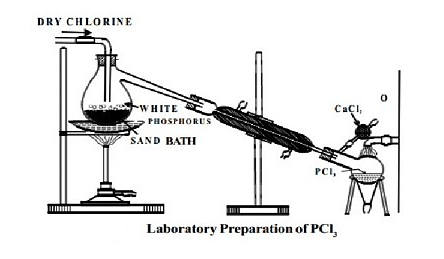
- The French chemists Joseph Louis Gay-Lussac and Louis Jacques Thénard created phosphorus trichloride for the first time in 1808 by burning calomel (Hg2Cl2) with phosphorus. Humphry Davy, an English chemist, created phosphorus trichloride by burning phosphorus in chlorine gas later that year.
- Phosphorus trichloride is made industrially by reacting chlorine with white phosphorus. PCl3 is eliminated as it is generated in this ongoing process to avoid the creation of PCl5).
P4 + 6Cl2 ? 4 PCl3
- In a Hoechst continuous process, molten white phosphorus and gaseous chlorine react in previously generated phosphorus trichloride. The synthesis of phosphorus pentachloride is prevented by the presence of a modest excess of phosphorus. The reaction's heat, which is almost 10 times the evaporation, keeps the solution boiling while the phosphorus trichloride evaporates. As reflux occurs, the vapours are fractionated, and the Phosphorus trichloride condenses in air-cooled condensers. The rate of PCl3 removal (i.e. the production rate) is equal to the phosphate and chlorine feed rate. The phosphorus content determines the boiling temperature, which controls the process. The chlorine flow rate is set, whereas the phosphorus input rate is manually regulated. There is no free phosphorus in the phosphorus trichloride generated; hence it does not require further treatment.
- The reaction between thionyl chloride with white phosphorus can also be used to produce it.
P4 + 8SOCl2 → 4PCl3 +4SO2 + S2Cl2
Physical Properties of Phosphorus Trichloride
Following are the Physical Properties of Phosphorus Trichloride:
- It's a yellow fuming liquid with a low boiling point.
- It emits fumes when exposed to damp air.
- It has a strong odour.
- It dissolves in water.
- It is soluble in benzene, ether, chloroform, ethanol, carbon tetrachloride, and carbon disulphide, among other chemicals.
- It's an oily liquid.
- Its boiling point is 347 K or 76.1 degree Celsius.
- Its melting point is 161 K or -93.6 degree Celsius.
- Its freezing point is -170-degree Fahrenheit or -112 degree Celsius.
- It is colourless.
Also Read:
Chemical Properties of Phosphorus Trichloride
Following are the Chemical Properties of Phosphorus Trichloride:
- Reaction with water: Water hydrolyses it violently, releasing phosphorous acid and hydrochloric acid gas.
PCl3 + 3 H2O → 3HCl + H3PO3
- Reaction with Sulphur trioxide: Phosphorus oxychloride and SO2 are formed when it interacts with SO3.
SO3 + PCl3 → POCl3 + SO2
- Reaction with hydroxyl group: It reacts with organic molecules with hydroxyl groups (OH), such as acids and alcohols.
PCl3 + 3CH3 COOH (Acetic Acid) → 3CH3COCl + H3PO3 (Acetyl Chloride)
PCl3 + 3C2H5OH (Ethyl alcohol) → 3 C2H5Cl + H3PO3 (Ethyl Chloride)
- Reaction with chlorine: It forms phosphorus pentachloride when it interacts with chlorine or sulphuryl chloride.
PCl3 + Cl2 → PCl5
- Reaction with oxygen: Phosphorus oxychloride is formed when it reacts with oxygen.
2PCl3 + O2 →2POCl3
- Reaction with sulfuryl chloride: It forms phosphorus pentachloride when it interacts with sulphuryl chloride.
PCl3 + SO2Cl2 → PCl5 + SO2
PCl3 + S2Cl2 → PCl5 + 2PSCl3
- It oxidised quickly to phosphorus derivatives.
- In both organic and inorganic processes, it undergoes substitution reactions.
Read More:
Uses of Phosphorus Trichloride
Following are the Uses of Phosphorus Trichloride:
- Phosphorus trichloride is a chemical intermediate that is used to make a variety of compounds.
- Pesticides, particularly the large-volume herbicide glyphosate and organophosphate insecticides, are the most common applications.
- Phosphorus trichloride is also used to make phosphorus oxychloride, which is a step in the production of flame retardants.
- Other applications include water treatment surfactants and metal extractants, plastic additives such as plasticizers and stabilisers, and miscellaneous items such as lubricating oil and paint additives.
- In organic synthesis, Phosphorus trichloride is also utilised directly as a reagent.
- Although thionyl chloride produces superior yields than Phosphorus trichloride, it is utilised to convert primary and secondary alcohols into alkyl chlorides and carboxylic acids into acyl chlorides.
- Phosphorus trichloride can be used in multistage chemical synthesis to make nerve gas chemical weapons.
- As a result, it is strictly regulated in manufacturing, usage, and export under the International Chemical Weapons Convention.
Read More:
Hazards of Phosphorus Trichloride
Following are the Hazards of Phosphorus Trichloride:
- When Phosphorus trichloride comes into contact with water or heat, it undergoes an exothermic reaction that produces acid gases. Wear a fire-retardant laboratory coat, safety eyewear, and impermeable gloves. Control the source of ignition and stay away from water or moisture. Maintain a supply of dry sand in the work area and make sure a Class D extinguisher is readily available.
- When working with significant amounts of Phosphorus trichloride, work in a dry environment, such as a glove box. Stay away from water and damp conditions.
- Although thionyl chloride produces superior yields than Phosphorus trichloride, it is utilised to convert primary and secondary alcohols into alkyl chlorides and carboxylic acids into acyl chlorides.
- Phosphorus trichloride can be used in multistage chemical synthesis to make nerve gas chemical weapons.
- As a result, it is strictly regulated in manufacturing, usage, and export under the International Chemical Weapons Convention.
Read More:
How Is Phosphorus Trichloride Stored?
Phosphorus Trichloride is stored by following steps:
- Store in airtight containers away from combustible materials in a cold, dry location.
- If polluted with water, storage containers may pressurise.
Read More: Solvent Examples
How Is Phosphorus Trichloride Disposed of?
Phosphorus Trichloride is disposed of by following steps:
- Phosphorus waste should be kept in firmly sealed containers.
- Dispose of this item as hazardous garbage.
Read More: What is Enthalpy
Procedures in Case of an Emergency
Following are the Procedures in Case of an Emergency:
- Contact with the skin results in severe burns with localised pain and redness. Rinse for at least 15 minutes with large amounts of water. Seek medical help if necessary. Before reusing or discarding infected clothing and shoes, thoroughly clean them.
- Contact with the eyes causes severe burns, as well as localised pain and clouded vision. Contact with fumes or liquids might cause irreversible damage. Rinse for at least 15 minutes with large amounts of water. Seek medical help as soon as possible.
- Abdominal discomfort and vomiting are symptoms of ingestion. Do not force yourself to vomit. Drink a couple of glasses of water and seek medical help right away.
- Extremely damaging to mucosal membranes and upper respiratory tract tissues. Burning sensations, coughing, wheezing, laryngitis, shortness of breath, headache, nausea, and vomiting are all possible symptoms. Get some fresh air and seek medical help right away.
- Put out the fire using a Class D extinguisher like Met-L-X or smother it with dry sand. Water, carbon dioxide, or halogenated extinguishing chemicals should not be used to extinguish the fire caused by Phosphorus trichloride.
- Contain all sources of moisture in the event of a spill. Cover the spill with sand while wearing personal protective equipment. Spilled materials should be scooped up with spark-resistant instruments and disposed of in a container.
Read More: Number of Moles Formula
Facts about Phosphorus Trichloride
Following are some facts about Phosphorus Trichloride:
- Phosphorus trichloride is primarily utilised in the manufacture of pharmaceutical intermediates, insecticides, and plastics.
- Phosphorus trichloride is employed in industrial applications and other operations in which workers may be exposed. Phosphorus trichloride is not utilised in any commercially available product; hence there is no risk of consumer exposure.
- Human health is endangered by phosphorus trichloride. If inhaled, phosphorus trichloride can be deadly, highly toxic if eaten, dangerous if absorbed via the skin, and can produce serious burns with scars.
- Manufacturing operations consume phosphorus trichloride. Phosphorus trichloride can enter the environment as a result of inadvertent releases (spills). Phosphorus trichloride is not only non-bio accumulative but also non-biodegradable.
- Phosphorus trichloride in higher quantities can be detrimental to aquatic life due to the formation of acids from Phosphorus trichloride hydrolysis, according to ecotoxicity studies on fish and freshwater invertebrates.
- Phosphorus trichloride occurs as a vapour when released into the atmosphere. When the vapours combine with the humidity in the air, they hydrolyse into hydrochloric and phosphoric acids.
- The Chemical Weapons Convention regulates the industrial manufacture of phosphorus trichloride.
- It is usually extracted from the reactor via distillation, which makes use of the reaction heat.
Read More:
Points to Remember
Following are some important points:
- Phosphorus trichloride is a halogen chlorine-phosphorus compound.
- White phosphorus is heated in a stream of dry chlorine to produce phosphorus trichloride (PCl3).
- The sp3 hybridization of the phosphorus atom gives the Phosphorus trichloride molecule its pyramidal form.
- It forms phosphorus pentachloride and ethyl alcohol when combined with organic substances with hydroxyl (OH) groups, such as acids and alcohols.
- Phosphorus oxychloride and Sulphur dioxide are formed when it reacts with oxygen.
- Causes severe burns to the skin, eyes, and mucous membranes, and is extremely hazardous when inhaled, ingested, or absorbed via the skin.
- Phosphorus trichloride is the most important commercial component, and it's used to make soaps, detergents, plastics, and pesticides, among other things.
Also Read:
Sample Questions
Ques: Phosphorus trichloride has a unique structure. Describe how?
Ans: Three P-Cl sigma bonds are formed in the structure of Phosphorus trichloride when three sp3 hybrid orbitals of P overlap with p-orbitals of Cl, while the fourth sp3 hybrid orbital contains a lone pair of electrons. As a result, Phosphorus trichloride has a pyramidal shape.
Ques: Describe two different methods for preparing phosphorus trichloride.
Ans: Phosphorus trichloride can be prepared in the following ways:
- When thionyl chloride interacts with white phosphorus, Phosphorus trichloride is formed.
P4 + 8SOCl2 → 4PCl3 +4SO2 + S2Cl,
- Dry chlorine gas is passed over hot white phosphorus to create the inorganic chemical. The Phosphorus trichloride vapours are then distilled and collected in water-cooled receivers.
P4 + 6Cl2 → 4PCl3
Read More:
Ques: Write some applications of Phosphorus trichloride.
Ans: Four applications of Phosphorus trichloride are:
- In organic synthesis, it is employed directly as a reagent.
- It is primarily used to oxidise phosphorus oxychloride with oxygen to produce phosphorus oxychloride.
- It's also utilized during metal electrodeposition on rubber.
- Pesticides, gasoline additives, plasticizers, surfactants, textile finishing agents, dyestuffs, medical goods, germicides, and other compounds are all manufactured with it.
Ques: Is phosphorus trichloride covalent or ionic?
Ans: The P+3 and Cl– ions form covalent bonds in the molecule.
Read More:
Ques: Describe the hazards of Phosphorus trichloride.
Ans: The substance is extremely dangerous. If swallowed or inhaled, it is lethal. It damages organs after long periods of exposure. The substance causes severe skin burns and eye damage when it comes into contact with it.
Ques: Write some physical properties of Phosphorus trichloride.
Ans: Physical properties of Phosphorus trichloride:
- It has a low boiling point and is a yellow fuming liquid.
- When exposed to damp air, it produces fumes.
- It has a pungent odour.
- It has no colour.
- It is water-soluble.
- Benzene, ether, chloroform, ethanol, carbon tetrachloride, and carbon disulphide, among other compounds, are all soluble in it.
- It's an oily substance.
Read More:
Ques: Write the boiling, melting and freezing point of Phosphorus trichloride.
Ans: The boiling point of this substance is 347 K, or 76.1 degrees Celsius. It has a melting point of 161 K or -93.6°C. The freezing point of this substance is -170 degrees Fahrenheit (-112 degrees Celsius).
Also Read:



Comments