



Education Journalist | Study Abroad Lead
Nematodes are a phylum of largely small, white, translucent worms that can be found in large numbers in practically any ecosystem on the planet. They can be as little as 0.2 mm long and as large as 8 m long, with a diameter ranging from 3 microns to 1 centimeter. Internal parasites are the biggest nematodes. Most outside hosts are 1 to 5mm long. Nematodes, as opposed to flatworms and higher segmented , are usually referred to as non-segmented roundworms, threadworms, or pinworms.
Key Terms: Worms, Internal parasites, Flatworms, Segmented Worms
Nematodes
[Click Here for Sample Questions]
Nematodes are a well-defined phylum unlike any other animal, but their evolutionary relationship to other phyla is unclear: they have been thought to be related to rotifers, nematomorphs, and other small phyla in a group known as aschelminthes, but some evidence suggests a relationship with tardigrades, insects, and crustacea in a group known as ecdysozoans.
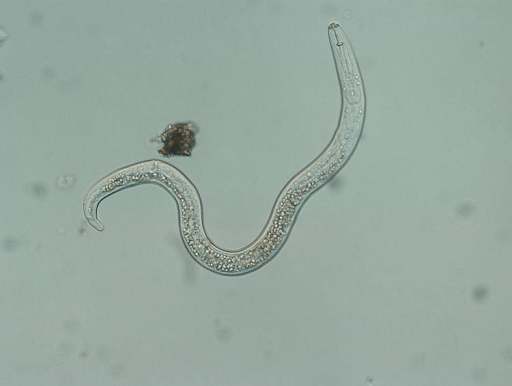
Nematode
There are an estimated 1,000,000 species of roundworms in the globe, with only 2-5 percent formally described, as well as numerous races, pathotypes, and other sub-specific taxa.
Read More:
Characteristics of Nematodes
[Click Here for Sample Questions]
- They're found all over the world, whether in the water or on land, parasitic or free-living.
- Their bodies are long, cylindrical, unsegmented, worm-like, bilaterally symmetrical, and tapering at both ends.
- They're triploblastic creatures with a larger perivisceral cavity than platyhelminths.
- Organ-system organization is found in the body.
![Characteristics of Nematode]()
Characteristics of Nematodes
- Cuticle setae (hairs), spines, and annulations are commonly found on the body, which is covered in a thick, flexible multi-layered collagenous cuticle.
- Periodically, the cuticle shed.
- They have a cellular or syncytial epidermis, which means that cell membranes do not separate nuclei.
- They only have four bands and are made up of longitudinal muscular fibers.
- The true coelom is missing. In the majority of cases, the body cavity is pseudocoel or blastocoel without mesoderm lining and is filled with parenchyma.
- Cilia are missing from their bodies.
- The respiratory and circulatory systems are missing. i.e., respiration occurs through the general body surface and is aerobic in the free-living state and anaerobic in the parasitic state.
- A unique mouth and anus round out the digestive system. Cilia do not typically line the muscular pharynx or the inner surface of the gut.
- They digest things outside of their cells.
- With a recognizable mouth and anus, the digestive system is complete. Cilia do not generally line the muscular pharynx or the inner surface of the gut.
- They have extracellular digestion.
- Six lips form a ring around the mouth.
- Excretory with nephridia and no flame cell. Renette cells with the duct in the class Adenophorea glandular.
- The nervous system is still in its infancy. The circumpharyngeal ring and the longitudinal nerve cord make up the circumpharyngeal ring.
- Papillae, which are well defined as amphid (in mouth) and plasmid, are weakly developed sense organs (anus).
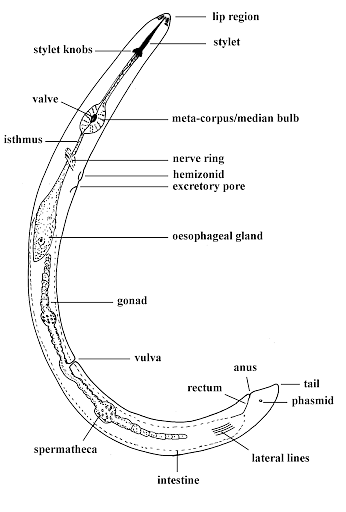

Structure of Nematodes
- The sexes are distinct (gonochoristic). Males are often smaller than females.
- There is a tubular gonad in them. The male genital duct enters the cloaca. Female genital ducts, each with its own opening.
- Sperm cells from amoebae.
- There isn't any asexual reproduction.
- Fertilization can be internal, cross-fertilization, or self-fertilization.
- Direct development, with or without an intermediary host, is possible, as well as indirect development.
Read More:
Lifecycle of Nematodes
[Click Here for Sample Questions]
Nematodes have a four-stage life cycle, known as juveniles or larvae. A new cuticle grows beneath the old cuticle, which is then molted and removed between each step. The morphology of immature stages is usually similar to that of adult stages, however, there are some significant variances. In some circumstances, there are numerous life cycles, with one morphology and life cycle completing in one habitat and another morphology and life cycle occurring in a separate habitat, with periodic changes between the two.

Life Cycle of Nematodes
Males and females coexist in most species in numbers ranging from 50 percent or more males to males that are extremely rare or only found under specific circumstances. Parthenogenic species, either mitotic or meiotic, are found in a few taxa. The majority of animals are oviparous, with only a few exceptions. Life cycles can last anywhere from a few days to several years, although resting stages can stretch them out virtually indefinitely.
Any step of the cycle can rest, including the egg, one of the immature phases, or an adult before or after mating. Throughout their adult lives, females can lay millions of eggs. Free-living nematodes rarely lay more than a few thousand eggs; parasitic nematodes lay the most.
Read about: Sexual Reproduction
Nematoda Phylum Classification
[Click Here for Sample Questions]
Phylum Nematoda has the largest number of members of any phylum. There are over 15,000 species of nematodes currently known. It's tough to categorize due to the wide range of forms and structures. On the basis of the presence or absence of phasmids, Chitwood (1933) divided them into two classes: Phasmidia and Aphasmidia.
Class 1- Aphasmidia (Adenophorea)
- There are no phasmids (causal sensory organs).
- Various forms of amphids (anterior sensory organs), rarely pore-like.
- There is no excretory system. If present, it is underdeveloped.
- Mesenterial tissue that is well-developed.
- There are sticky glands in the caudal region.
Order 1. Enoplida
- Six labial papillae and 10-12 sensory bristles on the anterior end.
- Typically, the cuticle has bristles.
- Cyanthiform amphids are a type of amphid.
- Free-living, primarily marine.
- Enoplus and Metonchdiamus are two examples.
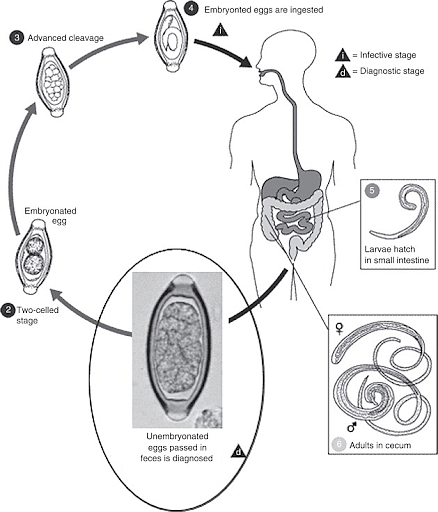
Enoplida Lifecycle
Read More:
Order 2. Dorylaimida
- 6-10 papillae on the anterior end.
- There are no bristles on the cuticle.
- Cyanthiform amphids are a type of amphid.
- The protruding spear in the buccal cavity.
- Free-living in freshwater and dirt.
- Dorylaimus and Tylencholaimus are two examples.
Order 3. Mermithida
- Large in size.
- There are 16 labial papillae on the anterior end, but no sensory bristles.
- There are no bristles on the cuticle.
- Amphibians that are cyathiform or reduced.
- The esophagus is a lengthy tube that leads to the blind intestine.
- Invertebrates are parasitic on larvae.
- Adults who are self-sufficient.
- Mermis and paramermis are examples.
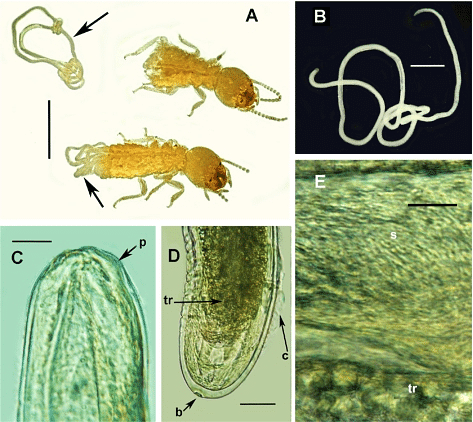
Mermithida
Order 4. Chromedorida
- Small in size.
- Smooth or ringed cuticle; thick bristles
- Spiral amphids are a type of amphid.
- Teeth in the buccal cavity.
- The posterior bulb of the pharynx.
- Mostly maritime and a free-roaming species.
- Halichoanolaimus is an example.
Read More:
Order 5. Monohysterida
- Small in size.
- Amphibians with a round shape.
- Smooth or somewhat ringed cuticle, frequently with bristles
- 4,6,8, or many sensory bristles on the anterior end.
- Free-living creatures, predominantly marine, but also freshwater and terrestrial.
- Monohystera and Plectus are two examples.
Order 6. Desmoscolecida
- Small in size.
- Amphids with a cresent or pump form.
- The cuticle is extensively ringed.
- The anterior end has four sensory bristles, and the head is armored.
- Those who live in the sea; those who are self-sufficient.
- Desmoscolex and Epsilonema are two examples.

Desmoscolecida
Read about: Salient Features of the Kingdom Monera
Class 2. Phasmidia (secernentea)
- Phasmids can be found.
- Amphibians with pore-like structures.
- The excretory system is well-developed.
- Weekly, mesenterial tissue developed.
- There are no sticky glands in the caudal region.
Order 1. Trichuroida (Trichinelloidea)
- Anteriorly, the body is filiform.
- Lipless mouth; narrow pharynx.
- Females have one ovary, while males have one or none.
- Vertebrate parasitic parasites
- Examples: Trichinella, Trichuris
Order 2. Dioctophymida
- Worm of a large size.
- Mouth with 6,12, or 18 papillae and no lips.
- The pharynx is elongated and bulbless.
- Male with one spicule and muscular Brusa, female with one ovary.
- Mammalian and avian parasites
- Dioctophyma, Hystrichis are two examples.

Dioctophymida affects the kidney of animals
Read More:
Order 3. Rhabditida
- Small to medium in size
- The cuticle, which can be either smooth or ringed.
- Sensory bristles are arranged in two rings, with an inner ring of six and an outside ring of four, six, or ten.
- The gubernaculum and copulatory spicules are present in males.
- In animals and plants, free-living or parasitic.
- Rhabditis is one example.
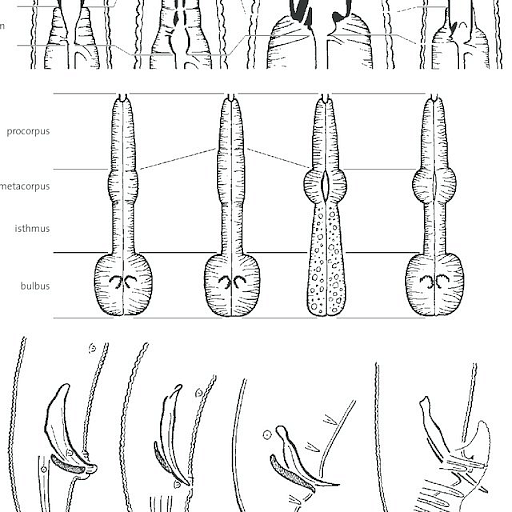
Morphology of Rhabditida
Order 4. Rhabdiasida
- Medium in size
- Cuticle is silky and smooth.
- The bulb of the pharynx is missing.
- Hermaphroditic or parthenogenetic parasite stages can be seen in vertebrates.
- Rhabdias and Strongyloides are two examples.
Read More:
Order 5. Oxyurida
- Small worm with a pin-like form.
- 3-6 tiny lips encircling the mouth.
- The posterior bulbs of the pharynx are valvular.
- Long, pointed tail on a female.
- Invertebrates and vertebrates both have parasitic hosts.
- Oxyuris and Enterobius are good examples.

Oxyurida
Order 6. Ascarida
- Worm with large size.
- Three lips encircle the mouth.
- Without the bulb, the pharynx is called a pharynx.
- A male with a curled tail on the ventral side.
- Invertebrates are parasitic.
- Ascaris and Ascaridia are two examples.
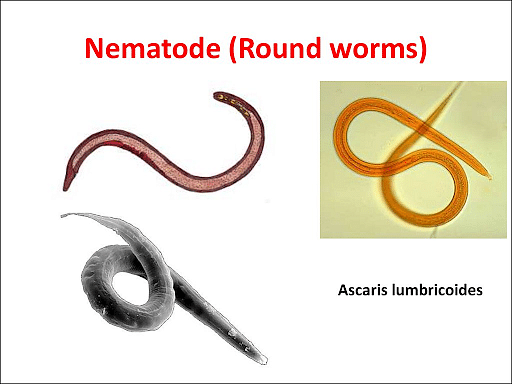
Roundworm comes under this order
Also Read:
Order 7. Strongylida
- There are no lips on the mouth, but there is a leaf crown.
- Buccal capsule is well-developed.
- The pharyngeal bulb is missing.
- Females normally have an ovijector, whereas males have an enlarged copulatory bursa.
- Vertebrate parasitic parasites
- Necator, Ancylostoma, and Strongylus are some examples.

Strongylida
Order 8. Spirurida
- 2 lateral lips in the mouth
- Bulbous pharynx, muscular in the front and glandular in the back.
- The Male has a spirally coiled tail but no copulatory bursa.
- Animals with parasites
- Spiroxys, Gnathostoma, and Thelazia are among the examples.

Spirurida
Also Read:
Order 9. Dracunculida
- Buccal capsule and lips are missing.
- Rings or papillae encircle the mouth.
- The pharynx is muscular in front and glandular in back, with no pharyngeal bulb.
- In the male, there is no copulatory bursa.
- Vertebrate parasitic organisms.
- Dracunculus and Philometra are two examples of such creatures.

Dracunculida causes Guinea worm disease
Order 10. Filarida
- Slender filiform worm.
- Lips and the buccal capsule are not present.
- There are six labial papillae present.
- There is no pharyngeal bulb.
- The male is tiny and has a curled tail.
- Microfilariae are parasitic worms that live in the blood or on the skin and develop in blood-sucking insects.
- Vertebrate parasitic parasites
- Wuchereria, Loa, and Microfilaria are some examples.

Filarisis Disease caused by Microfilaria
Read More:
Things to Remember
- Nematodes in the soil feed on bacteria, fungus, and other nematodes, and they serve a key role in nutrient recycling. They also kill insects and keep pests at bay. Plants, on the other hand, are severely harmed. They eat the plant roots, reducing the plant's nutrient intake and stress tolerance.
- The phylum Nematoda is also known as "roundworms" because of the organisms that belong to it. To present, 28000 species of Nematoda have been recognized. They are vermiform animals that are not segmented.
- They are unsegmented vermiform pests that are commonly referred to as roundworms. They are self-contained organisms.
- Numerous Nematodes can be found in a spadeful of soil. Human disorders caused by them include Ascariasis, Trichuriasis, Hookworm, Enterobiasis, Filariasis, and Angiostrongyliasis.
Read More:
Sample Questions
Ques. What are the feeding habits of Nematodes? [5 marks]
Ans. Nematodes do not have true detrivores; they all feed on live things. The exact diets of nematodes in nature are unknown, and what we do know comes from laboratory observations, culturing studies, mouthpart morphology, and extrapolation from known taxa. Nematodes are polyphagous to some extent, however, they are divided into categories based on the type of food they consume and how they obtain it. There are slightly different classifications for aquatic and terrestrial nematodes; the following is a unified approach based on both.
Feeders for plants: They feed on or inside all parts of the plant. Root feeders are the most prevalent. Some species are economically harmful parasites that kill the host plant, while others appear to have minimal effect, and there are species in between. Marine and freshwater macroalgae are eaten by a few species.
Fungal feeders: They eat hyphal fungus found in soil, cadavers, wood, and bark.
Microbial feeders: They eat single-celled microorganisms, primarily bacteria. Many nematodes found in decomposing plant debris and manure feed on microorganisms rather than the plant matter or dung itself. This trophic group can feed either selectively or non-selectively by sucking cells from suspension or scraping cells off substrates.
Algal feeders: They eat microalgae, which are typically found on land. Plant-feeding nematodes are grouped with plant-feeding nematodes.
Predators: They eat mites, insects, other nematodes (often of the same species), and protists, among other microscopic creatures. Some predators pierce potential prey with a huge spear or teeth, then suck out the contents, while others crush prey with a large mouth and powerful jaws.
Omnivores: They eat a variety of meals, presumably based on what is available.
Stages of non-feeding.Animal parasites, such as arthropods, annelids, and mollusks, feed on the interior or exterior bodies of larger creatures.
Ques. Explain the Nematode Excretory System? [2 marks]
Ans. Specialized excretory systems in nematodes are not well established. Nitrogenous wastes can be eliminated through diffusion throughout the body or into the pseudocoelom (body cavity), where specialized cells remove them. Renette glands, which are found under the pharynx in marine worms, regulate the body's water and salt content.
Ques. What is the nervous system of nematodes and how does it work? [2 marks]
Ans. Most nematodes have four longitudinal nerve cords that run dorsally, ventrally, and laterally down the length of the body. The dorsal and lateral nerve cords are less developed than the ventral nerve cord. All nerve cords join at the anterior end, around the throat, to form the worm's "brain" (which takes the shape of a ring around the pharynx), and at the posterior end, to form the tail ganglia. The nervous system in C. elegans accounts for about a third of the total number of cells in the animal.
Ques. Explain how nematodes reproduce. [3 marks]
Ans. Depending on the species, nematodes use a number of reproduction techniques, which range from monoecious to dioecious to parthenogenic. C. elegans is a monoecious species that displays the formation of eggs in the uterus as well as sperm in the spermatheca. The vulva is the exterior opening of the uterus. The female genital pore is located around the center of the body, while the male genital pore is located towards the tip. The male's tail has specialized features that keep him in place when he deposits sperm with copulatory spicules. Internal fertilization occurs, and embryonic development begins shortly after fertilization. During the gastrulation stage, the embryo is expelled from the vulva.
Ques. Is it true that all Nematodes are parasitic? [2 marks]
Ans. 40 percent of nematodes are free-living and feed on bacteria, protozoa, fungus, and other parasitic nematodes. The majority of nematodes are parasitic on animals (invertebrates and vertebrates account for 44 percent of all species). Plants are also home to 15% of the species.
Ques. Nematodes induce which disease? [2 marks]
Ans. Ascariasis, trichuriasis, hookworm, enterobiasis, strongyloidiasis, filariasis, trichinosis, dirofilariasis, and angiostrongyliasis (rat lungworm sickness) are examples of nematode infections in humans.
Ques. What effect do nematodes have on the soil? [2 marks]
Ans. By transporting living and dormant microbes on their surfaces and in their digestive systems, nematodes assist in the distribution of bacteria and fungi through the soil and along with roots. Source of sustenance Predatory nematodes, soil microarthropods, and soil insects eat nematodes.
Ques. In humans, what are the signs and symptoms of nematodes? [2 marks]
Ans. Itching can occur when larvae enter the skin (referred to as "ground itch"). Pneumonitis, cough, dyspnea, and hemoptysis are all signs that larvae are moving through the lungs. Intestinal infection can produce anorexia, fever, diarrhea, weight loss, and anemia, depending on the adult worm load.
Ques. What are the functions of nematodes? [2 marks]
Ans. Beneficial nematodes are soil-dwelling insects that seek out and kill all stages of destructive insects. They can be employed to manage a wide range of soil-dwelling insects as well as above-ground insects in their soil-dwelling stage. Parasitic nematodes are useful in the control of pest insects.
Read More:



Comments