



Education Content Expert
Pitot Tube is a pressure measurement device that is used to measure fluid flow rates. A pitot tube is made up of two hollow tubes where the impact or stagnation pressure is measured by one tube, while the static pressure is measured by the other, usually at the pipe wall.
- Pitot tube is frequently used in industrial settings to measure the velocity of liquids and gases.
- It is also used to measure the speed of an aircraft and a boat.
- Pitot tube is used to determine the local velocity at a specific point in the flow stream.
- It helps in calculating the pressure energy of a stopped fluid.
Pitot Tube operates on a fundamental principle of fluid mechanics, i.e. when a fluid stops flowing, all of its kinetic energy is converted into pressure energy.
| Table of Content |
Key Terms: Pitot Tube, Dynamic Pressure, Static Pressure, Pitot Static Tube, Fluid Flow, Velocity, Kinetic Energy
What is Pitot Tube?
[Click Here for Sample Questions]
Pitot Tube is a mechanical device used to measure fluid flow velocity in a pipe or channel at any point.
- Henri Pitot, a French engineer, invented the pitot tube in the early 18th century.
- Henry Darcy, a French scientist, altered it to its modern form in the mid-19th century.
- It helps us compute the pressure energy of a stopped fluid.
- It is extensively used in industrial applications to monitor aviation airspeed, boat speed, and fluid flow.
Read More:
| Relevant Concepts | ||
|---|---|---|
| Anemometer | Fluid Mechanics Formula | Low Pressure & High Pressure System |
| Mechanical Properties of Fluids | Continuity Equation | Mechanical Properties of Fluids Formula |
Construction and Working of Pitot Tube
[Click Here for Sample Questions]
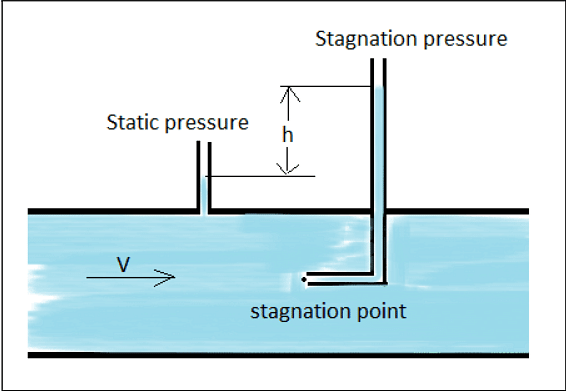
Pitot Tube is made up of two hollow tubes that measure pressure at various places within the pipe.
- First tube gauges the impact or stagnation pressure.
- The other tube is used to measure only the static pressure, usually at the pipe wall.
- These tubes can be mounted separately in a pipe or can be installed together in one casing as a single device.
Pitot Tube Diagram
Here is the diagram for a Pitot Tube:
Pitot Tube
Pitot Tube Working Principle
[Click Here for Sample Questions]
- Pitot meter is made up of a tube that points directly at the flow.
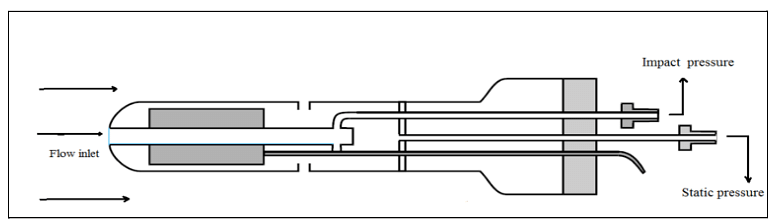
- The fluid enters through the impact hole, and the static pressure is supplied by one or two other holes in the Pitot tube.
- A basic pitot tube requires another pressure sensor element to monitor static pressure.
- The axis of the tube measuring static pressure should be perpendicular to the boundary, resulting in a clean boundary.
Pitot-static tube has a static pressure inlet as shown below:
Working of Pitot Tube
A Pitot tube is a simple round cylinder with one end open and the other end closed. The fluid moving through the pipeline enters and rests in the Pitot tube. The dynamic pressure is determined by measuring the pressure difference between the two pressures.
- The dynamic pressure is determined by the difference in level between the liquid in the tube and the free surface.
- Like other devices, the flow rate is computed by taking the square root of the pressure.
- The estimation of the flow rate from the pressure is affected by factors such as tube design and the placement of the static tap.
- To eliminate this characteristic, the Pitot-static probe incorporates static holes in the tube system.
- The static pressure and impact pressure are coupled to the appropriate differential pressure meter for determining flow velocity and thus flow rate.
Types of Pitot Tubes
[Click Here for Sample Questions]
There are two types of Pitot tubes which are as follows:
- Simple Pitot Tube: Simple Pitot Tube is a kind of device which is used for the calculation of velocity of flow at any point in a channel or pipe. It is further used for the measurement of stagnation pressure.
- Static Pitot Tube: It is used for the making of temporary measurements of the flow. It usually measures the local velocity of the flow at any particular point within the pipe.
Read More: Mass Flow Rate Formula
Difference between Pitot Tube and Pitot Static Tube
[Click Here for Sample Questions]
The difference between Simple Pitot tube and Pitot-static tube is as follows:
| Pitot Tube | Pitot-Static Tube |
|---|---|
| Pitot tube is commonly used to estimate the liquid stream in stationary fluid collections. | Pitot-static cylinder is a pressure-measuring device that is used in fluid dynamics and aerodynamics. |
| It's a pressure gauge that measures the total pressure in a liquid framework. | Pitot-static tube, also known as a velocity test, is an instrument used to measure velocity. |
| It is also a pressure-detecting instrument that is commonly used to calculate liquid speed in a line or vessel. | Pitot-static tubes are aircraft instruments that combine a Pitot tube and a static port. |
Uses of Pitot Tube
[Click Here for Sample Questions]
The various applications of the Pitot Tube are:
- It is used in jet planes to determine speed by measuring air pressure.
- It is used in the air channel and line structure.
- It is used in speedometers for ships and planes.
- Infrequently used to indicate stream rate.
- It is used in a variety of sectors to monitor fluid flows.
- It is used when extreme precision is not necessary.
- It is used to determine the flow profile of a duct or channel.
- Pitot tubes are commonly used to monitor flow velocity.
Advantages of Pitot Tube
[Click Here for Sample Questions]
The advantages of the Pitot Tube are as follows:
- It is simple and inexpensive to install and remove.
- Because of its small size, it may become acquainted with liquid streams without interrupting the flow.
- These have no moving parts, which helps to reduce frictional losses.
- Permanent pressure loss is minimal.
- Can be easily introduced in extreme weather, high temperatures, and high-stress situations.
Disadvantages of Pitot Tube
[Click Here for Sample Questions]
The limitations or disadvantages of the Pitot tube are as follows:
- Its accuracy is not very high.
- It has a limited range and is not very sensitive.
- High-velocity flow is more effective in pitot tube.
- Significant changes in measurements can result from a change in the velocity profile.
- The direction of the flow disturbs its sensitivity.
- Pitot tubes can readily become clogged with foreign particles in a fluid, which will interfere with the typical reading.
Check More:
| Related Topics | ||
|---|---|---|
| Properties of Fluids | Mach Number | Dynamic Viscosity |
| Pressure Drop Formula | Froude Number Formula | Relation between Pressure and Velocity |
Things to Remember
- Pitot Tube is a pressure measuring device used to calculate fluid flow rates.
- It was invented by Henri Pitot and was further modified by Henry Darcy.
- It is used in industrial settings for the measurement of the airspeed of an aircraft and the water speed of a boat.
- Pitot tube is made up of two hollow tubes, one measuring the stagnation pressure and the other measuring the static pressure.
- There are two types of Pitot tube namely the Simple Pitot Tube and the Pitot-Static Tube.
Sample Questions
Ques. What is a Pitot Tube? (2 Marks)
Ans. Pitot tube is a pressure measurement device that is used to measure fluid flow rates at a specific point in the flow stream. It is a flow sensor that measures the velocity of fluids (air or liquid) flowing through a pipe at any given time.
Ques. What is the primary function of a Pitot tube? (5 Marks)
Ans. Pitot tube is a device used to measure the fluid velocity, particularly in fluid dynamic applications such as airflow measurement in airspeed indicators of aircrafts, fluid flow measurement in fluid dynamics research, and fluid flow measurement in industrial process control.
- In aircrafts, a Pitot tube is mounted on the exterior of the aircraft, facing forward and measuring the velocity of the incoming air. This measurement is used to determine the aircraft's airspeed.
- In fluid dynamics research, Pitot tubes are used to measure velocity of fluid in different conditions such as laminar, turbulent or transitional flow and also used to study the fluid flow behavior in open channels, pipes and different geometries.
- In industrial process control, Pitot tubes are used to measure the fluid flow in process industries,such as chemical and petrochemical industries, power plants, oil and gas industries, etc.
Thus, the primary function of a Pitot tube is to measure fluid velocity by converting the fluid's kinetic energy into pressure energy, and by using Bernoulli's equation to determine the fluid velocity.
Ques. Which is the most common device used for measuring air speed? (2 Marks)
Ans. Pitot Tube is the most common device used for measuring the air speed. It is commonly used device for the air speed measurement due to the following reasons:
- Pitot tube is an L-shaped tube.
- One end of the Pitot tube is exposed to air, allowing it to directly contact the flow velocity.
- The velocity is calculated by measuring the pressure inside the tube.
Ques. How is kinetic energy converted into pressure energy in a Pitot tube? (3 Marks)
Ans. The kinetic energy is converted into the pressure energy in a Pitot tube in the following manner:
- Pitot tube consists of a tube with one or more openings facing the flow of the fluid.
- When the fluid flows into the openings of the Pitot tube, its kinetic energy is converted into pressure energy, which can be measured by a pressure gauge or sensor.
- This pressure difference, known as the dynamic pressure, can be used to calculate the fluid's velocity by using Bernoulli's equation.
Ques. What is Dynamic Pressure in a Pitot Tube? (2 Marks)
Ans. Air has mass and dynamic energy in motion, which is converted to pressure as the body tries to stop or slow down. This is referred to as dynamic pressure. It is generally measured with the pitot and includes static pressure at that point as well. In other words, dynamic pressure is the pressure created by the velocity head.
Dynamic Pressure = Stagnation Pressure – Static Pressure
Ques. What is the other name for Pitot tube? (2 Marks)
Ans. The other name for the Pitot tube is “Pitot Probe”. It is used for the measurement of the fluid flow rates at a particular point in the flow stream. It is used for various purposes in the industries and the laboratories.
Ques. What happens if the Pitot tube is blocked? (5 Marks)
Ans. If a Pitot tube becomes blocked, it will no longer be able to measure the fluid velocity accurately. This can have serious consequences, depending on the application of the Pitot tube.
- If the Pitot tube becomes blocked, the airspeed indicator will not be able to display the correct airspeed, which can lead to difficulties in flying the aircraft. Pilots may not be able to accurately determine the aircraft's speed, which can make it difficult to maintain a safe speed during takeoff, landing and in-flight. This can also affect the aircraft's stability and altitude control, making it harder to fly safely.
- In industrial process control, Pitot tubes are used to measure the fluid flow in process industries, such as chemical and petrochemical industries, power plants, oil and gas industries, etc. If the Pitot tube is blocked, the measurement of the fluid flow rate will be inaccurate, which can cause the process to malfunction. This can lead to production losses, increased energy consumption and potentially dangerous conditions.
- Additionally, if the Pitot tube becomes blocked, it can also cause damage to the pressure gauge or sensor connected to it.
Ques. Is it possible to measure velocity with a Pitot tube? (5 Marks)
Ans. Pitot tubes can be used to calculate fluid flow velocities by calculating the difference between static and dynamic pressures in the flow. By converting the kinetic energy in a fluid flow to potential energy, a Pitot tube can be used to measure fluid flow velocity. It is possible to measure velocity using a Pitot tube, although the process is somewhat indirect.
- Pitot tube has a second opening that is facing upstream, which is called the "impact pressure" port. It measures the pressure due to the impact of the fluid on the tube. This pressure is higher than the static pressure, and the difference between the two is called the "impact pressure" or "velocity pressure".
- The velocity can be computed from the measured pressure difference by applying Bernoulli's equation which states that the velocity pressure is directly proportional to the fluid velocity.
- This is typically done using a pressure transducer and a computer or data logger that applies the appropriate equations to convert the pressure readings into velocity.
Ques. What factors influence the performance of Pitot tubes? (5 Marks)
Ans. There are several factors that can influence the performance of Pitot tubes:
- Fluid Properties: The density and viscosity of the fluid flowing through the Pitot tube can affect its performance. For example, a denser fluid will produce a higher pressure reading than a less dense fluid.
- Tube Length: The length of the Pitot tube can also influence its performance. A longer tube will typically produce a more accurate pressure reading due to the increased time the fluid has to reach steady state flow.
- Tube Diameter: The diameter of the Pitot tube can also affect its performance. A larger diameter tube may be more prone to clogging, but it will also be able to handle higher flow rates without becoming overwhelmed.
- Tube Orientation: The orientation of the Pitot tube can also influence its performance. A properly aligned tube will produce more accurate pressure readings, while a misaligned tube may produce inaccurate readings.
- Flow Rate: The flow rate of the fluid passing through the Pitot tube can also affect its performance. At low flow rates, the pressure reading may be less accurate due to the reduced velocity of the fluid.
Ques. How should a Pitot tube be cleaned? (5 Marks)
Ans. A Pitot tube should be cleaned in the following manner:
- Shut off the flow of fluid through the Pitot tube.
- Disconnect the Pitot tube from any monitoring or measuring equipment.
- Use a soft, dry cloth to gently wipe away any visible dirt or debris from the exterior of the tube.
- Flush the Pitot tube with a small amount of clean, dry air or nitrogen to remove any loose particles.
- If the tube is still dirty, it can be carefully cleaned with a soft bristle brush or a cloth soaked in a mild cleaning solution. Be sure to use a cleaning solution that is compatible with the material of the Pitot tube and the fluid it is used to measure.
- Rinse the Pitot tube thoroughly with clean, dry air or nitrogen to remove any cleaning solution or debris.
- Allow the Pitot tube to dry completely before reconnecting it to any monitoring or measuring equipment.
- Test the Pitot tube to ensure it is functioning correctly before returning it to service.
Check-Out:



Comments