



Content Writer
Potassium bromide is also known as tripotassium tribromide or potassium bromide salt. In Potassium Bromide or KBr, potassium stands for K and bromine stands for Br2. It was widely used in the late 19th and early 20th centuries as an anticonvulsant and a sedative.
Potassium Bromide salt is a white crystalline powder that can be easily diluted in water. The main Component Compounds in Potassium Bromide are Hydrogen bromide and Potassium. Notably, excessive amounts of potassium bromide might irritate the mucous membrane of the stomach. Vomiting could occasionally occur due to side effects due to all potassium salts
Read more: Potassium Acetate
Key Terms: Potassium Bromide, Iron, Salt, Aqueous Solution, Copper Bromide, Hydrogen
Structure of Potassium Bromide
[Click Here for Sample Questions]
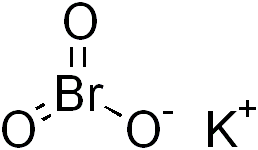
Structure of Potassium Bromide
It is formed by a single cation that is potassium (K+) and a single anion that is bromine (Br-). Its structure is made by the traditional method where there is a reaction of potassium carbonate with bromide of iron.
4 K2CO3 + Fe3Br8 \( \rightarrow\) 8 KBr + Fe3O4 + 4 CO2
This reaction is made by adding excess Br2 underwater made by treating scrap iron (Fe3Br8).
Properties of Potassium Bromide
[Click Here for Sample Questions]
The properties of Potassium Bromide are as follows:
- KBr or Potassium Bromide is an ionic salt that is odorless.
- It looks like colorless white crystals or granules.
- The pH value of the aqueous solution is 7.
- This Potassium Bromide salt may taste sweet if mixed in aqueous solutions.
- If there is an increase in the concentrations of potassium ions the taste of this chemical compound is pungent, strong, bitter, and also saline.
| Physical Properties | |
|---|---|
| Chemical formula | KBr |
| Molecular weight | 119.002 g/mol |
| Form/ Structure | Cubic Crystals |
| Colour | Colorless or white crystals/granules |
| Taste | Pungent, salty, bitter |
| Odor | Odorless |
| pH | In aqueous solution pH is 7 or neutral |
| Boiling Point | 1435 °C/ 2615 °F |
| Melting Point | 730 °C/ 1346 °F |
| Density | 2.75 at 77 °F/ 2.74 g/cu cm at 25 °C |
| Vapor Pressure | 1 mm Hg at 1463 °F/ 795 °C |
| Solubility | Soluble in water at 67.8 g/100 g at 25 °C (1g dissolves in 1.5 mL water) (1 mL boiling water) Soluble in alcohol (1g dissolves in 250 mL of alcohol) (21 mL boiling alcohol) Soluble in glycerol 217 g/L, 4.6mL |
Reactions of Potassium Bromide
[Click Here for Sample Questions]
Potassium Bromide is vital for the manufacturing of silver bromide. Silver bromide is an important component of photographic film. Below is the reaction, where silver nitrate with an alkali bromide (KBr) is mixed to form Silver bromide and Potassium Nitrate.
| KBr (aq) + AgNO3 (aq) \( \rightarrow\) AgBr(s) + KNO3 (aq) |
Furthermore, in aqueous solution bromide generates complexes if it reacts with metal halides such as copper (II) bromide. The reaction is shown below where Potassium bromide is reacted with copper (II) bromide to produce K2 [CuBr4]
| 2 KBr (aq) + CuBr2 (aq) \( \rightarrow\) K2 [CuBr4] (aq) |
Read more: Sodium Bromide
Uses of Potassium Bromide (KBr)
[Click Here for Sample Questions]
Potassium Bromide finds many applications. Some of the important applications are as follows:
- It is used as a cleaning agent and is found in products of household care such as bleach. In the laundry, it helps to remove marks or staining of cloth.
- Used in Construction for building materials like flooring, mirrors, tile, bathtubs, sinks, etc.
- It is also used in Items that are used to furnish homes or workplace. In furniture like tables, chairs, and mattresses this compound is found.
- It helps in the production of silver bromide which is further used in photographic films.
- This is one of the most widely used compounds in the petroleum industry and paper manufacturing industry. It is also used as a heat stabilizer for nylon production.
- Potassium Bromide (KBr) is used for water treatment in aquariums.
- This is also used in plasticizers which helps to soften the PVC, which makes it flexible.
- Some other uses for potassium bromide are in the production of active substances and chemicals in the laboratory.
Read more:
Use of Potassium Bromide in Medicine
Some of the significant applications of potassium bromide in field of medicine are as follows:
- It is used as animal antiepileptic drug
- It works at the cellular level and reduces seizure activity by suppressing nerve excitability
- Potassium bromide can be taken orally and is excreted mainly by the kidneys.
- In dogs, Potassium bromide is used to treat epilepsy and seizures.
- However, in the treatment of cats use of Potassium bromide is limited as it can cause pneumonitis.
Read more: Pneumonia
Health Risks of Potassium Bromide (KBr)
[Click Here for Sample Questions]
It is rarely considered the drug of choice because it is slow-acting and takes almost four months to reach stable levels of bromide ions in the brain. Some other risks include
- Some common side effects of potassium bromide in animals are drowsiness, vomiting, temporary sedation, and pancreatitis, and polydipsia, loss of appetite, constipation, and polyuria.
- In humans, Potassium Bromide (KBr) has been reported to cause depression, weakness, malaise, lethargy, coma, and other symptoms.
- Using KBr in food makes people ingest different amounts of bromide. After ingestion of bromide, it impacts the central nervous system and can affect neurological behavioral processes such as learning and memory.
Things to Remember
- Potassium bromide(KBr) is also known as tripotassium tribromide or potassium bromide salt.
- Potassium bromide salt may taste sweet if mixed in aqueous solutions.
- Potassium bromide plays a significant role in the manufacturing of silver bromide.
- Potassium bromide was used as a remedy for seizures in the late 19th or 20th century. However, today it is used primarily as an antiepileptic drug for veterinary purposes.
- The pH value of the aqueous solution is 7.
- If there is an increase in the concentrations of potassium ions the taste of this chemical compound is pungent, strong, bitter, and also saline.
- Ingestion of bromide impacts central nervous system (CNS)
Sample Questions
Ques. Chlorine gas, when passed through potassium bromide/ KBr solution, forms potassium chloride and bromine. On this basis, which is a more reactive non-metal? Justify your answer. (3 marks)
Ans. In the solution of Potassium Bromide, chlorine gas is passed (Cl2).
After this, the chlorine displaces Bromine-from K-Br and forms potassium chloride (KCl) and releases Bromine, which is orange in color to the solution.
| 2KBr(aq) + Cl2(aq) \( \rightarrow\) 2KCl(aq) + Br(aq) |
Therefore, Chlorine is more reactive than bromine the relative order is: Chlorine > Bromine
The chlorine is more reactive than bromine because the electronegativity of chlorine is more than that of bromine.
Ques. What is the chemical reaction of potassium bromide? (2 marks)
Ans. It is formed by a single cation that is potassium (K+) and a single anion that is bromine (Br-). Its structure is made by the traditional method where there is a reaction of potassium carbonate with bromide of iron. This reaction is made by adding excess Br2 underwater made by treating scrap iron (Fe3Br8).
The chemical equation of potassium bromide reaction is
2 K + Br2 \( \rightarrow\) 2KBr
Ques. What is the complete balanced reaction of Potassium bromide (aq) + Barium iodide (aq) \( \rightarrow\) Potassium iodide (aq) + Barium bromide (s) (1 mark)
Ans.
Potassium bromide (aq) + Barium iodide (aq) → Potassium iodide (aq) + Barium bromide(s)
2KBr (aq) + BaI2 (aq) \( \rightarrow\) 2KI (aq) + BaBr2(s)
It is a reaction where two reactants exchange ions also called double displacement reaction. Here exchange ions form two new compounds.
Ques. State few compounds of Potassium and Bromine (5 marks)
Ans.

Barium bromide

Potassium bromate

Silver bromide

Diatomic Bromine

Zinc bromide

Lithium bromide

Magnesium bromide
Ques. State few properties of Potassium bromide (5 marks)
Ans. Properties of Potassium bromide (KBr) are as follows:
- Potassium Bromide is an ionic salt. KBr is odorless.
- It has a saline and pungent taste.
- The pH value of potassium bromide is 7 (neutral) and its molecular weight is 119.002 g/mol.
- The solubility of KBr in water is at 67.8 g/100 g at 25 °C (1g dissolves in 1.5 mL water) (1 mL boiling water), and in alcohol (1g dissolves in 250 mL of alcohol) (21 mL boiling alcohol), in glycerol 217 g/L, 4.6mL.
- Melting and boiling point is at 730 °C/ 1346 °F and 1435 °C/ 2615 °F respectively.
Ques. What is the color of the potassium bromide solution? (1 mark)
Ans. Potassium bromide is pure white crystalline powder under normal conditions
Ques. How can bromine be separated from potassium bromide solution? (2 marks)
Ans. As chlorine is considered the stronger oxidizing substrate than bromine, it can react with potassium bromide and generate KCl and bromine gas. Here is the chemical equation of this reaction-
2 KBr + Cl2 \( \rightarrow\) 2 KCl + Br2
Ques. What happens if potassium bromide(KBr) is dissolved in water? (1 mark)
Ans. When potassium bromide is dissolved in water it dissociates into K+ or potassium ions or Br- ions.
Ques. How does potassium bromide work?( 2 marks)
Ans.Potassium bromide competes with chloride ions for access to the brain's tissues. Electrical activity in the central nervous system is interrupted, making it challenging to induce a seizure, if bromide levels rise and chloride levels fall in the brain.
Ques. Why does potassium bromide have a high solubility? (2 marks)
Ans. Potassium bromide has ionic bonding between its two elements potassium and bromine. Bromine has a -1 charge, and potassium has a +1 charge. Silver ions can dissolve halide anions out. Potassium bromide is a strong electrolyte as it can be entirely dissociated in an aqueous solution.
Check out:



Comments