



Education Journalist | Study Abroad Lead
Bleaching Powder and Sodium Hydroxide are the chemical compounds produced from Common Salt (Sodium Chloride). The chemical name for bleaching powder is Calcium Hypochlorite, and the formula is CaO(Cl)2. Sodium Hydroxide is commonly referred to as caustic soda, also an inorganic compound used to make soaps, rayon, etc. The chemical formula for Sodium Hydroxide is NaOH.
Read More: Acids, Bases and Salts
| Table of Content |
Key Takeaways: Bleaching Powder, Calcium Hypochlorite, Sodium Hydroxide, Sodium Chloride, Caustic Soda, Organic Compounds, Acids, Chlorine, Slaked Lime
Bleaching Powder
[Click Here for Sample Questions]
Bleaching Powder, also known as Calcium Hypochlorite, is a pale yellowish powder existing with a strong smell of chlorine. Bleaching Powder is soluble in water but due to the presence of impurities, we never observe a clear solution. The chemical formula for bleaching powder is CaO(Cl)2. It is formed with the action of chlorine gas (from the Chlor-alkali method) on dry slaked lime Ca(OH)2.

Bleaching Powder
Read more:
Preparation of Bleaching Powder
The chlorine gas produced in the process of electrolysis of brine is used in the preparation of bleaching powder. It is combined with dry slaked lime Ca(OH)2.
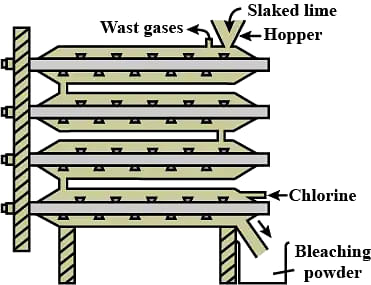
There are two conditions that one should keep in mind while preparing the compound.
- The chlorine should be diluted at the time of use.
- The temperature should be no more than 40°C.
Uses of Bleaching Powder
There are quite a few uses of Bleaching Powder. Its primary use of it is to treat water and make it fit for drinking. The harmful microorganisms are removed using this. Some other uses are:
- Textile Industries use it to bleach cotton and linen.
- It is used to bleach-washed clothes.
- Chemical Industries use it as an oxidizing agent.
- Bleaching Powder is used to manufacture chloroform.
- The wool does not shrink if treated with bleaching powder.
Read More: Sodium Chlorate
Properties of Bleaching Powder
Bleaching Powder is a widely used chemical and just like other elements, atoms and molecules, it has certain properties as well.
- Bleaching Powder reacts with dilute acid to form chlorine.
- It dissolves in cold water. The insoluble residue left behind is lime.
- If it is mixed with an excessive dilute, the calcium hypochlorite liberates chlorine.
Read More: Hypochlorite
Harmful Effects of Bleaching Powder
Everything has advantages and disadvantages. No matter how advantageous bleaching powder is, it too has some harmful effects.
- The fumes released during the manufacturing process cause irritation and health problems.
- When it comes in contact with the skin, it corrodes it.
- If it comes in contact with the eyes, it might result in the formation of lumps.
- Bleaching powder has the power to burn tissue both internally and externally.
Sodium Hydroxide
[Click Here for Sample Questions]
Sodium Hydroxide, popularly known as Caustic Soda, is white in colour and is available in three forms- granules, flakes, and pellets. The chemical formula for sodium hydroxide (caustic soda) is NaOH.It dissolves in water but not in ether. It is a strong alkaline compound that consists of sodium cations and hydroxide anions. Sodium Hydroxide can be found in oven cleaners and commercial drains.

Sodium Hydroxide
Preparation of Sodium Hydroxide
The Chlor-alkali process is followed to manufacture Sodium Hydroxide. In this process, sodium chloride solution is passed with electricity. After a little while, the solution starts decomposing. At the anode, deposition of chlorine takes place and on the cathode, the deposition of hydrogen takes place.
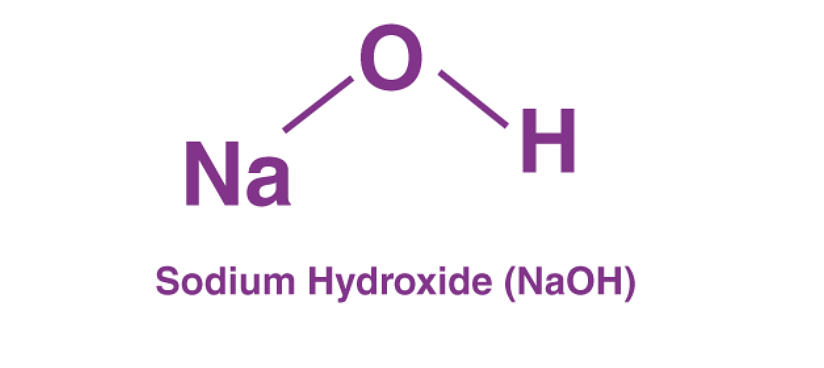
Sodium Hydroxide
Three products are formed during the process and they are all useful. The amalgam formed during the process produces Hydrogen (g) and Sodium Hydroxide when treated with water.
Read more: Sodium Hypochlorite Formula
Uses of Sodium Hydroxide
Sodium Hydroxide is primarily used to manufacture soaps and detergents. It is also widely used to degrease metals. However, there are other uses of it too.
- It is used to manufacture paper.
- It is used in caustic washing. Caustic washing is a process in which sulfurous impurities are removed from crude oil using sodium hydroxide.
- Textile fibres like Rayon are made from Sodium Hydroxide.
- Bauxite ore is purified using this to extract aluminium.
Properties of Sodium Hydroxide
Just like other elements, sodium hydroxide has certain properties as well. It is a strong alkaline that has a stable nature. Some of its properties are:
- The melting point of Sodium Hydroxide is 591K.
- It is bitter in taste and feels soapy when touched.
- It dissolves in water but leaves residue when dissolved in alcohol.
Harmful Effects of Sodium Hydroxide
Despite the advantages that Sodium Hydroxide has, there are certain limitations that you should keep in mind while using it.
- Sodium Hydroxide is capable of dissolving human tissue. One should be very careful about it.
- If it comes in contact with the eye, it may lead to permanent blindness.
- If it comes in contact with the skin, it may lead to severe burns.
- The solvation process is exothermic and may lead to splashing. It can come in contact with eyes or skin during this process.
Read More:
Things to Remember
[Click Here for Sample Questions]
- Bleaching Powder and Sodium Hydroxide are two chemical compounds produced from Common Salt (Sodium Chloride).
- Calcium Hypochlorite is commonly known as Bleaching Powder. It has a lot of uses including washing clothes, bleaching textile fibres like cotton and linen, sterilizing water, etc.
- The chemical formula of Bleaching Powder is CaO(Cl)?. It has two forms- hydrous and anhydrous. It is white in colour and has a pungent smell.
- Sodium Hydroxide is commonly known as caustic soda. The chemical formula for Sodium Hydroxide is NaOH.
- It has a lot of uses including degreasing materials, removing sulfurous impurities from crude oil, and manufacturing soaps and papers among many others.
Sample Questions
Ques. Why is Calcium Hypochlorite widely used in Industries? (3 Marks)
Ans. Calcium Hypochlorite is an organic compound that is commonly known and sold as bleaching powder or chlorine powder. It is used for sanitizing and disinfection in almost every household. All the more, calcium hypochlorite is known to be the best product that can disinfect water and make it potable. It is highly used in various industries like paper mills, textile industries, mines, pharmaceutical plants, and many other manufacturing industries to sanitize waters for the purpose to rinse, wash, spray, coating, or cooling during processing.
Ques. List any four uses of Sodium Hydroxide. (3 Marks)
Ans. Four uses of Sodium Hydroxide are as follows:
- It is used to manufacture soaps, detergents, and paper.
- It is used to degrease metals.
- It is used in caustic washing. Caustic washing is a process in which sulfurous impurities are removed from crude oil using sodium hydroxide.
- Textile fibres like Rayon are made from Sodium Hydroxide.
Ques. What are the chemical properties of Sodium Hydroxide? (3 Marks)
Ans. The chemical properties of Sodium Hydroxide are
- Sodium Hydroxide is a white solid ionic compound composed of hydroxide anions, OH- , and sodium cations, Na+.
- Water and salt are formed when Sodium Hydroxide reacts with protic acids like hydrochloric acid.
- Caustic Soda has highly acidic with a pH of 13.
- It is a base used to leach amphoteric hydroxides or oxides.
- A covalent bond is found between molecules of hydrogen and oxygen.
Ques. Explain the reaction of Sodium Hydroxide with acids and acidic oxides with equations. (3 Marks)
Ans. The reaction of Sodium Hydroxide with Acids:
You will obtain water and salt when sodium hydroxide reacts with an acid.
Reaction of Sodium Hydroxide with Acidic Oxides: It is common for sodium hydroxide to react with acidic oxides. In these kinds of reactions, harmful acidic gases are purified.
Ques. What are the physical properties of Sodium Hydroxide? (3 Marks)
Ans. The Physical Properties of Sodium Hydroxide are
- It melts at 318°C and boils at 1,388°C.
- It is colourless and crystalline in nature.
- It can easily dissolve in water but is partially soluble in methanol and ethanol.
- It feels slippery when touched.
Ques. List three physical properties of Bleaching Powder? (3 Marks)
Ans. Three physical properties of Bleaching Powder are
- It is white in colour.
- It has a pungent smell just like chlorine.
- It can easily dissolve in water.
Ques. Is Calcium Hypochlorite toxic? (3 Marks)
Ans. Wise use of calcium hypochlorite is beneficial for people. However, if it comes in contact with tissue, it can dissolve it. One should avoid skin contact with it for long periods of time as it can cause severe burns. If consumed, it causes sharp stomach pains, coughing, nausea, a burning sensation, and vomiting. If animals drink water containing bleaching powder, they might die. One should also avoid inhaling it as it can cause respiratory issues.
Ques. What happens to the pH level of water when calcium hypochlorite is added to it? (3 Marks)
Ans. Calcium Hypochlorite produces hypochlorite and calcium ions when it is dissolved in water. In general, chlorine decreases the pH of water. However, on the other hand, calcium hypochlorite increases the pH value of water. This reduces the acidity of water. The end result will release hypochlorite and chlorine gas and both will contain the same type of residuals.
Ques. Write the importance of sodium hydroxide. (2 marks)
Ans. Sodium hydroxide (NaOH) is referred to as a metallic caustic base and is also known as lye or caustic soda. An alkaline, caustic soda is widely used in many industries, particularly in the manufacture of pulp and paper, textiles, drinking water and detergents as a strong chemical base.
Ques. Is bleaching powder acidic or basic? (1 mark)
Ans. Bleaching powder is basic in character as it gives calcium chloride, chlorine, and water when bleaching powder reacts with hydrochloric acid.
Ques. Can you mix sodium hydroxide and bleach? (2 marks)
Ans. Household bleach often contains a small amount of sodium hydroxide in order to prevent the decomposition of sodium hypochlorite. Sodium hydroxide is frequently used in reactions to increase the pH of sodium hypochlorite.
Ques. Is bleach an oxidizing or reducing agent? (3 marks)
Ans. Bleach is an oxidizing agent.
While most bleaches are oxidizing agents, that is the chemicals that can remove electrons from other molecules, some are reducing agents (that donate electrons). Chlorine, a powerful oxidizer, is the active agent in many household bleaches.
Read More:



Comments