



Content Writer-SME
pH or potential of hydrogen is degree of measurement that determines the nature of a solution. In other words, it is an important parameter that measures the amount of hydrogen ion activity (H+) in a given solution.
- Acidic, basic, and neutral nature of a solution is determined by the logarithmic scale depending on the concentration of hydrogen or hydronium ions.
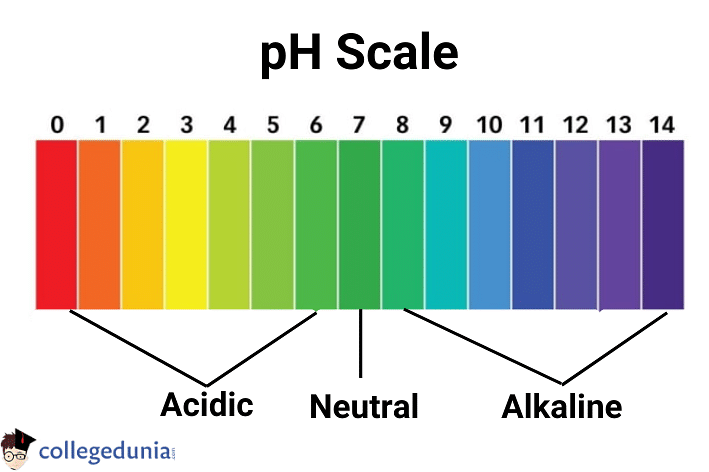
- The pH range on the logarithmic scale lies between 0 to 14.
- When the value of pH drops beyond 7, it indicates the acidic nature of a solution.
- A solution with a pH value ranging from 8 to 14 is basic in nature.
- The pH value of 7 indicates the neutral nature of a solution.
pH is defined as the negative logarithm of the molar concentration of hydronium-ion. Mathematically, pH formula is expressed as:
| pH = −log[H3O+] |
Read More: Importance of pH in Everyday Life
Key Terms: pH, pH Scale, Acid, Bases, Hydrogen Ions, Hydronium Ions, pH Formula, pH Equation, Aqueous Solution, pOH
What is pH?
[Click Here for Sample Questions]
pH is a logarithmic scale that helps to determine whether a given solution is acidic, basic, or neutral in nature. pH is a term derived from the German word, “Potenz” meaning “Power or Potential”. The full form of pH is the “potential of Hydrogen ”.
- The concept of pH was proposed by Soren Sorensen, a Danish chemist.
- pH is the negative of the base-ten logarithm of the concentration of H+ or H3O+ expressed in moles/liters.
pH scale has values ranging from 0 to 14. A solution is classified as a neutral, acidic, or basic solution on the basis of the given criteria:
- pH < 7: Acidic Solution
- pH> 7: Basic Solution
- pH = 7: Neutral Solution
pH Scale
Read More:
pH Formula in Chemistry
[Click Here for Previous Years’ Questions]
pH of a solution is dependent on the concentration of hydrogen ions or hydronium ions.
- When an acid is added to water, it releases H+ ions that combine with H2O to form H3O+ ions.
- The more the concentration of these ions in a solution, the lower will be its pH value.
- Strong acids have a low pH value since they ionize readily to release hydrogen or hydronium ions.
pH Formula in Chemistry is given as
| pH = −log[H+] |
pH Formula can also be expressed as
| pH = −log[H3O+] |
- Acidic solutions have a concentration of hydrogen ions of [H+] > 10-7 M.
- In the case of basic solutions, the concentration of hydrogen ions is [H+] < 10-7 M.
Read More: NCERT Solutions For Class 11 Chemistry Equilibrium
How to Calculate pH value?
[Click Here for Sample Questions]
The concentration of ions in a solution can easily be calculated if the pH value of a solution is provided. The pH equation can be transformed to be written as
| pH = −log[H+] [H+] = 10–pH |
pOH Scale
pOH scale is another scale like the pH scale that is used for the measurement of the concentration of ions in a solution. In pOH scale, if pOH is negative of the logarithm, then
| pOH = –log [OH–] [OH–] = 10–pOH |
pH of Water
[Click Here for Previous Years’ Questions]
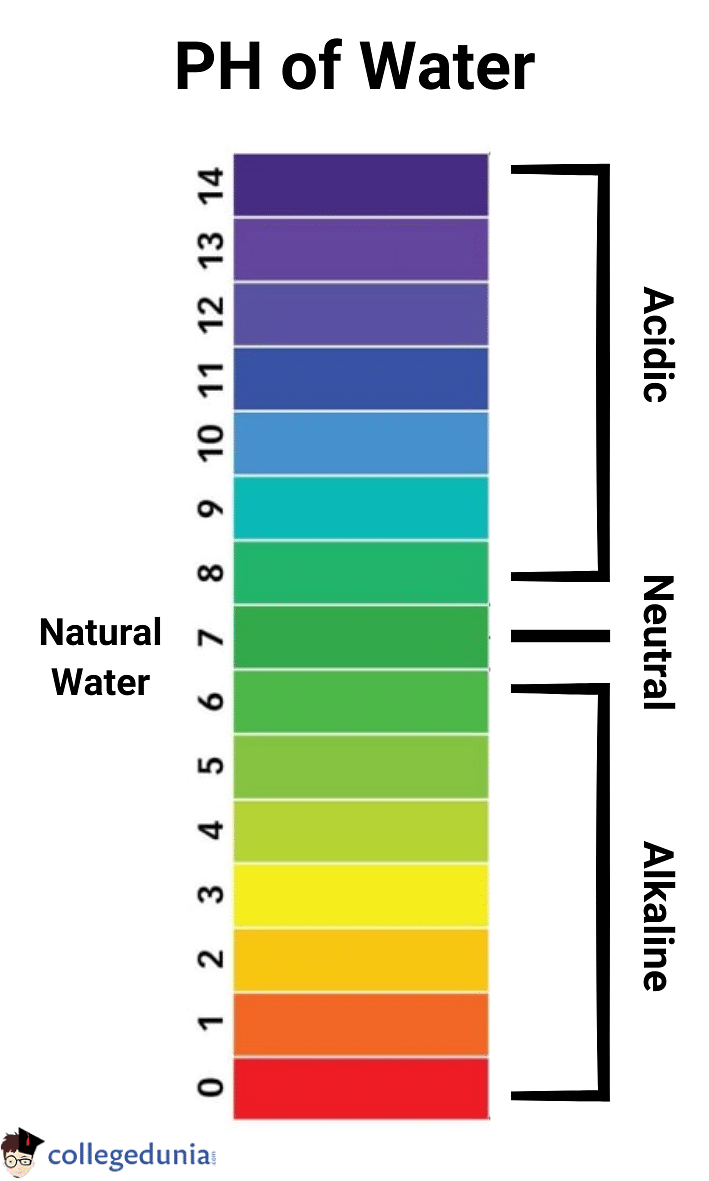
Pure Water is neutral, i.e it has a pH value of 7 which means it is neither acidic nor basic. A sample of pure water undergoes negligible auto-ionization or self-ionization. The H+ ion concentration in water is [H+] = 1.0 x 10⁻⁷ moles/liter.
Thus, the pH of water can be calculated as:
pH = - log [1.0 x 10⁻⁷]
pH = -(-7)
pH = 7
pH of Water
Ionic Product Constant of Water
Water undergoes the process of self-ionization, hence it dissociates in the given manner. According to the Law of Mass Action, the formula for Equilibrium Constant (Kw) is given as:
Kw = [H3O+] [OH-]/ [H2O].
Since water is the solvent, its concentration can be estimated to be 1.
| Kw = [H3O+] [OH-] |
Hence, at room temperature,
Kw = 1.0 x 10⁻¹⁴
In an aqueous solution, it can be concluded that
- [H3O+] > [OH-], pH < 7 (Acidic Solution)
- [H3O+] < [OH-], pH > 7 (Basic Solution)
- [H3O+] = [OH-], pH = 7 (Neutral Solution)
Read More: Equilibrium Important Questions
Relation between pOH, pH & pKw
The relation between pOH, pH, and pKw is described as follows:
–log Kw = pKw
–log Kw = –log ([H3O+][OH-])
–log Kw = (–log [H3O+])+(–log[OH-])
Thus, we have pKw = pH + pOH
As we already know,
Kw = 1.0×10⁻¹⁴
So, pKw = 14
Hence, pH + pOH = 14
pH Value Equation
[Click Here for Sample Questions]
Weak acids partially dissolve in an aqueous solution and attain a state of equilibrium. The equilibrium equation for such acid is
HA = H+ + A-
| Ka = (H3O+) (A-) |
Where
- [H3O+] is Hydronium Concentration.
- [A-] is Conjugate Base Concentration.
- HA is the Weak Acid Concentration.
If the bases are weak, they partially dissolve and also attain a state of equilibrium. Such equation of equilibrium and their partial dissociation is:
BOH = OH- + B+
| Kb = (OH-) (B+) |
Where
- [OH-] is Hydroxide Concentration.
- [B+] is Ion.
- B is the Weak Base concentration.
Read More: Equilibrium MCQs
pH of Acid and Base in Buffer Solution
[Click Here for Previous Years’ Questions]
Buffer solutions are those solutions that consist of a weak acid, and a conjugate base. The pH of human blood is maintained by buffer such as carbonic acid (H2CO3) and bicarbonate ions (HCO3--).
pH of Acid Buffer Solution
Consider an example of an acid dissociating in its aqueous solution. Acid HA dissociates and results in the formation of an H+ ion and its conjugate base A-.
| HA ⇌ H+ + A- |
Then, for such an ionization reaction, the equilibrium constant (Ka) is:
Ka = [H+] [A-]/ [HA]
Taking the negative log & rearranging, we get,
-log ([HA]/[A-1]) – log Ka = - log [H+] .......(1)
So, pH= - log [H+] & pKa = -log Ka
So we can say,
pH = pKa + log ([A-]/[HA]) which is also written as
pH= pKa + log ([salt]/[acid])
pH of Basic Buffer Solution
Consider an example of dissociation of the base in its aqueous solution.
| B + H2O ⇌ BH+ + OH- |
For such an ionization reaction, the equilibrium constant (Kb) is:
Kb = [BH+] [OH-] / [B]
Taking the negative log & rearranging, we get,
-log ([B]/[BH+]) – log Kb = - log [OH-] .......(1)
As we already know,
pOH = -log [OH-]= -log [OH-] & pKb = - log Kb
So, pOH = pKb + log [BH+]/ [B]), which can also be written as pOH = pKb + log ([salt]/[Base])
Check More:
Applications of pH Scale
[Click Here for Sample Questions]
pH paper is used to determine the pH level of any given solution. The pH paper is dipped in the solution. The value is then compared with the color which appears on the pH paper with a color chart and the pH value is obtained.
The important applications of pH are as follows:
- The pH value is very important for industries like Pharmacy.
- The pH of medicines is checked as it needs to be equal to the pH of the fluids present in the human body.
- A device known as a pH meter is used to check the précised pH value of a given solution.
- It has a connected pH electrode that is dipped in a solution and the pH meter shows the pH value.
- Buffer solutions are made for maintaining the pH of a solution.
- In chemical reactions, the pH of equations needs to be in proper equilibrium.
Important Topics for JEE MainAs per JEE Main 2024 Session 1, important subtopics included in the pH are as follows:
Some memory based important questions asked in JEE Main 2024 Session 1 include: 1. What is the pH of CH3COONH4+? (At 25°C). Given: Ka of CH3COOH = 1.8 x 10⁻⁵, Kp of NH4OH = 1.8 x 10⁻⁵. 2. The Ksp of Mg(OH)2 is 1 x 10-12. Find the limiting pH at 25 °C at which 0.01 M Mg2+ ions will precipitate. |
Things to Remember
- pH is the quantitative measure of the acidity or alkalinity of an aqueous solution.
- It is the negative logarithm of H+ ion concentration.
- pH Formula is given as pH = −log[H3O+] or pH = −log[H+].
- pH scale ranges from 0-14 with 7 being the neutral state.
- pH value greater than 7 is considered basic while a pH value less than 7 is considered acidic.
- For acidic solutions, the pH is [H3O+] > [OH–].
- For neutral solutions, the pH is [H3O+] = [OH–].
- For basic solutions, the pH is [H3O+] < [OH–].
Previous Years’ Questions
- pH-scale was proposed by…
- The pH value of 0.001 M aqueous solution of NaCl is…
- The pH range for phenolphthalein is…
- The pH value of an acid is 5 and its concentration is 1 M… (Manipal 2004)
- The pH value of human blood is about… (AIIMS 1996)
- The pH of rainwater is approximately… (JEE Main 2019)
- The pH value of 1×10⁻⁴ M NaOH solution is… (AFMC 2009)
- If pH of a solution decreases from 5 to 2, then it is…
- B2H6 reacts with (CH3)3N to produce… (UPSEE 2019)
- The pH of a solution prepared by mixing 2.0 mL of HCl solution…
Sample Questions
Ques. A sample of soft drinks has a concentration of H+ ion 3.8 x 10⁻³ M. Calculate its pH. (3 Marks)
Ans. The concentration of H+ ions is 3.8 x 10⁻³ M.
Using the pH Formula, we get
pH = −log[H+]
pH = -log [3.8 x 10⁻³]
pH = - {log [3.8] + log [10-3]}
pH = - (0.58) + (-3.0)
pH = - (-2.42)
pH = 2.42
So, the pH of the soft drink is 2.42 and hence, it is an acidic solution.
Ques. If the concentration of Hydronium ion is 8.0 x 10⁻⁸M, calculate the pH of its solution. (3 Marks)
Ans. The concentration of Hydronium ion is 8.0 x 10⁻⁸ M.
Using the pH Formula, we get
pH = −log[H3O+]
pH = - log [8.0 x 10⁻⁸]
pH= 7.09
So, the pH of the Hydronium ion solution is 7.09.
Ques. What is the pH of a solution of 0.005 M HBr? (3 Marks)
Ans. Using the pH Formula,
pH = - log [H3O+]
[H3O+] = 5.5 x 10⁻²M
pH = - log [5.5 x 10⁻²]
pH = 1.26
Hence, the pH of the solution is 1.26 and the solution is acidic in nature.
Ques. What is pH in chemistry? (2 Marks)
Ans. pH in Chemistry is a measure of the concentration of hydrogen ions in a solution. It gives the measure of the acidity or alkalinity of a solution. The pH scale ranges between 0 and 14. Solutions with a pH of less than 7 are acidic and those with a pH greater than 7 are basic or alkaline solutions.
Ques. What do you mean by the pH of an Acid? (2 Marks)
Ans. pH is considered the measurement of the amount of hydroxyl and hydrogen ions in water. The range of pH is 0-14, and 7 is the neutral value. If pH is less than 7, the pH value inferred is acidic. If pH is greater than 7, the pH value inferred is basic.
Ques. How can one calculate pH and pOH? (3 Marks)
Ans. The "p" in pH and pOH signifies "-log." The H or the OH in pH and pOH denote the concentration of either hydronium ions (H3O+) or hydroxide ions (OH-). Therefore, pH measures hydronium ion concentration, whereas pOH measures hydroxide ion concentration.
The pOH of a solution can be calculated by a formula:
pOH = –log [OH-]
Both pH and pOH are related as pH + pOH = 14
Ques. What will be the pH of 0.001M of the HCl solution? (2 Marks)
Ans. HCl is a very strong acid and hence, completely dissolves into water and dissociates in H+ and Cl-.
pH = - log [H+]
pH = -log [0.001]= 3
So, the pH of the HCl solution is 3.
Ques. What is the pH of a formic acid solution of 5 x 10⁻³M? [Ka (HCOOH) = 2 x 10⁻⁴] (3 Marks)
Ans. Ka (HCOOH) = 2 x 10-4 = 0.0002
C = 5 x 10-3 = 0.005
Hence, [H+]2 + Ka [H+]- C Ka = 0
Let [H+] = x
X2 + (0.0002x)- (0.005) x (0.0002)= 0
X = [H+] = 0.0009
pH = - log10 [H+]
= - log (0.0004)
= 3.039
Ques. Explain what will be the pH value for a neutral solution. (2 Marks)
Ans. The pH value of a neutral solution is 7. The pH of pure water is neutral. When chemicals will be mixed with water, they will either turn acidic (pH<7) or basic (pH>7). In a neutral solution, the consistency of the hydrogen ion remains equal to hydroxide ions.
Ques. List the factors on which the pH of a solution is dependent. (3 Marks)
Ans. The pH value of a solution is dependent on the following factors:
- pH of strong acid or base is not dependent on the temperature.
- pH of weak acids decreases with an increase in temperature as there is an increase in ionization.
- pH of weak bases increases with an increase in temperature as there is an increase in ionization or [OH-] ion concentration.
Check-Out:



Comments