



Content Curator
Potential Energy of a spring can be determined when a spring is being compressed or extended.
- Potential energy is the energy stored in an object due to its position with respect to some zero position.
- When we compress or extend a stretched spring, we experience the same force that we applied in the opposite direction.
- When a spring deviates from its mean position, it tries to regain equilibrium by exerting a force equal to and opposite to the external force.
The formula for the potential energy of a spring is given by
\(F=\frac{1}{2}kx^2\)
Where
- k is known as the spring constant
- x is the displacement from the mean position
What is Potential Energy?
[Click Here for Sample Questions]
Elastic potential energy is energy stored as a result of applying a force to deform an elastic object.
- The energy is stored until the force is removed and the object springs back to its original shape, doing work in the process.
- The deformation could involve compressing, stretching or twisting the object.
- We have seen the use of the spring force in bike carriers, where the energy generated by disrupting the spring equilibrium is used as its potential energy and transformed into various forms.
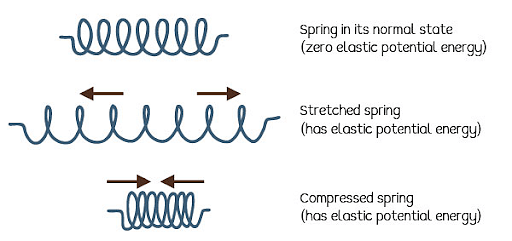
This form of energy is caused by a force acting on an object temporarily which results in the object changing its shape. A good example of such objects is: when a squishy ball is squeezed with the hand or when an elastic band is stretched and released.

Laws Relating to Potential Energy of Spring
[Click Here for Sample Questions]
When a stretched spring is compressed or extended, we feel a power in the opposite direction. The explanation behind this is that when a spring deviates from its mean position, it uses an equal and opposite force to restore its balance.
Hooke’s Law of Spring Constant
Hooke’s law states that the force that requires stretching an elastic object like a metal spring is always directly proportional to the spring extension for small-scale distances. The force applied back by the spring is known as Hooke's Law. It is expressed as:
Fs = -kx
Where,
- Fs → Force of the spring
- x → Unstretched length of the spring
- k → Spring constant.
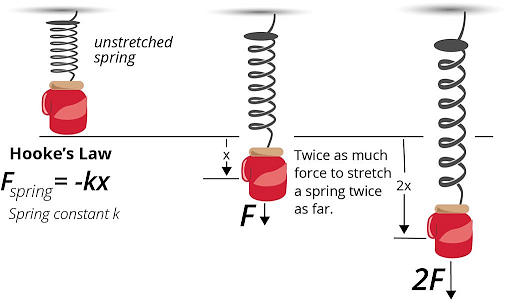
The spring force may be dubbed as the restorative force since the spring force is always opposed to the displacement, this is why the Hooke law equation has a negative sign. When the spring is stretched downwards, an upward force is generated in the spring.
Formulas for Potential Energy of a Spring
[Click Here for Sample Questions]
When we pull the spring to a displacement, the work done by the spring is:

The work done by pulling force is:

When the displacement is less than 0, the displacement done is:
Ws = –\(\frac{k(xc^2)}{2}\)
The external strength work Ws = –\(\frac{k(xc)^2}{2}\) is F. In the transition from the initial transition xi to the final transformation, xf, the work is done.

It is evident from the equation that the work of spring forces depends on displacement endpoints solely.
- We can also observe that the work performed by the spring force is zero in a cyclic process.
- Therefore, the spring force is said to be a conservative force, because it only depends on beginning and ending locations.
- This job is therefore carried out in the form of the potential energy for the Spring.

Uses of Potential Energy of Spring
[Click Here for Sample Questions]
There are multiple uses of the Potential Energy of Spring. Below listed are some of the uses:
- In many mechanical systems such as the shock absorbers used in vehicles, and spring mattresses, elastic potential energy is stored by a spring.

- Elastic energy may be employed in numerous ways, as the spring may stay compressed or expanded without wasting energy for lengthy durations.

- The elastic stretch energy is used by balloons, rubber belts, bungees and trampolines.
- In squishy balls, a bow and arrow and spinning springs, we can find elastic energy applications.
- Also, elastic energy is used by catapults and slingshots.

Things to Remember
- Elastic potential energy is the energy stored as a result of applying a force to deform an elastic object.
- This form of energy is caused by a force acting on an object temporarily which results in the object changing its shape.
- Hooke’s law expresses potential energy for a spring as Fs = -kx.
- This type of spring potential energy is used in many applications such as vehicle suspension systems, spring mattresses, shock absorbers, etc.
- Spring force is said to be a conservative force because it only depends on beginning and ending locations.
Sample Questions
Ques. Is potential energy considered as work? (2 marks)
Ans. Potential energy and work done are the same as cinematic energy and work done. Potential energy is an electricity storage system since it is configured or moved, while labor is done mostly to transmit this energy from one body to another.
Ques. Define Elastic energy. (2 marks)
Ans. The energy of elastic potential is stored by the application of force to the deformation of an elastic object. The energy is retained until the force is released and the item returns to its original form. The deformation might include the object's compression, deformation, or twisting.
Ques. At the equilibrium position, what is the potential energy V(x) of the spring? (2 marks)
Ans. If the cinematic energy is maximal, the energy potential is nil. This happens when the speed is highest and the mass is at a position of balance. When the speed is zero, the potential energy is maximal.
Ques. What is potential energy? (2 marks)
Ans. Potential energy is the energy stored by an object due to its position, internal tensions, electric charge, or other factors.
Ques. What is elastic potential energy? (2 marks)
Ans. Elastic potential energy is the mechanical potential energy stored in the configuration of a material or physical system as a result of work performed on it.
Ques. Name some objects that possess elastic potential energy. (2 marks)
Ans. Rubber bands, trampolines, and bungee cords are all examples of elastic potential energy.
Ques. What are the different types of potential energy? (3 marks)
Ans. The different types of potential energy are
- Gravitational potential energy
- Elastic potential energy
- Electrical potential energy
- Chemical potential energy
- Nuclear potential energy
Ques. What is the relationship between potential and kinetic energy? (2 marks)
Ans. Potential and kinetic energy are related in that they can be changed into one another. This can be described by imagining water held in a tank. When the tank's tap is closed, the water in the tank has potential energy. When the tank's tap is turned on, water gains kinetic energy.
Ques. Point out the correct alternative:
(a) When a conservative force does positive work on a body, the potential energy of the body increases/decreases/remains unaltered.
(b)Work done by a body against friction always results in a loss of its kinetic/potential energy.
(c) The rate of change of total momentum of a many-particle system is proportional to the external force/sum of the internal forces of the system.
(d) In an inelastic collision of two bodies, the quantities that do not change after the collision are the total kinetic energy/total linear momentum/total energy of the system of two bodies. (3 marks)
Ans. (a) Potential energy of the body decreases because the body, in this case, goes closer to the center of the force.
(b) Kinetic energy, because friction does its work against the motion.
(c) Internal forces can not change the total or net momentum of a system. Hence the rate of change of total momentum of many particle systems is proportional to the external force on the system.
(d) In an inelastic collision of two bodies, the quantities that do not change after the collision are the total kinetic energy/total linear momentum/ total energy of the system of two bodies.
Ques. What is the unit of the spring constant? (2 marks)
Ans. The pitch produces the continuous spring in N/m. The Hooke Law formula is F (Newtons) = k x in meters. The constant spring k has Newtons units/metre.
Ques. Define the Law of Conservation of Energy. (2 marks)
Ans. According to the law of conservation of energy, the total energy of an isolated system does not change. Energy may be transformed from one form to another but the total energy of an isolated system remains constant.
Ques. Answer carefully, with reasons:
(a) In an elastic collision of two billiard balls, is the total kinetic energy conserved during the short time of collision of the balls (i.e., when they are in contact)?
(b) Is the total linear momentum conserved during the short time of an elastic collision of two balls?
(c) What are the answers to (a) and (b) for an inelastic collision?
(d) If the potential energy of two billiard balls depends only on the separation distance between their centers, is the collision elastic or inelastic? (Note, we are talking here of potential energy corresponding to the force during collision, not gravitational potential energy) (2 marks)
Ans. (a) In this case total kinetic energy is not conserved because when the bodies are in contact with elastic collision, the kinetic energy is converted into potential energy.
(b) Yes, because total momentum is conserved as per the law of conservation of momentum.
(c) The answers remain unchanged.
(d) It is a case of elastic collision because in this case, the forces will be of a conservative nature.
Ques. Give the equation of Hooke’s law for the potential energy of a spring. (2 marks)
Ans. Fs = -kx
Here,
Fs is the force of the spring
x is the unstretched length of the spring
k is the spring constant.
Ques. A person trying to lose weight (dieter) lifts a 10 kg mass, one thousand times, to a height of 0.5 m each time. Assume that the potential energy lost each time she lowers the mass is dissipated, (a) How much work does she do against the gravitational force? (b) Fat supplies 3.8 x 10⁷ J of energy per kilogram which is converted to mechanical energy with a 20% efficiency rate. How much fat will the dieter use up? (3 marks)
Ans. Here, m = 10 kg, h = 0.5 m, n = 1000
(a) work done against gravitational force.
W = n(mgh) = 1000 x (10 x 9.8 x 0.5) = 49000J.
(b) Mechanical energy supplied by 1 kg of fat = 3.8 x 107 x 20/100
= 0.76 x10⁷ J/kg
.-. Fat used up by the dieter =1kg/(0.76 x 107) x 49000 = 6.45 x 10-³ kg
Ques. Which of the following potential energy curves in Fig. cannot possibly describe the elastic collision of two billiard balls? Here r is the distance between centres of the balls. (2 marks)

Ans. The potential energy of a system of two masses varies inversely as the distance (r) between them i.e., V (r) α 1/r. When the two billiard balls touch each other, P.E. becomes zero i.e., at r = R + R = 2 R; V (r) = 0. Out of the given graphs, curve (v) only satisfies these two conditions. Therefore, all other curves cannot possibly describe the elastic collision of two billiard balls.
Also Read:



Comments