



Content Curator
Properties of Bulk Matter consists of various essential concepts, including Stress, Strain, Elasticity, Hook's law, Pascal's law, Viscosity, Surface Energy, etc.
The internal restorative force is known as stress that is applied to a deformed body per unit area. And, the difference between the body's changed and initial shape is known as strain. Hook's law states that stress is directly proportional to strain within the boundaries of elastic limits.
The ratio of stress to its corresponding strain within the elastic limit is known as a body's modulus of elasticity. There are three varieties of elasticity modulus, and they are as follows:
- The ratio of longitudinal strain to everyday stress inside the elastic limit is known as Young's modulus of elasticity, or Y.
- The volumetric strain inside the elastic limit is referred to as the bulk modulus of elasticity, or K.
- η or modulus of stiffness It is the amount of shearing strain to tangential stress.
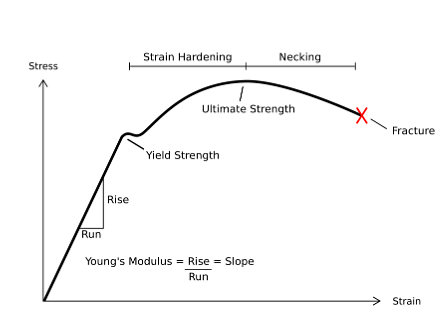
Properties of Bulk Matter
Read Also: Hooke's Law Formula
Properties of Bulk Modulus MCQs
Ques 1: What happens to the elasticity modulus as the temperature rises?
- Increases
- Remains constant
- Becomes zero
- Decreases
Click here for the answer
Ans: d) Decreases
Explanation: The way a material is stiff is determined by its elastic modulus. To put it another way, it is a gauge for how easily a material can stretch or bend. It is the stress and strain diagram's slope up to the proportionality limit. The modulus of elasticity decreases as temperature rises. The initial impact stress will grow as the elastic modulus increases.
Ques 2: Hook’s law is used for explaining which of the following:
- Strain
- Elastic Limit
- Stress
- Modulus of elasticity
Click here for the answer
Ans: (d) Modulus of elasticity
Explanation: By Hooke's law, a principle of elasticity, for relatively minor deformations of an object, the displacement or size of the deformation is directly proportional to the deforming force or load. It applies only to an elastic object.
Ques 3: An iron needle floats when it is slowly placed on the water's surface because
- The density of the material used in the needle is less than that of water
- It depends on the shape
- Water will be displaced which is equal to the weight of the needle
- Surface tension is mainly responsible
Click here for the answer
Ans: d) Surface tension is mainly responsible
Explanation: The density of a metal paper clip or needle is greater than that of water. As a result, when it is placed into water, it sinks to the water's bottom. But because of the surface tension of the water, if we carefully place it horizontally on the surface, it can float virtually indefinitely.
Read More:
| Topic Related Concepts | ||
|---|---|---|
| Elastic Limit | Stress | Bulk Modulus |
| Hooke's Law | Derivation Relation between Elastic Constants | Shear Modulus |
Ques 4: What is a liquid's rigidity modulus?
- Non-zero constant
- Infinite
- Zero
- None
Click here for the answer
Ans: c) Zero
Explanation: Water’s modulus of rigidity or Shear Modulus is Zero. In case of any applied stress, water starts flowing, making the strain larger.
Ques 5: The proportion of the lengths of the two identical-material wires A and B is 1:2. The ratio of their diameters is 2:1. If the wires are stretched with the same force, what will be the ratio of their lengths?
- 2:1
- 8:1
- 1:8
- 1:4
Click here for the answer
Ans: c) 1:8
Explanation: Here, the issue is resolved by applying Hooke's law. According to Hooke's law, the force needed to stretch or compress a spring or wire over a given distance grows linearly as the distance rises. Additionally, the equation yields elastic energy per unit of time. E= ½ ×stress×strain
Read More: NCERT Solutions for Class 11 Physics Mechanical Properties of Solids
Ques 6: How would the volume of elasticity vary if the material's Young's modulus is three times that of its rigidity?
- 3 x 10¹⁰ N/m2
- 2 x 10¹⁰ N/m2
- Infinity
- Zero
Click here for the answer
Ans: d) Zero
Explanation: To get the value of volume elasticity, first determine the relationship between the young modulus and the modulus of rigidity. Next, determine the relationship between Poisson's ratio and the modulus of rigidity.
Ques 7: Which of the following factors causes a regular body's shape to change?
- Shearing strain
- Volume stress
- Longitudinal strain
- Metallic strain
Click here for the answer
Ans: a) Shearing strain
Explanation: Shear strain, which is the amount of deformation perpendicular to a particular line as opposed to parallel to it, is the ratio of displacement to an object's original dimensions as a result of stress. Shear strain, which is sometimes simpler to calculate, is the tangent of the angle in engineering and equal to the greatest deformation length divided by the perpendicular length in the plane of the force application.
Ques 8: Young’s modulus is equal to __.
- Longitudinal strain divided by stress
- Longitudinal stress divided by strain
- Longitudinal strain
- Metallic strain divided by longitudinal strain
Click here for the answer
Ans: b) Longitudinal stress divided by strain
Explanation: Young's modulus, also known as the modulus of elasticity, is determined by dividing the longitudinal stress by the strain. For a metal bar under tension, stress and strain can be explained as follows. Young's modulus = stress/strain.
Ques 9: Units of Hooke’s law
- N/m
- m/N
- S/s
- Kg/s
Click here for the answer
Ans: a) N/m
Explanation: Hooke's Law can be expressed mathematically as F= - kx. As long as the load does not exceed the material's elastic limit, many materials abide by this rule. The force and extension are related in SI units by the rate or spring constant, k: N/m or kg/s2
Read More:
Ques 10: The most commonly used unit of Young's modulus is __.
- Dyne
- Newton
- Watt
- Pascal
Click here for the answer
Ans: d) Pascal
Explanation: Young's modulus is essentially a constant that varies depending on the substance. Young's modulus gauges a material's resistance to length or size changes when an object composed of that material is compressed or stretched. It is sometimes referred to as the elasticity modulus.
Read more:



Comments