



Education Content Expert
Hooke’s Law is one of the foundational laws in the field of Physics. Hooke’s Law states that the force required to extend or compress a spring by a certain distance is directly proportional to that distance. Thus, once the force is removed, the object returns to its original shape.
In simpler terms, Hooke’s Law states that the amount of stress we apply to any object is equal to the amount of strain observed on it, i.e, Stress ∝ Strain. Hooke’s Law was proposed by British physicist Robert Hooke in 1660.
Read More: NCERT Solutions for Class 11 Physics: Mechanical Properties of Solids
Key Terms: Hooke’s Law, Hooke’s Law Formula, Force, Displacement, Stress, Strain, Elasticity, Spring
What is Hooke’s Law?
[Click Here for Sample Questions]
Hooke’s Law states that the force required to compress or extend a spring by a specific distance is directly proportional to that distance.
- The stiffness of the spring is a constant factor feature.
- The property of elasticity implies that stretching a spring twice as long requires twice as much power.
- Thus, Hooke’s law is the linear dependence of displacement on stretching.
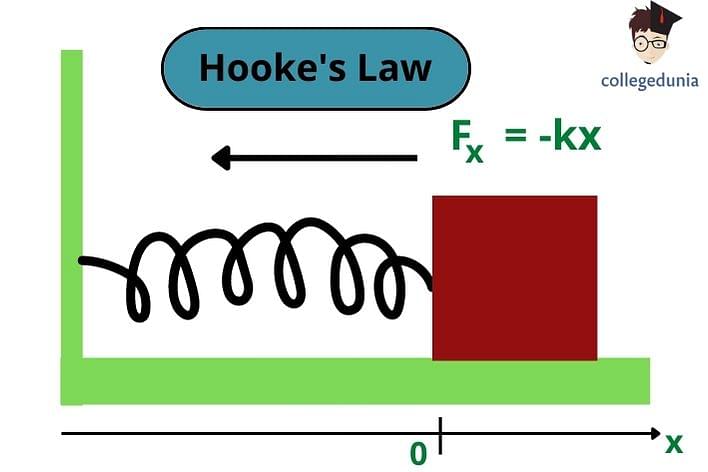
Hooke's Law
Read More: Mechanical Properties of Solids
Mathematically, Hooke’s Law can be represented as
Stress ∝ Strain
- As long as the stress is applied, the strain will remain in the object, and when the tension is removed, the object will return to its original shape.
- Hooke’s law basically provides the foundation for elasticity, thus, it is also referred to as the law of elasticity or elasticity principle.
Check-Out:
Hooke’s Law Formula
[Click Here for Previous Years' Questions]
Hooke’s Law Formula is used to determine the displacement, force in a stretched spring and the force or spring constant.
Hooke’s Law Formula is given as follows:
F = –K x
Where
- F refers to the amount of force applied to the object.
- k refers to the force constant or the spring constant.
- x refers to the displacement in the spring.
The negative sign in the formula indicates the direction of the applied force. Minus or negative sign is present in Hooke’s Law Formula by convention.
Read More: Mechanical Properties of Solids Important Questions
Solved ExampleExample 1: Determine the force applied on the spring, if the spring is stretched by 22 cm and has a force constant of 6 cm/dyne. Solution: Given that,
According to Hooke’s law formula, F = – k x F = – 6 × 22 cm F = – 132 N Thus, the force applied to the spring is -132 N. Example 2: A spring is extended up to 10 cm with a force of 500 N. What will be the spring constant of the spring? Solution: According to the question,
Using Hooke’s Law Formula, F = -kx k = – F / x k = -500 N / 0.10 m k = -5000 N/m Thus, the spring constant of the spring is -5000 N/m. |
Check-Out:
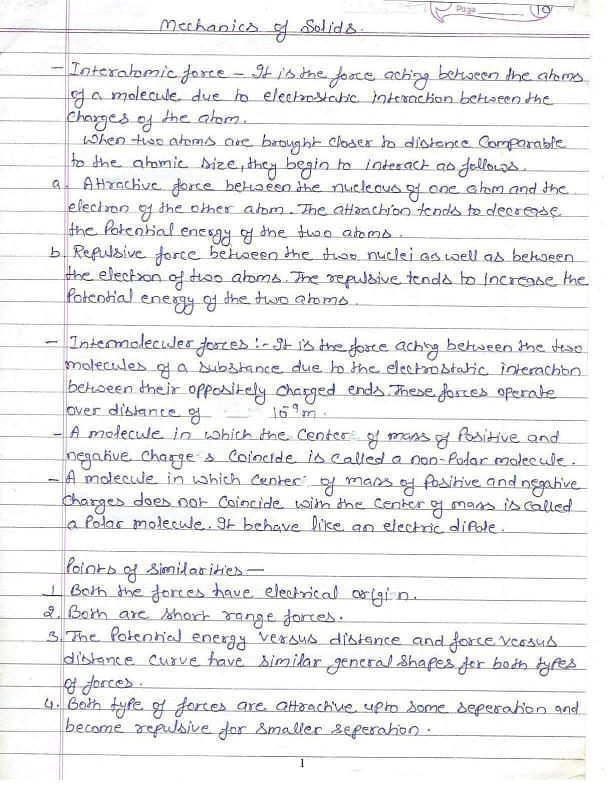
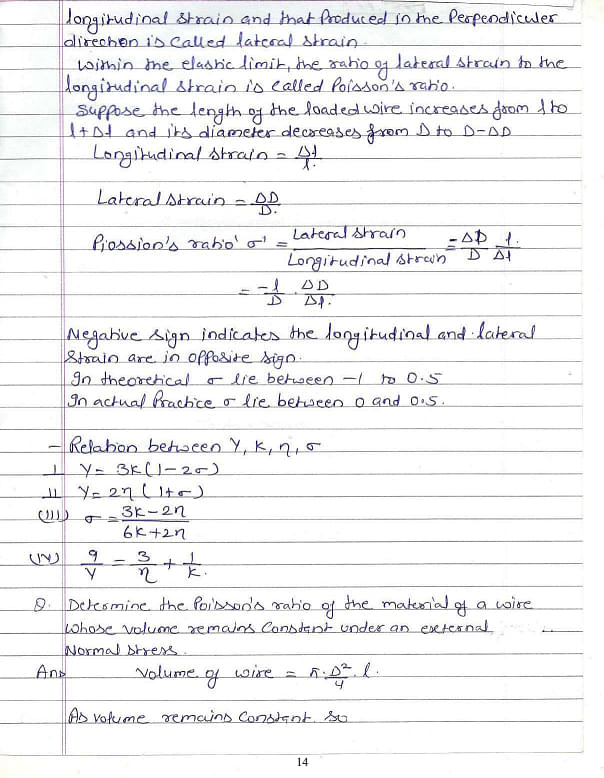
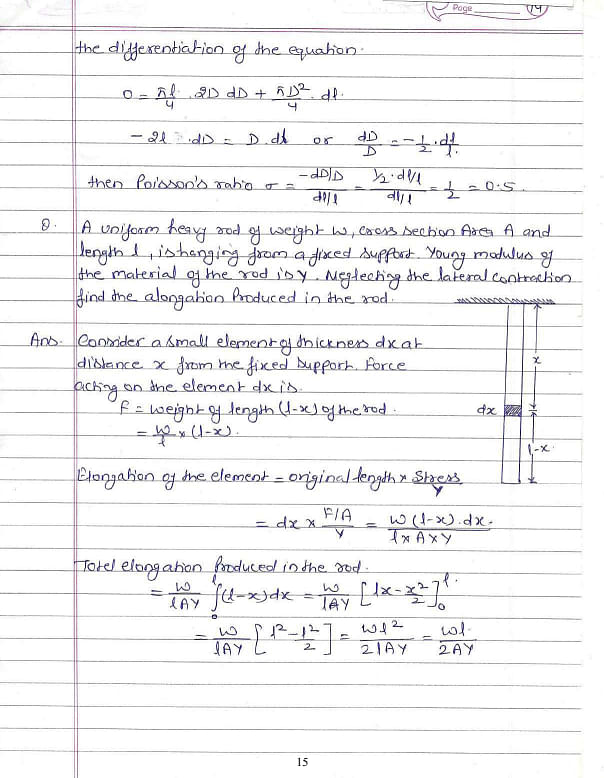
Handwritten Notes on Mechanical Properties of Solids
[Click Here for Sample Questions]
Given below are the handwritten notes for Mechanical Properties of Solids:


Things to Remember
- Hooke’s Law formula states that the force applied to extend or compress a spring by a certain distance is directly proportional to that distance.
- Hooke’s Law was proposed by Robert Hooke in 1660 and is one of the foundational principles in the field of physics.
- According to Hooke’s Law, Stress ∝ Strain, means that the amount of stress applied to an object is equal to the amount of strain observed on it.
- Hooke’s Law is also known as the elasticity principle or law of elasticity as it provides the foundation for elasticity.
- Hooke’s Law Formula is given as F = -K x, where F denotes the force applied, x is the displacement/ extension and k is the spring constant or force constant.
Read More: Important MCQs on Mechanical Properties of Solids
Previous Years’ Questions (PYQs)
- Hooke's law states that…
- The length of elastic string, obeying Hooke’ Law is
- The extension in a string obeying Hooke's law v is… (BITSAT 2007)
- The extension in a string, obeying Hooke's law, is x. The speed… (JEE Advanced 1996)
- Two similar springs P and Q have spring constants… (NEET 2015)
- An elastic string has length β when subjected to 5 N tension… (AMUEEE 1999)
- Shear stress is related to…
- Which of the modulus of elasticity is involved in compressing a…
- The modulus of elasticity is dimensionally equivalent to…
- Stress is the internal force per unit area of a body. Rubber…
Sample Questions
Ques. What will be the force constant if a force of 200 N stretches a spring by 1.8 m? (3 Marks)
Ans. According to the given parameters:
- Force Applied (F) = 200 N
- Displacement /Extension in Spring (x) = 1.8 m
As per Hooke’s law formula,
F = – k x
k = – F / x
k = – 200 / 1.8
k = – 360 N/m
Thus, the force constant will be – 360 N/m.
Ques. What will be the force required to compress a spring, if the displacement of a spring is 20 cm and the spring constant is 150 N/m? (3 Marks)
Ans. According to the question,
- Displacement of Spring (x) = 20 cm = 0.2 m
- Spring Constant (k) = 150 N/m
- Force Required to Compress the Spring (F) =?
Using the Hooke’s Law Formula,
F = – k x
Ignore the -ve sign as we only need to calculate the force needed to compress the spring.
F = k x
F = 150 × 0.2
F = 30 N
Thus, the force required to compress the spring is 30 N.
Ques. What will be the force applied to the spring if it is stretched by 10 cm and has a force constant of 2 cm /dyne? (3 Marks)
Ans. According to the given parameters,
- Displacement/ Extension in Spring (x) = 10 cm
- Force constant (k) = 2 cm/dyne
- Force Applied (F) =?
Using the Hooke’s Law Formula,
F = – k x
F = – 2 × 10 cm
F = – 20 N
Thus, the force applied on the string is -20N.
Ques. Calculate the force required to stretch a spring, if the displacement of a spring is 60 cm and the value of the spring constant is 85 N/m. (3 Marks)
Ans. Given parameters are,
- Displacement of Spring (x) = 60 cm = 0.6 m
- Spring Constant (k) = 85 N/m
- Force required to stretch the spring (F) =?
According to Hooke’s Law Formula,
F = – k x
Since we only need the force needed to stretch a spring, we can neglect the -ve sign.
F = k x
F = 85 × 0.6
F = 51 N
Thus, the force needed to stretch the given spring is 51 N.
Ques. What will be the force constant if a force of 100 N stretches a spring by 0.8 m? (3 Marks)
Ans. According to the question,
- Force Applied (F) = 100 N
- Displacement/Extension of Spring (x) = 0.2 m
- Force Constant (k) =?
Using Hooke’s law Formula,
F = -k x
k = – F / x
k = – 100 / 0.8
k = – 125 N/m.
Thus, the force constant will be – 125 N/m.
Ques. There is one tough, shock-absorbing spring that has been compressed upto 3.00 cm by applying a force of 1500 N. Determine the value of force constant k for the spring. (5 Marks)
Ans. The magnitude of the force applied to the spring is 1200 N which means that the spring is exerting an equal (magnitude) and opposite restoring force of -1200 N.
The extension of the spring is 3.00 cm. First, we need to convert it into meters:
x = 3.00 cm
x = (3.00)(1/100) = 0.03 m
Now, we need to find the force constant.
Using the Hooke's law formula,
F = -kx
k = -F/x
k = -(-1200 N)/0.03 m = 1200N/0.03 m
k = 40000 N/m
Thus, the force constant of the spring is 40000 N/m.
Ques. List down some limitations of Hooke’s Law. (3 Marks)
Ans. Here are a few limitations of Hooke’s Law:
- Hooke’s law is applicable beyond the elastic limit of a material.
- This law is only applicable to solids and then also only if the deformation force is very small.
- It is not classified as a universal law.
- The law is only applicable to the objects as long as they are not stretched beyond their capacity.
Ques. What will be the spring constant if the spring is stretched 0.75 m by an external force of 30 N? (3 Marks)
Ans. Given parameters are:
- Extension of Spring (x) = 0.75 m.
- Force Applied (F) = 30 N
- Spring Constant (k) =?
Using the Hooke’s Law Formula,
F = -k x
k = -F/x
k = -30/0.75
k = - 40 N/m.
Thus, the spring constant will be -40 N/m.
Check-Out:



Comments