



Education Journalist | Study Abroad Lead
Proteins are an essential macronutrient present in all living organisms. It is found throughout the body — in our muscles, bones, skin, hair, and basically every other body part or tissue. The term ‘Protein’ was invented by Swedish chemist Jöns Jacob Berzelius in 1838. It was derived from the Greek word ‘proteins’, which means "the first position". Proteins are responsible for making enzymes, which are extremely important to carry out certain chemical reactions in your body. The functioning and regulating of our body cells, tissues, and organs are also performed by proteins in our body. Proteins are made up of linear chains of smaller units called amino acids. There are a total of 20 amino acids. The sequence of these amino acids determines the shape and the function of these proteins. Our body cannot synthesize these essential amino acids on its own, hence, we should have plenty of protein foods in our everyday diet to keep our body metabolisms stable. In this article, we will learn more about proteins, their structure, classification, and synthesis.
| Table of Contents |
Key Takeaways: Proteins, Fibrous proteins, Globular proteins, enzymes, hormones, amino acids
What are Proteins?
[Click Here for Sample Questions]
An essential part of every cell in our body, protein is one of the three macronutrients which is required by our body in larger amounts. Proteins are made up of linear chains of smaller units called amino acids. Every biochemical process that takes place inside our bodies is possible because of these proteins. Proteins are 3-dimensional structures that are assembled with different amino acid sequences.

Proteins
Sources of Proteins:-
Protein is an essential nutrient needed by all living organisms. Both animal and plant products are excellent sources of proteins. Some of the strongest sources of protein are nuts, seafood, seeds, eggs, soy products, eggs, legumes, beans, pulses, milk, cheese, yogurt, meat, and poultry. Vegetables and whole grains also contain proteins, but not as much as other sources. We should have plenty of protein foods in our everyday diet to keep our body metabolisms stable.
Protein Structure
[Click Here for Sample Questions]
A protein molecule is made from a long chain of amino acids, each linked to its neighbor through a covalent peptide bond. Hence, proteins are also known as polypeptides. Due to different rearrangements of amino acids, the structure of proteins are divided into four types:
- Primary Structure: In the primary structure of proteins, the proteins are linked through covalent bonds.
- Secondary Structure: It is a three-dimensional form of a local segment of proteins. They are formed by the linear peptide chains that fold either into an alpha-helical structure (coiled) or a beta-pleated structure (sheets) making hydrogen bonds between the atoms along the backbone of the polypeptide chain.
- Tertiary Sector: This structure is characterized by the arrangement of proteins into loops and bends. The tertiary structure contains hydrogen, ionic, and disulfide bonds. Many numbers of tertiary structures fold to form Quaternary Structure.
- Quaternary Structure: This structure is basically the arrangement of proteins containing more than one peptide chain.

Protein Structure
Read More:
| Related Articles | ||
|---|---|---|
| Structure of Glucose and Fructose | Important Notes on Cellulose | |
Protein Synthesis
[Click Here for Sample Questions]
Protein synthesis is an essential biological process that takes place inside a cell. The translation is a process by which protein synthesis takes place. Occurring in the cytoplasm of a cell, this process involves the rendering of genetic codes. Ribosomes present inside a cell are responsible for translating genetic codes into a polypeptide chain. These polypeptide chains become functioning proteins after undergoing certain modifications.
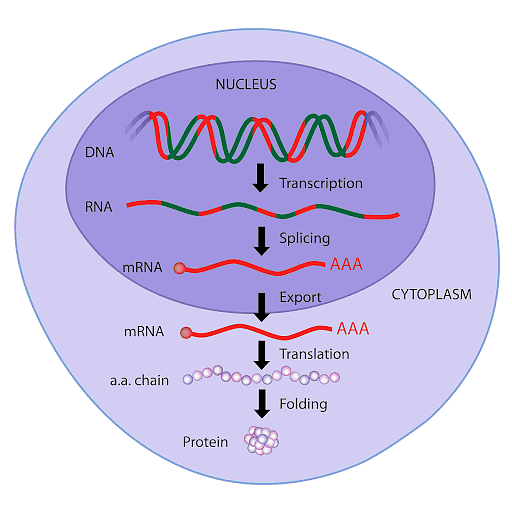
Process of Protein Synthesis
Classification of Protein
[Click Here for Sample Questions]
Proteins are classified on the basis of:
- Shape
- Constitution
- Nature of Molecules
On the basis of shape
- Fibrous Proteins: Usually long and elongated in structure, fibrous proteins help in maintaining and giving shape to the cell. They are insoluble in water and are less sensitive to factors such as changes in temperature and pH. Examples include keratin, collagen, elastin, and fibrin.
- Globular Proteins: Typically spherical in shape. they are responsible for carrying out specific biological functions in the body. They are soluble in water and are more sensitive to temperature and pH. Examples include hemoglobin, myoglobin, insulin, enzymes.
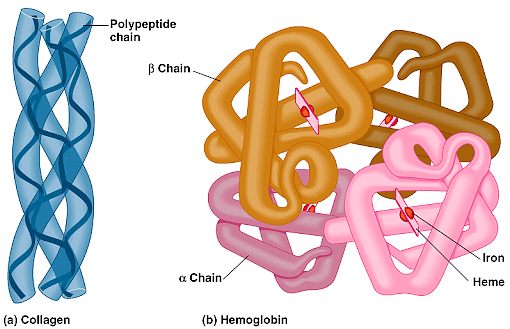
Fibrous Protein and Globular Protein
On the basis of the constitution
- Simple Proteins: They are the combinations of only amino acids. Example: .g. albumins, globulins, prolamins, etc.
- Conjugated Proteins: These are combinations of complex proteins and non–amino acid substances called a prosthetic group. These are of the following types:
- Nucleoproteins: Combination of protein and nucleic acid
- Mucoproteins: Combination of proteins and carbohydrates
- Glycoproteins: Combination of proteins and carbohydrates
- Chromoproteins: Combination of proteins and colored pigments.
- Lipoproteins: Combination of proteins and lipids.
- Metalloprotein: Combination of proteins and metal ions.
- Phosphoprotein: Combination of proteins and phosphate group.
- Derived Proteins: These are the degradation products obtained when proteins are hydrolyzed by acids, alkalies, or enzymes.
On the basis of the nature of molecules:
- Acidic Proteins: These proteins contain acidic amino acids which exist as anions. Eg: blood groups.
- Basic proteins: These proteins contain basic amino acids which exist as cations. Eg: lysine, arginine.
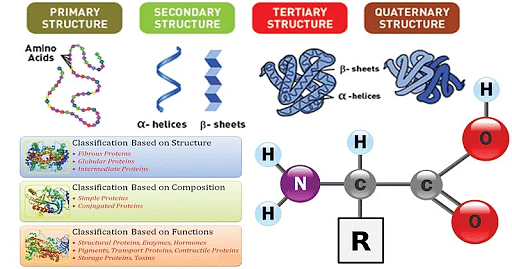
Classification of Proteins
Functions of Protein
[Click Here for Sample Questions]
Proteins are used in many ways. Some of their functions are:
- Enzymes: Most of the important chemical reactions which take place inside a cell are mostly carried out by enzymes. They also play a role in regenerating and creating DNA molecules and carrying out complex processes.
- Hormonal Regulation: Proteins create various types of hormones that help in balancing the components of the body. For example, hormones like insulin help in regulating blood sugar and secretin. The formation of digestive juices essential for the whole digestion process is also possible because of hormones.
- Protection: Being the main constituent of antibodies, proteins protect our body against antigens and pathogens thus preventing infections.
- Energy: Proteins are one the most essential sources of energy required for our body movements. The right amount of proteins should be consumed so that they can be turned into energy.
- Structural functions: Proteins are the building blocks of the body. They are required for the growth, development, healing, and repair of tissues. Proteins are essential in order to strengthen various structures like hair, skin, and muscles. It is also present in the outer membrane of all cells in the human body.

Functions of Proteins
Things to Remember
- Proteins are an essential macronutrient present in all living organisms.
- Proteins are made up of linear chains of smaller units called amino acids.
- The structure of proteins is divided into four types: Primary, Secondary, Tertiary, and Quaternary.
- Protein synthesis is an essential biological process that takes place in the cytoplasm of a cell.
- The translation is a process by which protein synthesis takes place.
- Proteins are classified on the basis of their shape, constitution, and nature of molecules.
- Most of the important chemical reactions which take place inside a cell are mostly carried out by enzymes.
Sample Questions
Ques. How are amino acids linked to form a peptide chain? (2 marks)
Ans. Amino acids come together to form a peptide chain. This peptide bond is formed by dehydration where the carboxyl group of one amino acid and the amino group of adjacent amino acid come together.
Ques. What is meant by the tertiary structure of proteins? (2 marks)
Ans. It is a structure of proteins where many amino acid units form polypeptides. The tertiary structure is characterized by the arrangement of proteins into loops and bends. The tertiary structure contains hydrogen, ionic, and disulfide bonds.
Ques. List any three functions of proteins. (3 marks)
Ans. Proteins are mainly used as:
- Enzymes: Most of the important chemical reactions which take place inside a cell are mostly carried out by enzymes. They also play a role in regenerating and creating DNA molecules and carrying out complex processes.
- Protection: Being the main constituent of antibodies, proteins protect our body against antigens and pathogens thus preventing infections.
- Energy: Proteins are one the most essential sources of energy required for our body movements. The right amount of proteins should be consumed so that they can be turned into energy.
Ques. Describe any two forms of lipid. (3 marks)
Ans. Lipids are hydrocarbon-containing molecules stored in the adipose tissue of the body. The various forms of lipid are:
- Simple lipids: These are the esters of fatty acids with alcohol. These can be divided into fats and waxes.
- Compound lipids: These are the compounds that contain simple lipids and prosthetic (other additional) groups. They are further divided into:
(i) Glycerophospholipids
(ii) Sphingolipids
(iii) Glycolipids
Ques. Classify proteins on the basis of their shape. (5 marks)
Ans. On the basis of shape, proteins can be classified into two types:
Fibrous Proteins:
- Usually long and elongated in structure, fibrous proteins help in maintaining and giving shape to the cell.
- They are insoluble in water and are less sensitive to factors such as changes in temperature and pH.
- Examples include keratin, collagen, elastin, and fibrin.
Globular Proteins:
- Typically spherical in shape. they are responsible for carrying out specific biological functions in the body.
- They are soluble in water and are more sensitive to temperature and pH.
- Examples include hemoglobin, myoglobin, insulin, enzymes.
Ques. What are the different types of conjugated proteins? (5 marks)
Ans. Conjugated Proteins: These are combinations of complex proteins and non–amino acid substances called a prosthetic group. These are of the following types:
- Nucleoproteins: Combination of protein and nucleic acid
- Mucoproteins: Combination of proteins and carbohydrates
- Glycoproteins: Combination of proteins and carbohydrates
- Chromoproteins: Combination of proteins and colored pigments.
- Lipoproteins: Combination of proteins and lipids.
- Metalloprotein: Combination of proteins and metal ions.
- Phosphoprotein: Combination of proteins and phosphate group.
Check-Out:



Comments