



Education Journalist | Study Abroad Lead
Pure Substances and Mixtures are classifications of matter. Everything on this planet is a form of matter, which is defined as any substance that occupies space and has mass. Pure substances are defined as those substances that are made up of only one kind of particle whereas an impure substance that consists of different kinds of elements combined physically and not chemically are called mixtures. Homogeneous and heterogeneous mixtures are the two types of mixtures. Pure substances, on the other hand, may be classified into elements and compounds.
| Table of Contents |
Key Terms: Pure Substances, Mixtures, Matter, Chemicals, Elements, Compounds, Homogeneous Mixtures, Heterogeneous Mixtures, Boiling Point, Melting Point
What are Pure Substances?
[Click Here for Sample Questions]
Pure substances can be simply defined as those substances that include just one type of particle and have a stable or consistent structure.
Elements and compounds are subcategories of pure substances. A material made up of only one kind or sort of atom is referred to as an element. An element is a pure material since it cannot be broken down or changed into a different substance by physical or chemical methods. The most common elements are metals, non-metals, and metalloids. Compounds, on the other hand, are pure substances formed by the chemical combination of two or more elements in a predetermined ratio. Chemical procedures, on the other hand, may break these compounds down into individual components.
Examples of Pure Substances: Lead (Pb) and oxygen (O2) are examples of pure elements, while water (H2O) and ammonia are examples of compounds (NH3).
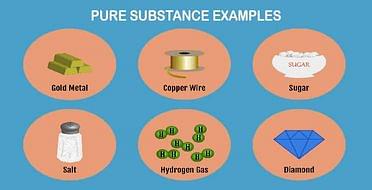
Pure Substances
Properties of Pure Substances
[Click Here for Sample Questions]
- In nature, most pure substances are homogenous, possessing just one kind of atom or molecule.
- Most of these compounds have a consistent or homogeneous composition throughout.
- The boiling and melting points of the pure substances are constant or fixed.
- In most cases, a pure material participates in a chemical process to produce predictable results.
Properties of compounds and elements are as follows-
| Compounds | Elements |
|---|---|
| It is homogenous in nature since it is made up of the same sorts of molecules. | It is a pure material that is made up of only one type of element and is homogenous in nature. Iron, sulphur, and aluminium are examples. |
| The components of molecules cannot be separated by physical means, but they can be separated by different chemical and electrochemical processes. | They are incapable of being broken down into simpler compounds by physical or chemical mechanisms like heat, electricity, or chemical reactions with other molecules. |
| Fixed compositions make up a compound. A compound has its own specific quality that is separate from the properties of its constituents. | The smallest unit of an element, an atom, is responsible for all of the element's characteristics. |
| The melting and boiling points of a compound are both quite high. | The boiling and melting points of elements are quite high. |
Read More:
What are Mixtures?
[Click Here for Sample Questions]
A material, on the other hand, is impure if it is made up of many components that have been mixed physically rather than chemically. Mixtures are another term for impure things. Homogeneous and heterogeneous mixtures are the two types of mixtures.
- A homogeneous mixture, often known as a solution, has a configuration that is relatively consistent. Every component of the combination is identical to the others. For example, if you liquefy sugar in water and thoroughly mix it, the result is practically the same no matter where you taste it. There are two or more chemical compounds in this combination.

Homogenous Mixture
- A heterogeneous mixture is a mixture whose composition changes from place to place within a sample. If you put a small bit of sugar in a jar, add some sand, and then shake the jar a few times, your mixture will not have the same configuration throughout the jar. These mixes may be clearly recognised and physically separated with ease.

Heterogeneous Mixture
Examples of Mixtures: Solution of Water and Oil, Sand and Water, Air
Read More: Types of Solutions: Homogeneous, Heterogeneous and Others
Properties of Mixtures
[Click Here for Sample Questions]
- It has no distinctive characteristics; rather, the properties of the mixture are a product of the average attributes of all of its elements.
- It develops as a result of a bodily alteration.
- They are present in a variety of shapes and sizes.
- They have different melting and boiling points.
Differences between Pure Substances and Mixtures
[Click Here for Sample Questions]
The main distinctions between pure substances and mixtures are as follows:
| Pure Substances | Mixtures |
|---|---|
| A single element makes up pure substances. | A mixture consists of two or more substances or components. |
| They have distinct physical and chemical characteristics. | The physical and chemical qualities of mixtures differ. |
| It can't be dismantled or divided into new items. | It may be separated using a variety of processes. |
Read More: Physical and Chemical Classification Of Matter
Things to Remember
- Pure substances and mixtures are the two major categories in which matter may be categorised.
- The composition and characteristics of pure substances remain consistent throughout the sample. Pure substances are made up of only one element or a few compounds.
- Compounds are compounds that include many types of atoms. The simplest substances are elements, which are made up of only one sort of atom.
- Mixtures are made up of many distinct compounds. Homogeneous and heterogeneous mixtures are the two major types of the same.
- Homogeneous mixes are made up of two or more compounds (or components) that cannot be distinguished visually. Heterogeneous mixes, on the other hand, are mixtures of two or more visibly identifiable substances (or components).
Sample Questions
Ques. List the distinctions between that mixture and pure substances? (3 marks)
Ans. The distinctions between a mixture and pure substances are as follows:
- A pure substance cannot be broken down or separated into new products whereas a mixture can be separated using different separation methods.
- A pure substance has constant or fixed physical and chemical properties whereas mixtures have varying physical and chemical properties.
- Pure substances are composed of a single element, on the other hand, a mixture is a combination of two substances or elements.
Ques. Explain the meaning of the term "pure substance." Is it true that pure substances have a high melting point? What makes this different from a mixture? (3 marks)
Ans. The term "pure substance" refers to a material that includes only one ingredient or compound. They have a high melting point because they only contain one element or compound. Because mixtures are made up of different elements or compounds, they melt at different temperatures.
Ques. What is the difference between evaporation and condensation? (3 marks)
Ans. Evaporation is the conversion of a liquid to a gas when it reaches its boiling point. Condensation is the conversion of a gas to a liquid when it cools. The processes of evaporation and condensation can be employed separately or in combination to separate mixtures.
Ques. (a) What kind of matter is wood? (2 marks)
(b) Why is coffee classified as a mixture rather than a pure substance?
Ans. (a) It's a combination since it's made up of components like carbon, hydrogen, and oxygen in molecules like cellulose, hemicellulose, and lignin. Wood is not a pure substance.
(b) Coffee is made up of many ingredients. It includes water, caffeine, and a variety of compounds derived from the coffee bean, all of which contribute to the flavour or taste. Even though it isn't a pure material, it is a homogenous mixture since the composition is consistent throughout.
Ques. List some examples of mixtures. (3 marks)
Ans. Some examples of mixtures are as follows:
- A gas-gas Mixture such as nitrogen and oxygen in the atmosphere.
- A liquid-liquid mixture like water and oil.
- A gas-liquid mixture such as water.
- A solid-liquid mixture such as sand and water.
Ques. (a) Determine if the following mixtures are heterogeneous or homogenous. Wood, air, dirt, vinegar, filtered tea, soda water. (3 marks)
(b) Is sugar syrup a solution or a mixture?
Ans. (a) Homogeneous mixes include soda water, air, and vinegar. Wood, dirt, and filtered tea are examples of heterogeneous mixtures
(b) The sugar is diluted with water, resulting in a liquid-solid combination. Sugar serves as a solute, whereas water serves as a solvent. Hence, sugar syrup is a solution.
Ques. List down the properties of pure substances. (3 marks)
Ans. A pure substance is defined as a substance that consists of a single kind of matter which cannot be separated into other kinds of matter through any physical means.
- They have a definite and constant composition.
- Pure substances are homogeneous, i.e., their composition is uniform.
- Pure substances can be further classified into both elements and compounds.



Comments