



Content Writer
A suspension is a heterogeneous mixture of particles mixed in a solution but still visible to the naked eye. Its diameter ranges around 1000 nm. All the components are completely mixed, and all the particles can be seen under a microscope in such a mixture.
- Suspension is a type of mixture that contains solid particles.
- The particles are sufficiently large for sedimentation.
- The particles are left floating freely in the mixture.
- Suspended particles are also known as particulates in the atmosphere.
- It is quite unstable from the thermodynamic point of view.
- Consider a solvent (let it be water) and mix a solute (let it be flour).
- Mix it thoroughly and check the mixture.
- The mixture is not mixed completely.
- After some time, it gets settled down at the bottom of the jar containing the solution.
Read More: Filtration
Key Terms: Suspension, Colloids, Solution, Tyndall Effect, Mixture, Sedimentation, Particles, Hetergenous Mixture, Thermodynamic, Solute, Solvent
What is Suspension?
[Click Here for Sample Questions]
A suspension is defined as a heterogeneous mixture in which the solid particles are spread throughout the liquid without dissolving in it. It is a heterogeneous mixture of several particles mixed in a solution that ranges around 1000 nanometers.
- Suspension can be viewed under a microscope and by the naked eye as well.
- Furthermore, it is a mixture of solid particles of sufficient size, which can also undergo sedimentation.
- The classification is done on the basis of dispersed phase and dispersed medium.
- The dispersed phase is solid in nature.
- Dispersed Medium can be either a solid, a liquid, or a gas.
- High-shear mixing technology is based on the concept of suspension.

Properties of Suspension
The properties of suspension are as follows:
- Suspension is a heterogeneous mixture of solid particles.
- The particles can be seen with the naked eye.
- The diametric range is around 1000 nm, which is about 100 times that of a solution.
- A suspension mixture shows the Tyndall effect.
- It can scatter a beam of light when passed through it.
- Suspension are said to be unstable, as they settle down after a while.
- In an unstable state, the suspension does not show the Tyndall effect.
- The particles of a suspension are separated using the filtration process.
Read More: Tyndall effect
Examples of SuspensionSome of the practical examples of suspension are as follows:
|
Read More:
What is a Solution?
[Click Here for Sample Questions]
A solution is referred to as a homogeneous mixture of two or more substances. It obtains a solute as well as a solvent as its components. The solvent is the component of the solution that dissolves the other component, whereas the other component that gets dissolved in the solvent is called the solute.
- Usually, in a solution, solute is present in a lesser amount than solvent.
- The solution does not scatter a beam of light.
- It is based on the level of concentration of a mixture.
- Concentration involves the measurement of solute in a solution.
- The mixing process of solution is based on the chemical polarity.

Properties of Solution
The properties of the solution are as follows:
- The solution is a homogeneous mixture.
- The size of the particles in any solution is less than 1 nm in diameter.
- Particles of the solution cannot be seen by the naked eye.
- It cannot be separated by simple physical methods of separation like filtration.
- The solution is made of only one phase.
Examples of SolutionWe encounter many examples of solutions in your day-to-day life. A few examples of solutions are listed below:
|
Read More: Pure Substances and Mixtures
What are Colloid?
[Click Here for Sample Questions]
A colloid is a homogeneous mixture or a solution within which the constituent particles are spread uniformly throughout. It exists somewhere between a suspension and a solution. The Colloid is barely noticeable to the naked eye. Its size is somewhere between 2 nanometers to 1000 nanometers.
- Using the Tyndall effect, they can be distinguished from the solutions.
- The particles existing in a colloid are known as colloidal particles.
- The mixture, therefore, formed is called a colloidal dispersion.
- All the three states of matter combine to form a colloidal dispersion.
Read More:
Properties of a Colloid
The properties of colloids are given below–
- A colloid is considered to be a heterogeneous mixture.
- The particles can not be seen by the naked eye and are stable mixtures.
- In colloids, dispersed phase particles have a diameter between 1 – 100 nm approximately.
- It displays the Tyndall effect.
- Dispersed phase and dispersion medium cannot be separated by filtration in colloids.
- Dispersed particles show Brownian movement in colloids.

Examples of a ColloidThe various examples of colloid are as follows: AerosolsIt’s a mixture of solid or liquid with gas. For example fog. SolsIt’s a mixture of solid with a liquid example: Paint. EmulsionIt’s a mixture of liquid with liquid. For example Oil in water. GelIt’s a mixture of liquid in solid. For example Jelly. |
Read more: Nomenclature of Alcohols, Phemola and Ethers
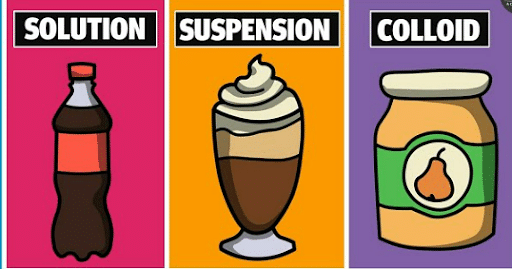
Difference between Suspension, Colloids and Solution
[Click Here for Sample Questions]
The difference between Suspension, Colloids and Solution are as follows:
| Property | Suspension | Colloids | Solution |
|---|---|---|---|
| Particle size | More than 100 nm | Between 1 to 100 nm | Less than 100 nm |
| homogeneous/ heterogeneous | Homogeneous | Homogeneous | Homogeneous |
| Tyndall Effect | Shows | Shows | Shows |
| Appearance | Opaque | Transparent | Transparent |
| Settling of particles | Settles on their own | Settle on centrifugation | Do not settle |
| Stability | Unstable | Stable | Stable |
Read More: Classification of Colloids
Things to Remember
- Suspension is a heterogeneous mixture that has particles of around 1000 nanometers.
- It can scatter a beam of light and hence shows the Tyndall effect.
- Suspension is quite unstable and settles after a while.
- A colloid is a homogeneous mixture within which the particles are spread equally.
- All three states of matter, solid, liquid and gas, combine to form a colloidal dispersion.
Read More:
Sample Questions
Ques: What is a suspension? (2 marks)
Ans: Suspension is defined as a heterogeneous mixture in which the solid particles are spread throughout the liquid without dissolving. It is a type of heterogeneous mixture of particles mixed in a solution that ranges around 1000 nanometers. It is in such a form that it can be viewed under a microscope and by the naked eye as well. Furthermore, it is a mixture of solid particles of sufficient size, which can also undergo sedimentation.
Ques: Discuss the Tyndall effect? (3 marks)
Ans: Consider a solution or a suspension, pass a beam of light through the solution or the suspension. It directly and smoothly passes through it. This entire process of the beam's light passing smoothly through the solution or the suspension is known as the Tyndall effect. It is similar to Rayleigh scattering experiment. The concept is named after physicist John Tyndall.
Ques: State any five properties of a suspension? (5 marks)
Ans: A suspension shows the following properties:
- It is a heterogeneous mixture.
- It shows the Tyndall effect as a beam of light passes through it uninterruptedly.
- It consists of particles easily visible through a microscope or the naked eye.
- The range of the particles of a suspension is around 1000 nanometers.
- A suspension is said to be unstable, and it settles down after a while if left untreated or untouched.
Ques: Give a few examples of suspension? (4 marks)
Ans: Some examples of suspension are:
- A mixture of chalk and water.
- A mixture of sand and water.
- A mixture of flour and water.
- Slaked lime is used for whitewash.
Ques: Discuss colloids with examples? (5 marks)
Ans: A colloid is a homogeneous mixture in which the constituent particles are spread equally all over the solution. It's an intermediate of both a solution and a suspension.
Some examples of colloids are:
- Gel- for example, jelly
- Sols– for example, paint
- Aerosols– for example, fog
- An emulsion– for example, Oil in water.
Ques: Highlight the difference between a suspension and a colloid? (5 marks)
Ans: The main differences between suspensions and colloids are as follows:
| Serial number | Suspension | Colloid |
|---|---|---|
| 1. | It is a heterogeneous mixture. | It is a homogeneous mixture. |
| 2. | It is unstable as it settles down after some period of time if left untreated. | It is stable as it does not settle down after any period of time. |
| 3. | The particles in it have a diameter of around 1000 nanometers. | The particles in it have a diameter ranging between 1-1000 nanometers. |
| 4. | It demonstrates the Tyndall effect. | It does not demonstrate the Tyndall effect. |
| 5. | It is easily evident through a microscope or with naked eyes as well. | It is not evident to naked eyes. |
Ques: “Suspension shows Tyndall effect.” Discuss? (2 marks)
Ans: It is said that a suspension shows the Tyndall effect, which means it is capable of scattering a beam of light if passed through it. The scattering is due to the large size of the suspension particles, which range around 1000 nanometers. It is unstable as it settles down after some period of time if left untreated.
Ques: What is meant by the solution? Mention a few examples of solutions? (4 marks)
Ans: A solution is referred to as a homogeneous mixture of two or more substances. A solution obtains a solute as well as a solvent as its components. The solvent is the component of the solution that dissolves the other component, whereas the other component that gets dissolved in the solvent is called the solute. Usually, in a solution, solute is present in a lesser amount than solvent.
A few examples of solutions are listed below:
- A mixture of sugar and water.
- Tincture of iodine (solution of iodine in alcohol)
- Soda water
- Air (a homogeneous solution of various gases)
- Alloys (Mixture of two or more metals or a metal and a nonmetal that cannot be separated by physical methods. For instance, brass and Stainless steel.)
Ques: What does colloid mean? (3 marks)
Ans: A colloid is a homogeneous mixture or a solution within which the constituent particles are spread uniformly throughout. It exists somewhere between a suspension and a solution. It is barely noticeable to the naked eye.
- Its size is somewhere between 2 nanometers to 1000 nanometers.
- Using the Tyndall effect, they can be distinguished from the solutions.
- The particles existing in a colloid are known as colloidal particles.
- The mixture, therefore, formed is called a colloidal dispersion.
- All three states of matter combine to form a colloidal dispersion.
Ques: What are the properties of colloids? (5 marks)
Ans: Properties of Colloids are given below–
- A colloid is considered to be a heterogeneous mixture.
- Particles of colloids can not be seen by the naked eye.
- In colloids, dispersed phase particles have a diameter between 1 – 100 nm approximately.
- They display the Tyndall effect.
- Dispersed particles do not settle down when left undisturbed in colloids.
- Colloids are stable mixtures.
- Moreover, the dispersed phase and dispersion medium cannot be separated by colloid filtration.
- Additionally, dispersed particles show Brownian movement in colloids.
Ques: Give examples of colloid on the basis of dispersed phase and dispersed medium? (4 marks)
Ans: Various examples of colloid on the basis of dispersed phase and dispersed medium are as follows:
| Dispersed Phase | Dispersed Medium | Examples | Type |
|---|---|---|---|
| Liquid | Gas | Fog | Aerosol |
| Gas | Liquid | Shaving Cream | Foam |
| Gas | Liquid | Smoke | Aerosol |
| Liquid | Liquid | Milk | Emulsion |
| Solid | Solid | Gemstone | Solid Sol |
| Liquid | Solid | Cheese | Gel |
Ques: What is the difference between colloid and solution? (5 marks)
Ans: The difference between colloid and solution are as follows:
| Property | Colloids | Solution |
|---|---|---|
| Particle size | Between 1 to 100 nm | Less than 100 nm |
| homogeneous/ heterogeneous | Homogeneous | Homogeneous |
| Tyndall Effect | Shows | Shows |
| Appearance | Transparent | Transparent |
| Settling of particles | Settle on centrifugation | Do not settle |
| Stability | Stable | Stable |
Ques: Explain the term solubility? (2 marks)
Ans: Solubility is defined as the amount of substance that can dissolve a solvent in it. It is usually expressed in terms of grams of solute per litre of solvent. The solubility of a solution depends upon the solubility product. Solubility product depends upon the temperature. Higher value of solubility product indicates a greater value of solubility. The solubility of a solution varies from liquid to liquid, solids in liquids and gases in liquids.
Ques: What is the difference between concentrated solution and diluted solution? (3 marks)
Ans: The difference between concentrated solution and diluted solution are as follows:
| Concentrated Solution | Diluted Solution |
|---|---|
| Concentrated Solution is a type of solution in which large amount of solute is dissolved in small amount of solvent. | Diluted Solution is a type of solution in which small amount of solute is dissolved in large amount of solvent. |
| It can be converted into a diluted solution by adding more solvent. | It can be converted into a concentrated solution by adding more solute. |
| For example: Concentrated Hydrochloric Acid | For example: vinegar |
Check-Out:



Comments