



Exams Prep Master
Electrochemistry is one of the main branches of physical chemistry and this is the study of chemical reactions and electrical energy or electrochemical reactions. It is a study of the production of electricity from the energy released during spontaneous chemical reactions. This process is called electrochemical reactions. The chemical reactions can take place like this: Mass production of electrical energy can happen by using a chemical reaction. In the same way, electrical energy acts as a carrier to produce chemical energy. In a simple way, electrochemistry is the research study of the interconversion of chemical energy and electrical energy. The electrochemical cell is one of the most important parts of the study of electrochemistry. Here we learn about the cells, galvanic, electrolytic cells, electrode potential and more about their applications.
| Table of Content |
Key Terms: Electrochemical reactions, cells, electricity, energy, electride, cathode, electrode
Electrochemical Cell
[Click Here for Sample Questions]
An Electrochemical cell is a mechanism that transforms chemical energy into electrical energy, or electrical energy into chemical energy. A spontaneous reaction in electrochemistry is the output of the conversion of chemical energy into electrical energy and this is also known as a redox reaction. The chemical reaction of the conversion of the chemical energy production in the redox reaction:
Zn(s) + Cu2+(aq) → Zn2+(aq) + Cu(s)
In an electrochemical cell, the Gibbs energy of the spontaneous redox reaction is converted into electrical energy which can be used for running a motor or other electrical gadgets like heater, fan, geyser, etc.
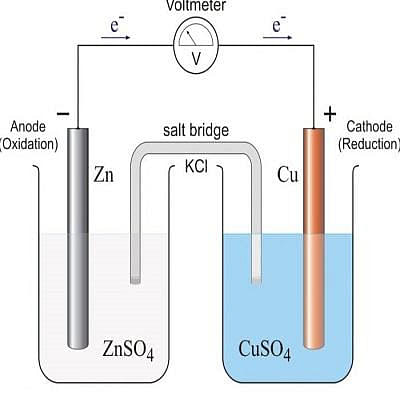
Electrochemical Cell
Use of Electrochemical Cells
[Click Here for Sample Questions]
- Electrochemical cells are used to power many electrical appliances such as TV, remotes, etc
- Electrochemical cells are used to electroplate metals, recharge batteries, and separate compounds like water.
- Electrochemical cells are used in the making of high-purity zinc, aluminum, and copper involves the use of electrolytic cells.
- The use of electrochemical cells in the electro-winning of non-ferrous metals.
- The main use of electrochemical cells in extracting metallic sodium from molten sodium chloride by placing the latter in an electrolytic cell with an electric current.
Types of Electrochemical Cell
[Click Here for Sample Questions]
There are mainly two types of electrochemical cells:
- Galvanic cells or voltaic cells
- Electrolytic cells
Galvanic Cell
By using chemical reactions galvanic cells can produce electricity. Taking the place of redox reactions in galvanic cells is spontaneous in nature. Oxidation that takes place inside the galvanic cells is called oxidation half-cell and also known as a zinc electrode and in the other half cell in which reduction takes place is also known as reduction half cell and copper electrode. A very important point of Galvanic cells is that oxidation takes place at the negatively charged anode and reduction takes place at the positively charged cathode.

Galvanic Cell
This reaction of oxidation and reduction can be represented like this and the following reaction explains the overall cell reaction:
Reduction half-reaction
Cu2+ + 2e– → Cu(s)
Oxidation half-reaction
Zn(s) → Zn2+ + 2e–
Electrolytic Cell
In this electrolytic cell, the conversion of electrical energy into chemical energy takes place. It also works like Galvanic cells which means electrolytic cells also consist of two half cells one is an oxidation half cell and the other is a reduction half cell. Electrolytic cells and galvanic cells both are the same because both of them require a salt bridge, a cathode and anode side and a consistent flow of electrons from the anode to the cathode. In an electrolytic cell, the cathode is -vly charged and the anode is +vly charged.

Electrolytic Cell
This reaction of oxidation and reduction in the electrolytic cell can be represented like this and the following reaction explains the overall cell reaction:
Cu(s) + 2Ag+(aq) → Cu2+(aq) + 2Ag(s)
Reduction half-reaction (Cathode)
2Ag+(aq) + 2e– → 2Ag(s)
Oxidation half-reaction (Anode)
Anode (oxidation): Cu(s) → Cu2+(aq) + 2e–
Difference Between Galvanic Cell and Electrolytic Cell
[Click Here for Sample Questions]
| Galvanic Cell | Electrolytic Cell |
|---|---|
| This is the conversion of chemical energy into electrical energy. | This is the conversion of electrical energy into chemical energy. |
| In a Galvanic cell, the anode is negatively charged and the cathode is positively charged. | In an electrolytic cell, the anode is positively charged and the cathode is negatively charged. |
| Spontaneous reactions occur in Galvanic cells. | Non-spontaneous reactions occur in Electrolytic Cell. |
| The electrons arise from the species that undergoes oxidation. | Electrons arise from an external source like a battery. |
Application of Electrolytic Cell and Galvanic Cell
[Click Here for Sample Questions]
Electrolytic Cell:
- Electrolytic cells are the main factors in the production of hydrogen gas and oxygen gas production by water utilization.
- By Using the electrorefining method the impurities from the metal can be removed.
- To check the purity of heavy metals like copper, zinc, and aluminum and the highest purity level, electrolytic cells are used.
- Electroplating is the most important application of the electrolytic cell. In this process, the protective covering of a specific metal is done on another metal.
Galvanic Cell:
- The use of galvanic cells is in watches, clocks, remote controllers, calculators etc.
- It also can be used in cell phones, cameras, and laptops.
- The use of Galvanic cells is in Fuel cells for engines to power up.
- A galvanic cell can also be used in toys.
Primary Cells
[Click Here for Sample Questions]
The electrochemical reactions which happen in this cell are irreversible in nature. Basically, Primary cells are use-and-throw galvanic cells. In this cell, there is also a lack of fluid and due to this reason, this is called a dry cell.

Primary Cell
Secondary Cells
[Click Here for Sample Questions]
Secondary cells ( rechargeable batteries) are electrochemical cells in which the cell has a reversible reaction, which means the cell can function as a Galvanic cell as well as an Electrolytic cell. It is an interchange reaction in which chemical energy turns into electrical energy and vice versa. It is made of molten salt and water cells.

Secondary Cell
Cell Potential
[Click Here for Sample Questions]
The behavior of an electrode that is in contact with an electrolyte to lose or gain electrons is described by its electrode potential. The values of these potentials can be used to predict the overall cell potential, standard hydrogen electrode is the helping mode to measure electrode potentials.
Things to Remember
- Electrochemistry is a salient part of the broader discipline of Chemistry.
- An electrochemical cell is a mechanism that transforms chemical energy into electrical energy, or electrical energy into chemical energy.
- Electrochemical Cell has two types: 1. Galvanic cells or voltaic cells 2. Electrolytic cells
- A galvanic cell is the Chemical energy that is transformed into electrical energy in these electrochemical cells.
- Electrolytic Cell is the Electrical energy that is transformed into chemical energy in these cells.
Sample Questions
Ques. How are the components of an electrolytic cell defined? (3 marks)
Ans. Actually, there are three components of an electrolytic cell: anode, cathode, and electrolyte.. The Anode is the negatively charged end that has free electrons. The cathode is the positively charged end that has electron deficiency. During Electrolysis, proceed oxidation occurs at the anode end and reduction at the cathode end. Electron movement takes place from anode end to cathode end. Thus, there is the primary component.
Ques. Define an electrolytic solution. (3 marks)
Ans. An electrolytic cell is also a kind of electrochemical cell. In this process, It converts electrical energy into chemical energy and the electrons flow from the anode to the cathode with the help of external sources such as batteries. In the electrolyte solution, only ions can flow, electrons cannot flow.
Ques. Explain an Electrochemical Cell? (2 marks)
Ans. Electrochemical cells are the mechanism that has the capacity to generate electrical energy from chemical reactions or cause chemical reactions by using electrical energy.
Ques. What is the name of the devices that are capable of converting chemical energy into electrical energy, or vice versa.? (1 mark)
Ans. The name of the device which converts chemical energy into electrical or vice versa is electrochemical cell.
Ques. What is the function of an electrolytic cell? (2 marks)
Ans. The function of an electrolytic cell is that it converts electrical energy into chemical energy. In this cell redox reaction is not spontaneous, and electrical energy is required to initiate the reaction.
Ques. What is a half cell? (2 marks)
Ans. The half cell is a metal used to conduct electrons in a cell.
The electrochemical reaction of a Daniell cell may be written as two half-cells. The original equation is:
2H+(aq) + 2e– → H2(g)
The half-cells or half-reactions are:
Zn → Zn2+ + 2e− (for the reaction at the anode or Zn)
Cu2+ + 2e− → Cu (for the reaction at the cathode or Cu)
Ques. How many are the main components of electrochemical cells? (2 marks)
Ans. The main components of electrochemical cells are
- The anode
- The cathode
- External sources
- Salt bridge or porous barrier.
Ques. What is cell potential? Which electrode is denoted by a negative sign? (2 marks)
Ans. The potential difference between the two electrodes is called cell potential. The cathode is denoted by a negative sign.
Ques. Can we stir a CuSO4 aqueous solution with a Zn rod (under standard conditions)? (3 marks)
The reduction potentials of electrodes are given as:
E°Zn2+| Zn = - 0.76 V
E°Cu2+| Cu = 0.34 V
Ans. The Zn2+ | Zn represents the Anode as oxidation is taking place here while the Cu2+ | Cu Canceling represents the Cathode as reduction is taking place here.
⇒ E°cell = E°cathode – E°anode
⇒ E°cell = 0.34 V – (-0.76V)
Therefore, the E°cell is 1.10 V.
1.10 > 0 . Therefore, this reaction will take place so we cannot stir a CuSO4 aqueous solution with the Zn rod.
Related Links:



Comments