



Content Curator
Renal calculi are also known as kidney stones, nephrolithiasis, or urolithiasis. It comprises solid hard stones made up of minerals and salts that form in the body of the kidneys. These kidney stones affect our kidneys till the bladder. As compared to women men can get kidney stones more often.
| Table of Content |
Key Terms: Kidney, Kidney Stones, Urine, Obesity, Lack of Water, Renal Calculi, Minerals
What Are Kidney Stones?
[Click Here for Sample Questions]
Kidney stones are hard stones made up of minerals and salt. It forms when it comes in contact with the normal waste removal system of the kidneys. The normal waste accumulates in the renal calculi. The normal waste accumulates to become more waste, and then the kidneys form such a state that it is not able to pass enough urine. These waste become balls, then balls transform into stones. The stones attract more salts and minerals. Hence, stones are called kidney stones or renal calculi.
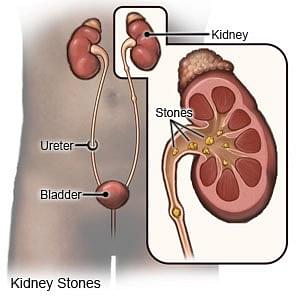
Kidney Stones
Also Check: Biology Study Notes
Symptoms Of Renal Calculi
[Click Here for Sample Questions]
Kidney stones are a mass of piled-up minerals in the kidney. These piled forms of minerals are caused due to either lack or overdose of minerals. The list of symptoms are as follows:
- Brown, red or white urine
- Cloudy urine
- Vomiting
- Nausea
- Chills and fever
- Frequent need to urinate
- Pain in the lower abdomen
- Pain and burning sensation during urination
- Foul smell in urine
- Discharge of blood in urine
- Severe pain in ribs
Risk Factors Of Renal Calculi
[Click Here for Sample Questions]
The risk factors causing kidney stones are:
- Obesity
- Hereditary
- Weight loss surgery
- Drinking too much or too little water
- Certain supplements or medications
- Consuming too much or too little sugar or salt
The above factors affect kidney stones as it increases the number of minerals present in our body.

Kidney Anatomy
Prevention Of Renal Calculi
[Click Here for Sample Questions]
Preventive measures of Renal Calculi are specified below:
| Prevention | Impact on the body |
|---|---|
| Try to drink more water | Drinking more water will fill our body with more blood, preventing excess minerals from entering our body. It also accelerates the amount of urine in our body, ensuring that our body can pass urine at the right time. |
| Limiting soda and soft drinks | Choose a fresh veggie-healthy recipe, which is low in minerals. In addition, eating chocolate is also bad, because it increases the amount of oxalate in the body. |
| Increase intake of citric acid | Drinking orange juice will increase the amount of Vitamin C and urine. |
| Consumption of calcium | Reduces the amount of oxalate being absorbed in our bodies, so stones are less likely to form. |
| Avoid overdose of minerals and vitamins | Overdose of minerals is the prime reason for kidney stones. |
Also Check: Biology MCQs
Cure Of Renal Calculi
[Click Here for Sample Questions]
If you suffer any of the symptoms consult a doctor immediately. Curing kidney stones at the initial stage is risk-free. There are certain tests like blood, urine, and ultrasound conducted to check kidney stones. Doctors prescribe medicines and diet on the basis of the type, size, location, and stage of kidney stones.
One of the best treatments for kidneys is Allopurinol. The treatment is considered to reduce the stone’s recurrences. This drug minimizes the urinary excretion of uric acid.
Drinking lots of water and following a diet can help break down small-sized kidneys.
If the stone is too large and blocks the flow of urine, or there is a sign of infection, then it is removed with surgery. More treatments for kidney stones are lithotripsy, cystoscopy & ureteroscopy, and nephrolithotomy. These treatments are given as per the need of the body.
Types Of Renal Calculi
[Click Here for Sample Questions]
There are two most common types of kidney stones named as
- Calcium Oxalate Monohydrate
Calcium oxalate monohydrate stones are a common and hardest type of kidney stone. It is formed due to high levels of calcium, oxalate, cystine, phosphate, and dehydration in the body.

Calcium Oxalate Monohydrate Stone
- Calcium Oxalate Dihydrate
Calcium oxalate dihydrates are uric acid stones or crystals. These stones can also be hereditary. The formation of calcium oxalate monohydrate is due to the consumption of less amount of water.
Also Check: NCERT Solutions for Class 11 Biology
Things To Remember
- Kidney stones are hard stones made up of minerals and salt. It forms when it comes in contact with the normal waste removal system of the kidneys.
- Kidney stones are a mass of piled-up minerals in the kidney. These piled forms of minerals are caused due to either lack or overdose of minerals.
- Drinking less water can cause kidney stones.
- Men can get kidney stones more often as compared to women.
- The two most common types of kidney stones are calcium oxalate monohydrate and calcium oxalate dihydrate.
Sample Questions
Ques. Can kidney stones dissolve? If Yes, then how much time does it take? Explain. (2 Marks)
Ans: Yes, stones in the kidney dissolves depending on the size, type, and location of the stone. A stone larger than 4mm will take three to six weeks to dissolve. When stonen reaches the bladder, it takes stones a few days to pass by.
Ques. What is the common age for renal calculi to occur? (1 Mark)
Ans: Common age for renal calculi is mostly between 20 and 50 years, as people of that age group consume a lot of chemicals during that time, however, kidney stones are found in 5-year-old children.
Ques. Is renal calculi a curable disease? (1 Mark)
Ans: Yes. Renal calculi or kidney stones a curable disease. Most of the time stones are treated without any treatment or surgery. However, stones pass by or dissolve within three to six weeks. The only required treatment is pain. Sometimes pains are unbearable and patients need high doses of painkillers.
Ques. What are the symptoms of kidney stones? (3 Marks)
Ans: Symptoms of kidney stones are as follows:
- Brown, red or white urine
- Cloudy urine
- Vomiting
- Nausea
- Chills and fever
- Frequent need to urinate
- Pain in the lower abdomen
- Pain and burning sensation during urination
- Foul smell in urine
- Discharge of blood in urine
- Severe pain in ribs
Ques. What are renal calculi? (2 Marks)
Ans: Renal calculi, more commonly known as kidney stones, is a solid hard stone made up of minerals, salts, and other chemicals present in the kidney. Too much waste in liquid end up forming crystals, and these crystals attract other elements and hence stone is formed. This stone made up of minerals, salts, and other chemicals is termed renal calculi or kidney stones.
Ques. What are the most common components of renal calculi? Which renal calculi is mostly found in India? (2 Marks)
Ans: The most common renal calculi is a calcium component named urate crystals. In India, calcium oxalate is most commonly found in kidney stones.
Ques. Do children get kidney stones? (2 Marks)
Ans: Yes, Kidney stones are found in children from the age of 5 years. This problem is common in children. Some hospitals conduct ‘stone' clinics for pediatric patients. The reason behind this is not drinking enough fluids and eating foods that are high in salt.
Kids should eat less salty foods like sandwich meats; canned soups; packaged meals; and even sports drinks. Sodas can also increase the risk of stones due to the high sucrose content.
In some kids overweight is also a common cause of kidney stones.
Ques. Are there any long-term consequences of having a kidney stone? (2 Marks)
Ans: Kidney stones or renal calculi increase the risk of chronic kidney disease. If an individual has had a stone, they are at risk of having another stone within. The probability of having another stone is 50%.
Ques. What causes kidney stones to form? (2 Marks)
Ans: Kidney stones are mainly formed due to the following reasons:
- Either too much or too little exercise
- Consumption of too much salt and sugar
- Less water consumption
- Hereditary
- Infections or medications
Ques. How is a large-sized kidney stone is treated? List a few kidney stone treatments. (2 Marks)
Ans: If the stone is too large and blocks the flow of urine, or there is a sign of infection, then it is removed with surgery. More treatments for kidney stones are lithotripsy, cystoscopy & ureteroscopy, and nephrolithotomy. These treatments are given as per the need of the body.
Also Check:
Also Check:
| Biology Study Material | ||
|---|---|---|
| NCERT Solutions for Class 6 to 12 | CBSE Class 11 Biology Sample Paper | NCERT Class 11 Biology Syllabus |



Comments