



Content Curator
Urethra is a thin tube or a duct present inside our body that transports urine from the kidney to the bladder. Urine is transported from the bladder to the outside of the body through the urethra during urination. The anatomy of the urethra in males and females is different.
- The male urethra, which is between 18 and 20 cm in length, travels the distance of the penis before emptying.
- The entrance of the female urethra is located between the labia and is lodged into the vaginal wall.
- The female urethra is just 4 cm in length, substantially shorter than the male.
- Female urethra starts at the bladder neck and exits via the urethral sphincter right before opening to the outside.
The urethral sphincter is a muscular organ that helps hold urine inside the bladder before voiding can take place, and keeps the urethra closed.
| Table of Content |
Key Terms: Urethra, Male Urethra, Female Urethra, Urinary Bladder, Urine, Urethral Sphincter, Penis, Urethral Cancer, Urinary Meatus
Urethra Anatomy
[Click Here for Sample Questions]
Urethra is a hollow tube that lets urine leave our body. The urethra connects the urinary bladder to the urinary meatus for the removal of urine from the body of both females and males. Urethra is structurally connected to the reproductive organs, hence the anatomy of the male urethra is very different from those of the female urethra.
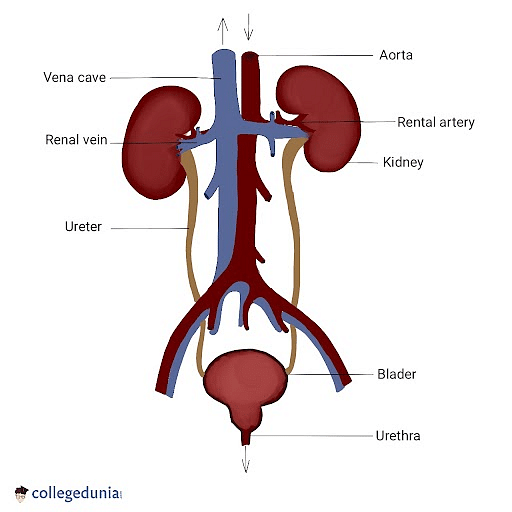
Human Excretory System
Male Urethra
A male's urethra is separated into four sections.
- Pre-prostatic urethra is the intramural portion of the male urethra that the urethral sphincter encloses.
- Its length varies between 0.5 and 1.5 cm depending on how full the bladder is.
- The prostatic urethra is the next component that begins in the bladder neck and is situated in the prostate.
- It is the broadest portion of the urethra, and a sphincter muscle surrounds it, holding the urine until the proper time.
- The bottom part of the urethra, which has various divisions like the bulbous and penile urethra, is made up of the spongy urethra.
- The longest portion of the urethra, the penile urethra, extends from the urogenital diaphragm to the apex of the penis.
- Every area of the male urethra has a supply of arteries that help blood flow.
- The inferior vesical artery is used by the prostatic urethra.
- The artery near the bulb of the penis is used by the membranous urethra.
- The pudendal artery, which is located deep in the pelvis, is used by the spongy urethra.
Read More:
| Relevant Concepts | ||
|---|---|---|
| Excretion in Human Beings | Excretory Products and their Elimination | Excretion in Plants |
| Role of Other Organs in Excretion | Difference Between Secretion and Excretion | Ammonotelism |
Female Urethra
Female Urethra anatomy is much simpler than that of males.
- Female urethra is less complex because it travels a shorter distance.
- It begins from the bladder and runs parallel to the floor of the pelvis.
- After going past the sphincter muscle, it opens onto the perineum.
- Three layers namely muscular, erectile, and mucous make up the female urethra.
- Female urethra measures approximately 4 centimeters in length.
- It stretches from the internal to the exterior urethral opening and is located between the clitoris and the vagina.
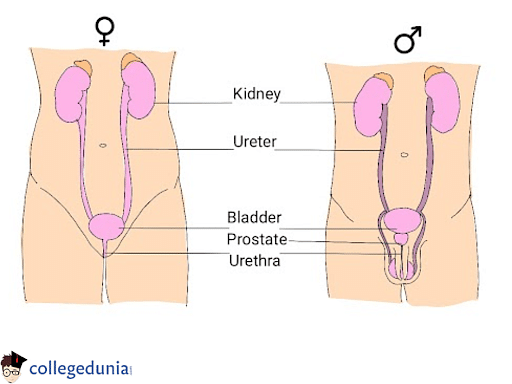
Male and Female Urethra
Read More: Male and Female Reproductive Organs
Anatomical Variations in Male and Female Urethra
[Click Here for Previous Year Questions]
Some people's urethras have congenital issues that prevent them from performing their normal tasks.
- A disorder known as hypospadias can occur in men when the urethra opening is not at the apex of the penis.
- During early childhood or infancy, it needs to be surgically rectified.
- Sometimes the urethra is shorter than the ideal length, and other times the urethral stricture may be blocked.
- The infection of the urethra, which causes purulent urethral discharge, is one of the organ's additional disorders.
- Cancer can also grow along the urethral walls.
Read More: Human Reproduction MCQs
Facts about Human Urethra
[Click Here for Sample Questions]
Here are some important facts about the Human Urethra:
- The length of the urethra differs between the sexes.
- The female urethra typically measures 4 to 5 cm in length, but the male urethra can measure 20 cm or more.
- The female urethra's main function is to make urinating easier.
- The male urethra, on the other hand, is in charge of urine and ejaculation.
- The striated muscle known as the external urethral sphincter is responsible for the voluntary regulation of urination.
- Only one or two persons with cancer have urethral cancer, which is an uncommon cancer form.
- Adenocarcinoma, transitional cell carcinoma, and squamous cell carcinoma are a few examples of the several forms of urethral cancer.
Read More: Excretory Products & their Elimination Important Questions
Disorders of Urethra
[Click Here for Previous Year Questions]
Aging, disease, or accident can all contribute to urethral issues.
- Uncommon cancer that affects men more frequently than women is urethral cancer.
- A narrowing of the urethra's opening is referred to as a urethral stricture.
- Urethritis is an infection-related urethral inflammation. Pain or trouble passing pee might be symptoms of urethral issues.
- Different tests are used by doctors to identify urethral issues.
- These consist of urinalyses, radiographs, and a cystoscope examination of the urethra.
- The cause of the issue will determine how it is treated. Medication and, in extreme circumstances, surgery may be part of it.
Also Check:
| Related Topics | ||
|---|---|---|
| Human Reproductive System | Testis | Female Reproductive System |
| Disorders of the Excretory System | Ultrafiltration and Reabsorption | Ovum |
Things to Remember
- Urethra is a duct or thin tube that connects the urinary meatus and bladder so that urine can exit from the human body.
- Male urethra is used for both ejaculation and urine, but the urethra in females is solely used for urination.
- Female urethra measures 4 to 5 cm in length, while the male urethra is around 20 cm or more.
- Urethral sphincter is a muscular organ that helps maintain urine in the bladder and holds the urethra in place.
- The main purpose of the urethra is to allow urine to exit the body from the bladder.
- Urethral Cancer, Urethral Stricture, and Urethritis are some of the diseases associated with the Urethra.
Previous Years’ Questions
- Urethral meatus refers to the…
- Which is the correct pathway for the passage of urine… (COMEDK UGET 2009)
- Urine is expelled from the body through… (Rajasthan PMT 2006)
- Human urine contains… (JIPMER 2018)
- For the formation of 200 sperms, how many…
- The correct sequence of spermatogenetic stages leading… (NEET 2009)
- Which one is not correct…
- Urinary bladder is absent in…
- Urinary Bladder is absent in all birds, except… (UPSEE 2018)
- Presence of air bladder, cycloid scales and terminal mouth… (JIPMER 2016)
Sample Questions
Ques. What is Urethra? (2 Marks)
Ans. Urethra is a tube-like structure that carries urine from the kidney to the bladder. During urination, the urethra carries urine from the bladder to the outside of the body first. A muscle structure called the urethral sphincter helps maintain urine in the bladder until voiding occurs and keeps the urethra tight.
Ques. Is there a difference between the male and female urethra? (2 Marks)
Ans. Yes. Due to the anatomical gender variations in this region, women's urethras are substantially shorter than those of males. As it must travel the entire length of the penis in men, it measures about 20 cm in length, compared to 4 cm in women.
Ques. What is the posterior urethral valve? (3 Marks)
Ans. Boys who are born with extra flaps of tissue that have formed in their urethra, the tube via which urine exits the urinary tract, are said to have urethral valves. The urethra cannot adequately transport urine from the bladder to the penile tip and outside the body because of this additional tissue. The kidneys, ureters, bladder, and urethra of the urinary tract may enlarge or swell when urine cannot be naturally evacuated from the body. The tissues and cells inside such organs could sustain significant harm if this dilatation happens.
Ques. What are Anterior Urethral Valves? (3 Marks)
Ans. The anterior and posterior urethral valves are the two basic varieties of urethral valves. The posterior urethral valve is far more frequent than the anterior urethral valve of two. The degree of blockage in the urethra determines how severe these illnesses are. Similar to posterior urethral valves, anterior urethral valves have symptoms and require similar care.
Ques. Why do posterior urethral valves develop? (5 Marks)
Ans. Because urethral valves are congenital, boys are born with these additional tissue flaps. These abnormalities are thought to arise early in the development of the male foetus and may have a hereditary component, although the exact aetiology is yet unknown. The tissue flaps in the urethra are typically relatively tiny parts of the body.
The body may transmit messages to the tissue during embryonic development instructing it to cease growing or assisting it in shrinking, according to researchers. This signal never gets delivered or picked up in males with posterior or anterior urethral valves, which results in the tissue continuing to expand.
Ques. What is Urethral Sphincter Control? (5 Marks)
Ans. Urethra in both males and females has two sphincter muscles that prevent pee from passing through. The internal urethral sphincter, also known as the IUS, is made up of smooth (involuntary) muscle fibres on the inside and striated muscle fibres on the outside. The detrusor muscle of the bladder continues in the smooth muscular layer.
Through the involuntary control of the sympathetic (fight or flight) nervous system via adrenergic excitatory receptors in the urethra and bladder neck, the EUS is held tight around the urethra. The internal sphincter remains closed as a result of this excitement.
Ques. What is urethral syndrome? (3 Marks)
Ans. The urethra, the tube that connects the bladder to the exterior of the body, is affected by the urethral syndrome. The urethra is in charge of removing urine from the body, as well as semen in those with male genitalia. A urethra that is inflamed or irritated is a symptom of urethral syndrome.
Another name for urethral syndrome is symptomatic abacteriuria. Many of its symptoms are similar to those of urethritis, an infection, and inflammation of the urethra. These signs include frequent, uncomfortable urination and stomach ache. Your urethra becomes irritated by either situation. While a virus or bacteria typically induce urethritis, the exact cause of the urethral condition is frequently unknown.
Ques. What needs to happen for urination to be possible for the external urethral sphincter? (2 Marks)
Ans. The two sphincters of the Urethra maintain continence in the urine
It relaxes to allow urine to pass and surrounds the bladder's entrance to the urethra. The voluntary external sphincter. It must be loosened in order for urination to take place because it surrounds the urethra outside the bladder.
Ques. Are there internal urethral sphincters in females? (3 Marks)
Ans. Both an internal and an exterior sphincter are present in the female urethra. Anatomically speaking, the internal sphincter is more of a functional idea. The muscle that is strengthened by Kegel exercises is the external sphincter. The female urethra is held in place by bulbourethral ligaments beneath the pubic arch.
Ques. What is urethral cancer? (2 Marks)
Ans. Both males and females can acquire cancer along the lining of the urethra which is known as urethral cancer. The presence of blood in the person's urine is one of the usual signs. Chemotherapy is part of the treatment for urethral cancer.
Ques. Describe UTI. (3 Marks)
Ans. Urinary Tract Infection, sometimes known as UTI, is a condition that affects the urethra. The transmission of bacteria from the region around the anus is the primary cause. Due to the shorter urethra in females, UTI is particularly prevalent in this group of people. Depending on the parts of the urinary system that are contaminated, an infection may develop along the upper or lower urinary tract.
Ques. What different components make up a woman's urethra? (3 Marks)
Ans. Female Urethra is located behind the symphysis pubis, which terminates just above the vaginal opening and below the clitoris. The internal sphincter, urethra-vaginal muscle, and external sphincter make up the female urethra. There are two skene glands, or mucous glands, at the tip of the female urethra. They act as an additional barrier that prevents infection.
Check-Out:



Comments