



Content Curator
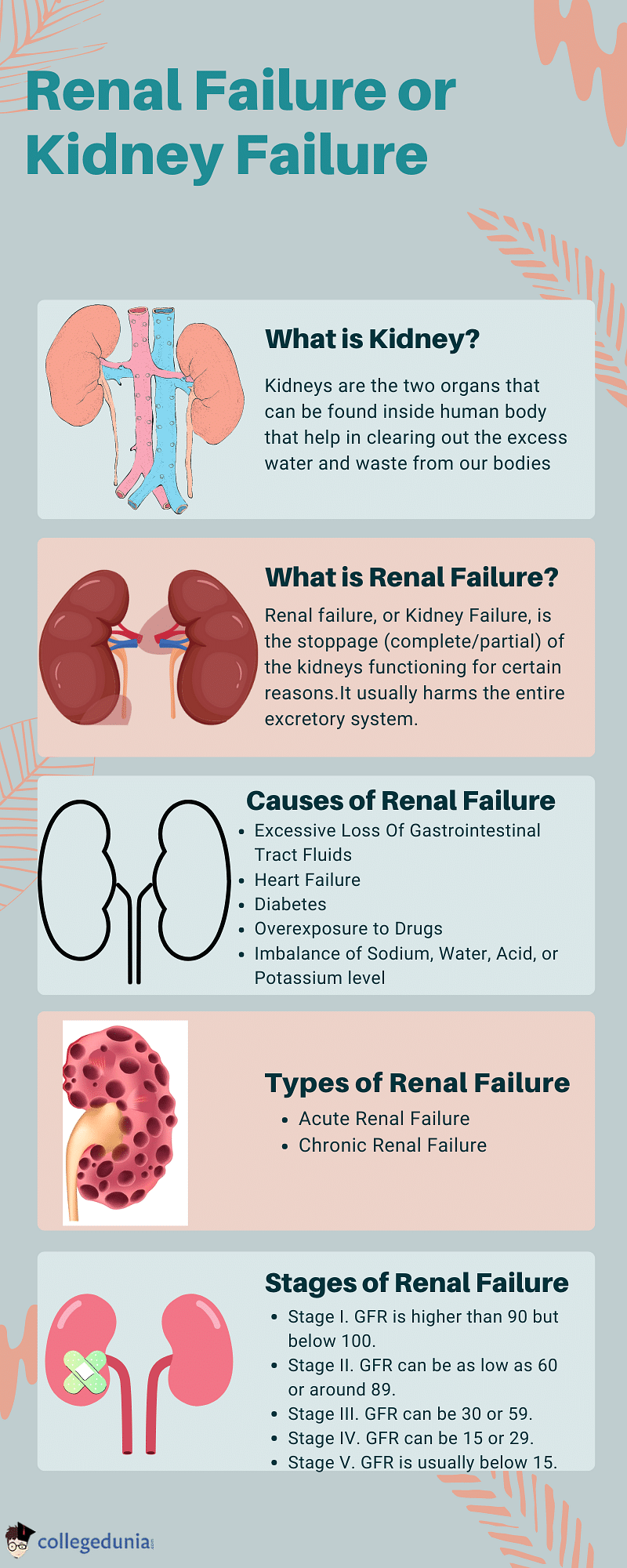
Renal failure (also known as kidney failure) refers to the stoppage (complete/partial) of the kidneys functioning for certain reasons. It typically harms the entire excretory system.
The kidneys helps to filter the blood and remove toxins from it. These toxins are further passed down to the bladder where they are removed during Micturition. However, when the kidneys become unable to remove toxic wastes from the body, it is known as Renal Failure.
- The kidney is the organ in our body that performs the function of excretion.
- Excretion denotes the removal of leftover products from the blood, fluids, and electrolytes.
- Acute or severe renal failure can happen suddenly (for instance, due to an injury) but can be treated and cured.
- Chronic renal failure, however, develops over the years, and can be caused by conditions such as diabetes or high blood pressure.
- Chronic renal failure cannot be cured.
The kidney is prone to different diseases like stone and polycystic kidney disease (a genetic disease due to which cysts may appear in both the kidneys). But, it is important to note that not all diseases will lead to Kidney failure or Renal failure.
Read Also: Difference Between Egestion and Excretion
| Table of Content |
Key Terms: Kidney, Renal Failure, Polycystic Kidney Disease, Cyst, Acute Renal Failure, Chronic Renal Failure, Blood, Nitrogen Waste
What is Renal Failure?
[Click Here for Sample Questions]
Renal failure is the condition in which the kidney fails to remove the end-products of different functions that happen in our body. Today, renal failure is a common condition. In 2017, about 697.5 people had kidney failure, globally. These statistics were said to be increasing at a rate of 29.3%, everywhere.
Kidneys are a pair of two organs which help in clearing the excess water and waste from our bodies. It also help in maintaining a balance of chemicals like calcium, sodium, and potassium in our bodies.

Kidney Diagram
Renal failure or kidney failure is a kind of condition where the kidneys stop functioning properly.
- Renal Failure or Kidney Failure is a condition wherein one or both kidneys stop working on their own.
- Renal Failure is often temporary, and can cure quickly. It is also known as Acute Renal Failure.
- However, Renal Failure can also be long-term, often worsening over time. It is also called Chronic Renal Failure.
- Kidney Failure is typically the most fatal stage of a Kidney Disease.
Causes of Renal Failure
There are several Renal Failure causes. Some include:
- Excessive Loss Of Gastrointestinal Tract Fluids
- Heart Failure
- Lifestyle Diseases like Diabetes
- Overexposure to Drugs and Heavy Metals
- Imbalance of Sodium, Water, Acid, or Potassium level
- High Activation of Vitamin-D
- Autoimmune Kidney Diseases
- Severe Dehydration
- Obstruction of the Urinary Tract
Many other functions that harm our kidneys can cause kidney failure. Renal failure is something that has to be found and treated early. Or else, it may lead to a condition wherein kidney transplantation becomes the only solution.
Read More:
| Topic Related Concepts | ||
|---|---|---|
| Gastric | Circulatory System | Excretion in Human Beings |
| Urine Infection | Kidney Function Test | What are Antibiotics? |
Symptoms of Renal Failure
[Click Here for Previous Year Questions]
Mainly, protein loss and blood loss through urine are considered symptoms of renal failure. But also remember that every kind of blood loss and protein loss (appearance of white foam with urine) doesn't show renal failure. A series of diagnoses by a doctor can alone ensure that. Some of the Kidney Failure symptoms are:
- Extreme exhaustion (or, fatigue).
- Nausea
- Swelling (or, edema), especially around your hands, ankles or face.
- Cramps (muscle spasms).
- Itchy skin.
- Poor appetite.
Renal Failure
Types of Renal Failure
[Click Here for Sample Questions]
There are mainly two types of Renal Failure, which are:
- Acute Renal Failure
- Chronic Renal Failure
What happens when Kidney Failure or Renal Failure starts?There are kidney disease stages as per the estimated glomerular filtration rate (eGFR). The eGFR can be defined as the calculation of how well the kidneys are able to filter substances. Typically, a normal eGFR is almost 100. The lowest eGFR is 0, meaning that there’s no remaining kidney function. The stages of any kidney disease include:
|
Acute Renal Failure
[Click Here for Previous Year Questions]
Acute Renal Failure causes speedy damage to the kidney and causes the whole functioning of the kidney to a poor stage. This leads to the accumulation of wastes that the kidney used to wash off. By this, the level of nitrogen waste and impair fluids increase in blood. This is often seen as a threat to old people and people with serious illnesses. But this can be treated and corrected in the clinic.
Considering the different kinds of effects that acute renal failure makes in a body, it has to be classified as three, namely, Prerenal Failure, Postrenal Failure, and Intrinsic Failure.
Prerenal failure
Prerenal failure is a condition in which the blood flow to the kidney decreases.
- The majority of people who have acute renal failure would have prerenal failure. But this can be easily identified and corrected.
- Prerenal failure is caused by a reduction in the blood flow in the kidney.
- This happens due to the reduction of vascular volume in the kidney.
- Vascular reduction in the kidney is a common issue faced by patients and old people who are asked to consume vasoactive mediators and non-steroidal anti-inflammatory drugs (NSAIDs).
- Here, the GFR of the kidney will reduce and may even fall to zero.
Postrenal failure
Postrenal failure is a rare kind of acute renal failure.
- People with postrenal failure would have difficulty in the delivery of urine.
- The presence of drugs or similar agents in a body would cause postrenal failure.
- The main cause of postrenal failure is an obstruction that happens in the system that dominates the outflow of urine from the kidney.
- Obstruction specifically means the damage that happened to the parts of the kidney, like the urethra, and rarely in the bladder.
- Treatment for nephrons has proved postrenal failure to be completely reversible.
Intrinsic failure
Intrinsic failure or also known as intrarenal failure causes damage to the structure of the kidney.
- Intrinsic Failure is the most commonly found form of acute renal failure, after prerenal failure.
- Intrinsic failure has shown damage made to the structure of the kidney.
- Here, the tubular structure of the kidney will show a toxic presence.
- The density of the toxic presence (ischemia) in the kidney will decide the intensity of the intrinsic renal failure.
- A high level of ischemia will have a severe impact on the patient's health.
Chronic Renal Failure
[Click Here for Sample Questions]
Chronic renal failure is the worst condition of renal failure which has a slow pace and is highly risky.
- It destroys the number of nephrons present in the kidney.
- The glomerular filtration rate is rapidly decreased and a complete shutdown happens in the kidney.
- This has a huge impact on the human body and it becomes hardly possible to survive without dialysis.
Read Also: Neuron Important Notes
Diagnosis of Renal Failure
[Click Here for Previous Year Questions]
The diagonosis of Renal Failure is:
Acute Renal Failure Diagnosis
The diagnosis is easy for acute renal failure. This helps in the complete recovery of acute renal failure by medicines and clinical treatment. Rarely, short-term dialysis would be required. Acute Renal Failure can be diagnosed with:
- Urine output measurements
- Urine tests
- Blood tests
- Imaging tests
- Removing a tissue sample of the kidney for testing
Chronic Renal Failure Diagnosis
But the diagnosis and treatment of chronic renal failure are crucial. The excess nitrogen waste in the blood is a serious symptom of chronic renal failure. Renal inefficiency is conserved with different therapies and dialysis. When the situation becomes worse, renal transplantation would be the final solution for chronic renal failure. Some of the Chronic Renal Failure diagnosis include:
- Urine tests
- Blood tests
- MRI scan
- Ultrasound Scan
- CT Scan
- Kidney Biopsy
Read Also: Hepatitis
Treatment of Renal Failure
[Click Here for Sample Questions]
Some treatment of Renal Failure include:
Preventive Dialysis
One of the approaches to reduce the incidence of nephrotoxicity is associated with radiocontrast dye administration. Typically, it is offered prophylactically to patients at high risk of acute renal failure. Hemofiltration is initiated and then continued for 24 hours post the dye administration has resulted in a significant reduction in mortality and a reduced need for dialysis.
Dopamine and Diuretics
Low doses of dopamine (≤ 2 mcg/kg/min) can potentially increase renal blood flow and is often expected to increase GFR (glomerular filtration rate). Theoretically, it can be considered beneficial, since an enhanced GFR (glomerular filtration rate) can flush nephrotoxins from the tubules, thus helping to reduce the toxicity.
Read Also:
| Chapter-Related Concepts | ||
|---|---|---|
| Human Digestive System | Tuberculosis | Leprosy |
| Symptoms of Thyroid | Symptoms of Dengue Fever | Thyroid |
Things to Remember
- Renal failure or kidney failure is a condition in which, the functioning of the kidney completely stops, and the waste that was to be removed by the kidney becomes accumulated in the blood.
- Renal failure is of two types: acute renal failure and chronic renal failure. Acute renal failure is a condition in which a rapid shutdown of kidney functions occurs. It can be a prerenal failure, postrenal failure, or intrinsic failure.
- Chronic renal failure is a condition in which the loss of nephrons' efficiency happens at a lower rate. This is more perilous and difficult to identify. Chronic renal failure causes the accumulation of nitrogen waste in the blood.
- Acute renal failure is treatable. But chronic renal failure is difficult to identify. Dialysis and renal translation are solutions to it.
Previous Year Questions
- Mammalian kidney is … [AMUEEE 2013]
- A fall in glomerular filtration rate activates … [KCET 2015]
- Compare the statements A and B … [KCET 2010]
- Effective filtration pressure in glomerulus … [KCET 2011]
- Facultative absorption of water from primary urine … [KCET 2016]
- Columns of Bertin is the structure … [JIPMER 2016]
- What causes the liquid part of blood filter … [JIPMER 1996]
- Ureotelic animals excrete out … [JIPMER 1996]
- In Ornithine cycle, which of the following wastes … [JIPMER 2007]
- Uricotelism is found in … [Manipal 2007]
Sample questions
Ques. What is renal failure? (1 mark)
Ans: Renal failure is the condition in which the kidney fails to remove the end-products of different functions that happen in our body. In the current world, renal failure is a common condition that has a high increasing speed, parallel to the increase in lifestyle diseases.
Ques. Is renal failure the final solution for rectifying renal failure? (2 marks)
Ans: The diagnosis and treatment of chronic renal failure are crucial as it has the worst effect on human health. The excess nitrogen waste in the blood is a serious symptom of chronic renal failure. Renal inefficiency is conserved with different therapies and dialysis. When the situation becomes worse, renal transplantation would be the final solution for chronic renal failure.
Ques. How can one realize if one's kidneys are damaged? (2 marks)
Ans: When a human kidney has difficulties in functioning properly, it will start to show some symptoms. Mainly, protein loss and blood loss through urine are considered symptoms of renal failure. But also remember that every kind of blood loss and protein loss (appearance of white foam and reddish color with urine) doesn't show renal failure. Some other common symptoms like vomiting tendency, high fever, and weight loss are also seen in the person having renal failure. The reduction in the quantity of urine and pain during urination causes.
Ques. Does renal failure mean a stoppage of the kidney's functioning? (3 marks)
Ans: No. Not all kinds of renal failure will lead to a complete stoppage of the kidney's function. Renal failure can be of two types, namely, Acute Renal failure and Chronic Renal Failure. Acute Renal failure is a condition in which a rapid loss happens to the renal functions. It is easily diagnosable and if treated at the right time, could be completely cured. But Chronic Renal Failure develops slowly. This slow pace makes it difficult to diagnose at an early stage, and this kind of renal failure causes complete damage to the kidney.
Ques. Why is chronic renal failure is said to be the irreversible type of renal failure? (3 marks)
Ans: Chronic Renal Failure is worse than acute renal failure. There are mainly three reasons why it is called the irreversible form of renal failure:
- Chronic renal failure develops slow, with negligible symptoms
- Chronic renal failure is difficult to identify
- Chronic renal failure causes irreversible damage to nephrons.
Ques. Briefly define the types of acute renal failure. (3 marks)
Ans: Acute renal failure can be classified as three, namely, Prerenal failure, postrenal failure, and intrinsic failure.
Prerenal failure: Prerenal failure is a condition in which the blood flow to the kidney decreases. The majority of people who have acute renal failure would have prerenal failure. But this can be easily identified and corrected.
Postrenal failure: Postrenal failure is a rare kind of acute renal failure. People with postrenal failure would have difficulty in the delivery of urine. The presence of drugs or similar agents in a body would cause postrenal failure.
Intrinsic failure: Intrinsic failure or also known as intrarenal failure causes damage to the structure of the kidney. This is the most commonly found form of acute renal failure, after prerenal failure.
Ques. How does acute renal failure differ from chronic renal failure? (3 marks)
Ans: The difference between acute renal failure and chronic renal failure is as below:
| Point of differences | Acute renal failure | Chronic renal failure |
|---|---|---|
| pace | Acute renal failure has a high pace | Chronic renal failure has a slow pace |
| impact | The impact of acute renal failure is not serious, comparatively. | The impact of chronic renal failure is worse than that of acute renal failure. |
| reversibility | The effect that acute renal failure make on the kidney is reversible by treatment. | The effect that chronic renal failure has on a kidney, is irreversible and leads to dialysis, or renal transplantation |
Ques. How can we prevent renal failure? (5 marks)
Ans: Renal failure is caused due to different reasons. Knowing the major reasons will help us to be cautioned about the chance of renal failure. Major causes of renal failure include:
- excessive loss of gastrointestinal tract fluids
- heart failure
- lifestyle diseases like diabetes
- overexposure to drugs and heavy metals
- imbalance of sodium, water, acid, or potassium level
- high activation of vitamin-D
- septic shock
- usage of nephrotoxic drugs
Also Read:



Comments