



Education Content Expert
Resources are defined as anything that satisfies the need of a person or a community. Earth is the only planet that supports life in the entire universe. It is only possible due to the resources present on the earth such as water, air, sunlight, etc. Resources on earth form the basis for the existence of life. Resources on earth are also referred to as natural resources as they are available naturally on the surface of the earth. They are crucial in maintaining a balance in our ecosystem. Natural resources can be further classified into renewable and non-renewable resources. A few examples of natural resources include water, air, soil, coal, natural gas, etc.
Read More: NCERT Solutions for Class 9 Science
Key Terms: Resources, Natural Resources, Renewable Resources, Non-renewable Resources, Ecosystem, Fossil Fuels, Population, Coal
What are Natural Resouces?
[Click Here for Sample Questions]
Natural resources are defined as those resources that exist on earth naturally and are developed without the intervention of humans.
- Natural resources are naturally occurring substances found in the environment.
- These resources form the basis of life and are essential for human survival.
- Natural resources provide us with food, building, clothing materials, fertilizers, metals, water, and geothermal energy among a lot of other resources.
- Examples of natural resources include water, air, sunlight, water, soil, plants, fossil fuels, etc.
Types of Resources on Earth
[Click Here for Sample Questions]
There are two major types of resources on earth that are available naturally:
- Renewable Resources
- Non-Renewable Resources
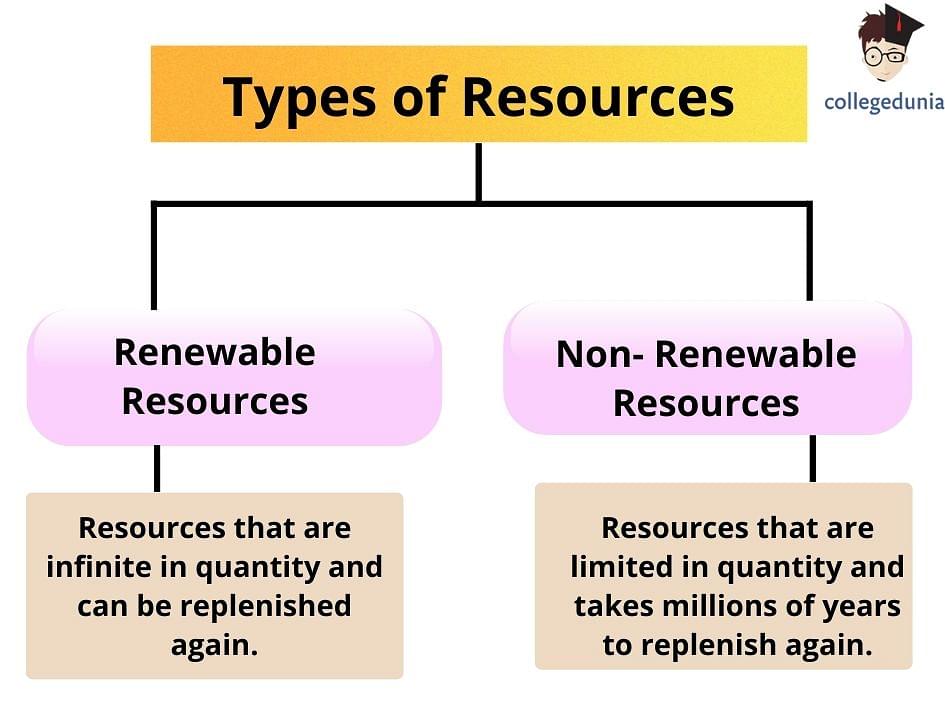
Renewable and Non-Renewable Resources
Renewable Resources
Renewable resources are those resources that are available in infinite quantity and can be used repeatedly.
- Renewable resources are available in abundance and will not run out in the future.
- They can easily be renewed by nature in a comparatively short period of time.
- Examples of renewable resources are Forest, Wind, Water, etc.
Non-Renewable Resources
Non-renewable resources are those resources that are present in limited quantity due to their non-renewable nature.
- Their availability may run out in the future and they can not be renewed in a short span of time.
- These resources take millions of years to renew again.
- Examples of Non-renewable resources include coal and petroleum, minerals, etc.
Read More: Differences between Renewable and Non-Renewable Resources of Energy
Importance of Resources on Earth
[Click Here for Sample Questions]
Natural resources are vital for the existence of life on earth. They perform several functions in order to sustain life. Some of them are as follows:
- Natural resources determine the socio-economic development of a country.
- Natural resources help to maintain a balance in the ecosystem.
- These resources meet the needs of the ever-growing population.
- Natural resources provide raw materials for large-scale industries and other purposes.
- Fossil fuels such as coal and petroleum are extremely important.
- Water, a natural resource, is the medium of life and helps to produce electricity in dams and reservoirs.
- Wind is used to produce wind energy that is used in turbines and to produce electricity.
- Solar energy is used in various items such as solar water heaters, solar-powered ventilation fans, and batteries that are charged using solar power.
Depletion of Resources on Earth
[Click Here for Sample Questions]
Natural resources on earth are continuously being depleted and eventually leading to harm to the environment. Due to the explosive growth of the human population, there has been increased consumption of resources on earth. Resources on earth are being depleted or degraded due to the following reasons:
- The main cause of depletion of resources on earth is Overpopulation.
- Over-exploitation of the resources is the second most important cause of depletion of resources on earth.
- Deforestation, which is the excessive cutting of forests has also led to the depletion of resources on earth and loss of Biodiversity.
- Pollution is increasing at an alarming rate due to the contamination of resources on earth.
- Industrialization, Soil Erosion, and various other factors are the main causes of resource depletion.
Things to Remember
- Resources refer to all those things that help us to satisfy our needs and wants.
- Resources are technologically accessible, economically feasible, and culturally sustainable.
- Natural resources are those resources that occur naturally such as air, water, soil, etc.
- There are two types of resources on earth namely renewable resources and non-renewable resources.
- Renewable resources are those resources that can be renewed again and are available in infinite quantity. Examples are wind energy, solar energy, etc.
- Non-renewable resources are those resources that are limited and cannot be replenished again. Examples include coal, petroleum, etc.
Sample Questions
Ques. What is the difference between renewable and non-renewable resources? (5 Marks)
Ans. The difference between renewable and non-renewable resources is as follows:
| Renewable Resources | Non-Renewable Resources |
|---|---|
| Renewable Resources can be renewed again as they are available in infinite quantity. | Non-renewable Resources cannot be renewed as they are available in limited quantity. |
| These resources are sustainable in nature. | These resources are exhaustible in nature. |
| Renewable Resources are environment-friendly. | Non-renewable resources are less environment-friendly. |
| Examples: Forest, wind, water, etc | Examples: Fossil fuels, minerals, etc. |
Ques. What are the problems associated with resources on earth? (3 Marks)
Ans. The irrational use and consumption of resources on earth have led to several socio-economic and environmental problems.
- Since the natural resources are available in a fixed quantity and are non-renewable, thus, there is a problem of shortage of resources.
- There is an ever-growing scarcity of these natural resources because of the explosive population growth.
- Non-renewable resources take millions of years to form, thus, there needs to be a rational approach while using them.
Ques. List any three important natural resources. (3 Marks)
Ans. The three most important natural resources are
- Air: It is essential for all plants, animals, and humans to survive on earth.
- Water: It is the medium of life and is used in all aspects of life be it for drinking, domestic or industrial purposes.
- Soil: Soil is the topmost layer of the earth and is composed of various particles and nutrients that help plants and crops grow.
Ques. How does overpopulation affect resources on earth? (3 Marks)
Ans. The human population is growing at an explosive rate, thus, causing a lot of pressure on the utilization of almost all natural resources. This situation leads to the over-exploitation of natural resources such as arable land, coral reefs, fresh water, fossil fuels, and wilderness forests. This causes a seriously alarming situation for the environment and living beings.
Ques. How is pollution affecting resources on earth? (3 Marks)
Ans. Natural resources are under immense threat due to the toxic substances and chemicals emitted from industries, agricultural products, and other harmful human practices. Pollution poses a serious threat to land, air, and water in various ways. Pollution is becoming a threat to the sustainably of biotic and abiotic components.
Ques. List the uses of natural resources. (3 Marks)
Ans. Natural resources are very essential for all living organisms and the sustenance of life on earth. They help to maintain a balance in the ecosystem. Some of the most important natural resources include minerals, forest products, water, and soil which are used by human beings use to produce energy and make use of things. Natural resources also help to determine the socio-economic development of a country.
Ques. How can we conserve natural resources? (3 Marks)
Ans. The various ways to conserve natural resources are:
- We should use an alternative source of power like solar and wind energy.
- People should plant more trees to prevent soil erosion.
- Industrial sewage and wastage should be disposed of properly even before they get released into the water bodies.
- One must incorporate a rainwater harvesting system in the house.
- Biofuels should be used instead of conventional petroleum-based fuels.
Ques. What are non-renewable resources? (3 Marks)
Ans. Non-renewable resources are those resources that exhaust after their frequent usage. It takes a really long time, around millions of years for them to regenerate and replenish again. An example of a non-renewable resource is coal which is limited which means that it cannot be recycled again. These non-renewable resources are extremely important and have a very high demand. Thus, there is a need to use them rationally.
Ques. Define natural resources. (3 Marks)
Ans. Natural resources are those resources that exist or occur without any intervention of human beings. Natural resources on earth consist of water, sunlight, atmosphere, and land including all minerals along with all the vegetation, crops, and animal life that occurs naturally being independent of humans. These natural resources also include all of the valued characteristics like gravitational, magnetic, electrical properties and forces, etc.
Ques. What are Biotic and Abiotic Natural Resources? (3 Marks)
Ans. Biotic resources are those resources that arise from living things such as animals, forests (vegetation), and other materials obtainable from them. Fossil fuels such as petroleum, oil, and coal are also included in biotic resources as they are made from decayed organic matter.
Abiotic resources are those resources that come from non-living materials such as water, land, air, iron, copper, silver, gold, and so on.
Ques. Why do non-renewable resources take so long to replenish again? (3 Marks)
Ans. Non-renewable resources take millions of years to form and replenish again. For instance, coal. Coal is formed as a result of the layers of decomposition of dead plant and animal matter over millions of years. This material undergoes changes due to physical factors such as temperature and pressure, causing the removal of oxygen, thus, leaving the matter carbon-rich, resulting in the formation of coal. Thus, it takes millions of years for the formation of non-renewable resources.
Check-Out:



Comments