



Content Curator
A fossil fuel is a hydrocarbon-containing material obtained from the Earth's crust which is formed naturally from the remains of dead animals and plants. Fossil fuels are obtained through the anaerobic decomposition of dead buried organisms containing organic molecules created through photosynthesis. This process takes millions of years.
- Fossil fuels are burned to provide heat which is used for heating or cooking.
- It is also used to generate electricity and to power engines.
- kerosene, gasoline, and propane are also made from fossil fuels.
- According to the National Academies of Sciences, fossil fuels account for 81% of global energy use.
| Table of Content |
Key Terms: Earth's crust, Energy, Hydrogen, Carbon, Pressure, Temperature, Chemical composition, Molecules, Energy, Coal, Petroleum, Natural gas.
Also Read: Coal and Petroleum
Fossil Fuel
[Click Here for Sample Questions]
Fossil Fuels are formed from dead, decaying plants and animals buried deep under the earth. The extreme pressure and temperature conditions present inside the earth’s crust facilitate the process. Fossil Fuels contain hydrogen and carbon in their chemical composition.
- Because fossil fuels can be easily burned in the open atmosphere, they have been important to human development.
- Over 80% of the carbon dioxide (CO2) produced by humans comes from burning fossil fuels which is around 35 billion tonnes a year.
- Coal, Petroleum, and Natural gas are examples of fossil fuels.
- Due to anaerobic decomposition, aquatic zooplankton and phytoplankton that died and sedimented in large quantities millions of years ago began forming petroleum and natural gas.
- The burning of fossil fuels has a number of harmful environmental impacts on human, pollution from fossil fuel combustion cause illness and death when inhaled.
- Fossil fuels are a non-renewable source of energy.

Read More:
Types of Fossil Fuels
[Click Here for Sample Questions]
Fossil Fuels are usually classified into three types:
- Coal
- Petroleum
- Natural Gas
Coal
Coal is a substance found in sedimentary rock deposits. These are formed over a long period of time by the decomposition of layers of rock and dead plant and animal waste.
- Heat and pressure turned the plants into coal after millions of years.
- It has an appearance of a gleaming black rock. It produces heat and light energy when it is burned.
- In the 1800s, people began utilizing coal for heating purposes.
- Later on, during the industrial revolution, it played a major role in powering up trains and ships.
- It was used as a major power source to manufacture iron and steel in factories.
- Today, coal is mostly used to generate energy.

Types of Coal
There are four types of coal, based on their carbon content in them.
- Anthracite Coal: It is the best quality of coal which contains over 80% of carbon. It is hard, compact, and black in colour. Anthracite is rare and found in very few places.
- Bituminous Coal: It is the most widely used variety of coal and contains about 60% to 80% of carbon. Its calorific value is very high due to the high proportion of carbon and lower moisture content. It is utilized for heating and production of coke.
- Lignite Coal: It is also called brown coal. It is of comparatively inferior quality. It is friable in nature. It has much higher moisture content and thus is not usually used for combustion.
- Peat Coal: It is formed during the earliest stage of the conversion process from wood to coal. It has a carbon content of around 50% to 60%. A lot of smoke and ash is produced when it is burnt.

Types of Coal
Petroleum
Petroleum is a fossil fuel that is also known as crude oil. Petroleum is formed by the decomposition of the remains of ancient sea organisms such as plants, algae, and bacteria.
- These organic remains (fossils) turn into carbon-rich substances over millions of years under severe heat and pressure.
- These are then extracted and used as raw materials for fuel and a variety of products.
- Petroleum has a carbon content of 82 % to 87 % by weight and hydrogen content of 12% to 15%.
- Petroleum is used to power internal combustion engines and is also used in manufacturing detergents, plastics, fibres, polyethene, etc.

Natural Gas
Natural gas is a fossil fuel that is formed deep below the earth's surface. It is a by-product of decayed organic matter deposited over 550 million years ago. This biological material combines with mud, silt, and sand on the sea bed and eventually gets buried.
- The organic matter is sealed in an oxygen-free environment and is subjected to increasing amounts of heat and pressure, resulting in a thermal breakdown process that transforms it into hydrocarbons.
- Natural gas is made up of the lightest of the hydrocarbons that exist in a gaseous state under normal conditions.
- It is a colourless, odourless gas made largely of methane (CH4) in its purest form.
- It also comprises gas, liquids and non-hydrocarbon gases like carbon dioxide and water vapour in lower concentrations.

Uses of Fossil Fuels
[Click Here for Sample Questions]
Uses of coal:
- Coal is used in the generation of electric power for mineral-based industries like the iron and steel industry.
- Coal is burned in thermal Power plants to produce electricity, providing an energy source to houses and other establishments.
- People burn coal during winter to generate heat.

Uses of Petroleum:
- Petroleum and its products are usually used for locomotive power.
- Petroleum is used as a lubricating agent.
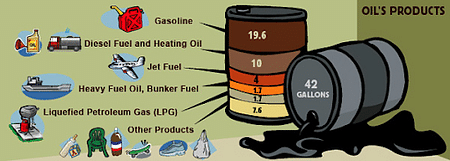
- Petroleum is the source of petrol, diesel, kerosene, paraffin wax, vaseline, and benzene.
- Petroleum is also used in the production of paints, medicines, plastic, and fertilizers.
Uses of Natural gas:
- Natural Gas is used as LPG for cooking.
- Natural gas in the form of CNG (Compressed Natural Gas) is now replacing petrol and diesel as automobile fuel sources because it produces less pollution.

Advantages of Fossil Fuels
[Click Here for Sample Questions]
The advantages of Fossil fuels are:
- Coal is the cheapest mineral. Prices for coal remain almost stable in the world market.
- Coal has a high calorific value, thus it is easier to burn.
- Unlike renewable sources of energy like wind, solar, and tidal, the energy obtained from coal does not depend on climatic conditions.
- Apart from providing energy upon combustion, byproducts of coal also have economic value.
- Coal is safer in comparison to nuclear energy.
- Extraction of petroleum is easier.
- Petroleum has a high density, thus a small amount can produce a substantial amount of energy.
- Natural Gas can be renewed, it can be produced in landfills.
- Natural gas can be stored safely and efficiently.
- Natural gas produces fewer emissions on burning, thus it is environmentally friendly.


Disadvantages of Fossil Fuels
[Click Here for Sample Questions]
- Fossil Fuels create greenhouse gas emissions, thus increasing global warming.
- Fossil Fuels are non-renewable sources of energy and its is depleting at a higher rate.
- With increased demand and diminishing supply, prices for fossil fuels are increasing.
- Mining for fossil fuels requires clearing large areas of land which leads to large-scale deforestation.

Fossil Fuel Disadvantages
Read More:
| Sources of Energy – Important Concepts | ||
|---|---|---|
| Solar cooker | Fuel Types | Effects of burning fossil fuels |
| Wave energy formula | Solar Car | Energy Consumption Formula |
Things to Remember
- Fossil Fuels can be defined as fuels formed from dead, decaying plants and animals buried deep under the earth.
- Coal, petroleum, and natural gas are the three forms of fossil fuels.
- There are 4 types of coal: Anthracite, Bituminous, Lignite, and Peat.
- Fossil Fuels are non-renewable sources of energy.
Sample Questions
Ques. What is the definition of fuel? What two features would you look for in a good fuel? (2 marks)
Ans. When a substance burns or performs a chemical or nuclear reaction, it creates usable energy. When a fuel such as coal, wood, oil, or gas is burned, it produces energy. An excellent fuel is one that generates a large quantity of heat when burned. It should produce very little smoke and is readily available.
Ques. Give three reasons why LPG is regarded as an ideal fuel. (2 marks)
Ans. LPG is regarded as an optimal fuel because of the following reasons:
- It's simple to store, handle, and move.
- When it burns, it produces a lot of heat.
- It burns cleanly and leaves no trace.
- Give three reasons why charcoal is better than wood.
Ques. Mention some of the advantages of charcoal over wood. (2 marks)
Ans. Charcoal has a number of advantages over wood.
- It has a higher calorific value, which means it generates more heat.
- Charcoal is a clean fuel since it does not emit smoke when burned.
- It's more convenient to transport and use because it's dry and broken up.
Ques. Distinguish between renewable and non-renewable sources of energy. Give an example of each of these resources as well. (3 marks)
Ans.
| Renewable Source of Energy | Nonrenewable Source of Energy |
|---|---|
| They are endless and are constantly replenished by nature. | They do not regenerate or rejuvenate themselves, and they are depleted. |
| Low cost of operation | High cost of operation. |
| They produce little or no pollutants. | They produce a lot of pollutants. |
| Examples, wind energy, solar energy. | Examples, Coal, Petroleum. |
Ques. What occurs when the wood is burned in a low-oxygen environment? Give the name of the residue left behind after the process, as well as two advantages of utilising it as a fuel instead of wood. (2 marks)
Ans. When wood is burned in a low-oxygen environment, volatile components in the wood are extracted and cooled, yielding wood tar and wood gas. Charcoal is the black residue left behind after the process. The following are some of the benefits of utilising charcoal as a fuel instead of wood:
- Charcoal does not emit smoke when burned. On the other hand, when the wood is burned, it produces a lot of smoke.
- Charcoal provides more heat per unit of volume than wood.
Ques. It is difficult to use hydrogen as a source of energy, although its calorific value is quite high. Explain. (2 marks)
Ans. (i) When hydrogen gas is lighted, it burns with an explosion which is very unsafe.
(ii) It is very expensive to produce hydrogen gas by the electrolysis of water because it requires a lot of electricity.
(iii) It is very difficult to store and transport hydrogen gas as it is explosively inflammable.
Hence it is difficult to use hydrogen as a source of energy, though it has a high calorific value.
Ques. Explain about coal tar. (2 marks)
Ans. It is produced when the gases are evolved due to the heating of coal in water. It is a black-coloured, thick, viscous liquid. It has a pungent smell. It is itself a mixture of many compounds. We can get benzene, toluene, napthalene, phenol, etc., from coal tar.
Ques. What is CNG? What are its uses? (2 marks)
Ans. CNG is a short form of Compressed Natural Gas. Natural gas is stored under high pressure as CNG. CNG is used for power generation. It is now being used as a fuel for transport vehicles because it is less polluting. It is a cleaner fuel.
Ques. The burning of fossil fuels causes air pollution. Explain. (2 marks)
Ans. The burning of fossil fuels causes a lot of air pollution. The burning of coal produces gases like carbon dioxide, carbon monoxide, sulphur dioxide, etc., which can lead to undesirable changes in climate due to the increased greenhouse effect. The major air pollutants produced by the burning of petrol in automobiles are carbon monoxide, sulphur dioxide, unburnt hydrocarbons, etc. These pollutants are harmful to human beings and living organisms which causes breathing problems and skin diseases.
Ques. List the steps to conserve the resources. (3 marks)
Ans. As we know, we all are dependent on resources. But we should keep in mind that resources are limited in nature. If we misuse it, our future generation will have no resources. This is an alarming situation.
We can take the following steps:
- We should cook our food on low flame.
- Devices that consume less energy like CFLs and LED lights should be preferred.
- We should take care not to waste electricity.
- We should cover our cooking vessels while cooking.
- Instead of the use of individual vehicles, the use of public transport should be encouraged.
- Solar or tidal energy should be developed and encouraged.
- Dams should be used to generate electricity instead of burning coal or petroleum.
- Public awareness programmes should be conducted
Also Read:



Comments