



Exams Prep Master
Respiration in plants is a process that involves the production of energy in plants. This process can easily be described as the intake of Oxygen and the releasing of Carbon Dioxide as the result of the oxidation of complex organic compounds. Though plants do not have any specific organ to control the process of respiration, their stems, roots, and leaves do this work at a lower rate than other living beings. The process of respiration is very important for the plants to maintain the growth of the plant tissues.
This process can be represented as-
C6H12O6 + 6O2 → 6CO2 + 6H2O + Energy
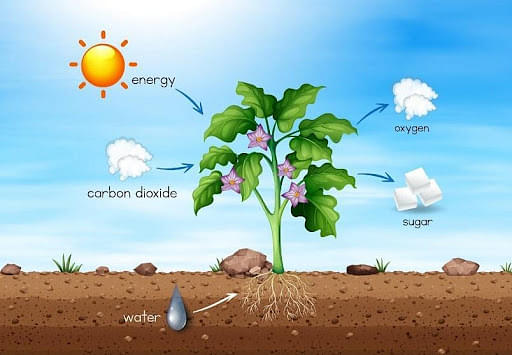
Respiration process in plants
The respiration in plants can be divided into two kinds- Aerobic respiration and Anaerobic respiration. Whereas aerobic respiration takes place in the presence of oxygen, anaerobic respiration takes place without the presence of oxygen. But to complete the whole respiration mechanism in plants, both parts need to be completed.
Also Read: Difference between Photosynthesis and Respiration
Very Short Answer Questions [1 Marks Question]
Ques. What are the different types of respiration occurring in plants?
Ans. The two different types of respiration occurring in plants are- 1. Aerobic respiration, and 2. Anaerobic respiration.
Ques. Name the molecule which is the terminal acceptor of the electron.
Ans. The name of the molecule that is the terminal acceptor of the electron is- Oxygen.
Ques. How is the energy released and stored during the oxidation of compounds in respiration?
Ans. The energy that is released by the respiration process in plants, is collected in ATP. This chemical bond can be represented as ADP + PI + energy = ATP. The necessary energy can be derived from this bond.
Ques. Write the name of the end product of glycolysis.
Ans. The first step of breaking down glucose to get the necessary energy for a cellular organism can be defined as Glycolysis. As the end product of this process, we get Pyruvic acid.
Ques. Where is ETC found in eukaryotic cells?
Ans. ETC, the electron transport system, can be found in the eukaryotic cell of the mitochondrial membrane.
Ques. Give the chemical equation for aerobic respiration.
Ans. The chemical equation for aerobic respiration can be represented as –
C6H12O6 + 6O2 → 6CO2 + 6H2O + 686 kcal.
Ques. What is fermentation?
Ans. The process by which partial breakdown of glucose occurs is called fermentation. It is another pathway for breaking down glucose. This process does not utilize oxygen.
Ques. What are the other two names for Krebs cycle?
Ans. The two other names for Krebs Cycle are- 1. Tricarboxylic acid cycle (TCA) and, 2. Citric acid cycle (CAC).
Short Answer Questions [2 Marks Question]
Ques. What is respiration?
Ans. Respiration is a physicochemical process that can easily be described as the intake of Oxygen and the releasing of Carbon Dioxide, water, and energy due to the oxidation of complex organic compounds. The process of respiration is very important for the plants to maintain the growth of the plant tissues.
This process can be represented as- C6H12O6 + 6O2 → 6CO2 + 6H2O + Energy

Respiration in Plants
Ques. Define aerobic respiration.
Ans. Aerobic Respiration is a cellular respiration process in plants that, in the presence of oxygen, produces energy from glucose. Through this process, the food – glucose, is completely oxidized and we get CO2, water, and energy. The transmission of electrons from molecules is also a result of this respiration process.
This process can be represented as-
Glucose (C6H12O6) + oxygen 6 (O2) → carbon dioxide 6 (CO2) + water 6 (H2O) + energy (ATP)

The process of Aerobic Respiration
Ques. Explain the term “Energy Currency” of the cell. Name the substance in animals and plants that act as an energy currency.
Ans. The process of respiration is very important for any living being to maintain cellular growth and the whole process of metabolism. ATP – Adenosine triphosphate is counted as the ‘energy currency of the cell, as it stores all the energies produced by the respiration process and releases them whenever it is required. This is an organic compound.
ATP works as the energy currency in both- animals and plants. Here is the chemical structure of ATP-

Ques. Define the process of fermentation by showing a chemical equation.
Ans. The process by which partial breakdown of glucose occurs, is called fermentation. It is another pathway for breaking down glucose. This process does not utilize oxygen. Hence, this process takes place under the anaerobic condition, where pyruvic acid is converted into carbon dioxide and ethanol. Therefore, we can conclude that fermentation is the process that carries the oxygen out of the microbes.
The chemical equation of the fermentation can be denoted as-
C6H12O6 → 2C2H5OH + Energy (247 kJ)

The process of fermentation
Ques. On what factor the respiratory quotient depends?
Ans. The respiratory quotient can be explained as the ratio of the amount of CO2 produced and the amount of Oxygen intake as the result of the respiration process.

The concept of respiratory quotient varies from one another depending upon the type of respiratory substrate used in the process of respiration. Hence, the RQ depends on this factor of using the respiratory substrate.
Ques. Give the difference between Breathing and Respiration?
Ans. Breathing and Respiration might seem similar, but there are a few basic differences between them.
- While breathing is a biophysical process, respiration is a biochemical process.
- Breathing can be easily described as a process of inhaling oxygen and releasing carbon dioxide in the air, but the process of respiration is a complicated one, as the oxygen we intake from outside is used to convert food into energy.
Long Answer Questions [3 Marks Question]
Ques. 1. Why is less energy produced during anaerobic respiration?
Ans. It can be observed that the amount of energy produced by anaerobic respiration is much less than aerobic respiration. This happens because-
- The glucose breakdown process in anaerobic respiration is not complete.
- The whole energy that a certain amount of food can produce, is not achievable in this respiration process. We can see that the processed food from this process can be processed further to produce the due energy.
- As we know that the anaerobic process is completed without using oxygen, the electron and proton cannot be secured.
- Finally, as electron transportation does not take place in this respiration process, the NADH2 is unable to create ATP.
Ques. Describe the mechanism of Respiration.
Ans. In the process of respiration, the food (glucose) molecules break down into an intermediate molecule and produce pyruvic acid. This mechanism can be described in two parts-
- At first, Pyruvic Acid breaks down and completes the process of Anaerobic Respiration. In this process, oxygen remains absent and it produces ethyl alcohol. But the process of breaking down the pyruvic acid remains incomplete.
This phase can be written as Glucose → Ethyl alcohol + CO2 + 2ATP
- In this part, the aerobic respiration process gets completed. The pyruvic acid breaks down completely in the presence of oxygen. This process takes place in the mitochondria of a cell. This process is also known as the Krebs cycle.
The chemical equation for aerobic respiration can be represented as –
C6H12O6 + 6O2 → 6H2O + 6CO2 + 686 kcal.

Ques. What is the significance of the citric acid cycle?
Ans. The citric acid cycle, also known as Krebs cycle, is a very important stage of the respiration process. The significances of this cycle are-
- By observing this cycle, we can understand how pyruvic acid breaks down and creates CO2 in the process. This is the key way to ATP generation.
- The amount of energy produced in the process of Krebs cycle is higher than the energy produced after glycolysis.
- As the result of this process, a lot of important intermediates compounds are formed which are necessary for the synthesis of biomolecules like amino acids, nucleotides, chlorophyll, cytochromes, and fats.
Ques. Calculate the efficiency of respiration in the living system.
Ans. We know that the Respiratory quotient can be explained as the ratio of the amount of CO2 produced and the amount of Oxygen intake as the result of the respiration process.

This respiratory quotient varies from one another depending upon the type of respiratory substrate used in the process of respiration. And when the carbohydrate is used as a substrate to complete the process, the equation is- C6H12O6 – 2C2H5OH + 2CO + Energy (247 K.J.)
That is,

Hence, the total released energy released after the completion of the oxidation process is 2870 KJ. This energy is mostly released as heat.
Long Answer Questions [5 Marks Question]
Ques. Explain Glycolysis. State where it occurs and its end products. In both aerobic and anaerobic respiration, determine the fate of these products.
Ans. Glycolysis can be defined as the basic step of the glucose breakdown process towards producing carbon dioxide and energy in the process. This process is necessary for cellular growth and metabolism.

Glycolysis process
The process of Glycolysis begins in the cytoplasm of a cell and is completed in two phases- 1. Energy requiring phase and 2. Energy releasing phase.
We get pyruvate as the final result of this process.
In both aerobic and anaerobic respiration, in the presence of different enzymes, the whole process of glycolysis takes place. This process takes ten continuous stages to complete. As mentioned earlier, pyruvate is the final product of glycolysis.
At first, Pyruvic Acid breaks down and completes the process of Anaerobic Respiration. In this process, oxygen remains absent and produces ethyl alcohol. But the process of breaking down the pyruvic acid remains incomplete.
This phase can be written as- Glucose → Ethyl alcohol + CO2+ 2ATP
In the next part, the aerobic respiration process gets completed. The pyruvic acid breaks down completely in the presence of oxygen. This process takes place in the mitochondria of a cell. This process is also known as the Krebs cycle.
This part can be represented as – C6H12O6 + 6O2 → 6H2O + 6CO2 + 686 kcal.
Here is the 10-step diagram of the whole glycolysis process-

Ques. Explain the significance of Oxygen in aerobic respiration in the context of ETS.
Ans. The electron transport system commonly known as ETS which is located in the inner mitochondrial membrane helps in releasing the energy stored after and while the process of respiration. Even after completing the oxidizing process the glucose molecules are completely transformed and the energy will not be released till the electron transport system is not completed. In other words, without the presence of oxygen, the ATS process cannot be completed full stop but we know that oxygen can only be used in the process of aerobic respiration. Oxygen is important to eliminate hydrogen from the molecules.
This process by which the production of ATP by phosphorylation of ADP occurs is called oxidative phosphorylation. Hence, the water is produced and the whole process comes to an end.
The electron transport chain looks like the following-

Ques. Describe the process and role of the citric acid cycle in living organisms.
Ans. With the help of a series of enzymes, the glucose is converted into pyruvic acid in the process of respiration. The pyruvic acid then enters the further processing phase. Within mitochondria, in the presence of oxygen and other necessary enzymes, pyruvate acid breaks further and produces CO2 and H2O. This phase is known as the Citric acid cycle or Krebs cycle.
In this cycle, NADH and FADH are produced from the three molecules of NAD and one molecule of FAD. Therefore, this process is interlinked with the ETS process.
This process is completed in two parts- 1. Removal of Hydrogen, and 2. The breaking of CO2.
The whole Krebs Cycle can be written in the following way-

Related Links:



Comments