



Content Curator
Electron transport chain is a series of complexes involved in the production of ATP by carrying out the transfer of electrons. This process takes place in mitochondria and is one of the most essential processes in the body. The whole process of the electron transport system and coupled ATP production is termed as Oxidative Phosphorylation.
| Table of Content |
Key Takeaways: Electron Transport Chain, Oxidative Phosphorylation, Mitochondria, Redox Potential, ATP Synthase, Thermogenesis, Electrochemical Gradient
Mitochondria
[Click Here for Sample Questions]
Mitochondria are the double-membrane bound cell organelles found in most eukaryotic cells. Mitochondria are the sites of aerobic respiration in eukaryotic cells. They are small in size and consists of the following:
Outer membrane - This is the outermost membrane of mitochondria and consists of channels called porins that allow some molecules to cross the membrane. The outer membrane also contains enzymes.
Inner membrane - It is the membrane which contains many protein complexes involved in ETS and ATP production. It is impermeable to most of the molecules.
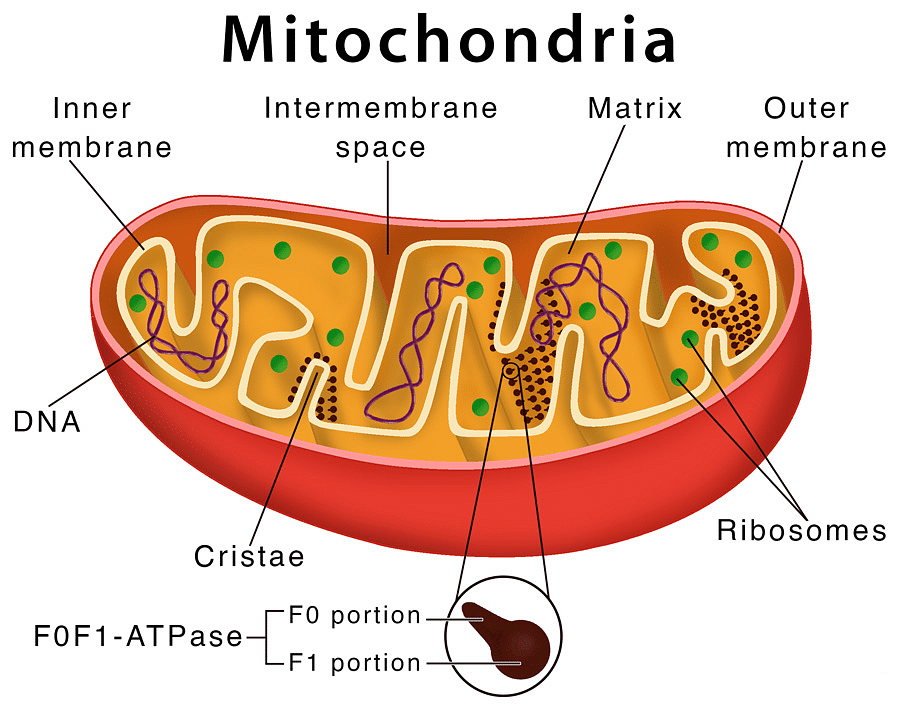
Parts of Mitochondria
Intermembrane Space - The space present between the outer and the inner membrane is called the intermembrane space.
Cristae - The inner membrane of the mitochondria folds inside to give rise to structures called cristae. Cristae serves to increase the surface area of the membrane.
Matrix - Mitochondrial matrix is the space enclosed by the membranes of mitochondria. It contains DNA and several enzymes.
Mitochondria contains their own DNA and ribosomes, so they are called semi-autonomous. Since the production of ATP occurs in the mitochondria, they are called ‘powerhouses of the cell’.
Also Read:
| Related Articles | ||
|---|---|---|
| Prokaryotic and Eukaryotic Translation | Binary Fission | Gene Regulation |
| DNA Replication | DNA Fingerprinting | Recombinant DNA Technology |
Electron Transport Chain
[Click Here for Sample Questions]
The electron transport chain consists of a series of protein complexes that transfers electrons through redox reactions. The transfer of electrons results in the formation of a proton gradient across the membrane. This proton gradient is then used for the production of ATP in the mitochondria. This whole process of electron transfer and ATP production is called oxidative phosphorylation.
The transfer of electrons is an exergonic process i.e energy is released during the process. This released energy drives the synthesis of ATP by forming a proton gradient. In an electron transport chain, electrons are always transferred from lower redox potential to a higher redox potential. In eukaryotes, the protein complexes involved in the electron transfer are present on the inner mitochondrial membrane.

Electron Transport Chain
In the electron transport chain, electrons from NADH and FADH2 are transferred to an electron acceptor having a higher redox potential. This transfer of electrons from lower to higher redox potential continues until it reaches the final electron acceptor. Oxygen is the final electron acceptor in aerobic respiration. The complexes involved in the electron transport and its process is given below:
Complex I - NADH Ubiquinone Oxidoreductase
The first complex in the electron transport chain is the NADH Ubiquinone Oxidoreductase. It is also called NADH Dehydrogenase. As the first step of the electron transport chain, two electrons from NADH are transferred to ubiquinone (Q) via a Fe-S molecule, reducing it to ubiquinol (QH2). During this, four protons (H+) are transferred across the membrane.
Complex II - Succinate Dehydrogenase
This complex is also called succinate-CoQ reductase. In this step, electrons are transferred from succinate to coenzyme Q (or Ubiquinone) via FAD (flavin adenine dinucleotide). In this step, transfer of protons does not take place.
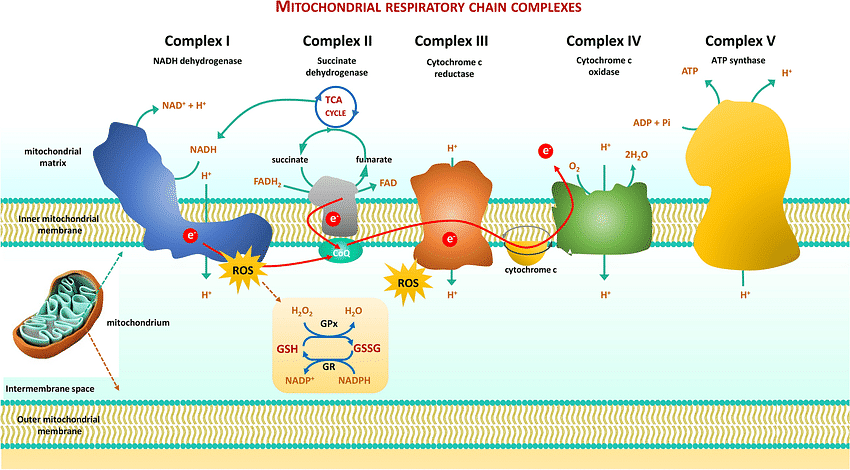
Electron Transfer Chain Complexes
Complex III - Cytochrome bc1 Complex
This is also called CoQH2 - cytochrome c reductase. Two electrons from QH2 are transferred to cytochrome c. Cytochrome c is found in the intermembrane space. During this transfer, four protons are transferred across the membrane.
Complex IV - Cytochrome c Oxidase
It is also called cytochrome AA3 complex. In this, four electrons from cytochrome c are transferred to oxygen molecules (O2). This reaction results in the formation of two water molecules. In this step, eight protons are transferred from the mitochondrial matrix.
Also Read:
| Related Articles | ||
|---|---|---|
| Prokaryotic cells | Genetics and Evolution | Molecular Basis of Inheritance |
| Electrophoresis | Difference between Prokaryotic and Eukaryotic Transcription | Biotechnology |
ATP Production
[Click Here for Sample Questions]
The proton gradient formed during the electron transport is used to synthesise ATP in the mitochondria. According to the chemiosmotic coupling hypothesis, the electron transport chain and oxidative phosphorylation are coupled by a proton gradient across the inner mitochondrial membrane.
The electrochemical gradient formed by the transfer of protons across the inner membrane provides the energy for synthesis of ATP. The FoF1 particle, also called ATP Synthase, uses this proton gradient to convert ADP into ATP by oxidative phosphorylation. The ATP synthase is also considered as the Complex V of the electron transport chain.

Electron Transport Chain and Oxidative Phosphorylation
For the production of ATP, it is necessary to couple the electron transport chain with oxidative phosphorylation. But sometimes, uncoupling these two processes can serve other biological purposes. This can be done with the help of uncoupling protein - thermogenin. Thyroxine is also a natural uncoupler of the process. These uncouplers allow for the flowing back of protons into the mitochondrial matrix. This backflow of protons results in thermogenesis instead of ATP production.
Read More: Packaging of DNA
Things to Remember
- In eukaryotes, mitochondria is the site for aerobic respiration. They are also called ‘powerhouses of the cell’.
- The electron transport chain consists of 5 complexes present in a sequence that carry out the transfer of electrons and coupled ATP production.
- Electrons in the electron transport chain are transferred from molecules of lower redox potential to that of higher redox potential.
- The final electron acceptor in the electron transport chain is the oxygen.
- The chemiosmotic coupling hypothesis states that the electron transport chain and oxidative phosphorylation are coupled by a proton gradient.
- Uncoupling the electron transport chain and oxidative phosphorylation results in thermogenesis instead of ATP production.
Also Read:
Sample Questions
Ques. Give the schematic representation of an overall view of Krebs’ Cycle. (3 marks) [NCERT]
Ans. The diagrammatic representation of Krebs cycle is shown below:

Ques. Differentiate between Glycolysis and Krebs’ Cycle. (5 marks) [NCERT]
Ans. The key differences between Glycolysis and Krebs’ Cycle are given below.
| Glycolysis | Krebs’ Cycle |
|---|---|
| It takes place in the cytoplasm of the cell. | It occurs in the mitochondria. |
| It is the first step of respiration in which glucose is converted to pyruvate. | It is the second step in the respiration process in which the acetyl group is broken down. |
| It is the common pathway of aerobic and anaerobic respiration. | It occurs only in aerobic respiration. |
| It consumes two molecules of ATP. | It does not consume ATP. |
| The net gain of energy is 8 molecules of ATP. | The net gain of energy is 24 molecules of ATP. |
| Carbon dioxide is not evolved during glycolysis. | Carbon dioxide is evolved in krebs’ cycle. |
Ques. What is the difference between aerobic and anaerobic respiration? (3 marks)
Ans. The key differences between aerobic and anaerobic respiration are tabulated below.
| Aerobic Respiration | Anaerobic Respiration |
|---|---|
| It occurs in the presence of oxygen. | It occurs in the absence of oxygen. |
| It gives carbon dioxide and water as the end products. | The end products are ethyl alcohol and carbon dioxide. |
| It involves complete oxidation. | It involves incomplete oxidation. |
| It results in the production of 36-38 ATP molecules. | Only 2 molecules of ATP are produced. |
Ques. What is the significance of stepwise release of energy in respiration? (2 marks) [NCERT]
Ans. Following are the significances of stepwise release of energy in respiration:
- It helps in the utilisation of a relatively higher proportion of energy.
- It controls the rate of the pathway and release of energy according to the need of the cell.
- Due to this, the same pathway can be used to produce intermediates to be used for the synthesis of other molecules.
Ques. What are the functions of mitochondria? (3 marks)
Ans. The main functions of mitochondria are as follows:
- The most important function of mitochondria is the production of ATP by the process of oxidative phosphorylation.
- It is involved in apoptosis or programmed cell death.
- Mitochondria absorb the calcium and store it in the cell until they are required for essential processes.
- Mitochondria helps in generating heat by a process called thermogenesis.
Ques. What is glycolysis? Explain with the help of a schematic representation. (3 marks)
Ans. Glycolysis is a ten-step process in which a molecule of glucose is broken down into two molecules of pyruvate. Energy is released during the process of glycolysis. It occurs in the cytoplasm of the cell and does not require oxygen. Glycolysis was discovered by Gustav Embden, Otto Meyerhof and Jakub Karol Parnas and is also called EMP Pathway. The whole pathway of glycolysis is divided into two phases: the energy-requiring phase and the energy-releasing phase. The steps of glycolysis are given below:

Ques. Define RQ. What is its value for fats? (3 marks) [NCERT]
Ans. RQ stands for Respiratory Quotient. It is defined as the ratio of the volume of carbon dioxide produced to the volume of oxygen consumed during respiration in a certain period of time.
RQ = Volume of CO2 evolved / Volume of O2 consumed
Its value ranges from 0 to 1 or can be even greater than 1.
For most of the fats and alcohol, its value is approximately 0.7. RQ value is 1 for carbohydrates and 0.8 for proteins.
Ques. Explain about the complexes involved in the Electron Transport chain. (5 marks)
Ans. The complexes involved in the electron transport chain are given below.
Complex I - NADH Ubiquinone Oxidoreductase
The first complex in the electron transport chain is the NADH Ubiquinone Oxidoreductase. It is also called NADH Dehydrogenase. As the first step of the electron transport chain, two electrons from NADH are transferred to ubiquinone (Q) via a Fe-S molecule, reducing it to ubiquinol (QH2). During this, four protons (H+) are transferred across the membrane.
Complex II - Succinate Dehydrogenase
This complex is also called succinate-CoQ reductase. In this step, electrons are transferred from succinate to coenzyme Q (or Ubiquinone) via FAD (flavin adenine dinucleotide). In this step, transfer of protons does not take place.
Complex III - Cytochrome bc1 Complex
This is also called CoQH2 - cytochrome c reductase. Two electrons from QH2 are transferred to cytochrome c. Cytochrome c is found in the intermembrane space. During this transfer, four protons are transferred across the membrane.
Complex IV - Cytochrome c Oxidase
It is also called cytochrome AA3 complex. In this, four electrons from cytochrome c are transferred to oxygen molecules (O2). This reaction results in the formation of two water molecules. In this step, eight protons are transferred from the mitochondrial matrix.
For Latest Updates on Upcoming Board Exams, Click Here: https://t.me/class_10_12_board_updates
Also Check:



Comments