



Content Curator
Rutherford's atomic model, also known as nuclear atom, or planetary model of the atom, refers to the explanation of atomic structure put forth by the physicist Ernest Rutherford.
- This model was proposed in 1911 and aimed to describe the organization of atoms.
- J. J. Thomson's plum pudding model was inadequate in explaining various experimental findings related to atomic structure.
- However,Rutherford conducted an experiment that led to new observations and a revised atomic model known as Rutherford's Atomic Model.
- This model provided a more accurate explanation of the atomic structure of elements.
Read More: Bohr Model of the Hydrogen Atom
Key Terms: Rutherford Model, Rutherford's Atomic Model, Nuclear l, Atom, Electrons, Nucleus, Gold Foil, Scattering, Alpha
Definition of the Rutherford Model
[Click Here for Sample Questions]
The Rutherford model of the atom consists of two primary components: the nucleus and the remaining space occupied by electrons.
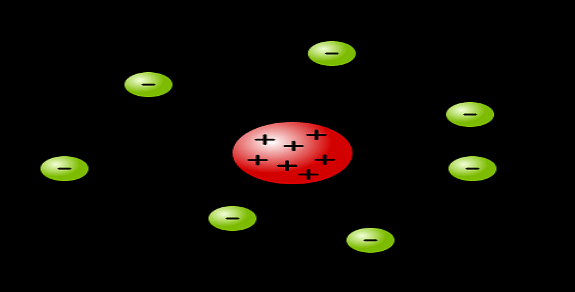
Rutherford Model
- According to this model, the nucleus is a minute fraction of the atom's total volume, located at the center.
- It is composed of protons and neutrons, which determine the atom's chemical properties.
- Rutherford proposed that electrons orbit around the nucleus in fixed paths, similar to planets orbiting the Sun.
- However, this aspect of the model was later found to be inaccurate.
Rutherford Gold Foil Experiment (Alpha Scattering Experiment)
[Click Here for Previous Year Questions]
Ernest Rutherford conducted the Alpha (α) Particle Scattering Experiment to investigate the arrangement of electrons in an atom. The experiment involved directing high-speed α-particles toward a thin sheet of gold.
- A thin layer of gold foil, approximately 1000 atoms thick, was carefully chosen for the experiment.
- α-particles, which are doubly-charged helium ions, were used due to their high energy and mass of about 4 amu.
- The hypothesis suggested that α-particles would experience minimal deflection from the subatomic particles within the gold atoms
- As the α-particles were much heavier than protons.
- However, the results of the experiment were completely unexpected and defied Rutherford's initial expectations.
Read More: Unit of Radioactivity
Observations of Rutherford’s Gold Foil (Alpha Scattering) Experiment
[Click Here for Sample Questions]
From Rutherford's α-particle scattering experiment, the following observations were made:

Alpha Scattering Experiment
- A significant number of alpha particles passed through the gold foil without any deflection
- It indicated that most of the space within an atom is empty.
- This suggests that the majority of an atom's volume consists of empty space.
- The positive charge within an atom is concentrated in a small region and is not uniformly distributed.
- The gold foil only deflected a small fraction of the alpha particles, and the deflections were extremely slight.
- This led to the conclusion that the positive charge is localized in a small volume.
Only a few alpha particles were deflected back or at large angles, and even fewer were deflected at an angle of 180 degrees. This indicates that the positively charged particles occupy only a small portion of the overall volume of an atom.
Conclusion of Rutherford’s Gold Foil (Alpha Scattering) Experiment
[Click Here for Previous Year Questions]
Based on his observations, Rutherford drew the following conclusions:
- Significant number of α-particles passed through the gold foil without any deflection
- It indicated that a large portion of the space within an atom is empty or vacant.
- Small number of α-particles were deflected off their original path
- It suggested that the positive charge in an atom occupies a relatively small volume compared to the overall size of the atom.
- Very small percentage of α-particles underwent complete rebound
- It indicated that the mass and positive charge of an atom are concentrated in a small volume
- They are not evenly distributed throughout the atom.
Read More: Alpha-Particle Scattering and Rutherford's Nuclear Model of Atom
Postulates of Rutherford Atomic Model
[Click Here for Sample Questions]
Based on the observations and conclusions of the gold foil experiment, Rutherford's atomic model proposed the following key postulates:
- An atom consists of positively charged particles.
- The majority of the atom's mass is concentrated in a small region called the nucleus.
- It was later discovered that the nucleus is composed of neutrons and protons, which are extremely small and dense.
- Surrounding the nucleus are negatively charged particles called electrons.
- These electrons move rapidly in fixed circular paths known as orbits.
- Since electrons carry a negative charge and the nucleus is positively charged, an atom is either electrically neutral or has no net charge.
- The strong electric force of attraction binds the nucleus and electrons together.
Drawbacks of Rutherford’s Model of Atom
[Click Here for Previous Year Questions]
The Rutherford atomic model has several limitations and drawbacks, including:
Instability of Electron Orbits
According to Rutherford's model, electrons orbit around the positively charged nucleus.
- However, this arrangement is not expected to be stable
- As charged particles in rapid motion would continuously lose energy and eventually collapse into the nucleus.
- This contradicts the observed stability exhibited by atoms.
Incomplete Explanation of Atomic Mass
The Rutherford model could not fully address the problem of atomic mass.
- It postulated the existence of protons in the nucleus
- It did not provide a comprehensive explanation for the distribution and contribution of atomic mass.
Lack of Electron Arrangement
The Rutherford atomic model does not explain the specific arrangement of electrons within the atom. This aspect remains unaccounted for in the model, making it incomplete in describing the overall structure of atoms.
| Relevant Concepts | ||
|---|---|---|
| Atoms Ncert Solutions | The nucleus of an Atom and Atomic Mass | Atomic Spectra |
Things to Remember
- Rutherford's atomic model was proposed by Ernest Rutherford in 1911 to explain the structure of atoms.
- It introduced the concept of a dense, positively charged nucleus at the center of an atom.
- Electrons were depicted as orbiting the nucleus in fixed paths or orbits.
- The model highlighted that most of an atom's mass is concentrated in the nucleus.
- Rutherford's experiment with gold foil demonstrated that the majority of an atom consists of empty space.
- The experiment revealed that the positive charge in an atom is concentrated in a small volume.
- The model did not explain the stability of electron orbits.
- It lacked a comprehensive explanation for atomic mass distribution.
Previous Year Questions
- Extraction of metal from the ore cassiterite involves...[JEE Advanced 2011]
- Commonly used vectors for human genome sequencing are...[NEET UG 2014]
- Interfascicular cambium and cork cambium are formed due to..
- Pneumotaxic centre is present in...[UP CPMT 2007]
- Reaction of HBr with propene in the presence of peroxide gives….[NEET UG 2004]
- Assuming the expression for the pressure exerted by the gas on the walls of the container, it can be shown that pressure is...[MHT CET 2016]
- Which among the following is the strongest acid?...[TS EAMCET 2017]
- Isopropyl alcohol on oxidation forms..
- A vector is not changed if..
- Which of the following arrangements does not represent the correct order of the property stated against it?...[JEE Main 2013]
Sample Questions
Ques. What was the specialty of Rutherford's atomic model? (5 Marks)
Ans. The specialty of Rutherford's atomic model lies in its groundbreaking concept of a dense, positively charged nucleus at the core of an atom. This model, proposed by Ernest Rutherford in the early 20th century, revolutionized our understanding of atomic structure. By conducting the famous gold foil experiment, Rutherford observed that most of the alpha particles passed through the gold foil with minimal deflection, suggesting that the atom is mostly empty space. However, a small fraction of alpha particles were deflected at large angles, indicating the presence of a concentrated positive charge in the nucleus. This discovery challenged the prevailing plum pudding model and established the concept of a central nucleus in the atom. Rutherford's atomic model laid the foundation for further advancements in atomic theory and provided a more accurate description of atomic structure.
Ques. What was the primary observation of Rutherford's atomic model? (2 Marks)
Ans. The primary observation of Rutherford's atomic model was that a significant number of alpha particles passed through the gold foil without deflection, indicating that most of the space within an atom is empty. This observation led to the understanding that atoms have a compact, positively charged nucleus surrounded by vast empty space.
Ques. Why was J.J. Thomson's atomic model flawed? (5 Marks)
Ans. J.J. Thomson's atomic model, also known as the "plum pudding" model, was flawed due to its inability to explain several experimental observations regarding atomic structure. According to Thomson's model, an atom was envisioned as a positively charged sphere with embedded electrons distributed throughout, much like raisins in a plum pudding. However, this model failed to account for the unexpected results obtained from Rutherford's alpha particle scattering experiment.
In the experiment, a thin sheet of gold was bombarded with alpha particles, and it was observed that some particles underwent significant deflection and even bounced back. This indicated the presence of a concentrated positive charge within a small region of the atom, which Thomson's model did not account for. The plum pudding model suggested a uniform distribution of positive charge, which could not explain the observed deflections and the existence of a dense nucleus.
As a result of these experimental findings, Thomson's model was deemed flawed, leading to the development of the more accurate atomic model proposed by Ernest Rutherford. Rutherford's model introduced the concept of a nucleus with a positive charge concentrated in a small volume, surrounded by negatively charged electrons in specific orbits.
Ques. Through his Alpha (α) Particle Scattering Experiment, which subatomic particle did Rutherford discover? (2 Marks)
Ans. Rutherford discovered the existence of the atomic nucleus, which consists of protons and neutrons, through his Alpha (α) Particle Scattering Experiment. This groundbreaking experiment involved bombarding a thin gold foil with alpha particles and observing their scattering patterns, leading to the conclusion that the positive charge and most of the mass of an atom are concentrated in a small, dense nucleus at the center.
Ques. What was the reason for using a gold foil in the Alpha (α) Particle Scattering Experiment? (3 Marks)
Ans. A gold foil was specifically chosen for the Alpha (α) Particle Scattering Experiment conducted by Rutherford due to its remarkable malleability and ability to be fashioned into an extremely thin sheet. This thinness was essential for the experiment as it allowed alpha particles to penetrate and interact with the atoms of the foil. By directing alpha particles at the gold foil, Rutherford aimed to investigate their scattering patterns, which would provide crucial information about the structure of the atom. The use of a gold foil provided a suitable target for the experiment, facilitating the study of the deflection and behavior of the alpha particles as they passed through the foil's atoms.
Ques. How did Rutherford define an orbit? (2 Marks)
Ans. Rutherford defined an orbit as a fixed circular path in which electrons revolve around the nucleus of an atom, much like planets orbiting the Sun. This concept was an attempt to explain the observed stability of atoms by suggesting that electrons have well-defined paths or orbits within the atom.
Ques. Who discovered the Atomic Nucleus? (3 Marks)
Ans. The discovery of the atomic nucleus is attributed to the groundbreaking work of Ernest Rutherford. Through his experiments on the scattering of alpha particles, Rutherford observed unexpected patterns that indicated the presence of a concentrated, positively charged center within the atom. This central region, which he termed the atomic nucleus, was found to contain the majority of the atom's mass. Rutherford's discovery revolutionized the understanding of atomic structure and paved the way for further advancements in the field of nuclear physics. His findings provided valuable insights into the composition and behavior of atoms, shaping the foundation of modern atomic theory.
Ques. Name the part of an atom discovered by Rutherford's α-particles scattering experiment. (2 Marks)
Ans. Rutherford's α-particles scattering experiment discovered the existence of the atomic nucleus, which is the dense, positively charged central part of an atom. This groundbreaking experiment provided evidence for the presence of a concentrated mass within the atom and challenged the prevailing model of the atom at the time.
Ques. Who first discovered the atom? (3 Marks)
Ans. The concept of the atom and its modern formulation can be attributed to the pioneering work of John Dalton, an English chemist, physicist, and meteorologist. In the early 19th century, Dalton developed a comprehensive atomic theory based on experimental evidence and scientific reasoning. His atomic theory proposed that atoms are indivisible and indestructible particles that combine in simple whole-number ratios to form compounds. Dalton's theory also included the concept of atomic weights and provided a framework for understanding chemical reactions and the conservation of mass. Although Dalton's atomic model depicted atoms as solid, indivisible spheres similar to billiard balls, his groundbreaking contributions laid the foundation for the development of atomic theory and our current understanding of the atom.
Ques. Who discovered the proton? (3 Marks)
Ans. The discovery of the proton, one of the fundamental particles of the atom, is credited to the New Zealand-born physicist Ernest Rutherford. In the early 20th century, Rutherford conducted a series of groundbreaking experiments, including the famous gold foil experiment, to investigate the structure of the atom. Through his experiments, Rutherford observed the scattering of alpha particles and deduced that the atom contains a small, dense, and positively charged nucleus. He hypothesized that this central nucleus is composed of positively charged particles, which he named protons. Rutherford's discovery of the proton revolutionized our understanding of atomic structure and paved the way for further advancements in nuclear physics. Today, we recognize the proton as a crucial component of the atomic nucleus, carrying a positive electrical charge and playing a fundamental role in determining an atom's chemical properties
For Latest Updates on Upcoming Board Exams, Click Here: https://t.me/class_10_12_board_updates
Check-Out:



Comments