



Education Content Expert
Thomson Model of Atom is one of the several scientific models of an atom proposed by William Thomson in 1900. The model was strongly supported by Sir Joseph John Thomson, who is credited for the discovery of the negatively charged particle of an atom called electron, .
- Thomson atomic model is popularly known as the ‘plum pudding model’ or the ‘watermelon model’.
- The model gives a description of the inner structure of atom theoretically.
- According to Thomson, atoms are surrounded by uniform spheres of positively charged matter which contain electrons.
Read More: NCERT Solutions for Class 11 Chemistry Structure of Atom
Thomson Atomic Model
[Click Here for Sample Questions]
Thomson Model of Atom is considered to be one of the first models of an atom that aimed to describe the structure of an atom.
- The model was proposed just after the discovery of electrons.
- The nucleus of an atom was yet to be discovered at that time.
- Thus, the model was laid on the basis of known properties at that time.
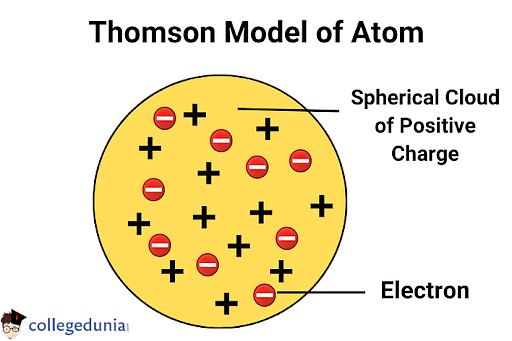
The properties of an atom that were known when the Thomson Model of Atom was proposed were:
- Negatively charged particles are called electrons while positively charged particles are called protons.
- Due to the presence of equal positive and negative charges the total charge on the atom becomes zero.
Read More:
History of Thomson Atomic Model
[Click Here for Previous Year Questions]
J.J. Thomson was one of the first scientists who proposed a model for the structure of an atom. He discovered electrons (negatively charged particles) through a cathode ray experiment in 1897.
- Cathode ray tubes are glass-sealed tubes that are air-tight and sealed completely.
- The negatively-charged particles were referred to as electrons.
- Thomson believed that electrons are two thousand times lighter than a proton.
- According to him, an atom is composed of a cloud of negative charge in a sphere of positive charges.
- J.J Thomson and Rutherford were the first people to demonstrate the ionization of air in X-rays.
Read More: Alpha-Particle Scattering and Rutherford’s Nuclear Model of Atom
Postulates of Thomson Model of Atom
[Click Here for Sample Questions]
The postulates of Thomson’s atomic model are as follows:
- Postulate 1: An atom consists of a positive charge with electrons embedded in it.
- Postulate 2: An atom is completely neutral where the positive charge is uniformly distributed and electrons are arranged in such a way that the atom is electrostatically stable.
Thomson Model of Atom is similar to a plum pudding or a watermelon in which
- Watermelon seeds are considered negatively charged particles.
- The red part of the watermelon is taken as the positively charged sphere.
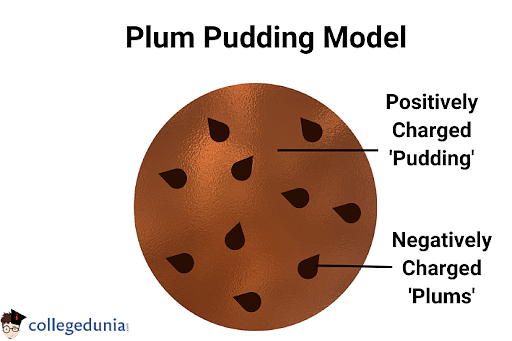
Plum Pudding Model
Read More: Structure of Atom Class 11 MCQs
Limitations of Thomson’s Atomic Model
[Click Here for Previous Year Questions]
Thomson Model of Atom was soon discarded by the Rutherford atomic model on several grounds. The limitations of Thomson’s atomic model are as follows:
- Thomson failed to explain the stability of an atom as to how can positive charge holds the negatively charged electron in an atom.
- He wasn’t able to explain the position of the nucleus in an atom and how the nucleus is so densely polluted with a positive charge.
- Thomson also failed to explain the scattering of alpha particles by thin metal foils
Though the Thomson Model of Atom was inaccurate and had several limitations, it proved to be the base for the development of other atomic models to describe the structure of an atom.
Check More:
Things to Remember
- Thomson Model of Atom is one of the very first atomic models proposed by William Thomson.
- Thomson proposed that an atom is neutrally charged with electrons embedded in a cloud of positive charge.
- Thomson Model of Atom is also called as watermelon model or plum pudding model.
- Thomson failed to explain the concept of the nucleus and presence of a nucleus in an atom and the charge density of the nucleus.
- The flaws of Thomson's atomic model were corrected and explained by Bohr's atomic model.
- Thomson's experiment is known for the cathode ray experiment, atom neutrality, and mass of an atom.
Read More: Structure of Atoms Important Questions
Previous Years’ Questions
- "Plum pudding" model of an atom was proposed by… (COMEDK UGET - 2012)
- The radius of an electron orbit in a hydrogen atom is… (DUET - 2009)
- If a species has 16 protons, 18 electrons, and 16 neutrons… (WBJEE - 2010)
- Of the following sets which one does not contain… (AIEEE - 2005)
- Rutherford's atomic model could account for… (KCET - 2011)
- In Sommerfeld's atomic model, corresponding to… (COMEDK UGET - 2006)
- If a magnesium atom having atomic number 12 has an… (AIIMS - 1999)
- Hydrogen atom in the ground state is excited by a… (NEET - 2014)
- According to Classical theory, the Rutherford model of atom is…
- In Rutherford’s α -particle scattering experiment, most of the…
Sample Questions
Ques. What are the features of the Thomson Model of Atom? (3 Marks)
Ans. The features of the Thomson Model of Atom are as follows:
- An atom is made up of positively charged spheres in which electrons are embedded in it.
- An atom is electrically neutral in which positive and negative charges are in the same numbers.
- He explained the measurement of mass to charge ratio.
- Thomson believed that particles emerge from the molecule of gas in the vicinity of the cathode.
Ques. What are the limitations of the Thomson Model of Atom? (3 Marks)
Ans. Thomson Model of Atom was discarded due to some of its limitations which are as follows:
- The model failed to explain the stability of an atom and how a positive charge holds the negatively charged electrons in an atom.
- It failed to explain the position of the nucleus in an atom.
- The scattering of alpha particles by thin metal foils was also not explained by the model.
Ques. What is the mass-to-charge ratio according to Thomson? (1 Mark)
Ans. According to Thomson, he discovered in his experiment that particles are the part of the atom and the mass of each atom is 1/2000 that of the mass of a hydrogen atom.
Ques. What is the Thomson Model of Atom known as the watermelon or plum pudding model? (2 Marks)
Ans. Thomson Model of Atom was compared with watermelon as the red mass of watermelon was compared with a positive charge and seeds were compared with a negative charge on an atom. Thomson's atomic model was also considered similar to plum pudding in a similar manner.
Ques. Explain the following:
1. Atom
2. Nucleus
3. Cathode Rays (3 Marks)
Ans. (A) An atom is the smallest particle of a matter or substance that uniquely describes a chemical element.
(B) Nucleus is the small, dense, and central part of an atom consisting of protons and neutrons.
(C) Cathode Rays are a beam of electrons emitted from the cathode of a big vacuum tube. These are negatively charged in nature.
Ques. What is Rutherford’s Atomic Model? (3 Marks)
Ans. In his experiment, Rutherford passed the alpha rays from the gold foil and found that some of the rays were reflected with an angle of almost 90 degrees while most of the rays passed through the gold foil. Rutherford's atomic model says that an atom is of mostly space and very tiny space in the center a positive charge nucleus is situated. This center point is called the nucleus of an atom.
Ques. What is an alpha particle? (1 Mark)
Ans. Alpha particles are also known as alpha rays or alpha radiation. It consists of protons and neutrons bound together that are identical to a helium nucleus. It is generally produced by alpha decay.
Ques. Why is J J Thomson's model important? (2 Marks)
Ans. JJ Thomson's model was considered important from the viewpoint of the neutrality of an atom as he explained that the atom as a whole is completely neutral. Also, though the model was not accurate, it laid the foundation for the several atomic models that were proposed later on.
Ques. Explain the three main postulates of Thomson Model of Atom. (3 Marks)
Ans. The three main postulates of Thomson Model of Atom are
- Cathode rays consist of a negative charge.
- An atom consists of a positive charge and electrons are embedded in it.
- The atom as a whole is electrostatically neutral and the center part is called the nucleus.
Ques. What factors contributed to the discovery of electrons? (2 Marks)
Ans. J.J. Thomson's cathode ray tube experiments demonstrated that all atoms contain small negatively charged subatomic particles or electrons. Thomson presented the plum pudding model of the atom, which contained negatively charged electrons within a positive charge sphere.
Check-Out:



Comments