



Content Curator
Scalar and Vector Quantities are used to represent the motion of an object. Scalar Quantity is related to the magnitude of any other quantity. Vector Quantity is the physical quantity that has both magnitude and direction. Common scalar quantities include distance, speed, etc., and vector quantities include displacement, force, etc.
Read Also: Motion
| Table of Content |
Key Terms: Scalar Quantities, Vector Quantities, Force, Vector Notation, Distance, Magnitude
Scalar Quantity
[Click Here for Sample Questions]
A scalar quantity is one in which the number of fields associated with the unit of measurements, such as a degree or meter, contains only one element. It is a quantity that is defined by a numerical value and a measuring unit and merely refers to size or magnitude.
Algebra rules can be used to link scalar quantities, such as scalars, which can be multiplied or subtracted in the same way that numbers can. For a scalar amount, however, the procedure is only possible for numbers with the same measurement unit.
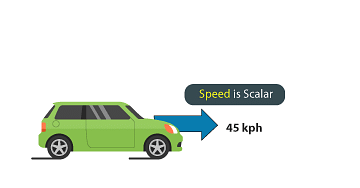
Scalar Quantity
Scalar Quantity ExamplesA scalar quantity can have many different forms. Below is a list of some of them!
|
The video below explains this:
Types of Vectors Detailed Video Explanation:
| Important Learning Concepts | ||
|---|---|---|
| Negative of a Vector | Coplanar Vector | Addition Of Vector |
| Unit Vector | Resolution of vectors | Vector product of two vectors |
Vector Quantity
[Click Here for Previous Year Questions]
The mathematical quantity that includes magnitude and direction as two independent qualities to describe it is known as a vector quantity. The size of the quantity with absolute value is represented by magnitude. In contrast, direction denotes the direction of travel, such as north, east, south, west, north-east, and so on.
Vector quantity adheres to the triangle law of addition. A vector is denoted by a vector quantity illustrated by an arrow put over or next to a symbol.

Vector Quantity
Vector Quantity ExamplesIn real life, there can be a plethora of vector quantity examples. Below is a list of some of them!
|
Difference between Scalar and Vector Quantities
[Click Here for Sample Questions]
Key differences between scalar and vector quantities are tabulated below:
| Parameters | Scalar | Vector |
|---|---|---|
| Definition | There is simply magnitude in a scalar, but no direction. | The magnitude and direction of a vector are both present. |
| Quantities | Each scalar quantity has only one dimension. | The dimension of a vector quantity can be one, two, or three. |
| Change | It shifts as the magnitude of the events shifts. | It shifts in response to changes in size or direction. |
| Resolution | Because a scalar quantity has the same value regardless of direction, it cannot be resolved. | The sine or cosine of the nearby angle can be used to resolve a vector quantity in any direction. |
| Operation | Any mathematical action between two or more scalar numbers returns just a scalar. When a scalar is combined with a vector, the outcome is also a vector. | Scalar or vector can be the result of mathematical operations between two or more vectors. The dot product of two vectors, for example, yields a scalar; nevertheless, the cross product, summation, or subtraction of two vectors yields a vector. |
| Expression | Simple alphabets are used to represent them, such as V for velocity. | Simple alphabets are used to represent them, such as V for velocity. |
| Measurement | Simple | Complex |
| Example | An automobile is traveling at 110 kilometers per hour. | An automobile is traveling at 50 kilometers per hour in the east. |
The video below explains this:
Multiplication of Vector by Scalar Detailed Video Explanation:
Vector Addition
As previously stated, vectors cannot be added algebraically. There are a few things to keep in mind when adding vectors:
- The addition of vectors is done geometrically rather than algebraically.
- The behavior of vectors whose resultant must be determined is independent of one another.
- Finding the outcome of several vectors acting on a body is known as vector addition.
- The addition of vectors is commutative. This indicates that the output vector is unaffected by the order of the input vectors.
- Property of Commutation:
\(\overrightarrow{A}+\overrightarrow{B} = \overrightarrow{B}+\overrightarrow{A}\)
Vector Subtraction
Vector subtraction isn't used very often in physics problems, although it does occur. Put their feet (or tails, the non-pointy bits) together to subtract two vectors; then draw the resultant vector, which is the difference of the two vectors, from the head of the vector you're subtracting to the head of the vector you're subtracting it from.
Vector Notation
[Click Here for Previous Year Questions]
Geometric Representation of Vectors
- An arrow is used in this vector representation. The magnitude of the vector is denoted by the length of the arrow, while the direction of the vector is indicated by the arrowhead.

Geometric Representation of Vectors
Rectangular Notation
- The vector is located in a rectangular coordinate system in this sort of vector representation, as seen below.

Rectangular Notation
Points to Remember
In terms of the scalar and vector difference, the following points are crucial:
- The scalar quantity is the quantity that has a magnitude without any direction. The vector quantity, on the other hand, takes into account both magnitude and direction when describing its physical quantity.
- Scalar quantities can be used to explain one-dimensional values; for example, a speed of 35 km/h is a scalar quantity. Multidimensional quantities, such as temperature changes, may be represented using vector quantities, whereas multidimensional quantities, such as temperature changes, can be described using vector quantities.
- When only the magnitude changes, the scalar quantity changes; however, when the vector quantity changes, both the magnitude and direction must change.
- Scalar quantities conduct operations using standard algebra rules such as addition, multiplication, and subtraction, whereas vector quantities use vector algebra principles.
- A scalar quantity can also divide another scalar amount, but two vector quantities cannot.
| Important Concepts | ||
|---|---|---|
| Displacement vector | Resultant Vector Formula | Velocity Vectors |
Previous Year Questions
- A man moves 20 m North, then 10 m East and then… [AP EAPCET]
- The ratios of the distance traversed, in successive intervals of time by a body… [AMUEEE 2010]
- A body is moved along a straight line by a machine delivering constant power… [NEET 2000]
- The numerical ratio of displacement to the distance covered is always… [BHU VET]
- The masses of blocks A and B are m and M respectively. Between… [BITSAT 2015]
- The displacement-time graph of a moving particle is shown below… [NEET 1994]
- The displacement-time graphs of two moving particles make angles of… [KCET 2011]
- A particle moves along a straight line OX. At a time…
- If a car at rest accelerates uniformly and attains a speed of… [AMUEEE 2005]
- Position-time graph for motion with zero acceleration is… [JKCET 2011]
- The displacement ′x′ (in meter) of a particle of mass ′m′ (in kg) moving in… [AMUEEE 2014]
- The relationship between the force F and position x of a body is as shown in…
- The displacement of a particle at time t is x, where…
- The length of perpendicular from the origin onto the line…
- Two lines, which do not lie in the same plane, are called…
Sample Questions
Ques 1. Why is Electric current not a vector as it has a direction? (1 mark)
Ans. Electric current flows in the opposite direction of electron flow. Current has both magnitude and direction, but it does not follow the vector addition rule. As a result, it's a scalar.
Ques 2. Is force a vector or scalar? (1 mark)
Ans. Even though a force has both magnitude and direction, it is still a force. However, the magnitude of some forces (such as the gravitational force) can be defined as a scalar quantity. To put it another way, while the gravitational force exerted on a particle is not a scalar, its magnitude is.
Ques 3. Is time a vector? (1 mark)
Ans. There is currently no defined definition of time. Time, however, is not a vector quantity, but rather a scalar one, according to the scientific community. Why? It goes forward in a straight line because its direction never changes.
Ques 4. Is temperature a scalar or Vector Quantity? (2 marks)
Ans. It's a hard question, to say the least. I mean, depending on how the temperature is measured, it can be either a scalar or a vector quantity.
It's a scalar quantity, for example, if you're measuring a constant temperature. The measurement of a temperature decline or increase, on the other hand, is a vector quantity.
Ques 5. Give the difference between dot product and cross product? (1 mark)
Ans. Dot product and cross product are distinguished by the fact that the dot product is the product of the magnitude of the vectors and the cos of the angle between them, but the cross product is referred to as the product of the magnitude of the vector and the sine of the angle in which they subtend each other.
Ques 6. What is the magnitude of a unit vector? (1 mark)
Ans. A unit vector has a magnitude of one. There are no units or dimensions in a unit vector.
Ques 7. What is the sum of two vectors' maximum and minimum values? (1 mark)
Ans. When two vectors are headed in the same direction, the maximum sum of the two vectors is obtained. When the two vectors are headed in opposing directions, the smallest sum is obtained.
Ques 8. Is it possible to add any two vectors? (1 mark)
Ans. Vector addition does not work with any two vectors. Only two vectors of the same type and nature are combined. Two velocity vectors, for example, can be combined, but one velocity vector and one force vector cannot.
Ques 9. Explain how vector addition has an associative property. (1 mark)
Ans. The associative property of vector addition asserts that regardless of the order in which the vectors are placed, the sum of the vectors remains the same.
Ques 10. Is it possible for the sum of two vectors to be zero? (1 mark)
Ans. Yes, the sum of two vectors of identical magnitude pointing in opposing directions is zero.
Ques 11. What is the key difference between a scalar quantity and a vector quantity? (1 mark)
Ans. The key difference between scalar and vector quantity is direction. Scalar Quantity has magnitude only and no direction. A vector quantity, on the other hand, has a magnitude and direction.
Ques 12. Differentiate between scalar and vector quantities based on the concept of distance and displacement. (2 Marks)
Ans. Both distance and displacement are measurements of length. Distance is the total length covered by a body, whereas displacement is the shortest distance between two endpoints. Where distance is just the length, displacement is along a certain direction, giving the shortest length between the starting and the endpoint. Thus, distance only has a value, but displacement has a direction along with a value.
Ques 13. A parallelogram law helps to find the magnitude and direction of the resultant of two forces:
a) State the law.
b) If the magnitude of two vectors and their results are the same, what is the angle between the two vectors? (MARCH – 2012) (3 Marks)
Ans. a) Parallelogram law of vector addition
This law states that if two vectors acting at a point can be represented in magnitude and direction by the two adjacent sides of a parallelogram, then the diagonal of the parallelogram through that point represents the resultant vector.
b) R = \(\sqrt{A^2+B^2+2ABcos \theta}\)
Here R = F, A = F and B = F
F = \(\sqrt{F^2+F^2+2F^2 cos\theta}\)
F² = F²+ F²+ 2F²Cos θ
F² = 2F² + 2F² Cos θ
F² – 2F² = 2F² Cos θ
F² = 2F² Cos θ
-1/2 = Cos θ
θ = 120°
Ques 14. Answer the following:
a) What are orthogonal unit vectors?
b) What is a zero vector? Give its significance in Physics with an example. (May 2012 Plus One) (3 Marks)
Ans. a) \(\hat{i}, \hat{j}, \hat{k}\) are orthogonal unit vectors.
b) A vector having zero magnitudes is called a zero vector.
Since the magnitude is zero, we don’t have to specify its direction.
Example: Suppose that an object which is at p at time t moves to p’ and then comes back to p. In this case, displacement is a null vector.
Ques 15. A stone is thrown with the help of a sling with initial velocity v0 at an angle 0 from the horizontal.
a) Working of a sling is based on law of vector addition.
b) With the help of a vector diagram.state this law.
c) Derive the expression for the maximum height reached by the stone. (Plus One MARCH – 2015) (3 Marks)
Ans. a) Parallelogram
b) Parallelogram law of vector addition: This law states that if two vectors acting at a point can be represented in magnitude and direction by the two adjacent sides of a parallelogram, then the diagonal of the parallelogram through that point represents the resultant vector.
c) Vertical height of body is decided by vertical com-ponent of velocity (u sinθ). The vertical displace-ment of projectile can be found using the formula
v² = u² + 2as
When we substitute v = 0, a = – g,s = H and u = usinθ, we get
0 = (usinθ)² + 2 – g x H
2gH = u²sin²θ
H = \(\frac{u²sin²θ}{2g}\)
Ques 16. Explain how time is a scalar quantity. (3 Marks)
Ans. The difference between a scalar and a vector is that a vector requires a direction. Scalar quantities have only magnitude; vector quantities have both magnitude and direction. Time is completely separated from direction; it is a scalar. It has only magnitude, no direction.
Important differential factors:
- Speed is a scalar, while velocity is a vector.
- Distance is a scalar, while displacement is a vector.
- Force and acceleration are vectors. Time is a scalar.
Ques 17. Michael walks 10m north, 3m west, 5m south, 12m east, and then stops to catch his breath. What is the magnitude of his displacement from his original point? (5 Marks)
Ans. Displacement is a vector quantity; the direction that Michael travels will be either positive or negative along an axis. We are being asked to solve for his position relative to his starting point, NOT for the distance he has walked.
First we need to find his total distance travelled along the y-axis. Let's say that all of his movement north is positive and south is negative.
∑Y=10m−5m=5m. He moved a net of 5 meters to the north along the y-axis.
Now let's do the same for the x-axis, using positive for east and negative for west.
∑X=−3m+12m=9m. He moved a net of 9 meters to the east.
Now to find the resultant displacement, we use the Pythagorean Theorem. The net movement north will be perpendicular to the net movement east, forming a right triangle. Michael's position relative to his starting point will be the hypotenuse of this triangle.
D2 = (∑X)2+(∑Y)2
D2 = (9m)2+ (5m)2
D2 = 106m2
Now, takeing square root of both sides.
\(\sqrt{D^2} = \sqrt{106m^2}\)
D=10.30m
Since the problem only asks for the magnitude of the displacement, we do not need to provide the direction.
Ques 18. Chris is washing windows on a large building. He starts by washing the window on the 4th floor, then down to the 3rd floor, then up to the 6th floor, then down to the 5th floor, then down to the 2nd floor, and finally washes the 1st floor window. What is his total distance? (4 Marks)
Ans. Distance is a scalar quantity and will take into account only the number of floors travelled, regardless of the direction of movement.
Walter takes an incredibly complicated path to wash the windows on the building. When calculating distance, we add up all the movement he does, regardless of direction.
First, he travels down one floor (4th to 3rd).
Dtotal=(1)
Then he travels up three floors (3rd to 6th).
Dtotal=(1)+(3)
Then he travels down one floor (6th to 5th), then down another three floors (5th to 2nd).
Dtotal=(1)+(3)+(1)+(3)
Finally, he travels down one more floor (2nd to 1st).
Dtotal=(1)+(3)+(1)+(3)+(1)=9
In total, Walter travelled 9 floors.
Also check:



Comments