



Education Journalist | Study Abroad Lead
The first law of thermodynamics states that energy can neither be created nor it can be destroyed, it can only be exchanged and therefore the total energy of the universe always remains constant. The second law of thermodynamics puts specific constraints on the heat engines’ achievable efficiencies and the direction of the heat transfer. Any process can only take place if it satisfies both the first and second laws of thermodynamics. In this article, we will cover the second law of thermodynamics, its equation, and its statements.
| Table of Content |
Keyterms: Thermodynamics, Constant Pressure Process, internal energy, force, piston, heat transfer, entropy, isolated system, second law of thermodynamics, First law of thermodynamics
What is the second law of thermodynamics?
[Click Here for Sample Questions]
The law of conversation of energy is the principal and first law of thermodynamics. General experience shows that there are many conceivable processes that are fully permitted by the First Law and yet they are never observed. The non-compliance of the process with the second law of thermodynamics might be the reason behind that.
The second law of thermodynamics states that the entropy of an isolated system never decreases over time. The entropy refers to the randomness of the universe. Thus, any process that occurs spontaneously escalates the universe’s entropy (S).
2nd Law of Thermodynamics:
- Heat flows spontaneously from a hot body to a cool one.
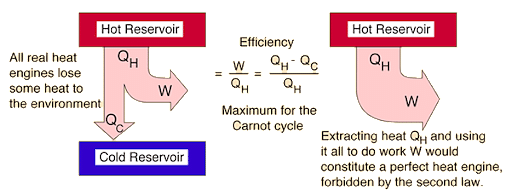
- One cannot convert hear completely into useful work.
- Every isolated system becomes disordered in time.
The equation of the second law of thermodynamics is ΔSuniv> 0.
The second law of thermodynamics justifies the concept of entropy as a physical property of the thermodynamic system. Entropy forecasts the spontaneous processes and determines if they are irreversible or impossible despite following the necessary requirements of conservation of energy stated as the first and principal law of thermodynamics.
Also Read:
| Related Articles | ||
|---|---|---|
| First Law of Thermodynamics | Zeroth Law of Thermodynamics | Adiabatic Process |
| Isothermal Process | Hess's Law of Constant Heat Summation | Standard Enthalpy of Formation |
Second law of thermodynamics: Equation
[Click Here for Sample Questions]
Mathematical representation of the second law of thermodynamics is as follows:
ΔSuniv > 0
ΔSsystem + ΔSsurrounding > 0
Here, ΔSuniv refers to the entropy change in the universe. Entropy is the measure of the chaos or energy within an isolated system. It’s the measure of randomness and can be viewed as a quantitative index describing the quality of energy. In the meantime, few factors cause an increase in the entropy of the closed system.
- In a closed system with constant mass, there is an exchange of heat. This change in heat content creates a disturbance in the system that the entropy of the system increases.
- Internal changes can occur in the movements of molecules in the system. This leads to disturbances, which also lead to irreversibilities within the system which contribute to an increase in entropy.
Check Important Notes for Helmholtz Free Energy
Second Law of Thermodynamics: Statements
[Click Here for Sample Questions]
There are two different statements of the second law of thermodynamics and they are given by Kevin Plank and Clausius. These two statements of the Second law of thermodynamics are completely equivalent.
-
Kelvin Plank Statement
The production of a network, by a heat engine, that generates power and works in a thermodynamic cycle is impossible if it only exchanges heat at a fixed temperature.
Exception: The Kelvin Plank statement is violated when Q2 =0, which means when the Wnet = Q1 and efficiency is equal to 1.
-
Clausius Statement
The transfer of heat from a source having low temperature to a medium with higher temperature is impossible when additional energy from an external source is not provided. The refrigerators and heat pump works on Clausius’ Principle.

Both above-stated statements are completely equivalent, which means that any device that violates Kelvin’s statement will violate Clausius’s statement.
Check out more detailed notes of Chapter 6 Thermodynamics. (THERMODYNAMICS.pdf)
Also Read:
Second Law of Thermodynamics: Things to Remember
- The second law of thermodynamics states that the entropy of an isolated system never decreases over time.
- The equation of the second law of thermodynamics is ΔSuniv> 0. Here, ΔSuniv refers to the entropy change in the universe.
- Kelvin Plank Statement: The production of a network that generates power and works in a thermodynamic cycle is impossible if it only exchanges heat at a fixed temperature.
- Clausius Statement: The heat transfer from a low temperature to a higher temperature is impossible when additional energy from an external source is not provided.
Read Also: Rotational Kinetic Energy Derivations
Sample Questions
Ques. Two bodies with varying temperatures T1 and T2 are brought into thermal contact but the final temperature is not (T1 + T2)/2?(1 mark)
Ans. In thermal contact, heat from the body at a higher temperature flows up into the body at a lower temperature until the temperatures even out. The final temperature can only be the mean temperature (T1 + T2)/2 if the heat capacities of the two bodies are the same.
Ques. While driving, a car tire’s air pressure increases. Why? (1 mark)
Ans.When driving a car, you work on types to overcome the dissipative forces of friction and drag, etc. This work done is converted into heat, so that the temperature of the types of cars increases.
Ques.The climate of a port city is warmer (without extreme heat and cold) than that of a city in a desert at the same latitude. (1 mark)
Ans.The climate of the port city is warmer (neither too hot nor too cold) due to the formation of the sea breeze during the day and the land breeze during the night
Ques. What does Kelvin Plank’s Statement in Thermodynamics deal with? (1 mark)
Ans. Kelvin Plank's statement reflects the concept of a heat engine. According to Kelvin Planck's statement on the second law, "It is impossible to build a device (motor) that works in a circuit that produces no other effect than the extraction of heat from a single reservoir and converts everything into work."
Ques. The heat flows from a cold body to a hot body with aid of an external source. Explain. (2 marks)
Ans. Clausius gave the statement that it’s impossible to construct a system that works in a circuit, transferring heat from the low-temperature object to the high-temperature one without any external influence or working interaction with the environment. Refrigerators are based on Clausius' statement of the second law of thermodynamics.
Ques. State and explain briefly the equation of entropy. (2 marks)
Ans. ΔSuniv> 0
The second law of thermodynamics establishes a new property called entropy S, which is a large property of a system. Here, ΔSuniv refers to the entropy change in the universe. Entropy is the measure of the chaos or energy within an isolated system.
Ques. What does the change in entropy depend on? (1 mark)
Ans. Entropy is a measure of the no. of microscopic configurations a thermodynamic system can have when it is in a state specified by the macroscopic variable. Therefore the change in entropy depends on the thermodynamic state.
Ques. How you can show that Kelvin and Clausius's statements are equivalent? (1 mark)
Ans. The Clausius and Kelvin Planck statements of the second law are completely equivalent. This equivalence can be shown by showing that violating one of the statements can lead to violating the other.
For Latest Updates on Upcoming Board Exams, Click Here: https://t.me/class_10_12_board_updates
Check-Out:



Comments