



Exams Prep Master
Silicones are Polymers. Any synthetic compound that is inert and is constructed from siloxane iterative units falls within this category of polymers. It is a chain of hydrogen, carbon, and silicon atoms that alternately combine with oxygen and silicon atoms. The family of high-performance materials known as silicones also includes silicone fluids, silicone polymers, and reactive silanes.
NCERT Solutions for: Class 12 Chemistry Chapter 7 The p-Block Elements
| Table of Content |
Key Terms: Silicone, Uses, Polymer, Insulation, Compounds, Silica, Safety, Carbon and Oxygen
What are Silicons?
[Click Here for Sample Questions]
A silicone, also known as polysiloxane, is a polymer made up of siloxane. They are typically colorless oils or rubber-like substances. The modern class of synthetic materials, silicones are used in countless applications that promote safety and wellbeing in daily life. They are widely utilized in a variety of industrial and consumer applications.
Read more:
| Related Articles | ||
|---|---|---|
| Group 15 Elements | Dinitrogen | Ammonia |
| Oxides of Nitrogen | Nitric Acid | Phosphine |
| Oxoacids of Phosphorus | Group 16 Elements | Dioxygen |
Properties of Silicones
[Click Here for Previous Years Questions]
The following are some of the typical characteristics of silicones.
- Silicones are chemically reactive and have poor thermal conductivity.
- Furthermore, they are not poisonous.
- It may create watertight seals and resist water.
- It possesses strong ozone, UV, and oxygen resistance.
- It possesses both conductive and electrically insulative qualities.
- Silicon High gas permeability
- It is a superior organic compound solvent.
- Adheres poorly to some substrates yet extremely well to others, such as glass
- Silicon does not permit the growth of microorganisms
- Silicone is appropriate for a variety of electrical applications because it may be made to be either electrically conductive or insulative.
Properties of Silicones
Read more: Transition Metals
Key Facts about Silicones
[Click Here for Sample Questions]
- When silicone is burned in the presence of oxygen, char, different gases, and solid silica (silicon dioxide, SiO2) are all produced. A common name for this white powder is silica fume.
- In important areas of our economy, such as health care, aerospace, personal care, electronics, transportation, and construction, silicon goods offer critical advantages.
- Typically, they are rubber-like compounds or colourless oils.
- Based on silicone resins, the second-largest class of silicone compounds is made up of branching and cage-like oligosiloxanes.
Structure and Composition of Silicones
[Click Here for Previous Years Questions]
Silicones differ from many industrial polymers in that carbon, the defining component of organic compounds, is not present in the chain of atoms that forms the backbone of their molecules.
- Silicone is a unique polymer since it doesn't contain carbon, even if every silicon atom is bonded to a maximum number of members of class II organic groups, including methyl (CH3) and vinyl (CH2).
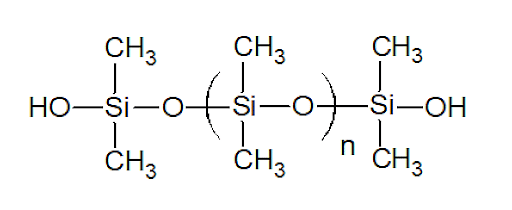
- Silicones, also known as polymerized siloxanes or polysiloxanes, feature an inorganic silicon-oxygen backbone chain (Si-O-Si-O-Si-O) with two organic groups joined to each silicon core.
- Silicon has the generic formula (R2SiO) x, where R can be any of the organic groupings.
- The silicone compound that best exemplifies the fundamental traits of the organic class is poly-dimethyl siloxane.
- The first material, made from silica sand, is metallic silicon. Over a copper catalyst, the silicon combines with methyl chloride (Ch3Cl) to produce dimethyldichlorosilane ([CH3]2Si [Cl] 2).
- Chlorine atoms in this chemical are replaced by hydroxyl groups when it reacts with water (OH). Condensation process causes the resultant molecule, silanol ([CH3]2Si [OH] 2), to polymerize.
- When molecules bind together to generate poly-dimethyl siloxane, water is lost as a result of the process.

Structure and Composition of Silicones
Read more: Inner Transition Metals
Uses of Silicone
[Click Here for Sample Questions]
Engineers, inventors, and businesses can employ silicones as a crucial component in a wide range of industrial applications since they can take on different forms, from liquids to solids.
Because of their adaptability, silicones are a crucial component in goods that improve our lives, whether they take the form of silicone gels, silicone glue, fluids, resins, or rubbers. Silicones can also be used in renewable energy sources, including solar panels and wind turbines, which rely on silicone technology.
- Automotive
Silicone grease is frequently used as a lubricant for brake components in the automotive industry because it is stable at high temperatures, is not water-soluble, and is far less likely to foul than other lubricants. The foundation of DOT 5 brake fluids is a liquid silicone.
To stop sparks from jumping to nearby wires and causing misfires, automotive spark plug wires are insulated by many layers of silicone. Some vehicle intake systems employ silicone tubing.
- Aerospace
Due to its ability to seal, maintain stability over a large temperature range, be durable, have sound-dampening and anti-vibration capabilities, and be naturally flame retardant, silicone is a material that is frequently utilized in the aerospace sector. In the aerospace sector, maintaining extreme functionality is crucial for passenger safety, hence each component of an aircraft needs high-performance materials.
Silicone grades created specifically for the aerospace industry range in temperature from 70 to 220 °C,and can be used to make gaskets for windows and cabin doors.
- Moldmaking
To cast resins, foams, rubber, and low-temperature alloys, two-part silicone systems are employed as rubber molds. As most materials don't stick to silicone, a silicone mould typically requires little to no mould-release or surface preparation. Ordinary one-part silicone can be moulded into shapes or used to create molds for experimental purposes.
- Construction
The construction sector is well aware of silicone rubber's durability and dependability. Buildings frequently utilize one-part silicone caulks and sealants to fill up cracks and gaps. Installation is made simpler by one-part silicones' ability to cure by absorbing atmospheric moisture. O-rings in brass taps and valves are frequently greased with silicone in plumbing to prevent lime from adhering to the metal.
- Coating
Glass, for example, is a silica-based substrate that can be coated with silicone sheets to provide a covalently bonded hydrophobic covering. Such coatings were created to be applied to airplane windshields in order to deflect moisture and maintain visibility without the need for mechanical wipers, which are unfeasible at supersonic speeds. Similar treatments later found their way into products sold by Rain-X and others for the automotive sector.
- Cookware
Where contact with food is essential, silicone can be utilized because it is a low-taint, non-toxic substance. In the cookware business, silicone is growing in importance, especially for bakeware and kitchen utensils. Silicone serves as an insulator in products like heat-resistant potholders.
- Dry Cleaning
The typical perchloroethylene (perc) solvent, which contains chlorine, can be substituted with liquid silicone as a dry cleaning solvent.
- Jewellery
With regard to rings, silicone is a well-liked substitute for conventional metals (such as silver and gold). In occupations where metal rings might cause injuries like electrical conduction and ring avulsions, silicone rings are frequently worn.
- Medicine and Cosmetic Surgery
Silicone is utilized for high biocompatibility applications such as microfluidics, seals, gaskets, shrouds, and more. In addition, the gel form is utilized in bandages, dressings, contact lenses, breast implants, testicular implants, pectoral implants, and numerous more medical applications.
Illegal cosmetic silicone injections have the potential to cause permanent silicone blood diffusion and dermatological issues.
- Personal Care
In many personal care items, silicones are employed. They are utilized to lessen the antiperspirant's white residue and sticky feeling in deodorants. To keep the colour and luster of the compound, silicones are added to shampoos, conditioners, and cosmetic products. Better shine is allegedly provided by silicones, and stronger SPF can be added to skincare products.
- Electronics
Keyboards, copier rollers, and keyboard keypads all include silicone. Silicones are used in a wide range of different parts of computers, mobile devices, and home entertainment systems. Silicones enable LED lighting technology. It has great dielectric qualities and strong thermal stability. As a result, it is employed in numerous electrical transmission applications.
- Solar Panels and Photovoltaic Devices
Silicones are excellent materials for enhancing the effectiveness, reliability, and performance of solar panels and other photovoltaic equipment. In essence, they can endure the light for years.
- Lubricants
In various situations, silicones are employed as lubricants. Chains on bicycles and other machinery are lubricated using silicone grease.
- Toys
Dimethyl siloxane, polydimethylsiloxane, and decamethyl cyclopentasiloxane are among the silicones that make up Silly Putty and comparable substances. This substance is renowned for its peculiar properties, such as the fact that it bounces yet breaks when subjected to a strong impact; given enough time, it will also flow like a liquid and form a puddle.
Read more: Argon
Production Process of Silicone
[Click Here for Previous Years Questions]
The most common method of making silicones is to reduce silicon dioxide (silica) in the form of sand with carbon at high temperatures:
SiO2(s) + 2C(s) → Si(s) + 2CO(g)
Typically, silicon is converted into silicone in three steps:
a) Chlorosilane synthesis
b) Chlorosilane hydrolysis
c) Polymerization condensation
White powder, char, and different gases are produced when silicone is burned in the presence of oxygen and solid silica (silicon dioxide, SiO2). The easily dispersed powder is occasionally referred to as silica fume.
Read more: Bromine
Safety and Environmental Effects of Silicone
[Click Here for Sample Questions]
The environment has been found to be heavily populated with silicone compounds. The safety of silicones has been the subject of numerous studies and discussions, but many people believe that the amount or concentration of this molecule entering the environment does not pose a threat to human life or health.
- On the other hand, despite being air and water pollutants, silicone compounds such cyclic siloxanes D4 and D5 have been linked to adverse health consequences in test animals.
- D4 is a persistent, bioaccumulative, and toxic (PBT) compound, while D5 is a very persistent, very bioaccumulative (vPvB) substance, according to the European Chemicals Agency.
- Other silicones biodegrade quickly, and a number of catalysts, including clays, can hasten this process.
- It has been demonstrated that cyclic silicones cause silanols to form during mammal biodegradation.
Read more: Bismuth iii chloride formula
Silicon Compounds
[Click Here for Previous Years Questions]
Around 95% of the chemicals in the crust of the planet are silicates and silica. Silica, often known as silicon dioxide (SiO2), exists in a variety of crystallographic shapes. When subjected to an appropriate temperature, some crystalline forms of silica include quartz, cristobalite, and tridymite, which are also interchangeable.
- Silicates
Silicate has the chemical formula SiO44-, in which one silicon atom is joined to four oxygen atoms. Silicate building blocks can be linked to create 3-D structures like rings and chains. Two significant man-made silicates are glass and cement.
- Zeolites
Zeolites primarily serve as a catalyst in the petrochemical industry. A zeolite known as ZSM-5 may convert alcohols directly into gasoline. These zeolites can also be used to soften hard water.
Read more:
| Related Articles | ||
|---|---|---|
| Ozone | Sulphur Dioxide | Oxoacids of Sulphur |
| Sulphuric Acid | Interhalogen Compounds | Aqua regia |
| Brown Ring Test | Organometallic compounds | Noble gases |
Things to Remember
- The Periodic Table's symbol for silicon, an element with the atomic number 14 and the letter Si, is silicon.
- Polymers called polysiloxanes and silicones are both types of polymers.
- Silicones feature an inorganic silicon-oxygen backbone chain (SiO, SiO, SiO), where each silicon core is joined to two organic groups.
- Silicon has the generic formula (R2SiO)x, where R can be any of the organic groupings.
- Silicones are chemically reactive and have poor thermal conductivity.
- Because of their adaptability, silicones are a crucial component in goods that improve our lives, whether they take the form of silicone gels, silicone glue, fluids, resins, or rubbers.
- In important areas of our economy, such as health care, aerospace, personal care, electronics, transportation, and construction, silicon goods offer critical advantages.
Previous Years’ Questions
- Noble gases are also known as aerogens because…?
- Maximum number of compounds are formed by…?
- The noble gas forming maximum number of compounds is…? [BHU UET 1980]
- Which one of the following reactions of xenon compounds is not feasible?
- Which structure for XeO3 and XeF4 are consistent with the VSEPR model?
- The noble gas used in atomic reactors is…?
- Number of lone pair (s) in XeOF4 is/are…?
- Xenon hexaflouride reacts with silica to form a xenon compound X…?
- The noble gas that does NOT occur in the atmosphere is… [JEE Main 2019]
- The last element of the p-block in 6th period is represented by the outer most electronic configuration…? [KCET 2020]
- Noble gases are group of elements which exhibit very?
- Noble gases are sparingly soluble in water due to…?
- The ease of liquifiaction of noble gases decreases in the order…?
- The lightest gas which is non-inflammable is…?
Sample Questions
Ques. What makes silicones inorganic polymers? (2 marks)
Ans: The "sidechains" of silicon, which are connected to the silicon atoms, have hydrogen and/or hydrocarbon groups as part of their silicon-oxygen backbone. Silicone is regarded as an inorganic polymer as its backbone is devoid of carbon.
Ques. What kind of catalyst is employed in the production of silicone? (2 marks)
Ans: The platinum-catalyzed hydrosilation process, which forms silicon-carbon (Si-C) bonds when a silicon-hydrogen (Si-H) link is introduced across an unsaturated carbon-carbon double bond (C=C) of an olefin, is widely used in the silicone industry.
Ques. How come silicones are flexible? (2 marks)
Ans: Due to the flexibility of the backbone chain, silicones form excellent elastomers. The two oxygen atoms are joined to a silicon atom via flexible bonds. These linkages create an angle that is easily capable of opening and closing like a pair of scissors. The entire backbone chain becomes flexible as a result.
Ques. What substances are found in silicones? (2 marks)
Ans: Since they are all chemically inert and unusually stable at high temperatures, silicones—synthetic organosilicon oxides made of silicon, oxygen, carbon, and hydrogen—are utilized as lubricants, and hydraulic fluids, waterproofing compounds, varnishes, and enamels.
Ques. Silicone is what sort of Polymer? (2 marks)
Ans: An inorganic polymer known as a silicone polymer, is mostly composed of siloxane that has been polymerized. In essence, they are a sort of synthetic polymer and are often composed of monomers that are linked together in long chains.
Ques. Is silicone heat-sensitive? (2 marks)
Ans: Thermal conductivity is minimal for silicone. This results in high heat resistance since it transfers heat at a considerably slower rate than some other materials.
Ques. What are some silicone applications that are useful? (3 marks)
Ans: Silicones are employed in a number of sectors, including building, transportation, and healthcare. They are utilized to make adhesives and sealants for marine vessels as well as airbag coatings and automotive components. Silicones are utilized in construction and building because they are strong and resistant to moisture, sunshine, and weather. To stop water leaks, silicones are also utilized in floor joints, sinks, tubs, and showers. Pharmaceuticals, renal dialysis components, and orthopedics are among the uses of silicone in healthcare.
Do Check Out:



Comments