



Exams Prep Master
The spinal cord is a long, tube-like tissue band. It is the link between your brain and your lower back. The spinal cord transmits nerve signals from the brain to the body and vice versa. These nerve signals assist you in feeling sensations and moving your body. Any damage to your spinal cord can impair your ability to move or function. Here, we will be discussing anatomy, structure, function of spinal cord along with some important questions.
| Table of Contents |
Key takeaways: Spinal Cord, Nerves, Gray matter, White Matter, Reflexes
Spinal Cord Diagram
[Click Here for Sample Questions]
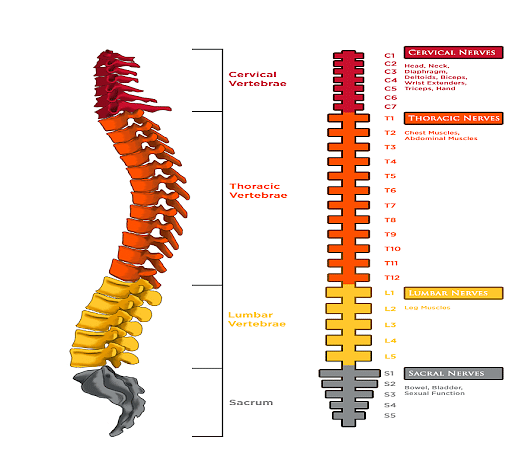
Spinal Cord Diagram
It must be noted that the above diagram shows the backbone, which contains a total of 24 stacked bones in an adult human. However, at birth, humans have a total of 33 bones in the backbone which eventually fuses to 24 bones.
Spinal Cord Anatomy
[Click Here for Sample Questions]
The spinal cord, in adults, is usually 40cm long and 2cm wide and forms an important connection between the brain and the body.
The spinal cord is divided into five different parts.
- Sacral cord
- Lumbar cord
- Thoracic cord
- Cervical cord
- Coccygeal
There exist many spinal nerves that emerge out of each segment of the spinal cord. There are 8 pairs of cervical, 5 lumbar, 12 thoracics, 5 sacral and 1 coccygeal pair of spinal nerves. It helps in the primary processing of information as it carries sensory signals from all parts of the body to the Central Nervous System through afferent fibres. Additionally, nerve tissue comprises the grey and white matter spread across uniformly. The smooth muscles as well as the skeletal system carrying nerve fibres liaise different reflexes when ventral horn projects axons which carry motor neurons. It also helps arbitrate autonomic control for visceral functions which consist of neurons with descending axons. It is a sensitive site, which is severely affected in case of a traumatic injury.
Function of Spinal Cord
[Click Here for Sample Questions]
The primary function of your spinal cord is to transport nerve signals throughout your body. These nerve messages serve three important purposes. They are:
- Control the movements and functions of the body: Your movements are controlled by signals sent from your brain to other parts of your body. They also control autonomic (involuntary) functions such as breathing rate, heart rate, and bowel and bladder function.
- Senses should be reported to your brain: Other parts of your body send signals to your brain, which helps it record and process sensations like pressure or pain.
- Control your reflexes: Some reflexes (involuntary movements) are controlled by your spinal cord without the involvement of your brain. Your spinal cord, for example, controls your patellar reflex (involuntarily moving your leg when someone taps your shin in a certain spot).
Structure of Spinal Cord
[Click Here for Sample Questions]
The length of the spinal cord varies between individuals. Females, according to some estimates, have a spinal cord length of about 43 centimetres (cm), while males have a spinal cord length of about 45 cm. The spinal cord is divided into three sections: the cervical (neck), thoracic (chest), and lumbar (lower back).
- The dura mater, arachnoid mater, and pia mater are three layers of tissue that protect the spinal cord. These layers are referred to as "meninges" by doctors. These are the layers:
- Dura mater: The outermost layer of the meninges of the spinal cord. It's a tough, protective layer.
- The epidural space is located between the dura and the arachnoid space. This is where doctors may inject local anaesthetic to alleviate pain during childbirth and some surgical procedures, such as those to repair a lung or abdominal aneurysm.
- Mater arachnoidum: The arachnoid mater is the spinal cord's middle layer of protection.
- Subarachnoid space (SAS): This is found between the arachnoid and pia maters. This space contains cerebrospinal fluid (CSF). A doctor may need to take a CSF sample to test for the presence of an infection, such as meningitis. For some surgical procedures, such as a caesarean section, they can also inject local anaesthetic into this space.
- The vertebral column, or spinal bones, protects the spinal cord and its protective layers. These bones extend from the base of the skull to the sacrum, a bone that fits into the pelvis.
- The number of bones in the cervical, thoracic, and lumbar regions varies. Most people have seven cervical vertebrae, twelve thoracic vertebrae, and five lumbar vertebrae.
If a person took a horizontal "slice" of the spinal cord, they would notice a circular area in the middle covered in protective layers (the meninges). Nerve projections radiate from this circular area. These radiate from the spinal cord and provide sensation to various parts of the body.
Key area of the Spinal Cord
[Click Here for Sample Questions]
A cross-section of the spinal cord reveals the following key areas:
- Gray matter is the dark, butterfly-shaped region of the spinal cord composed of nerve cell bodies.
- White matter: The white matter in the spinal cord surrounds the grey matter and contains cells coated in myelin, which speeds up nerve transmission. Gray matter nerve cells are not as heavily coated with myelin.
- Posterior root: The part of the nerve that branches off the back of the spinal column is known as the posterior root. In a cross-section of the spinal cord, the top wings of the grey matter "butterfly" reach toward the spinal bones. The bottom wings are oriented toward the body's internal organs.
- The anterior root is the portion of the nerve that arises from the front of the spinal column.
- The spinal ganglion is a collection of nerve bodies that contain sensory neurons.
- Spinal nerve: A spinal nerve is formed by the union of the posterior and anterior roots. The spinal cord is made up of 31 pairs of nerves. These regulate both sensation and movement in the body. The spinal cord is not elongated.
Things to Remember
- Spinal Cord is a column of nerve tissue that runs down the centre of the back from the base of the skull. It is protected by three thin layers of tissue known as membranes. The vertebrae surround the spinal cord and membranes (back bones).
- The central nervous system is made up of the spinal cord and the brain (CNS). The spinal cord nerves transmit messages from the brain to the rest of the body.
- There are 12 pairs of thoracic nerves. Between the T1 and T2 vertebrae, the first nerve root emerges. There are five pairs of lumbar nerves.
- The first of these nerve roots emerges between the lumbar vertebrae L1 and L2. There are five pairs of sacral nerves. Between S1 and S2, the first nerve root emerges. In the area of the tailbone, one pair of coccygeal (Co1) nerves meet.
- The thoracic nerves are divided into 12 pairs. The first nerve root emerges between the T1 and T2 vertebrae.
- The lumbar nerves are divided into five pairs. The first of these nerve roots emerges between the L1 and L2 lumbar vertebrae.
- The sacral nerves are divided into five pairs. The first nerve root appears between S1 and S2. One pair of coccygeal (Co1) nerves meet near the tailbone.
Sample Questions
Ques: Elaborate the functions of Spinal Cord. (2 marks)
Ans: The spinal cord's primary function is to relay sensory, motor, and autonomic messages between the brain and the rest of the body. To facilitate these actions, myelinated nerves along the spinal cord pathways send electrical signals to one another.
Ques: Define White Matter. (2 marks)
Ans: The white matter is made up of nerve fibres known as axons that run up and down the length of the spinal cord. Each axon group carries a specific type of information that must be communicated. Ascending axon tracts communicate with the brain, while descending axon tracts transport signals from the brain to various muscles and glands throughout the body.
Ques: Define Grey Matter. (2 marks)
Ans: The grey matter is also organised based on its function. If you divide the grey matter into two halves, each half has a dorsal, ventral, and lateral horn. Skeletal muscle is supplied by the dorsal and ventral horns, while cardiac and smooth muscle is supplied by the lateral horn.
Ques: What is reflex? Enumerate its five components. (3 marks)
Ans: A reflex can be either an uncontrolled and simple response or a learned response. Simple ones, such as pulling your hand away from something hot, are hardwired into our nervous systems. A learned reflex, such as playing the piano, is the result of practise. A reflex is made up of five parts:
The five components include:
- Receptor
- Afferent pathway
- Integrating centre
- Efferent pathway
- Effector organ
Ques: What are nerves? (2 marks)
Ans: A nerve is an organ that resembles a small cord and is composed of several axons that are linked together. The spinal cord is made up of 31 pairs of nerves.
There are 31 pairs of spinal nerves which includes:
- 8 are cervical nerves.
- 12 are thoracic nerves.
- 5 are lumbar nerves.
- 5 are sacral nerves.
- 1 is the coccygeal nerve
Ques: What are the tissues and fluids that make up the spinal cord? (2 marks)
Ans: The spinal cord, like the brain, is protected by layers of tissue called meninges. Among these protective tissues are:
- Dura mater. The outer layer of your spinal cord that protects it from injury.
- Mater arachnoidum. The layer that lies between the epidural and subarachnoid spaces.
- Alma mater. The layer that surrounds your spinal cord on the inside.
Ques: What is the location of the spinal cord? (2 marks)
Ans: The spinal cord begins at the medulla oblongata, which is located at the bottom of your brainstem. The conus medullaris is a cone-shaped structure formed by your spinal cord in your lower back.
Ques: How can one keep their spinal cord healthy? (2 marks)
Ans: One can keep the spinal Cord healthy by the below effective steps:
- Eat nutritious Diet
- Practice Good Posture
- Perform Aerobic exercise
- Quit Smoking
- Sleep in proper regular positions
Check-Out:



Comments