



Education Journalist | Study Abroad Lead
Tension can be expressed as a combination of reaction and action forces occurring at each end of the specified elements.
- Besides from the ends of a rope, the tension force can be felt by all components of the rope in both directions.
- The ends are subjected to tension on one side and force by the connected weight on the other.
- In other cases, the tension fluctuates across the length of the string.
| Table of Content |
Key terms: Tension, String, Acceleration, Force, Mass, Wire, Stress, Liquid, Cable, Length, Dimension, Terminals
What is Tension?
[Click Here for Sample Questions]
Tension force operating from both ends refers to the force transmitted by a rope, string, or wire when pulled by opposing forces at the two ends.
- As a result, tension can alternatively be defined as a force-action pair operating on the ends of a wire or string.
- The tension force pulls evenly on the bodies at the two ends of the string and proceeds along its length.
- Every section of the rope in both directions feels the tension force as well as the terminals. In rare cases, the tension force might vary along the string.
- Because wires and cables are capable of transporting a force over a short distance, they can be employed to exert force.
- Please keep in mind that, because ropes cannot actively push, the force of tension will be equal to the pulling force.
- A weightless rope transmits force from one portion to the other precisely.
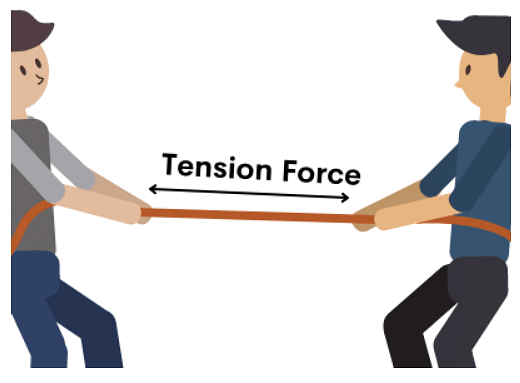
Tension Force
Tension Force Formula
[Click Here for Previous Year Questions]
The tension on an object can be stated mathematically as follows:
T = mg + ma
In this instance,
- T denotes tension.
- The object mass is denoted by m in kilogrammes
- The gravitational force is denoted by g is 9.8 m/s2.
- Acceleration is denoted by a in m/s2
Read More: Central Force
Common Misconception
[Click Here for Sample Questions]
Tension serves as a pulling force instead of a force that pushes since ropes cannot adequately push.
- Trying to push the rope will lead it to become slack and lose its tension.
- This may seem apparent, yet when depicting the forces acting on an item, individuals tend to draw the force of tension in a different direction.
- As a result, it is critical to keep in mind that tension can only pull on an object and cannot push against it.
Important Points about Tension
[Click Here for Previous Year Questions]
When a string is open or slack, no tension force emerges in the string.Tension force becomes active when a string becomes extensible or tight.Nature is always being pushed by this force. As a result, it consistently moves away from the tangled ends.
- Ideal string has no mass and is inextensible.
- The ideal string maintains the exact same tension throughout its entire length.
- When atoms or molecules are forced to separate from one another and acquire additional energy while a force that restores it remains
- The restoring force may cause tension. Under such stress, each end of an elastic cord or rod might pull on the item
- Tension is simply described in the situation of bodies suspended from cord, wire, rope, and so on.
- It is represented by the letter T (sometimes also by the letter Ft).
If such a suspended body moves vertically at a constant velocity, then;
T = W ± ma
Where W is the body's weight and m is the body's mass
Case (i) If the body is travelling upwards at a constant rate of a, the tension equals
T = W + ma.
Case (ii) If the body is travelling downwards with a constant acceleration, the tension T = W - ma
Case (iii), if the body is simply suspended (without moving), the tension;
T = W.
Case (iv) If the body goes up and down at the same rate, tension;
T = W
W = mg is the object's weight.
As a result, the tension formula may be adjusted as follows:
T = m(g ± a)
Where m = body mass, g = gravity acceleration, and a = moving body acceleration.
Because tension is a force, the SI unit for it is newton (N).
Read More: Heat Formula
What is Surface Tension?
[Click Here for Sample Questions]
Surface tension is defined as the phenomena that takes place when the surface of a fluid comes into contact with another phase (which can also be a liquid). Fluids prefer to have the smallest possible area of surface.
- The liquid's display behaves like a flexible sheet.
- Surface tension is determined not just by the forces of attraction among parts inside a specific liquid
- But also by the forces of attraction of solids, liquids, and gases in contact with it.
- Surface tension energy can be defined as being roughly similar to the effort or energy necessary to eliminate the surface layer of molecules in a unit area.
- Surface tension is commonly measured in dynes/cm, which is the force necessary to break a 1 centimetre layer.
What causes Surface Tension?
[Click Here for Previous Year Questions]
The fluid's molecules are drawn together through intermolecular forces such as the Van der Waals force. The particles are drawn towards the remaining component of the fluid that lies along the surface. Surface tension is defined as follows:
The surface force F divided by the length L throughout which the force acts.
Surface tension can be stated numerically in the following manner:
T = F / L
Where,
- F stands for force per unit length.
- L denotes the length over which force acts.
- T denotes the liquid's surface tension.
Dimension of Surface Tension
[Click Here for Sample Questions]
The formula for surface tension is
Surface tension = F / L
F = ma
substituting the value.
Surface Tension = ma / L
By plugging the essential quantities into the equation
Surface tension = MLT-2L-1
= MT-2
Thus, the surface tension dimensional formula is MT-2.
Read More: Pressure of Ideal Gas
Example of Surface Tension
[Click Here for Previous Year Questions]
Water striders, which are little insects, can walk on water because their weight is significantly less than that required to breach the water's surface. There are numerous examples of surface tension in nature, such as this. Following are some examples:
- Moving insects on liquid
- Floating a needle on the liquid's top.
- Water's tension on the surface will link the pores in the structure's substance, making it rainproof.
- Yellowing of the skin clinical test
- Surface tension disinfecting agents (disinfectants are with low surface tension formulations).
- Washing garments with soaps and detergents, which reduces the outer tension of the water's surface
- Using cold water for cleaning
- Spherical bubble formed when the surface tension of water supplies exceeded the wall tension for the production of water bubbles.
Read More:
| Relevant Concepts | ||
|---|---|---|
| Unit of Speed | Measurement of Time | Equation of Motion |
| Speed and Velocity | Kinetic Energy | Static Friction Formula |
Things to Remember
- Tensile force or tension is the reaction of an elastic cord or a rope to any alterations in the way it started when it is being pulled on both ends.
- The SI unit of tension is Newton (N), while the CGS unit is dyne, with the following relationship: 1 N = 105 dyne.
- When atoms or molecules are forced away from one another and accumulate extra energy while a force that restores it is still present
- The restoring force may cause tension.
- The tension on an object can be stated mathematically as follows: T = mg + ma
- The phenomenon of surface tension occurs when the surface of an object comes into contact with an additional stage (which can also be a fluid).
- The formula for surface tension is T = F / L.
Previous Year Questions
- Nascent hydrogen consists of..
- In which of the following reactions the hydrogen peroxide acts as a reducing agent?..[JEE MAIN 2023]
- Major product of the following reaction is..[JEE MAIN 2023]
- The total current supplied to the circuit by the battery is...[AIEEE 2004]
- The reading of voltmeter in the circuit shown is….[Rajasthan PMT 2023]
- The oxidation of toluene to benzaldehyde by chromyl chloride is called...[NEET UG 1996]
- An aggregate fruit is one which develops from..[NEET UG 2014]
- The order of stability of the following carbocations..[JEE MAIN 2013]
- Complete hydrolysis of cellulose gives...[BITSAT 2012]
- Which one among the following metals is the weakest reducing agent?..[JEE MAIN 2023]
Sample Questions
Ques. How can we determine the tension force's direction? (2 marks)
Ans. The direction of tension is the pull, which is called tension. As a result, the strain will be directed away from the mass and towards the string/rope. The string pushes the weight that hangs higher, hence the string/rope imposes an upper force on the mass and the tension is on the side that is higher.
Ques. A 10 kilogramme mass is suspended from a rope. What is the tension in the rope if the mass's acceleration value is zero. (3 marks)
Ans. We already know that the tension force is determined using the formula T = mg + ma.
T = (10 kg) (9.8 m/s2) + (10 kg) (0)
T = 108 N
(i) Suppose that the result is an upward acceleration of + 5 m/s2.
T = (10 kg) (9.8 m/s2) + (10 kg) (5 m/s2) after substitution
T = 148 N
(ii) Suppose that the falling acceleration is a = – 5m/s2.
T = (10 kg) (9.8 m/s2) + (10 kg) (-5) after substitution
T = 48 N
Ques. A small object of mass m has been attached to a string of length l at one end of a smooth horizontal table, and its other end is tied to a little peg. What is the net force that acts on the particle if it moves in a circle at v mph? (3 marks)
Ans. A centripetal force is required in order to propel a particle in a circular direction when it is linked to a string and revolves in a circular path around the centre. In this scenario, the centripetal force is provided by the tension in the string. As a result, the tension T will be the net force on the particle, as F = T = mv2/l, where m = particle mass, F = net force on the particle, and T = tension force.
Ques. Does the tension on the cord always remain constant? (1 mark)
Ans. No, not all of the time. The tension of a string with some mass is not constant. Also, when friction is present in the spring-pulley system, tension is not equal on both sides.
Ques. Why does tension always do zero work? (3 marks)
Ans. The amount of work done is determined by both force and displacement. Tension is a force, yet it has no effect on displacement. If the work done is given by the equation:
W = FS
Where F is the force and S is the displacement, then in tension
W = F × 0 = 0.
As a result, the work done by tension is nil.
Ques. A light and inextensible string supports a 15 kg body suspended from its bottom end. What is the tension in the string if the higher end is securely secured to a hook on the roof? (1 mark)
Ans. Because the body is not moving and is just suspended, the tension in the string will be equal to the weight of the body. m = 15 kg
T = W = mg = 15 × 9.8 = 147 N
Ques. A light string is used to suspend a ball from the roof of a lift. T1 is the tension in the string when the lift begins to accelerate up with a uniform acceleration ′ a′. T2 is the tension in the string when the lift accelerates downhill with the same uniform acceleration. What is the string tension if the lift is stationary? (3 marks)
Ans. In each scenario, apply Newton's law to the ball to obtain an expression for tension.
In Case1:
T1 – mg = ma
T1 = mg + ma ………. (1)
In Case 2:
mg - T2 = ma
T2 = mg – ma ………. (2)
If the lift is motionless, the tension will be equal to the weight of the bob, i.e. T = mg.
When we constitute equations 1 and 2, we obtain
T1 + T2 = 2mg
mg = T1 + T2
T = T1 + T2
Ques. Determine the tension in the horizontal string that connects the 2 kg and 4 kg blocks. (3 marks)
Ans. Consider a two-block system with tension T in the string.
The system's net force is F = 20 – 10 = 10 N.
System acceleration = Net ForceTotal mass = 106 = 53
Consider merely a 2 kg block and use Net Force = mass * acceleration.
T - F2 = 2a
T – 10 = 253
T = 403 N
Ques. Define tension force and its basic formula. (5 marks)
Ans. Tension force acting from opposite sides is the force imparted by a rope, thread, or wire when pulled by opposing forces at each end. As a result, tension can also be defined as an action-reaction pair of forces operating on the ends of a cable or string. The tension force draws energy evenly on the bodies at the ends and is directed along the length of the string.
The tension on a body can be stated numerically as follows:
T = mg + ma
Where;
- T in (N) represents tension.
- Object mass (m) in kilogrammes
- The gravitational force (g) is 9.8 m/s2.
- Acceleration (a) in m/s2
Ques. What effect does gravity have on tension force? (1 mark)
Ans. Tension operates in the opposite direction of gravity. If an object is suspended, it must be balanced by tension or it will fall owing to gravity.
For Latest Updates on Upcoming Board Exams, Click Here: https://t.me/class_10_12_board_updates
Check-Out:



Comments