



Content Curator
Transposons are genetic elements with the ability to move around. It can relocate within a genome. As a result, it's also known as the jumping gene. They make up a large portion of the genome and thus are responsible for genome function. It also has an impact on evolution.
- Barbara McClintock discovered transposons for the first time in 1940.
- They changed the location of the gene within the chromosomes.
- Transposons are classified into three types- class II transposons, class III transposons, and retrotransposons (class I transposons).
- Transposons have the ability to cause or reverse mutations.
Read More: Law of Limiting Factor
| Table of Content |
Key Terms: Transposons, jumping genes, mutation, chromosome, DNA, RNA
What are Transposons?
[Click Here for Sample Questions]
Transposons are DNA segments that are present in the genomes of all living things with the capability of moving from one place to another place within a genome. It does not use an independent element, such as a phage or plasmid, but instead jumps from one site to another.
- They carry genes for antibacterial resistance, infection, symbiotic factors, and xenobiotic catabolism.
- Transposons cause a wide range of DNA rearrangements that have far-reaching implications for cell survival and evolution.
- Transposons have diverse structures and are highly regulated by a variety of mechanisms.
- They are discovered to encode a special protein called transposase, which catalyzes the transposition process.
- Transposons are unique to different types of organisms.
- Transposons have a significant impact on changing an organism's genetic composition
Read More: Genetic Engineering
Various names of Transposons
[Click Here for Sample Questions]
There are various names for Transposons like
- Jumping genes
- Transposable elements
- Cassettes
- Mobile elements
- Insertion sequences.
Read More: Miller Urey Experiment
Discovery of Transposons
[Click Here for Sample Questions]
Barbara Mcclintock discovered transposable elements in 1965 while studying genetic instability in maize and earned a Nobel Prize in 1983.
- The instability involved chromosome breakage and was found to occur at transposable sites.
- Before this discovery, it was widely assumed that genes lined up in a chromosome in a consistent manner and occupied specific positions.
- She discovered that certain genes known as transposons can move to different locations on the chromosome.
- She made this discovery on corn kernels and discovered that the offspring plants can differ in color due to activated or deactivated genes.
Read More: Biofortification
Characteristics of Transposons
[Click Here for Sample Questions]
A few mentionable characteristics of transposons are–
- They are DNA sequences that code for enzymes that cause an identical copy of themselves to be inserted into a new DNA site.
- Transposition events involve both recombination and replication processes, which frequently result in the production of two daughter copies of the original transposable elements.
- One copy is kept at the parent site, while others are displayed at the target site.
- Transposable element insertion invariably compromises the integrity of their target genes.
- Transposable elements carry signals for the start of RNA synthesis and can occasionally activate previously dormant genes.
- Because a transposon is not a replicon, it cannot replicate independently of the host chromosome as plasmids and phages can.
- There is no homology between the transposons and the target site for their insertion.
Read More: Animal Cell
Types of Transposons
[Click Here for Sample Questions]
Transposons are classified into the following types based on their transposition mechanism:
- Cut-and-Paste Transposons:
- They transpose by removing the transposable sequence from one location in the genome and inserting it into another location in the genome (pasting) (Fig. 1).
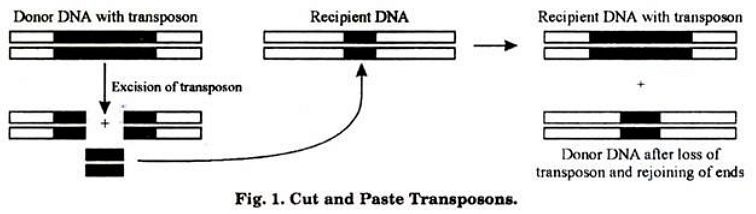
Cut-and-Paste Transposons
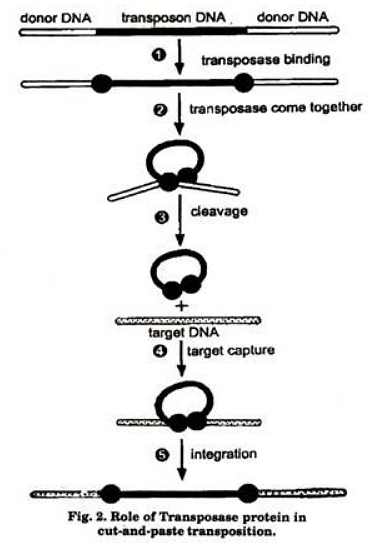
- Two transposase subunits are involved in the cut-and-paste transposition. Each transposase submission binds to specific sequences at the transposon's two ends. These transposase protein subunits then interact, resulting in transposon excision.
- This 'transposon-Transposase Complex' is then excised and integrated into the target recipient site. The transposon is thus cut from one site and pasted on another via a mechanism mediated by transposase protein (Fig. 2)
- IS-elements, P-elements in maize, hobo-elements in Drosophila, and other cut-and-paste transposons are examples.
- Replicative Transposons:
- They transpose through a mechanism that involves the replication of transposable sequences, and the resulting copy of DNA is inserted into the target site while the donor site remains unchanged (Fig. 3).

Replicative Transposons
- In this type of transposition, one copy of the transposon is gained, and both the donor and recipient DNA molecules have one transposable sequence each after transposition.
- Bacterial Tn3-elements are a good example of this kind of transposon.
- Retro Elements:
- Their transposition is done through a process that uses elements of RNA as the template to synthesize DNA by reverse transcription (i.e., RNA DNA) (Fig. 4).
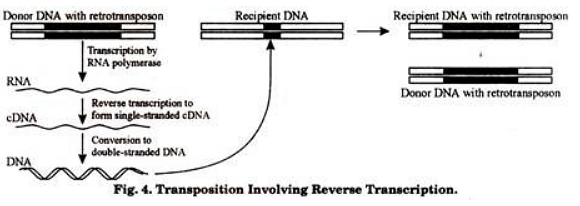
Reverse transcription
- In this kind of transposition, the transposable DNA is transformed to create an RNA molecule as an intermediate. The reverse transcriptase enzyme then uses this RNA as a template to create complementary DNA.
Once formed, this single-stranded DNA copy is double-stranded before being inserted into the target DNA site.
- Retro transposons are transposable elements that move only when reverse transcriptase is active.
- Some retro-transposons are related to retroviruses. Only Eukaryotic organisms contain retro-transposon.
- The retro components could be viral or non-viral. Non-viral retroelements are the more important of the viral retroelements and can be further divided into.
- Retrovirus-like elements: Retrovirus elements carry long terminal repeats(LTR). Copia and gypsy elements are two examples of drosophila.
- Retroposons: In this LTR are not present. Human LINEs and SINEs are two examples.
Read More: Discovery of Cells
Examples of Transposons
[Click Here for Sample Questions]
1) Transposase - a protein with 1015 amino acids that are required for transposition.
2) Repressor (resolvase) - a 185 amino acid protein that regulates the transposase.
3) Beta-lactamase - an enzyme that confers antibiotic resistance to ampicillin.
Read More: Microbiology
Significance of Transposable Element
[Click Here for Sample Questions]
The important significances of transposable elements are–
- Transposons, by changing their position in the genome, can alter the structural and functional characteristics of the genome.
- Transposable elements cause mutation through insertion, deletion, and so on.
- It contributes positively to evolution because it has a large impact on the changes in the genetic organization of organisms.
- They can also be used as cloning vectors in gene cloning. P-elements, for example, are frequently used as vectors for introducing transgenes into Drosophila.
- Transposons may also be used as genetic markers in genome mapping.
- Transposon-mediated gene tagging is used to find and isolate a specific gene.
Things to Remember
- A Transposon is a genetic element that can move.
- Transposons are classified into three types- class II transposons, class III transposons, and retrotransposons (class I transposons).
- Barbara McClintock discovered transposons for the first time in 1940 on maize.
- Transposons cause a wide range of DNA rearrangements that have far-reaching implications for cell survival and evolution.
- Transposons are DNA sequences that code for enzymes that cause an identical copy of themselves to be inserted into a new DNA site.
- Different types of Transposons are as follows: Cut-and-Paste Transposons, Replicative Transposons, and Retro Elements.
- Examples of Transposons are Transposase, Repressor (resolvase), and Beta-lactamase.
Sample Questions
Ques. What is a Genome? (2 Marks)
Ans. A genome is an organism's complete set of genetic instructions. Each genome contains all of the information required to construct an organism and enable it to grow and develop.
Human bodies are made up of millions of cells, each with its own set of complete instructions for creating us, similar to a recipe book for the body. Our genome is made up of DNA and contains this set of instructions. This same set of instructions is found in every cell in the body, including skin cells and liver cells.
Ques. What is Transposons ? (2 Marks)
Ans. "A DNA sequence that can move or insert itself into another location in the genome." Transposons are small, mobile DNA sequences that move around chromosomes with no regard for homology, causing deletions, inversions, chromosomal fusions, and even more complex rearrangements.
Ques. What are the different types of transposons? (2 Marks)
Ans. The different types of transposons are
- Cut-and-Paste Transposons: They transpose by removing a transposable sequence from one location in the genome and inserting it in another.
- Replicative Transposons: They transpose by replicating transposable sequences, and the resulting copy of DNA is inserted into the target site while the donor site remains unchanged.
- Retro Elements: Their transposition occurs via a process that uses RNA as a template to synthesize DNA via reverse transcription (i.e., RNA DNA)
Ques. Explain briefly about types of Transposable elements in Prokaryotes. (2 Marks)
Ans. Prokaryotic transposable elements are classified as follows:
(a) Insertion Sequences (IS Elements): These are transposable sequences that can insert at various locations on bacterial chromosomes.
(b) Prokaryotic Transposon Element: Also known as composite transposons, these are represented by the symbol Tn. It consists of two IS elements. These are large transposons that are formed by capturing an immobile DNA sequence within two insertion sequences, allowing it to move.
Ques. Explain briefly about Transposable elements in maize. (2 Marks)
Ans. Barbara Mc. Clintock studied and presented this system of transposable elements in maize. Ac stands for Activator, and Ds stands for Dissociation. Barbara discovered that the Ds and Ac genes were occasionally mobile and moved to different chromosomal locations, resulting in distinct kernel phenotypes.
Ques. Explain briefly about Transposons in Humans. (2 Marks)
Ans. Transposons in humans are composed of repetitive DNA sequences that are intermixed throughout the entire human genome. These sequences are transposable, meaning they can move around the genome.
SINEs (Short Interspersed Elements) and LINEs (Long Interspersed Elements) are two types of Transposons in Humans
Ques. What is gene mapping? (2 Marks)
Ans. The process of determining the location of genes on chromosomes is referred to as gene mapping. Today, the most efficient method for gene mapping involves sequencing a genome and then analyzing the sequence with computer programs to determine the location of genes.
Ques. What is the purpose of transposons? (1 Mark)
Ans. A portion of foreign DNA can be inserted into a genome using DNA transposons.
For Latest Updates on Upcoming Board Exams, Click Here: https://t.me/class_10_12_board_updates
Check-Out:



Comments