



Content Curator
Miller Urey experiment was a simulation experiment which was done to prove the molecular evolution of life. The experiment supported the Alexander Oparin's and J.B.S. Haldane's hypothesis that putative conditions on the primitive earth favored the reactions of the chemical that synthesized more complex organic compounds from the simpler inorganic precursors. This was considered to be the most classic experiment investigating abiogenesis done by them.
| Table of Content |
Keyterms: Evolution, Earth, Hypothesis, Organic compounds, Amino acids, Methane, Ammonia, Hydrogen, Abiogenesis, Protein, Simple compounds
Also Read: Heredity and Evolution
Miller Urey Experiment: Definition
[Click Here for Sample Questions]
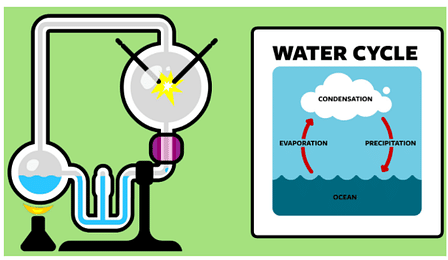
This experiment demonstrated that a mixture of just water vapor and some simple gases like methane, ammonia and hydrogen are merely subjected repeatedly to electrical sparks over the time which resulted in chemical products including a number of amino acids.
Amino acids are the “building blocks” from which the proteins which are essential for life are formed. Urey and Miller experimentally proved the production of simple organic compounds from other simple compounds under the specified conditions.
Miller Urey Experiment: Explanation
Miller Urey Experiment: Apparatus and Procedure
[Click Here for Previous Year Questions]
Here are the details of Miller Urey Experiment:
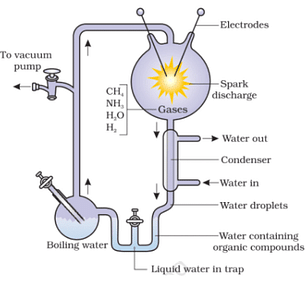
- The groundbreaking experiment used a sterile glass flask of 5 liters and it was attached with a pair of electrodes, to hold water (H2O), methane (CH4), ammonia (NH3) and hydrogen (H2), and the major components of primitive earth. This was connected to another glass flask of 500 ml capacity and it was half filled with water. On heating it, the water vaporized to fill the larger container with the water vapor.
- The electrodes induced continuous electrical sparks in the gas mixture to simulate the lightning. When the gas was cooled, the condensed water made its way into a U-shaped trap at the apparatus's base.
- After electrical sparking had continued for a day, the solution in the trap turned into the pink color. At the end of that week, the boiling flask was removed from the experiment, and mercuric chloride added to prevent the microbial contamination.
- After stopping the chemical reaction, the scientist duo examined the cooled water collected by them to find that 10-15% of the carbon present in the system was in the organic compounds form.
- 2% of carbon went into the formation of various amino acids, including 13 of the 22 amino acids essential to make the proteins in living cells, glycine being the most abundant.
- Though the result of the experiment was the production of only simple organic molecules and not a complete living biochemical system, still the simple prebiotic experiment could, to a considerable extent, prove the primordial soup hypothesis.
Miller Urey Experiment: Apparatus and Procedure
Chemistry Of the Miller Urey Experiment
The components of the mixture can react among themselves to produce formaldehyde (CH2O), hydrogen cyanide (HCN) and other intermediate compounds.
CO2 → CO + [O] (atomic oxygen)
CH4 + 2[O] → CH2O + H2O
CO + NH3 → HCN + H2O
CH4 + NH3 → HCN + 3H2
The ammonia, formaldehyde and HCN so produced react by a process which is known as Strecker synthesis to form the biomolecules including amino acids.
CH2O + HCN + NH3 → NH2-CH2-CN + H2O
NH2-CH2-CN + 2H2O → NH3 + NH2-CH2-COOH (glycine)
In addition to the above, formaldehyde and water can react by Butlerov’s reaction to produce a variety of sugars like ribose and many others.
Though later studies have indicated that the reducing atmosphere as replicated by Miller and Urey could not have prevailed on the primitive earth, still, the experiment remains to be a milestone in synthesizing the building blocks of life under the abiotic conditions and not from living beings themselves.
Also Read:
| Related Articles | ||
|---|---|---|
| Heredity | Types of Fossils | An Overview of Homo Erectus |
| Rules for the Inheritance of Traits | Mendelian Disorders | Gonads |
| Vestigial Organs | Keystone Species | Tissue Culture |
Before Miller and Urey: Historical Perspective
[Click Here for Previous Year Questions]
Let’s get a historical perspective of events that happened before Miller and Urey experiment was conducted:
- The explanation of the origin of life has always been an intensely debated and controversial topic for the people. During the time of the Renaissance, it was believed that life originated suddenly and out of nowhere. This hypothesis is known as the spontaneous generation.
- Later, the scientists' critical thinking began to germinate and the hypothesis was discarded. However, the unknown raised at the beginning remained diffuse.
- In the 1920s, scientists of the time used the term "primordial soup" to describe a hypothetical oceanic environment in which life probably originated.
- The problem was to propose a logical origin of the biomolecules that make life possible (carbohydrates, proteins, lipids and nucleic acids) from inorganic molecules.
- Already in the 1950s, prior to the Miller and Urey experiments, a group of scientists succeeded in synthesizing formic acid from carbon dioxide. This formidable discovery was published in the prestigious magazine Science.
Oparin and Haldane
[Click Here for Sample Questions]
Oparin claimed that the organic compounds undergo a series of reactions to produce complex molecules. He believed that the molecules formed coacervates in an aqueous environment.
Haldane believed that the atmosphere of the primordial sea was missing oxygen, and was composed of carbon dioxide, ammonia, and ultraviolet light. This raised various organic compounds. Sea contains large amounts of organic monomers and polymers and it was previously called a ‘hot dilute soup’.
He explained that the polymers and monomers acquired lipid membranes. Molecules developed and gave rise to the first living organism. ‘Prebiotic soup’ was a term coined by Haldane.

Creating Life in the Lab
Also Read:
Criticism of Miller Urey Experiment
[Click Here for Previous Year Questions]
- The experiment failed to explain how proteins available were responsible for the formation of amino acids.
- Out of all scientists a few scientists have contradicted that the gases which are used by Urey and Miller are not as abundant as shown in the experiment.
- They were of the notion that the gases released by the volcanic eruptions such as oxygen, sulfur dioxide, nitrogen, argon, and carbon dioxide make up the atmosphere. Therefore, the results of the Miller and Urey experiment are not reliable.
Also Read: Reproductive Health
Things to Remember
- Complex organic molecules could have their origin from simpler inorganic molecules.
- The experiment allows us to observe how the building blocks of living organisms could have been.
- The experiment managed to experimentally verify the appearance of organic molecules and proposes a quite attractive scenario to explain the possible origin of life.
Important Questions: How do Organisms Reproduce?
Previous Year Questions
- Which of the following is the most primitive ancestor of man ?..[BHU UET 2008]
- Which is connecting link between reptiles and aves...[BCECE 2006]
- A prehensile tail as in chameleon is an adaptation for…..[COMEDK UGET 2012]
- According to the theory of spontaneous generation..[COMEDK UGET 2015]
- After the industrial revolution melanic moths survived because………[COMEDK UGET 2010]
- Cro-Magnon people were…..[CUCET 2010]
- Which one of the following is a mismatch ?..[COMEDK UGET 2007]
- The important gas which was absent during the formation of Earth is...[WBJEE 2012]
- Homo erectus evolved during...[WBJEE 2012]
- Wings of birds and fore limbs of horse are …… organs ?
- Archaeopteryx is connecting link between…..[MHT CET 2007]
- Which one of the following is the basic chromosome number of Wheat ?..[WBJEE 2010]
- Darwin judged the fitness of an individual by...[DUET 2011]
- Duck-billed Platypus is a connecting link between
- Fossils are generally found in
Sample Questions
Ques. What was the main purpose of Miller and Urey experiment? (1 Mark)
Ans. The Miller and Urey experiment – Chemical Evolution of Miller and Urey experiment was a simulation of conditions on early earth testing the idea that life, or more specifically organic molecules, could have formed only by the simple chemical reactions.
Ques. What did Stanley Miller and Harold Urey do? (1 Mark)
Ans. Miller and Urey experiment. Miller and Urey performed an experiment in the year 1953 only to describe the origin of life on the earth. They were of the idea that the early earth’s atmosphere was able to produce amino acids from inorganic matter.
Ques. Where did the amino acids from the Miller experiment come from? (1 Mark)
Ans. When Bada performed an experiment of Miller-type with the addition of iron and carbonate minerals, the products were richer in amino acids. This basically suggests that the origin of significant amounts of amino acids may have occurred on the early earth even with an atmosphere which contains gases like carbon dioxide and nitrogen.
Ques. What did the experiment of Miller and Urey prove? (1 Mark)
Ans. In the year 1950, biochemists Stanley Miller and Harold Urey, conducted an experiment which demonstrated that the several organic compounds could be formed spontaneously by simulating conditions of the early atmosphere of the earth. They both found that several organic amino acids had formed spontaneously from the raw materials which were inorganic.
Ques. Which assumption did Urey and Miller make regarding conditions on the early earth? (1 Mark)
Ans. This mixture, along with some “sparks” which simulated lightning, led to the amino acids' formation. With this setup, Miller and Urey assumed that the early earth had a reducing atmosphere, which basically indicate that it had almost no oxygen and had large amounts of hydrogen
Ques. What was the conclusion of the Miller-Urey experiment? (1 Mark)
Ans. The Miller and Urey experiment proved that the organic molecules could have been synthesized under the abiotic (life-free) conditions of early earth. Organic molecules are found there where life originated. Therefore, the Miller and Urey experiment has many applications to evolution.
Ques. Miller and Urey experiment is in support of the Oparin Haldane hypothesis of chemical evolution containing which of the following gases? (3 Marks)

(a) I and II only
(b) II only
(c) I, III and IV
(d) II and IV (4 Marks)
Ans. In Miller-Urey experiment, the experimental design consisted of the introduction of atmospheric gases which are thought to exist in the early earth into a closed chamber. Methane (CH4) , Hydrogen (H) and ammonia (NH3) gases were introduced into an environment containing water vapour (H2O) which evaporated from the water filled container of the chamber.
Primitive earth atmosphere was oxygenless, so they did not use oxygen gas. To simulate primitive lightning conditions, Miller provided the system with electric current using tungsten electrodes. After a few days Miller observed the flask contained organic compounds such as amino acids which are the building blocks of proteins. Therefore, among the options given in the question, I. Hydrogen gas, III. Methane, IV. Ammonia is correct. And II. Hydrogen is incorrect.
Thus, option C. I, III and IV is the correct answer.
Ques. Explain the miller's experiment with the help of a diagram. (4 Marks)
Ans. Stanley Miller was an American chemist who conducted one of the most exciting experiments in modern science. He and Harold C. Urey conducted an experiment to understand the origin of life.
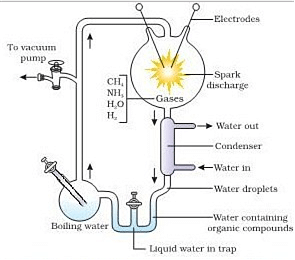
Miller took molecules that represent the major components of the early earth's atmosphere and put them into a closed system.
The gases used were methane (CH4), ammonia (NH3), hydrogen (H2), and water (H2O). Electric current was passed through the system, to simulate lightning storms believed to be common on the early earth. Analysis of the experiment was done by chromatography.
At the end of one week, they observed that as much as 10-15% of the carbon was now in the form of organic compounds. Two per cent of the carbon had formed some of the amino acids which are used to make proteins. Thus this experiment showed that organic compounds such as amino acids, which are essential to cellular life, could be made easily under the conditions believed to be present on the early earth.
Miller Urey Experiment Diagram
For Latest Updates on Upcoming Board Exams, Click Here: https://t.me/class_10_12_board_updates
Check-More:



Comments