



Content Curator
Trigonometry is made up of two words which can be simplified to mean ‘measurement of triangles’. Trigonometry helps us to understand the relationship between lengths, breadths, and angles. The sides with respect to the angle in a right-angled triangle are hypotenuse, opposite side, and adjacent side.
With the help of various trigonometric functions such as sin, cos, tan, cot, cosec and sec, we can understand the different relations between the angle and the sides of a triangle. The relationship of such functions depends on the value of the angle. When the angle changes, the value of these trigonometric functions also changes. These trigonometric functions make work easier for physicists, astronomists, architects, engineers, surveyors, etc.
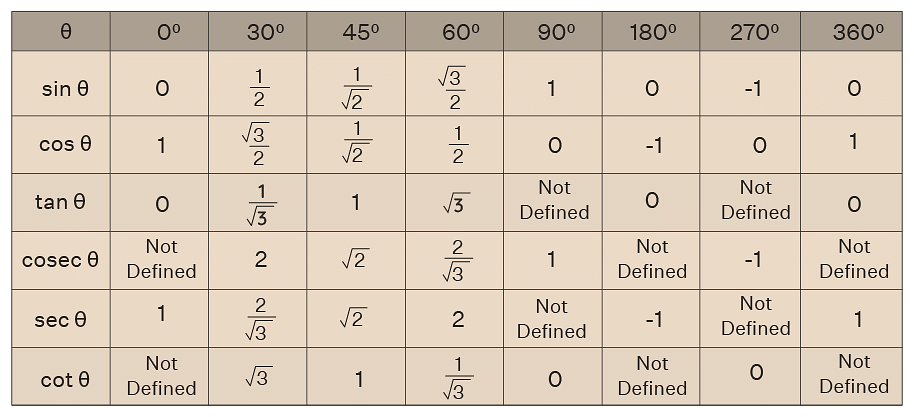
Trigonometric Table
The value table of all trigonometric ratios are given in the table below.
Read More:
Very Short Answer Questions [1 Mark Questions]
Ques. Find the value of sin 30° and cos 30°
Ans. sin 30° = \(\frac{1}{\sqrt{2}}\)
cos 30° = \(\frac{\sqrt{3}}{2}\)
Ques. Find the sign of sin 300°
Ans. For the given angle, we need to find the coterminal angle which lies between 0° and 360°.
270° < 300° < 360°
Therefore 300° angle lies in the fourth quadrant.
Thus sin 300° is negative.
Ques. What is sin 15°
Ans. sin 15° can also be written as sin (45° – 30°)
= sin 45° cos 30° – cos 45° sin 30°
= (\(\frac{1}{\sqrt{2}}\)) × (\(\frac{\sqrt{3}}{2}\)) – (\(\frac{1}{\sqrt{2}}\)) × (\(\frac{1}{2}\))
= \(\frac{\sqrt{3} - 1}{2\sqrt{2}}\)
Ques. Find the sign of cos 400°
Ans. For the given angle, we need to find coterminal angle which lies between 0° and 360°.
400° = 360° + 40°
400° and 40° are coterminal angles hence their trigonometric ratios are the same.
Since 40° lies in the first quadrant, 400° also lies in the first quadrant
Thus cos 400° is positive.
Ques. Solve cos 30° × cos 60° + sin 30° × sin 60°
Ans. cos 30° × cos 60° + sin 30° × sin 60°
= \(\frac{\sqrt{3}}{2}\) × \(\frac{1}{2}\) + \(\frac{1}{2}\) × \(\frac{\sqrt{3}}{2}\)
= \(\frac{\sqrt{3}}{2}\)
Ques. Find the sign of cot (- 206°)
Ans.
-206° = -360° + 154°
154° and - 206° are coterminal angles.
Since 154° lies in the second quadrant, therefore cot (- 206°) is negative.
Ques. Solve 4 cos 30° – cos2 45°
Ans. 4 cos 30° – cos2 45°
= 4 (\(\frac{\sqrt{3}}{2}\)) – (\(\frac{1}{\sqrt{2}}\))2
= \(\frac{4\sqrt{3}}{2}\) – \(\frac{1}{2}\)
= \(\frac{4\sqrt{3}-1}{2}\)
Ques. Solve sin20 – sin2\(\frac{\pi}{6}\)
Ans. sin20 – sin2\(\frac{\pi}{6}\)
= (0)2 – (\(\frac{1}{2}\))2
= -\(\frac{1}{4}\)
Short Answer Questions [2 Marks Questions]
Ques. Find the value of sin \(\frac{41\pi}{4}\)
Ans. We know the sine function is periodic with period 2π
Therefore,
sin \(\frac{41\pi}{4}\) = sin \(\left( 10\pi + \frac{\pi}{4}\right)\)
= sin \(\frac{\pi}{4}\)
= \(\frac{1}{\sqrt{2}}\)
Ques. Find the value of cos 765°
Ans. We know that cosine function is periodic with period 2π
Therefore cos 765° = cos (720° + 45°)
= cos (2 × 360° + 45°)
= cos 45°
= \(\frac{1}{\sqrt{2}}\)
Ques. sin π + 2 cos π + 3 sin \(\frac{3\pi}{2}\) + 4 cos \(\frac{3\pi}{2}\) – 5 sec π – 6 cosec \(\frac{3\pi}{2}\)
Ans. sin π + 2 cos π + 3 sin \(\frac{3\pi}{2}\) + 4 cos \(\frac{3\pi}{2}\) – 5 sec π – 6 cosec \(\frac{3\pi}{2}\)
= 0 + 2(-1) + 3(-1) + 4(0) – 5(-1) – 6(-1)
= 0 – 2 – 3 + 0 + 5 + 6
= 6
Ques. Find all the trigonometric functions of the angle made by OP with X-axis where P is (-5, 12)
Ans. Let θ be the measure of the angle in standard position whose terminal arm passes through P (-5, 12).
r = OP = \(\sqrt{(-5)^2 + 12^2}\) = 13
P (x, y) = (-5, 12)
Thus x = -5 and y = 12
Sin θ = \(\frac{y}{r}\) = \(\frac{12}{13}\)
Cosec θ = \(\frac{r}{y}\) = \(\frac{13}{12}\)
Cos θ = \(\frac{x}{r}\) = \(\frac{-5}{13}\)
Sec θ = \(\frac{r}{x}\) = \(\frac{-13}{5}\)
Tan θ = \(\frac{y}{x}\) = \(\frac{-12}{5}\)
Cot θ = \(\frac{x}{y}\) = \(\frac{-5}{12}\)
Ques. For θ = 30°, Verify that sin 2θ = 2 sin θ cos θ
Ans.
Given θ = 30°, thus 2θ = 60°
Sin θ = sin 30° = \(\frac{1}{2}\)
Cos θ = cos 30° = \(\frac{\sqrt{3}}{2}\)
Sin 2θ = sin 60° = \(\frac{\sqrt{3}}{2}\)
LHS
= 2 × \(\frac{1}{2}\) × \(\frac{\sqrt{3}}{2}\)
= \(\frac{\sqrt{3}}{2}\)
= RHS
Ques. Solve sin20 + sin2\(\frac{\pi}{6}\) + sin2\(\frac{\pi}{3}\) + sin2\(\frac{\pi}{2}\)
Ans.
= sin20 + sin2\(\frac{\pi}{6}\) + sin2\(\frac{\pi}{3}\) + sin2\(\frac{\pi}{2}\)
= (0)2 + (\(\frac{1}{2}\))2 + (\(\frac{\sqrt{3}}{2}\))2 + (1)2
= 0 + \(\frac{1}{4}\) + \(\frac{3}{4}\) + 1
= 2
Ques. If Sin θ = –\(\frac{3}{5}\) and 180° < θ < 270° then find all trigonometric functions.
Ans. Since and 180° < θ < 270°. θ lies in the third quadrant.
Since sin θ = -\(\frac{3}{5}\) thus cosec θ = - \(\frac{5}{3}\)
Now cos2θ = 1 – Sin2θ
Thus, cos2θ = 1 – \(\frac{9}{25}\)
= \(\frac{16}{25}\)
Then cos θ = -\(\frac{4}{5}\)
Thus, sec θ = -\(\frac{5}{4}\)
Now tan θ = \(\frac{\sin \theta}{\cos \theta}\)
Thus,
tan θ = \(\frac{3}{4}\)
And cot θ = \(\frac{4}{3}\)
Long Answer Questions [3 Marks Questions]
Ques. If sin A = \(\frac{-5}{13}\), π < A < \(\frac{3\pi}{2}\) and cos B = \(\frac{3}{5}\), \(\frac{3\pi}{2}\) < B < 2π, find cos (A – B)
Ans.
Given, sin A = \(\frac{-5}{13}\)
We know that,
Cos2A = 1 – sin2A
= 1 – (\(\frac{-5}{13}\))2
= 1 – \(\frac{25}{169}\)
= \(\frac{144}{169}\)
Thus, Cos A = \(\pm \frac{12}{13}\)
Since π < A < \(\frac{3\pi}{2}\)
A lies in the third quadrant
Cos A < 0
Cos A = -\(\frac{12}{13}\)
Also, cos B = \(\frac{3}{5}\)
Sin2B = 1 – cos2B
= 1 – (\(\frac{3}{5}\))2
= 1 – \(\frac{9}{25}\)
= \(\frac{16}{25}\)
Thus Sin B = \(\pm \frac{4}{5}\)
Since \(\frac{3\pi}{2}\) < B < 2π
Thus B lies in the fourth quadrant.
Sin B = -\(\frac{4}{5}\)
Cos (A – B) = cosA cosB + sinA sinB
= (-\(\frac{12}{13}\))(\(\frac{3}{5}\)) + (-\(\frac{5}{13}\))(-\(\frac{4}{5}\))
= -\(\frac{36}{65}\) + \(\frac{20}{65}\)
= -\(\frac{16}{65}\)
Ques. Prove that (1 + tan2A) + (1 + \(\frac{1}{\tan^2A}\) ) = \(\frac{1}{\sin^2A- \sin^4A}\)
Ans.
LHS
= (sec2A) + (\(\frac{\sec^2 A}{\tan^2 A}\))
= \(\frac{1}{\cos^2 A}\) + \(\frac{\frac{1}{\cos^2A}}{\frac{\sin^2 A}{\cos^2 A}}\)
= \(\frac{1}{\sin^2A \cos^2A}\)
= \(\frac{1}{\sin^2A(1-\sin^2A)}\)
= \(\frac{1}{\sin^2A - \sin^4A}\)
LHS = RHS
Ques. Prove that (sin θ + sec θ)2 + (cos θ + cosec θ)2 = (1 + cosec θ sec θ)2
Ans.
LHS
= (sin θ + sec θ)2 + (cos θ + cosec θ)2
= (sin θ + \(\frac{1}{\cos \theta}\))2 + (cos θ + \(\frac{1}{\sin \theta}\))2
= \({\left( \frac{\cos \theta \sin \theta + 1}{\cos \theta} \right)}^2\) + \({\left( \frac{\sin \theta \cos \theta + 1}{\sin \theta} \right)}^2\)
= \(\frac{(1 + \sin \theta \cos \theta)^2}{\cos^2 \theta}\) + \(\frac{(1 + \sin \theta \cos \theta)^2}{\sin^2 \theta}\)
= (1 + sin θ cos θ)2 \(\left( \frac{1}{\cos^2 \theta} + \frac{1}{\sin^2 \theta} \right)\)
= (1 + sin θ cos θ)2 \(\left( \frac{\sin^2 \theta + \cos^2 \theta}{\cos^2 \theta \sin^2 \theta} \right)\)
= (1 + sin θ cos θ)2 \(\left( \frac{1}{\cos^2 \theta \sin^2 \theta} \right)\)
= \(\left(1+\frac{1}{ \operatorname{cosec} \theta} \times \frac{1}{\sec \theta}\right)^{2} \times \sec^{2} \theta \times \operatorname{cosec}^{2} \theta\)
= \(\left(\frac{\operatorname{cosec} \theta \sec \theta+1}{\operatorname{cosec} \theta \sec \theta}\right)^{2} \times \sec^{2} \theta \times \operatorname{cosec}^{2} \theta\)
= (1 + cosec θ sec θ)2
LHS = RHS
Ques. Solve cos2A + cos2B + cos2C = -1 – 4cosAcosBcosC
Ans.
LHS
= cos2A + cos2B + cos2C
= (cos2A + cos2B) + cos2C
= 2 cos \(\frac{2A + 2B}{2}\) cos \(\frac{2A - 2B}{2}\) + cos2C
= 2 cos (A + B) cos (A – B) + cos2C
[we know that A + B + C = π
Thus A + B = π – C
cos (A + B) = cos (π - C)
cos (A + B) = - cos C]
= -2cosC × cos (A – B) + 2cos2C – 1
= -2cosC (cos (A – B) – cosC) – 1
= -2cosC (cos (A – B) – cos (A + B)) – 1
= -2cosC × 2cosA × cosB – 1
= -1 – 4cosAcosBcosC
LHS = RHS
Very Long Answer Questions [5 Marks Questions]
Ques. Prove that cosA + cosB - cosC = 4 cos\(\frac{A}{2}\) cos\(\frac{B}{2}\) sin \(\frac{C}{2}\) – 1
Ans.
LHS
= cosA + cosB – cosC
= (cosA + cosB) – cosC
= 2 cos \(\frac{A + B}{2}\) cos \(\frac{A - B}{2}\) – cosC
= 2 cos (\(\frac{\pi}{2} - \frac{C}{2}\)) cos\(\frac{A - B}{2}\) + cosC
= 2 sin\(\frac{C}{2}\) cos \(\frac{A - B}{2}\) – (1 – 2sin2\(\frac{C}{2}\))
[A + B + C = π
\(\frac{A+B+C}{2}\) = \(\frac{\pi}{2}\)
\(\frac{A+B}{2}\) = \(\frac{\pi}{2} - \frac{C}{2}\)]
= 2 sin\(\frac{C}{2}\) cos\(\frac{A - B}{2}\) + (2sin2\(\frac{C}{2}\) – 1)
= 2 sin\(\frac{C}{2}\) (cos\(\frac{A - B}{2}\) + 2sin\(\frac{C}{2}\)) – 1
= 2 sin\(\frac{C}{2}\) (cos\(\frac{A - B}{2}\) + sin \(\frac{\pi}{2} - \frac{(A+B)}{2}\)) – 1
= 2 sin\(\frac{C}{2}\) (cos\(\frac{A - B}{2}\) + cos\(\frac{A + B}{2}\)) – 1 … [sin (\(\frac{\pi}{2}\) – θ) = cosθ]
= 2 sin\(\frac{C}{2}\) × 2 cos \(\frac{A}{2}\) × cos \(\frac{B}{2}\) – 1
= 4 cos\(\frac{A}{2}\) cos\(\frac{B}{2}\) sin\(\frac{C}{2}\) – 1
LHS = RHS
Ques. Prove that SinA + SinB + SinC = 4 cos\(\frac{A}{2}\) cos\(\frac{B}{2}\) cos\(\frac{C}{2}\)
Ans.
LHS
= SinA + SinB + SinC
= (SinA + SinB) + SinC
= 2 sin \(\frac{A + B}{2}\) × cos \(\frac{A - B}{2}\) + SinC
[A + B + C = π
\(\frac{A+B+C}{2}\) = \(\frac{\pi}{2}\)
\(\frac{A+B}{2}\) = \(\frac{\pi}{2} - \frac{C}{2}\)
\(\frac{C}{2}\) = \(\frac{\pi}{2}\) – \(\frac{A+B}{2}\)]
= 2 sin(\(\frac{\pi}{2} - \frac{C}{2}\)) cos\(\frac{A - B}{2}\) + sinC
= 2 cos\(\frac{C}{2}\) cos\(\frac{A - B}{2}\) + 2 sin\(\frac{C}{2}\)cos \(\frac{C}{2}\)
= 2 cos\(\frac{C}{2}\) (cos\(\frac{A - B}{2}\) + sin\(\frac{C}{2}\))
= 2 cos\(\frac{C}{2}\) (cos\(\frac{A - B}{2}\) + sin \(\frac{\pi}{2} - \frac{(A+B)}{2}\))
= 2 cos\(\frac{C}{2}\) (cos\(\frac{A - B}{2}\) + cos\(\frac{A + B}{2}\))
= 2 cos\(\frac{C}{2}\) × 2 cos \(\frac{A}{2}\) × cos \(\frac{B}{2}\)
= 4 cos\(\frac{A}{2}\) cos\(\frac{B}{2}\) cos\(\frac{C}{2}\)
LHS = RHS
Ques. Sin2A + Sin2B + Sin2C = 2 + 2cosA cosB cosC.
Ans.
LHS
= Sin2A + Sin2B + Sin2C
= \(\frac{1- \cos 2A}{2}\) + \(\frac{1- \cos 2B}{2}\) + Sin2C
= \(\frac{1}{2}\) – \(\frac{\cos 2A}{2}\) + \(\frac{1}{2}\) – \(\frac{\cos 2B}{2}\) + Sin2C
= 1 – \(\frac{1}{2}\) [cos 2A +cos 2B] + Sin2C
= 1 – \(\frac{1}{2}\) 2cos \(\frac{2A + 2B}{2}\) cos \(\frac{2A - 2B}{2}\) + Sin2C
= 1 – cos (A + B) cos (A – B) + Sin2C
[A + B + C = π
A + B = π – C]
= 1 – cos (π + C) cos (A – B) + Sin2C
= 1 – cosC × cos (A – B) + 1 – Cos2C
= 2 + cosC × cos (A – B) – Cos2C
= 2 + cosC (cos (A – B) – CosC)
= 2 + cosC (cos (A – B) – Cos π – (A + B))
= 2 + cosC (cos (A + B) + cos (A + B))
= 2 + cosC × 2cosA × cosB
= 2 + 2cosA cosB cosC
LHS = RHS
Read More:
Related Links:



Comments