



Content Curator
NCERT Solutions for class 11 mathematics Chapter 3 Trigonometric Functions are provided in the article below. Trigonometric Functions are the functions of angles of a triangle that explains the relationships between them.
NCERT Solutions for Class 11 Mathematics Chapter 3 cover important concepts including Basic Trigonometric Functions, Trigonometric Identities, and Formulas.
Download: NCERT Solutions for Class 11 Mathematics Chapter 3 pdf
Class 11 Maths NCERT Solutions Chapter 3 Trigonometric Functions
Class 11 Maths NCERT Solutions Chapter 3 Trigonometric Functions are provided below:
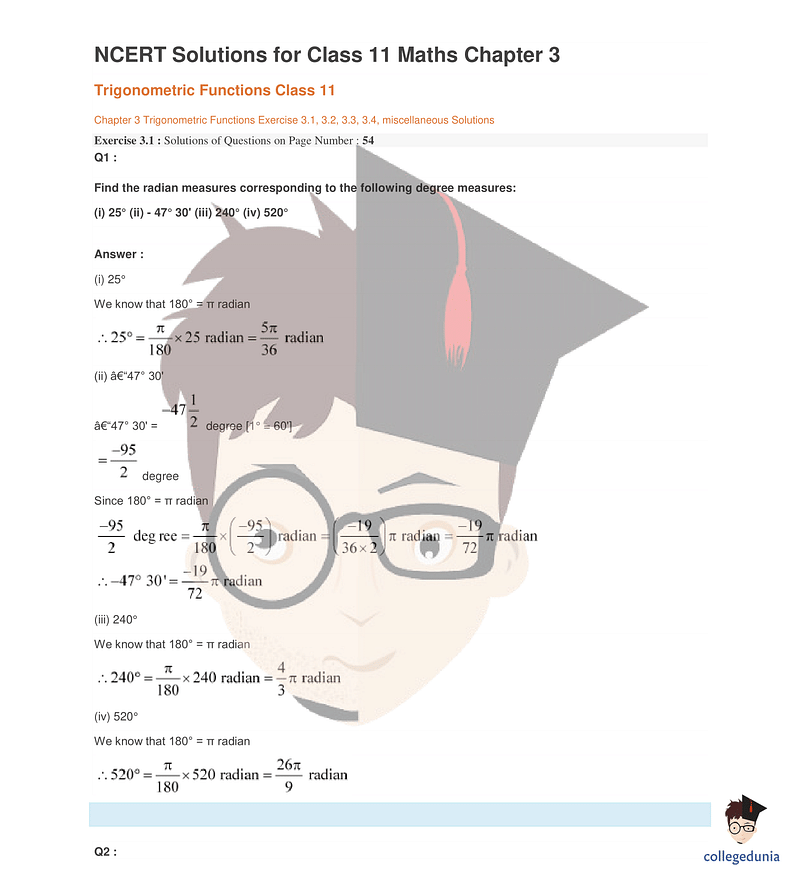

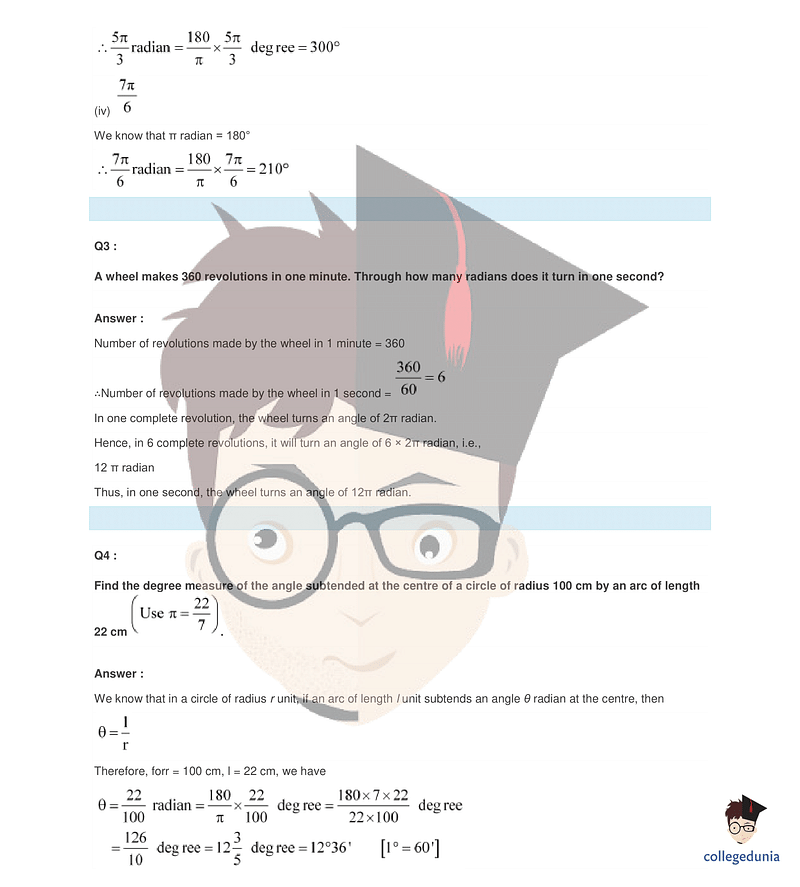


Also check: Trigonometric Functions
Important Topics: Class 11 Maths NCERT Solutions Chapter 3 Trigonometric Functions
Important Topics Class 11 Maths NCERT Solutions Chapter 3 Trigonometric Functions are elaborated below:
- Degree measure
Important angles of trigonometry are 0°, 30°, 45°, 60°, 90°. These are standard angles of trigonometric ratios like sin, cos, tan, sec, cosec, and cot. These angles have different values with different trigonometric functions.
- Radian measure
Angle subtended at the centre by an arc of length 1 unit in a unit circle (circle of radius 1 unit) is said to have a measure of 1 radian.
| The symbol used to denote the radian measure is “rad” or “c” |
- Relation between radian and real numbers
The relation between radian and real numbers can be established using following steps:
| Step 1: Consider the unit circle with centre A. Step 2: Locate a point, say B on the circle. Step 3: Now, take the line segment AB as the initial side of an angle. Step 4: From the initial side AB, the length of an arc of the circle will give the radian measure of the angle, which the arc will subtend at the centre of the circle. Step 5: Draw the line OPQ, which is tangent to the circle with the point of contact B. Step 6: Consider this line as a number line with real numbers such that the point O represents the real number zero (0), OB represents the positive real numbers, and BP represents negative real numbers. |
- Sign of trigonometric functions
Following are the signs of trigonometric functions:
| Trigonometric Functions | Quadrant I | Quadrant II | Quadrant III | Quadrant IV |
|---|---|---|---|---|
| sin θ | +ve | +ve | -ve | -ve |
| cos θ | +ve | -ve | -ve | +ve |
| tan θ | +ve | -ve | +ve | -ve |
| cosec θ | +ve | +ve | -ve | -ve |
| sec θ | +ve | -ve | -ve | +ve |
| cot θ | +ve | -ve | +ve | -ve |
NCERT Solutions For Class 11 Maths Chapter 1 Exercises:
The detailed solutions for all the NCERT Solutions for Chapter 1 Sets under different exercises are as follows:
- NCERT Solutions For Class 11 Maths Chapter 3 Exercise 3.1 Solutions
- NCERT Solutions For Class 11 Maths Chapter 3 Exercise 3.2 Solutions
- NCERT Solutions For Class 11 Maths Chapter 3 Exercise 3.3 Solutions
- NCERT Solutions For Class 11 Maths Chapter 3 Exercise 3.4 Solutions
- NCERT Solutions For Class 11 Maths Chapter 3 Miscellaneous Exercises
Also check:



Comments