



Content Curator
Sin, Cos and Tan are the basic trigonometric ratios used to examine the relationship between the angles and sides of a triangle (especially of a right-angled triangle). Sin, Cos and Tan are the abbreviated forms of Sine, Cosine and Tangent respectively. These can be represented in terms of the sides (opposite side, adjacent side and hypotenuse) respective to the angle of a right-angled triangle. The formula for sin, cos and tan can be represented as follows.
- Sin θ = \(\frac {Opposite} {Hypotenuse}\)
- Cos θ = \(\frac {Adjacent} {Hypotenuse}\)
- Tan θ = \(\frac {Opposite} {Adjacent}\)
In trigonometry, sin cos and tan values are the essential functions that are considered while solving trigonometric problems. These trigonometry values help measure the angles and sides of a right-angle triangle. Along with sine, cosine and tangent values, the other three values included are cotangent, secant and cosecant. When the sin cos and tan values for a triangle are determined, the angles 0°, 30°, 45°, 60° and 90° are considered.
| Table of Content |
Key Terms: Sin, Cos, Tan, Hypotenuse, Angle, Trigonometric Ratios, Value Table, Adjacent side, Opposite Side, Right Angle Triangle
Sin, Cos and Tan Formula
[Click Here for Sample Questions]
The formula of sin cos and tan can be understood with the help of a right-angle triangle:
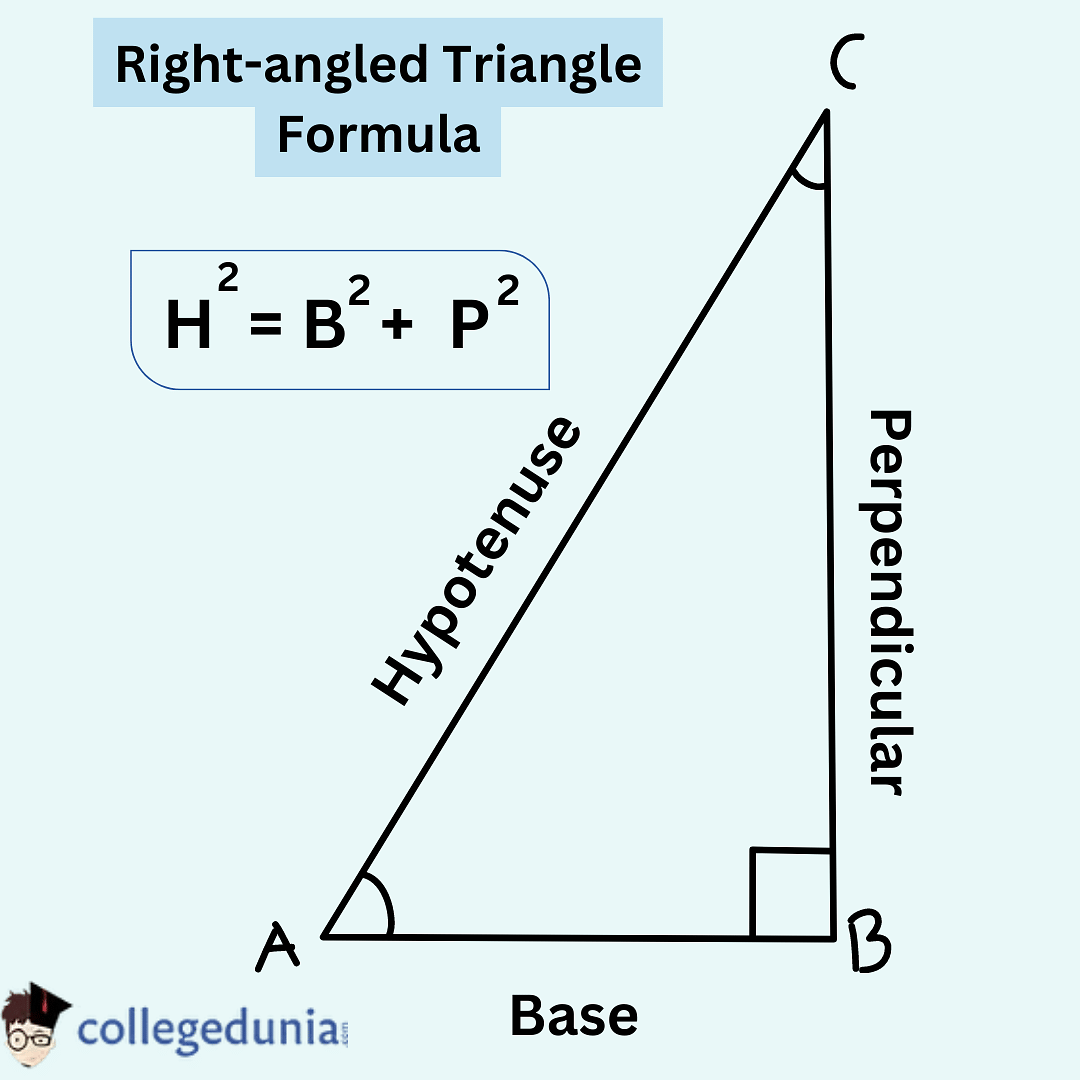
In the above triangle, the longest side of the triangle that is opposite to the right angle is called the Hypotenuse. The side adjacent to θ is called the Adjacent (Base) and the side opposite to θ is called the opposite (Perpendicular).
One can find the value of any of the missing sides of the right-angle triangle by applying the following formula given in the table below:
| Trigonometric Ratio | Formula |
|---|---|
| Sin θ | \(\frac {Opposite} {Hypotenuse}\) |
| Cos θ | \(\frac {Adjacent} {Hypotenuse}\) |
| Tan θ | \(\frac {Sin \theta} {Cos \theta}\)= \(\frac {Opposite} {Adjacent}\) |
| Cosec θ | \(\frac {1} {Sin \theta}\)= \(\frac {Hypotenuse} {Opposite}\) |
| Sec θ | \(\frac {1} {Cos \theta}\)= \(\frac {Hypotenuse} {Adjacent}\) |
| Cot θ | \(\frac {Cos \theta} {Sin \theta}\)= \(\frac {Adjacent} {Opposite}\) |
From the above formulas:
Tan θ = sin θ/cos θ
Now, the formulas for other trigonometry ratios are:
- Cot θ = 1/tan θ = Adjacent side/ Side opposite
- Sec θ = 1/Cos θ = Hypotenuse / Adjacent side
- Cosec θ = 1/Sin θ = Hypotenuse / Side opposite
Also,
- Tan θ = sin θ/cos θ
- Cot θ = cos θ/sin θ
- Sin θ = tan θ/sec θ
- Cos θ = sin θ/tan θ
- Sec θ = tan θ/sin θ
- Cosec θ = sec θ/tan θ
Trigonometric Functions Detailed Video Explanation
Also Read:
Sin, Cos, Tan Chart
[Click Here for Previous Year Questions]
The values of the trigonometric functions are tabulated below.
| Angle | 0o | 30o | 45o | 60o | 90o |
|---|---|---|---|---|---|
| sin x | 0 | \(\frac {1} {2}\) | \(\frac {1} {\sqrt 2}\) | \(\frac {\sqrt 3} {2}\) | 1 |
| cos x | 1 | \(\frac {\sqrt 3} {2}\) | \(\frac {1} {\sqrt 2}\) | \(\frac {1} {2}\) | 0 |
| tan x | 0 | \(\frac {1} {\sqrt 3}\) | 1 | √3 | Not Defined |
| cot x | Not Defined | 3 | 1 | 13 | 0 |
| sec x | 1 | \(\frac {2} {\sqrt 3}\) | √2 | 2 | Not Defined |
| cosec x | Not Defined | 2 | √2 | 23 | 1 |
Use of Sin Cos Tan
[Click Here for Sample Questions]
In our daily lives, the trigonometry ratios sin, cos, and tan are used to calculate heights and distances. Many real-life problems are solved using sin, cos, and tan. It is even used to calculate planetary motions and distances.
- It is used to calculate the angle of elevation, slope and heights of buildings, mountains, etc.
- It is used in the structural field to calculate the loads, roof slopes, flooring, etc.
- Trigonometry is used in flight engineering to calculate the angle change due to wind loads in flight aviation.
- It is even used by Archaeologists to calculate the excavations work.
- It is used in satellite systems.
- Trigonometry is used in marine engineering to design marine ramps.
Finding Sin Cos Tan Values
[Click Here for Previous Year Questions]
Here, to find the sin, cos, tan values,
- Divide 0,1,2,3, and 4 by 4, then consider their positive roots of them.
- It can help get the sine ratios, which are, 0, ½, 1/√2, √3/2, and 1 for the angles 0°, 30°, 45°, 60° and 90°.
- Provide the values of sine degrees in reverse order in order to acquire values of cosine for the same angles.
- Since tan is the ratio of sin and cos, that is, tan θ = sin θ/cos θ, it can help acquire the values of the tan ratio for the specific angles.
Sin Values
For Sine Values,
- sin 0° = √(0/4) = 0
- sin 30° = √(1/4) = ½
- sin 45° = √(2/4) = 1/√2
- sin 60° = √3/4 = √3/2
- sin 90° = √(4/4) = 1
Cos Values
For Cos Values,
- cos 0° = √(4/4) = 1
- cos 30° = √(3/4) = √3/2
- cos 45° = √(2/4) = 1/√2
- cos 60° = √(1/4) = 1/2
- cos 90° = √(0/4) = 0
Tan Values
For Tan Values,
- tan 0° = 0/1 = 0
- tan 30° = (1/2) / (√3/2) = 1/√3
- tan 45° = (1/√2) / (1/√2) = 1
- tan 60° = [(√3/2)/(½)] = √3
- tan 90° = 1/0 = ∞
Hence, the sin cos tan values are found.
Also Read:
| Related Articles | ||
|---|---|---|
| Sine Squared X | Sin 30 Degrees | Sin 90 Degrees |
| Sin 180 Degrees | Cos 120 Degrees | Sin 30 Degrees |
Things to Remember
- Sin, Cos and Tan are the basic trigonometric ratios used to examine the relationship between the angles and sides of a triangle.
- Sin θ is given by the ratio of the opposite side to the hypotenuse. It is given by Sin θ= Opposite/Hypotenuse = tan θ/sec θ
- Cos is given by the ratio of the adjacent side to the hypotenuse. It is given by Cos θ = Adjacent/Hypotenuse = sin θ/tan θ
- Tan θ is given by the ratio of sin θ to cos θ. It is given by Tan θ = Sin θ/Cos θ = Opposite / Adjacent.
Previous Year Questions
- If [x] denotes the greatest integer \le x≤x, then the system of linear equations….[JEE MAIN 2019]
- If ∠BPC=β, then tanβ is equal to :...[JEE MAIN 2017]
- Let P={θ:sinθ−cosθ=2cosθ} and Q={θ:sinθ+cosθ=2sinθ}….[JEE MAIN 2016]
- If sinθ=1+t22t and ? lies in the second quadrant, then cosθ ….[WBJEE 2011]
- The number of solutions of 2sinx+cosx=3 is….…....[WBJEE 2011]
- Let tanα = a+1a and tanβ=2a+11 then α+β is..[WBJEE 2011]
- Let f(?)=(1+sin2?)(2−sin2?). Then for all values of ?….[WBJEE 2013]
- Let p,q and rr be the sides opposite to the angles P,Q and R, respectively…..[WBJEE 2012]
- If 0≤x<2π , then the number of values of x for which sinx−sin2x+sin3x=0, is...[JEE ADVANCED 2019]
- The expression1−cotAtanA+1−tanAcotA can be written as...[JEE ADVANCED 2013]
- If ∠ADB=θ,BC=p and CD = qCD=q, then AB is equal to...[JEE ADVANCED 2013]
- If the angles of elevation of the top of a tower from three collinear points….[JEE MAIN 2015]
- The height (in mm) of the lamp-post is:….[JEE MAIN 2019]
- If L=sin2(16π)−sin2(8π) and ,M=cos2(16π)−sin2(8π), then :….[JEE MAIN 2020]
- If sum of all the solutions of the equation...[JEE MAIN 2018]
Sample Questions
Ques. If tan θ + cot θ = 5, find the value of tan2θ + cotθ. (CBSE 2012) (2 marks)
Ans. tan θ + cot θ = 5 … (given)
tan2θ + cot2θ + 2 tan θ cot θ = 25 … (Squaring both sides)
tan2θ + cot2θ + 2 = 25
∴ tan2θ + cot2θ = 23
Ques. Find the principal solution of the eq. Sin x = \(\frac {\sqrt 3} {2}\) (2 marks)
Ans. Sin x = \(\frac {\sqrt 3} {2}\)
Sin x = Sin \(\frac{ \pi }{3}\)
x = \(\frac{ \pi }{3}\)
Sin x = Sin ( π – \(\frac{ \pi }{3}\))
x = \(\frac{2 \pi }{3}\)
Ques. A ladder leans against a brick wall making an angle of 50° with the horizontal. What height of the wall does the ladder reach if it is 10 feet from the wall? (2 marks)
Ans. The neighbouring side (which is 10 feet) is known, and the opposite side must be found (which is x ft). As a result, we use the tan relationship between the opposite and adjacent sides.
tan 50° = x/10
x = 10 tan 50°
x ≈ 11.9 ft
As a result, the ladder extends up to 11.9 feet from the wall.
Ques. If tanθ1 = \(\sqrt{3}\) and tan θ2 = \(\frac{1}{\sqrt{3}}\), 0<θ1 θ2 < 90, find the value of cot (θ1 + θ2) (2 marks) (CBSE 2017)
Ans. tan θ1 = \(\sqrt{3}\) = tan 60 ...(1)
tan θ2 = \(\frac{1}{\sqrt{3}}\) = tan 30 ...(2)
From (1) and (2) θ1 = 60 and θ2 = 30
cot (θ1 + θ2) = cot (60 + 30)
= cot 90
= 0
Ques. If Sin θ - Cos θ = 0, Find the value of Sin4θ+Cos4θ (2 marks) (CBSE 2017)
Ans. Sin θ - Cos θ = 0
Therefore,
Sin θ = Cos θ
\(\frac{sin\theta}{cos\theta}\) = 1
\(\frac{sin\theta}{cos\theta}\) = tan θ = 1
θ = 45
Sin4θ+Cos4θ = \(\frac{1}{\sqrt{2}}^4\) + \(\frac{1}{\sqrt{2}}^4\)
= ¼ + ¼
= 2/4
=½
Ques. Evaluate tan 75°. (2 marks)
Ans. It can be written as tan 75° = tan (45° + 30°)
→ \(\frac {tan 45 + tan 30} {1-tan 45 tan 30}\)
→ \(\frac {\sqrt 3+1} {\sqrt 3-1}\)
Ques. Verify the cosec θ tan θ cos θ=1 (2 marks)
Ans. Now solving L.H.S we get,
→ 1/sin θ × sin θ/cos θ × cos θ {cosec θ =1/sin θ and tan θ =sin θ / cos θ}
Solving this we get
→ 1×1×1= 1
→ LHS = RHS
Hence proved.
Ques. Simplify the trigonometric expression? (2 marks)
2 cot (A)-2/1 - tan(-A)
Ans. 2 cot A-2/1 - tan A
= (2 cos A/sin A)-2/1-(sin A/cos A)
= 2(cos A- sin A)/sin A/(cos A-sin A)/cos A
= 2 (cos A-sin A)/sin A × cos A/(cos A-sin A)
= 2 × cos A/sin A
= 2 × cot A {cot A=cos A/sin A}
= 2 cot A
Ques. Evaluate sin 300° in exact form. (2 marks)
Ans. sin (300°) = sin (360°- 60°)
= -sin (60°)
= - \(\frac {\sqrt 3} {2}\)
Note: (sin(360°- θ ) = -sin θ )
Ques. Given tan(A) = 10 and tan (B) = 4, find the value of tan (A-B). (2 marks)
Ans. Tan (A) =10, tan (B) = 4
Applying Tan (A-B) = (tan A - tan B)/(1+ tan A. tan B)
→ (10-4)/(1+10 × 4)
→ 6/41
So, tan (A-B) = 6/41
Ques. A circus artist is climbing a 20 m long rope, which is tightly stretched and tied from the top of a vertical pole to the ground. Find the height of the pole, if the angle made by the rope with the ground level is 30°. (2 marks)
Ans. Length of the rope (AC) = 20m and ∠ACB = 30º
Let the height AB of the pole be h m.

Then in triangle ABC,
Sin 30 = AB/AC
½ = h/20
h = 20/2 = 10m
Hence, the height of the pole is 10 m
Ques. A tree breaks due to a storm and the broken part bends so that the top of the tree touches the ground making an angle 30° with it. The distance between the foot of the tree to the point where the top touches the ground is 8 m. Find the height of the tree. (2 marks)
Ans. Here,
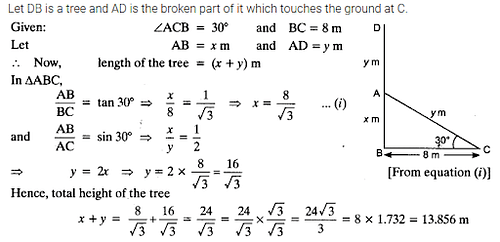
Ques. The angle of elevation of the top of a tower from a point on the ground, which is 30 m away from the foot of the tower is 30°. Find the height of the tower. (2 marks)
Ans. 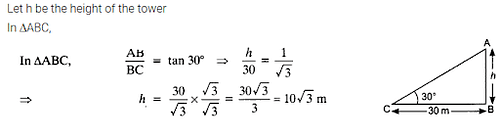
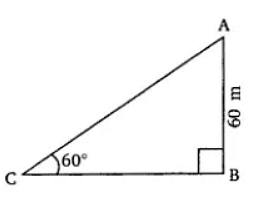
Ques. A kite is flying at a height of 60 m above the ground. The string attached to the kite is temporarily tied to a point on the ground. The inclination of the string with the ground is 60°. Find the length of the string, assuming that there is no slack in the string. (2 marks)
Ans. Given: AB = 60 m and ∠ACB = 60 o
Let AC be the length of the string.
Then in the right ΔABC,
sin 60o = \(\frac{AB}{AC}\)
⇒ \(\frac{\sqrt{3}}{2} = \frac{60}{AC}\)
⇒ AC = \(\frac{60 \times 2}{\sqrt{3}} \times \frac{\sqrt{3}}{\sqrt{3}} = \frac{120 \times \sqrt{3}}{3} = 40\sqrt{3} \)m.
Hence, the length of the string is \(40\sqrt{3} m\)
For Latest Updates on Upcoming Board Exams, Click Here: https://t.me/class_10_12_board_updates
Check Out:



Comments