



Content Curator
Acetic acid, also known as methane carboxylic acid and ethanoic acid, is basically a clear, colourless liquid, with a strong and pungent smell. Interestingly, the word 'acetic' is derived from the Latin word 'acetum' which means 'vinegar'. Vinegar is a diluted form of acetic acid and is the most common chemical substance among people. Acetic acid is the main component of vinegar and also gives vinegar its characteristic smell.
| Table of Content |
Key Terms: Acetic Acid, Glacial Acetic Acid, Acetic Anhydride Uses, Ethanoic acid, Vinegar
What is Acetic acid?
[Click Here for Sample Questions]
Acetic acid is a byproduct of fermentation and gives vinegar its characteristic smell. Vinegar contains about 4-6% acetic acid in water. Its more concentrated solutions can be found in laboratory use.
Pure acetic acid which contains only traces of water is known as glacial acetic acid. Acetic acid is also known as ethanoic acid, ethyl acid, and methane carboxylic acid; it has the chemical formula of CH3COOH.
Structure of Acetic Acid
[Click Here for Previous Year's Questions]
Structurally, ethanoic acid is the second simplest carboxylic acid (the simplest is formic acid, HCOOH), and essentially has a methyl group with a carboxyl functional group attached to it. The structure of acetic acid is as follows:
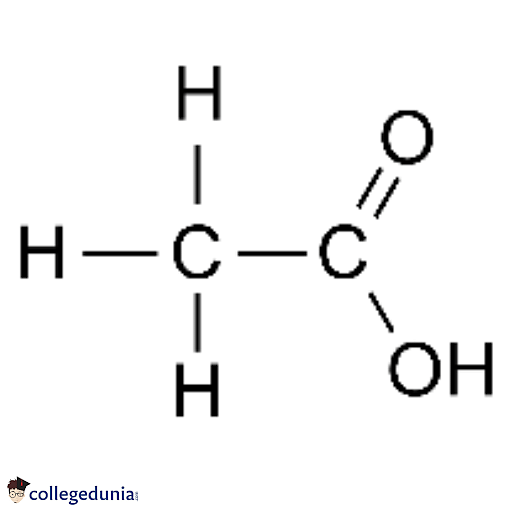
Acetic Acid Structure
Uses of Acetic Acid
[Click Here for Sample Questions]
In addition to being considered a food preservative (vinegar), acids are used in many areas and instances. Some of the top and important uses are discussed below:
- Acetic acid is used for the production of substrates and as a chemical reagent for the production of numerous chemical compounds such as acetic anhydride, esters, vinyl acetate monomer, vinegar, and many other polymeric materials.
- In the medical field, Acetic acid can be used as an antiseptic against Pseudomonas, Enterococci, Streptococci, Staphylococci, and others. It is also used for cervical cancer screening and treatment of infections. It is used as an agent to lyse (destruction of cells by lysin) red blood cells before the white blood cells are examined.
- In the food industry, Acetic acid is used in commercial pickling operations and in condiments such as mayonnaise, mustard, and ketchup. It is also used for seasoning various food items like salad etc.
- Acetic acid which is a dilute solution is widely used as vinegar in households. Vinegar is widely used for cleaning, laundry, cooking, and many other households use. Farmers commonly spray acetic acid on livestock silage to prevent bacterial and fungal growth.
Physical Properties of Acetic Acid
[Click Here for Previous Year's Questions]
Although ethanoic acid is considered a weak acid, in its concentrated form, it has strong corrosive powers and can even attack human skin if exposed to it. Some common properties of acetic acid are listed below:
- Ethanoic acid appears as a colourless liquid and has a strong odour.
- At STP, the boiling and melting points of ethanoic acid are 289K and 391K, respectively.
- The molar mass of acetic acid is 60.052 g/mol and its density in liquid form is 1.049 g.cm-3.
- The carboxyl functional group in ethanoic acid can ionize the given compound by the reaction: CH3COOH ⇌ CH3COO– + H+
- The release of protons described by the above equilibrium reaction is the root cause of the acidic quality of acetic acid.
- The acid dissociation constant (pKa) of ethanoic acid in water solution is 4.76.
- The conjugate base of acetic acid is acetate, which is given by CH3COO–.
- An ethanoic acid solution of 1.0M concentration has a pH of 2.4, indicating that it does not completely dissociate.
- In the liquid form, acetic acid is a polar, protic solvent, having a dielectric constant of 6.2.
The metabolism of carbohydrates and fats in many animals centres around the association of acetic acid with coenzyme A. This compound is produced by the reaction between methanol and carbon monoxide (carbonylation of methanol).
Chemical Properties of Acetic Acid
[Click Here for Sample Questions]
The chemical reactions caused by acetic acid are similar to those of other carboxylic acids. When heated above 440oC, this compound undergoes decomposition to yield methane and carbon dioxide or water and ethanone, as described by the following chemical equations:
- CH3COOH + Heat → CO2 + CH4
- CH3COOH + Heat → H2C=C=O + H2O
Some metals such as magnesium, zinc, and iron corrode when exposed to acetic acid. The formation of acetate salts is the result of these reactions.
- 2CH3COOH + Mg → Mg (CH3COO)2 (magnesium acetate) + H2
The reaction between ethanoic acid and magnesium results in the formation of magnesium acetate and hydrogen gas, which is described by the chemical equation given above.
Acetic Acid as Solvent
[Click Here for Previous Year's Questions]
In its liquid state, CH3COOH is hydrophile (dissolves readily in water) and is also a polar, protic solvent. A mixture of acetic acid and water is, in this way, similar to a mixture of ethanol and water. Acetic acid also forms miscible mixtures with hexane, chloroform, and some oils. However, it does not form a miscible mixture with long-chain alkanes (such as octane).
The desirable solvent properties of acetic acid, together with its ability to form miscible mixtures with polar and non-polar compounds, make it a very important industrial solvent. It is used to a very large extent in the industrial preparation of dimethyl terephthalate (DMT).
Read More:
| Topic Related Links | ||
|---|---|---|
| Difference between Acetic acid and Glacial Acetic acid | Properties of Acetic acid | Acetate |
| Ethanoic Acid | Ester | Difference between ethanol and methanol |
Dangers of Using Acetic Acid
[Click Here for Sample Questions]
There are some dangers of using acetic acid, like:
- Acetic acid can be dangerous, and in some cases, can lead to significant injuries and severe burns if the exposure is prolonged.
- People who are under the influence of respiratory distress are more susceptible to problems related to acetic acid because it can quickly enter their airways and cause them to become irritated for a while.
- If a user ingests it or the acetic acid vapor gets into the lungs, it can cause irritation and difficulty breathing. In these cases, the user needs to see a doctor and get the necessary medical attention immediately.
Previous Year Questions
- The pH of 10−8MNaOH is:
- Find pH of 0.1 M NaOH solution.
- The compound that is not a Lewis acid, is?
- What is the pH for a neutral solution at the body temperature…?
- The pH value of 0.01 N NaOH solution is…?
- The pH of human small intestine is around 7.5 and the pH of large intestine can be 5.5…?
Things to Remember
- Acetic acid is a byproduct of fermentation and gives vinegar its characteristic smell.
- Acetic Acid is used in industries, the medical sector, the food industry, and households.
- In its liquid state, CH3COOH is hydrophile (dissolves readily in water) and is also a polar, protic solvent.
- Acetic acid can be dangerous, and in some cases, can lead to significant injuries and severe burns if the exposure is prolonged.
Sample Questions
Ques.1. What is acetic acid? (2 Marks)
Ans: Acetic acid, also known as ethanoic acid, ethyl acid, acetic acid, and methane carboxylic acid; is a byproduct of fermentation and gives vinegar its characteristic smell. It is formed from the fermentation and oxidation of natural carbohydrates; acetate is an acetic acid salt, ester, or acyl. Acetic acid is a biologically significant metabolic intermediate that can be found in body fluids and plant juices.
Ques.2. What are the hazards of acetic acid? (2 Marks)
Ans: Although acetic acid is a weak acid; Its concentrated form is corrosive to the skin causing blisters and burns. Prolonged inhalation of acetic acid vapor at 10 ppm for about eight hours can cause irritation to the eyes, nose, and throat. Lung irritation and possible damage to the lungs, eyes, and skin can result at 100 ppm. Workers exposed to acetic acid for long periods of time can also suffer from bronchitis, pharyngitis, erosion of exposed teeth, and conjunctivitis. Therefore, the risk mainly depends on the concentration of the acid.
Ques.3. What are the uses of acetic acid in chemical synthesis? (3 Marks)
Ans: There are so many uses of Acetic acid in chemical synthesis, which are as under:
- Acetic acid is used in the synthesis of cellulose acetate, which is useful in making photographic films and textiles.
- Acetic acid is useful as a solvent in the synthesis of terephthalic acid. The process is called the Amoco process. p-xylene is oxidized to terephthalic acid. Terephthalic acid is used in the synthesis of PET, which is widely used in the production of plastic bottles.
- Acetic acid is very useful in the synthesis of esters by reaction with various alcohols. Acetic acid ester derivatives are used to a large extent as food additives.
- Acetic acid is used in the synthesis of vinyl acetate monomer. This monomer then polymerizes to form poly (vinyl acetate) which is also commonly known as PVA. PVA has a wide range of applications from medicine to paper production (due to its biocompatibility with nanotechnology (as a stabilizing agent).
- Acetic acid is useful as a solvent in many organic catalytic reactions.
Ques.4. State the uses of acetic acid in the industrial sector. (3 Marks)
Ans: There are different types of uses of Acetic acid which are as follows:
- Acetic acid is useful in the synthesis of dyes and inks and fragrance synthesis.
- It is useful in the rubber and plastic industry. It is used as a solvent and starting material for many important polymers in the rubber and plastic industry like PVA, PET, etc.
- It is useful as a starting material for components of paints and adhesives
- It is useful in the food processing industry as an additive and food preservative in cheese and sauces.
Ques.5. What are the uses of acetic acid in medicine? (3 Marks)
Ans: The uses of acetic acid in medicine are:
- Acetic acid is useful in a technique called chromoendoscopy which is an alternative to conventional endoscopy.
- Acetic acid is useful for visual inspection of cervical cancer, lesions, and cervical cancer screening.
- Acetic acid is useful in the treatment of otitis externa.
- Acetic acid is also sometimes used in the treatment of bacterial and fungal infections.
- In laboratory trials on mice, it has been shown that acetic acid can suppress the inflammatory response in mice.
Ques.6. What are the household uses of acetic acid? (3 Marks)
Ans: The household uses of acetic acid are as under:
- Acetic acid is the main component of vinegar, which is used in pickling vegetables.
- It is useful in salads for seasoning and in the baking process. It reacts with baking soda to release carbon dioxide gas that makes the food fluffy.
- Acetic acid also works as an anti-fungal agent.
Ques.7. What are the household uses of vinegar? (2 Marks)
Ans: Acetic acid, in the form of a dilute solution, is used to a large extent as vinegar. And, as we all know, vinegar is commonly used in the home for cleaning, laundry, cooking, and various other purposes. To combat bacterial and fungal growth, farmers spray cattle silage with acetic acid. Acetic acid is a sour substance found in vinegar, pickled vegetables, and chutneys, as well as raw materials for spices.
Ques.8. What are some preparation methods for acetic acid? (3 Marks)
Ans: Industrially, acetic acid is made by the carbonylation of methanol. These two compounds react to create a methyl iodide intermediate which then reacts with carbon monoxide. The resulting compound reacts with water to form acetic acid. Here, the carbonyl complex is required as a catalyst in the second step. Here are the equations of the preparation process:
- CH3OH (methanol) + HI (hydrogen iodide) = CH3I (methyl iodide intermediate) + H2O
- CO (carbon monoxide) + CH3I = CH3COI (acetyl iodide)
- H2O+CH3COI = CH3COOH (acetic acid) + HI
Ques.9. Are there any other methods of Preparing Acetic Acid? (3 Marks)
Ans: Yes, some naphthalene salts of cobalt, chromium, and manganese can be used as metal catalysts in the oxidation of acetaldehyde. The chemical equation for such a reaction will be:
- O2 + 2CH3CHO = 2CH3COOH
Ethylene (C2H4) can be oxidized to acetic acid with the help of a palladium catalyst and a heteropoly acid, as described by the following chemical reaction:
- O2 + C2H4 = CH3COOH
Some anaerobic bacteria have the ability to convert sugar directly into acetic acid.
- C6H12O6 = 3CH3COOH
It may be noted that no ethanol intermediate is formed in the anaerobic fermentation of sugar by these bacteria.
Ques.10. What are the reactions of Acetic Acid? (3 Marks)
Ans: Acetic acid reacts with alkalis to form acetate salts as described below:
- CH3COOH+ KOH = CH3COOK + H3O
This compound also reacts with carbonate (with carbon dioxide and water) to form acetate salts. Examples of such reactions include:
- 2CH3COOH + Na2CO3 (sodium carbonate) = 2CH3COONa + CO2 + H2O
- CH3COOH + NaHCO3 (sodium bicarbonate) = CH3COONa + CO2 + H2O
The formation of ethanoyl chloride is the result of the reaction between PCl5 and ethanoic acid.
Also Check:



Comments