



Education Journalist | Study Abroad Lead
Magnets are objects that produce its magnetic field, a force that can attract or repel objects. On the basis of magnetic lines of force, a magnet attracts the opposite poles (N-S) and repels like poles (N-N and S-S). There are various uses of magnets that extend into various fields of science, technology, and everyday life. A magnet can be in a small toy or a heavy device to pick up heavy objects.
Read on to know more about the uses of magnets in daily lives and advanced technologies.
| Table of Content |
Key Terms: Magnets, Electromagnets, Permanent Magnets, Temporary Magnets, Applications of Magnets
Applications and Uses of Magnets in Daily Life
[Click Here for Sample Questions]
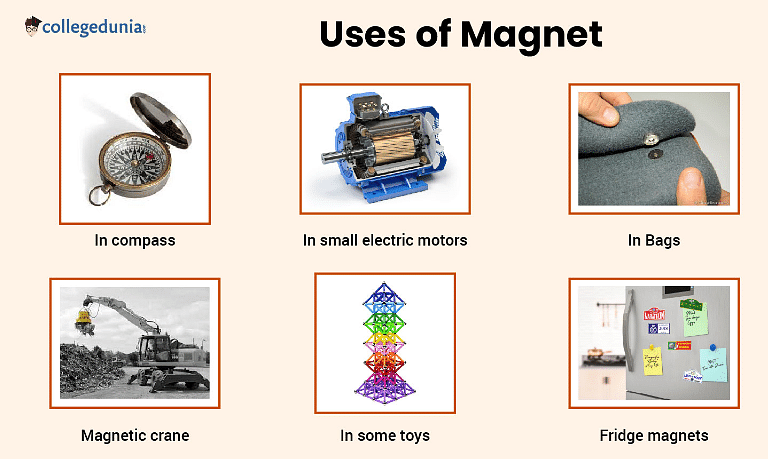
Temporary magnets, Permanent Magnets and Electromagnets are used in daily life. Also, magnetism plays an important role in electrical engineering to generate motion in electric motors which are found in various appliances like electric fan, door bell, washing machine etc. Listed below are some applications of magnets:
- Magentic Door Latches: Magnets are used in door latches to keep the doors securely closed without the help of mechanical locks.
- Refrigerator Magents: These magnets are used to attach notes, pictures or reminders on the refrigerator doors.
- MRI Machines: Medical practisioners use magnets in MRI machines (Magnetic Resonance Imaging) to create detailed images of internal organs/structures of the human body.
- Credit Card Stripes: Credit and debit cards contain a magnetic stripe that stores information about the cardholder's account and is read by card readers.
- Magnetic Compass: Navigational compasses uses earh’s magnetic field to provide direction, aiding in navigation on land and sea.
- Magnetic Toys: Children’s toys such as building structure, cars etc.
- Magnetic Therapy: Some people use magnets for therapeutic purposes, believing in the potential health benefits of magnetic fields on the body.
- Magnetic Closure in Bags and Jewelry: Some bags and jewelry use magnetic closures for a secure and easy-to-use fastening mechanism.
- Electric Motors: Magnets play a crucial role in the operation of electric motors, driving various devices from household appliances to industrial machinery.
- Magnetic Stirrers in Laboratories: Magnetic stirrers use rotating magnetic fields to stir liquids in laboratory settings, facilitating experiments and reactions.
These examples showcase the versatility of magnets, ranging from everyday applications to high-tech uses across various industries.

Magnets
Also Read:
Types of Magnets
[Click Here for Sample Questions]
There are three types of magnets - Permanent magnet, Temporary magnets and Electromagent.
- A magnet that retains its property for a long time is called a permanent magnet.
- Temporary magnets behave as magnets while attached to or close to something that releases a Magnetic Field, but lose this characteristic when the source of the magnetic field is removed.
- An electromagnet is a temporary magnet that acts only under the influence of applied electric current.
- Sizes of electromagnets can range from very small to large giant structures. Iron nails and paper clips are examples of temporary magnets.
The theory of electromagnetism are applied to the following areas:
- Electrostatics
- Magnetic fields of slow and steady currents
- Motional e.m.f. and EMI
- Maxwell's equations
- The propagation and radiation of EMW
- Electric and magnetic properties of matter, and
- Laws of conservation
Uses of Permanent Magnets
[Click Here for Sample Questions]
Those magnets that do not lose their magnetic properties once magnetised. In other words, “a magnet that retains its property for a long time is called a permanent magnet”. Uses of permanent magnets in our daily life can be found in the areas/objects such as Speakers, Headphones/earphones, Mobile phones, Cars, Generators, Television, Transducers, Hard drives, Sensors.
Refrigerators
The most widely used application of a permanent magnet is found in the closing door of a refrigerator/fridge. The gasket of the refrigerator that closes the door contains a thin inner magnetic strip, which is a permanent magnet.
Automobiles
Magnetic Levitation concept is used to make maglev train. The magnets used in these automobiles are made of materials with a high proportion of rare earth magnets, which is both expensive and limited supply. Maglev trains work on the principle of North-South magnetic field and offer a great contribution to the sustainable transportation field.

Principle of Maglev trains
Jewellery
Various jewellery like bracelets, earrings, necklaces and beads are made of permanent magnets as these magnets help to hold the jewellery.
Uses of Magnet
Other Uses of Permanent Magnets
- Door Magnets
- Magnetic Name tags
- Magnetic Jewellery
- Magnetic Clasps
- Magnetic Water Treatment
- Magnetic Filter
- Adhesive Magnets
- Magnetic Pickup Tools
- Magnetic Knife Holder
- Magnetic Tray
- Compass
- Magnetic Toy
- Maglev Train
- Telephone
- Cell Phone
- Clocks
- Scientific instruments
Uses of Electromagnets
[Click Here for Sample Questions]
Electromagnets are used in home appliances like electric fan, electric doorbell, induction cooker etc. In the medical field, MRI Scan machines also uses electromagnets.
Electromagnets are also used to store data in the form of bits and bytes in ebook gadgets and phones. Most of the computer hardware work on the principle of electromagnetism.
All communication systems like mobile phones uses electromagnets to make phone calls.
Other Uses of Electromagnets are mentioned below:
- Generators, motors, and transformers
- Electric buzzers and bells
- Loudspeakers
- Relays and valves
- Data storage devices like VCRs, tape recorders, hard discs, etc.
- Induction cooker
- Magnetic locks
- Particle accelerators
- Mass spectrometers
Uses of Temporary Magnets
[Click Here for Sample Questions]
Temporary magnets rely on outside force to create their own magnetic field. These are the objects made of iron/steel and can be transformed into magnets using stronger permanent magnets. Examples can be iron nails, screws, metal bolts, kitchen utensils (forks, knives, etc.), paper clips and thumb tacks. Here are some uses of temporary magnets:
- Temporary magnets help in separating different types of metal based materials.
- These are used in electromagnets to conduct electricity in motors.
- Temporary magnets are used in cranes to move larger and weaker magnetic materials/metals.
Things to Remember
- An electromagnet is a temporary magnet that acts only under the influence of applied electric current.
- On an electric fan, the electromagnetic induction keeps the motor spinning and helps to rotate the fan blades.
- In an electric doorbell, when we press the button, the coil's electromagnetic force gets stronger and the bell rings.
- In the old days, electromagnets were mostly used for VCP and VCR data storage.
- Permanent magnets are also used in screwdrivers.
- Permanent magnets emits magnetic filed without any external field while temporary magnets require external Magnetic Force to act as a magnet.
- Magnets are used in our daily life to make the human task easier like sensor, to lift heavy metal bodies, make communication channel stronger using electromagnets, and separating differnt types of metal based materials using temporary magnets.
Also Read:
Sample Questions
Ques: What is a Magnet? [2 marks]
Ans: A magnet is a substance that has the characteristics of attracting objects that are made of iron, cobalt and nickel. Magnets usually have north and south poles with invisible magnetic field lines. Based on their presence, magnets can be classified as natural magnets and synthetic magnets.
Ques: You are given Two rods, An Iron Rod and A Magnet, how will you identify Which is the Magnet? [2 marks]
Ans: Take both rods and suspend them separately. Bring one end of a bar magnet closer to both ends of the suspended rod. It is an iron rod, if it shows attraction at both ends. It is a bar magnet, if it shows attraction at one end and repulsion at the other end.
Ques: How should a Magnet be stored? [2 marks]
Ans: If a magnet is not stored properly, it also loses its magnetism. Bar magnets should always be stored in pairs on the same side with their opposite poles. A piece of wood is placed in the middle to separate them. In the case of horse-shoe magnets, a single magnet protector must be placed so that it touches both poles of the magnet.
Ques: What is a Compass? [2 marks]
Ans: A compass is a magnetic device that is used to determine geographic directions like North, South, etc. The entire object is not a magnet. But a compass is a device that has a magnetic needle that points in a direction or position.
Ques: What are Permanent Magnets? [2 marks]
Ans: Magnets that do not lose their magnetic properties even after a long time are called permanent magnets. A permanent magnet is made of a hard material like steel. The most powerful magnets are made of an alloy containing aluminium, nickel, iron and cobalt. A permanent magnet does not require an electric current to act as a magnet.
Ques: Write two Uses of Magnets? [3 marks]
Ans: The uses of magnets are:
- ATMs, credit and debit cards have a magnetic strip that stores information and enables money transactions.
- Magnetic recording devices such as VHS, audio cassettes, computers, floppy disks and hard disks contain magnets for recording data.
- Trains are also pulled by the magnetic force that works on the rails.
Ques: How can an iron strip convert into a Temporary Magnet? [3 marks]
Ans: The procedures to convert an iron strip into a temporary magnet are as follows:
- Place the iron strip on a hard surface.
- Take the bar magnet
- Then, gently rub the bar magnet along the length of the iron strip.
- Repeat this activity about 20-30 times.
- To check if the iron strip has become a magnet, bring some iron to the nail and observe.
Ques: Write the Properties of Poles of the Magnet? [3 marks]
Ans: The properties of poles of the magnet are:
- A freely suspended magnet always comes to rest on the North-South side.
- Both the poles of a magnet have approximately the same capacity to attract.
- Two poles of a magnet can not be separated ever.
- Opposite poles attract each other.
- The same poles repel each other.
Ques: What are the Differences between Magnetic and Non-magnetic Materials? [5 marks]
Ans: Differentiate between magnetic and non-magnetic materials are as follows:
| Magnetic materials | Non-magnetic materials |
|---|---|
| Materials that get attracted to magnets are magnetic materials. | Materials that do not get attracted to magnets are non-magnetic materials. |
| Usually made of metals | Usually not made up of metals. |
| They can be converted into magnets | They cannot be converted into magnets |
| Examples are iron, nickel, cobalt, etc. | Examples are paper, wood, stone, plastic, etc. |
Ques: Write two Properties of a Magnet. [5 marks]
Ans: The two properties of permanent & electro magnets are:
Permanent Magnets:
- Permanent magnets are permanent until they are magnet-free for a variety of reasons.
- Magnetism works with magnetic fields and magnetic forces.
Electromagnets:
- If necessary, the magnetic effect of the electromagnet can be used by turning on the current.
- Electromagnetism is the combination and interaction of both electricity and magnetism.
For Latest Updates on Upcoming Board Exams, Click Here: https://t.me/class_10_12_board_updates
Check-Out:



Comments