



Education Journalist | Study Abroad Lead
Magnetic levitation is a concept of magnetism that has a lot of applications in our modern world. It is used to make maglev, a train transporting system in which the train levitates on a pair of magnets. It can accelerate and decelerate faster and also has no moving parts. Magnetic levitation technology absolutely eliminates friction from the scene and trains can move to elevated paths easily. Also, this reduces noise and makes it quieter and smoother to travel. The two main issues faced in implementing magnetic levitation are lifting forces and stability. There are various ways to attain both of these. All types of magnets can be used to generate lift for magnetic levitation; permanent magnets, electromagnets, ferromagnets, diamagnets, superconducting magnets, and magnetism due to induced currents in the conductor. But not all kinds of magnets can provide stability. In this article, we will have a look at the magnetic levitation project and its principles.
| Table of Content |
Keyterms: Magnets, Magnetism, Magnetic levitation, Friction, Permanent magnets, Electromagnets, Ferromagnets, Diamagnets, Superconducting magnets, Magnetic force, Gravitational force
Magnetic levitation
[Click Here for Sample Questions]
Magnetic levitation is a state where an object is suspended with the help of magnetic forces and no other force is involved. It is also called magnetic suspension. To suspend an object with magnetic force, we have to provide sufficient magnetic force to counteract the gravitational force. The force only is not enough to suspend an object, stability also plays a key role in this.
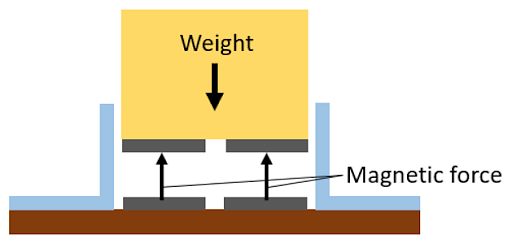
Magnetic Levitation
Stability: It is found that paramagnetic materials are not useful in creating stable suspensions as objects would always slide over each other. Therefore diamagnetic materials, superconductors, or eddy currents are used to stabilize the magnetic levitation system.
Check Important Notes for Magnetic Properties
Basic principles of magnetic levitation
[Click Here for Previous Year Questions]
The basic principles of magnetic levitation are:
- Maglev principle
The levitation coils are attached to the two sides of pathways, similar to the two rails which are laid on the path. There are superconducting electromagnets installed on the train. While these superconducting magnets pass closely through the coils, an electric current is induced in these coils which makes these coils a temporary electromagnet. Due to this, there are electromagnetic forces that push the train upwards and also forces that pull it simultaneously, resulting in the levitation of the vehicle.
- Principle of lateral guidance
When the vehicles pass over the two levitation coils facing each other, it forms a loop. Assume that the vehicle which has a superconducting magnet displaces laterally, a current is induced in the loop which provides a repulsive force acting on the levitation coils near the vehicle and attractive force on the side away from the vehicle. This helps in keeping the position of the vehicle stable at the center.
- Principle of propulsion
We know that both attractive and repulsive forces are involved in the movement of vehicles. There are propulsion coils located in the sidewalls of the pathway which are connected with a continuous three-phase AC current, which creates a shift magnetic field in the pathway. The superconducting magnets on the vehicles are attracted and pushed by this shifting field, propelling the vehicle forward.
Also Read:
| Related Articles | ||
|---|---|---|
| Magnetic Properties of Materials | Class 12 Magnetism and Matter | Magnetization and Magnetic Intensity |
| Permanent Magnets and Electromagnets | Earth’s Magnetic Field | Magnetic Pole |
Project Requirements
[Click Here for Sample Questions]
The material needed for the project are:
- Magnetic tape with a width of 0.5 inches.
- Some perpendicular plastic angle pieces 0.75 inches wide and 24 inches long.
- A wood piece of size 5 * 0.75 * 1 inch as length, breadth, and height.
- Thick cardboard pieces at least 3 inches wide and 24 inches long.
- Double-sided tape
- Plastic cups
- Scissors
- Coins
- Ruler
Read More: Electromagnetism
Procedure
[Click Here for Previous Year Questions]
The procedure to illustrate the magnetic levitation project are:
Step-1: First make sure to have the right magnetic tape. Strips of monopolar magnetic tape repel each other and strips of bipolar tape attract each other. You have to use monopolar tape for this purpose.
Step-2: Remove the paper backing off the two short magnetic strips and attach them to one side of the wooden block. The strips should look like the two rails of a train. This block is now the train car. Make sure the strips are stuck perfectly.

Wooden Block
Step-3: Cut a piece of cardboard to make the base of the train track. The length should be at least 24 inches and the width should be 3 inches at least.
Step-4: Using the ruler, draw five lines as mentioned below:
- Draw a centerline in the middle of the cardboard along the longer part.
- Draw two lines at a distance of 5 mm to both sides of the centerline.
- Draw two lines at a distance of 20mm to both sides of the centerline.

Centerline
Step-5: Join the long magnetic tapes and the plastic pieces to the side of the pathway according to the spacing mentioned.
Remove the paper peeling from the magnetic tapes. Place them on the base so their inside edges line up with the lines 5 mm from the centerline so that strips are 10 mm apart from each other.
Use double-sided tape to stick the plastic angle pieces to the base so their inside edges are at a distance of 20 mm from the centerline on both sides.

Pathway
Step-6: Put your train on the track keeping the magnetic tape side downward. It should hover parallel on track and you could move it back and forth without any disruptions. Now you have simulated magnetic levitation in this project.

Picture of a completed track
Collecting Data
[Click Here for Sample Questions]
Take a ruler to measure the distance between the train and the track. Make a table with mass (in gram) and length (in cm). Put 0 in the mass column and measure the distance as shown in the figure. Initially, the mass added is zero.
- Now Place a plastic cap on your train and add some coins to it. Measure the new distance and weight added.

- Record this on your table. Finally, draw a scatterplot with the mass on the x-axis and distance on the y-axis.

Things to Remember
- Magnetic levitation is a concept of magnetism that has a lot of applications in our modern world.
- Maglev technology absolutely eliminates friction from the scene and trains can move to elevated paths easily.
- Magnetic levitation is a state where an object is suspended with the help of magnetic forces and no other force is involved
- There are electromagnetic forces that push the train upwards and also forces that pull it simultaneously, resulting in the levitation of the vehicle.
- Diamagnetic materials, superconductors, or eddy currents are used to stabilize the system.
Do check out:
Previous Year Questions
- The average e.m.f. induced in the coil is 0.1 V, when it is removed from the field in t sec….[NEET 1991]
- The current in a coil of L = 40 mH is to be increased uniformly from…..[VITEEE 2017]
- A dynamo converts….[UPSEE 2014]
- A 800 turn coil of effective area 0.05 m2 is kept perpendicular to….[NEET 2019]
- A cycle wheel of radius 0.5m is rotated with constant angular velocity of...[NEET 2019]
- A long solenoid has 1000 turns. When a current of….[NEET 2016]
- At the centre of the solenoid, a coil of 100 turns and radius 0.01 m is….[NEET 2017]
- In the series L−C−R circuit … [KCET 2011]
- A rectangular coil of 100 turns … [KCET 2013]
- A bar magnet is allowed to fall vertically … [KCET 2017]
- A jet plane of wing span 20m is travelling towards west … [KCET 2017]
- A rectangular, a square, a circular and an elliptical loop, all in the...[NEET 2009]
- A resistance 'R' draws power 'P' when connected to an AC source….[NEET 2015]
- the region of magnetic field as shown in the figure below. Then the e.m.f. generated is….[NEET 2016]
- A conducting loop in the shape of a right angled isosceles triangle of height...[JEE Advance 2016]
- If a transformer of an audio amplifier has output impedance…..[JCECE]
- the circular loop of wire is moved with velocity towards the infinite current carrying wire…… [VITEEE 2016]
- Two identical coaxial coils P and Q carrying equal amount of current in the same direction are ...[KEAM]
- The polarity of induced emf is given by….[KEAM]
- In a coil of resistance 100Ω , a current is induced by changing the magnetic flux through it….. [JEE Main 2017]
Sample Questions
Ques. Why maglev trains are better than conventional trains? (3 marks)
Ans. Magnetic levitation is a concept of magnetism that has a lot of applications in our modern world. It is used to make maglev, a train transporting system in which the train levitates on a pair of magnets. It has so many advantages like it can accelerate and decelerate faster, it has no moving parts, etc. Maglev technology absolutely eliminates friction from the scene and trains can move to elevated paths easily. Also, this reduces noise and makes it quieter and smoother to travel.
Ques. What are the materials needed for the magnetic levitation project? (3 marks)
Ans. The materials required for the magnetic levitation project are:
- Magnetic tape with a width of 0.5 inches.
- Some perpendicular plastic angle pieces 0.75 inches wide and 24 inches long.
- A wood piece of size 5 * 0.75 * 1 inch as length, breadth, and height.
- Thick cardboard pieces at least 3 inches wide and 24 inches long.
- Double-sided tape
- Plastic cups
- Scissors
- Coins
- Ruler
Ques. What are electromagnets? (3 marks)
Ans. Electromagnets are objects which can be magnetized by the application of electric current. Its magnetic poles can be changed as desired by alternating the flow of electricity but a typical magnet has fixed poles. Iron is an easily magnetizable material. Maglev trains use electromagnets for the propulsion of the vehicle.
Ques. How objects are stabilized during electromagnetic levitation? (3 marks)
Ans. To suspend an object with magnetic force, we have to provide sufficient magnetic force to counteract the gravitational force. The force only is not enough to suspend an object, stability also plays a key role in this. It is found that paramagnetic materials are not useful in creating stable suspensions as objects would always slide over each other. Therefore diamagnetic materials, superconductors, or eddy currents are used to stabilize the system.
Ques. Explain the first principle of maglev. (3 marks)
Ans. The levitation coils are attached to the two sides of pathways, similar to the two rails which are laid on the path. There are superconducting electromagnets installed on the train. While these superconducting magnets pass closely through the coils, an electric current is induced in these coils which makes these coils a temporary electromagnet. Due to this, there are electromagnetic forces that push the train upwards and also forces which pull it simultaneously, resulting in the levitation of the vehicle.
Ques. Explain the three principles of maglev. (5 marks)
Ans. The three principles of maglev are:
- Maglev principle: The levitation coils are attached to the two sides of pathways, similar to the two rails which are laid on the path. There are electromagnetic forces that push the train upwards and also forces which pull it simultaneously, resulting in the levitation of the vehicle.
- Principle of lateral guidance: Assume that the vehicle which has a superconducting magnet displaces laterally, a current is induced in the loop which provides a repulsive force acting on the levitation coils near the vehicle and attractive force on the side away from the vehicle.
Principle of propulsion: There are propulsion coils located in the sidewalls of pathway which are connected with a continuous three-phase AC current, which creates a shift magnetic field in the pathway.
For Latest Updates on Upcoming Board Exams, Click Here: https://t.me/class_10_12_board_updates
Check-Out:



Comments