



Education Journalist | Study Abroad Lead
A solenoid is an electromagnet that uses a coil twisted into a closely packed helix to create a regulated magnetic field. When an electric current is supplied through the coil, it may be adjusted to generate a consistent magnetic field in a volume of space. André-Marie Ampère developed the name solenoid to describe a helical coil in 1823. Solenoids are used in vehicles to provide the necessary power to start the vehicle. It functions similarly to a sprinkler system and is shaped like a valve. A rectangular section of the magnetic object is called a bar magnet. It is composed of permanent magnetic materials such as steel, iron, or any other ferromagnetic composite or ferromagnetic. When compared to permanent magnets, electromagnets are an excellent piece of equipment. By turning on and off the electric current, we can control the magnetic field. This facilitates the use of electromagnets as switches. In this article, we will understand bar magnet, solenoid, bar magnet as an equivalent solenoid, and look at the working of a solenoid.
Read Also:- Magnetic Force and Magnetic Field
| Table of Contents |
Key Takeaways: Solenoid, Bar magnet, Magnetism, Magnet, Magnetic field, Electric Current, Piston, Electromagnetic field, Valve
What is a Solenoid?
[Click Here for Sample Questions]
The solenoid is a type of electromagnet that produces regulated magnetic fields by running an electric current through it. It has a length larger than its diameter. Like other magnets, solenoids with an active magnetic field have positive and negative poles. The magnetic solenoid's negative end attracts, while the positive end repels. The electromagnetic field within the solenoid moves forward and backward as the piston moves forward and backward.

Solenoid
Use of Solenoid
The solenoid has numerous applications such as:
- A solenoid is a component of an automobile's ignition system.
- The solenoid works as a relay, bringing metal closer together.
- A solenoid is particularly valuable because of its versatility.
- In the case of doorbells, solenoids are used.
- Solenoid paintball guns are used in certain automated production equipment.
Also Read:
| Related Articles | ||
|---|---|---|
| Magnetic Properties of Materials | Magnetic effects of electric current | Magnetization and Magnetic Intensity |
| Electromagnetic field | Earth’s Magnetic Field | Magnetic Pole |
What is a Bar Magnet?
[Click Here for Previous Year Questions]
The bar magnet is a rectangle or a square piece of an item composed of iron or steel with permanent magnetic characteristics and two poles: north and south.
Use of Bar Magnet
Bar magnets are used to form tiny metallic items such as screws and nails, metal shavings, as well as magnetic stirring rods for laboratory applications. They are also used in refrigerator magnets. The needle used in compasses is the most typical use of a bar magnet.

Bar Magnet
Read More about Magnetism and Gauss’s Law
Working of a Solenoid
[Click Here for Sample Questions]
The solenoid operates on the basis of "electromagnetism." When current flows through a coil, a magnetic field is formed in it; if a metal core is placed within the coil, the magnetic lines of flux are focused on the core, increasing the coil's induction over an air core.
The majority of the flux is centered solely on the core, with a little amount of flux appearing at the coil's ends and outside the coil. Increasing the density of the turns or improving the current flow in the coil will increase the solenoid's magnetic strength.

The active solenoid, like all other magnets, has both Positive and Negative poles, which may attract or repel an item. A solenoid valve is a valve that is operated by electricity. A solenoid is understood as an electric coil that has a movable core (ferromagnetic), known as a plunger. A solenoid is used in the valve. The plunger shuts a tiny aperture in the rest position. A magnetic field is created by passing an electric current through the coil. The magnetic field pushes the plunger higher which further opens the hole. This is the essential concept that allows solenoid valves to open and close.
Read more:- The Bar Magnet
Types of Magnets
[Click Here for Previous Year Questions]
As not all magnets are made up of the same elements, they may be classified according to their composition and source of magnetism.
- Magnets that keep their magnetism after being magnetized are known as permanent magnets.
- Temporary magnets are materials magnets that function like permanent magnets while in a magnetic field but lose their magnetism when not in one. Temporary magnets may be made of a variety of materials, as long as they act as permanent magnets when exposed to a magnetic field. Paper clips and other soft iron devices are frequently used as temporary magnets.
- Electromagnets are wire coils that become magnets when an electric current is put through them. The magnet's strength may be changed by modifying the current's intensity and direction.
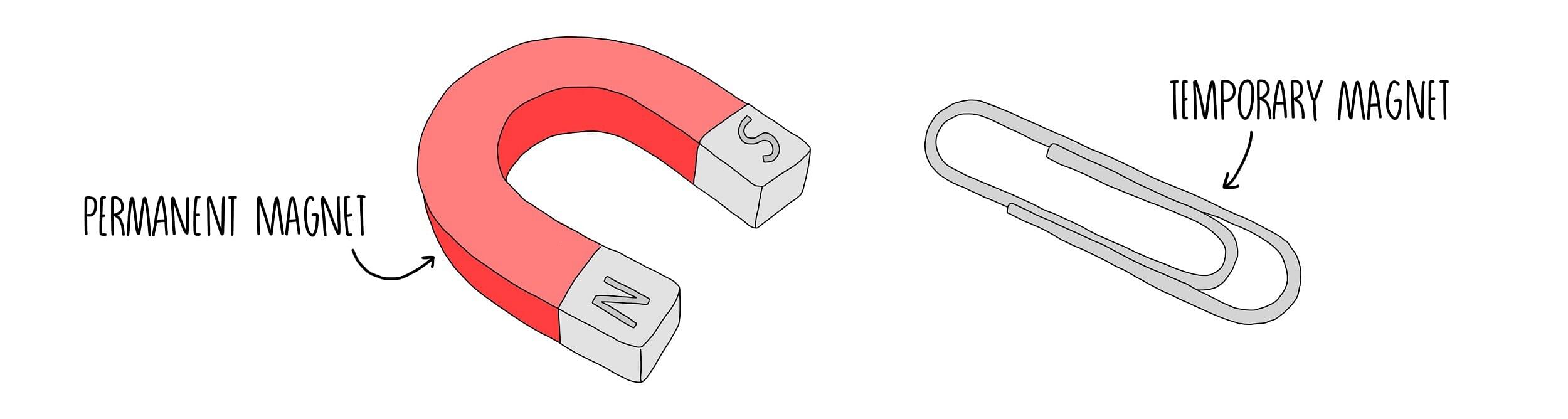
Permanents and Temporary magnets
Read more: The Solenoid and the Toroid
Difference between Solenoid and Bar Magnet
[Click Here for Sample Questions]
The differences between a solenoid and a bar magnet are:
- A permanent magnet is a bar magnet, but an electromagnet is a solenoid that operates as a magnet only when an electric current is supplied through it.
- When a bar magnet is split into two halves, both portions operate as magnets with the same magnetic qualities, however, when a solenoid is divided into two halves, the fields are weaker.
- The poles of a bar magnet are fixed, but the poles of a solenoid may be changed.
- The strength of a bar magnet's magnetic field remains constant, but the strength of a solenoid's magnetic field is dependent on the electric current that passes through it.
Read more: Class 12 Physics Chapter 5 Magnetism and Matter
Similarities between Solenoid and Bar Magnet
[Click Here for Previous Year Questions]
Despite their differences, solenoids and bar magnet are also similar in many ways such as:
- Both the bar magnet and the solenoid have attractive and directional qualities, meaning they can align themselves with the external magnetic field.
- Both have the same magnetic field at the axial point.
- Both have the same magnetic moment.
Read more: Difference between electromagnet and permanent magnet
Bar Magnet as an equivalent Solenoid
[Click Here for Sample Questions]
A bar magnet may be proven as a solenoid by calculating the axial field of a finite solenoid carrying current. Consider a solenoid with a radius of a and a length of 2l, with n, turns per unit length, and current I flowing through it. Consider a tiny element of solenoid thickness dx at a distance x from O, where OP = r.
The radius of the solenoid is denoted by a.
2l is the length.
n denotes the number of turns per unit of length.
I is the current that flows through the solenoid.
Let's assume that dx is the tiny thickness of a solenoid element, measured at a distance of x from point O.
OP = r in this case.
Let's figure out the solenoid's axis as a result of the n number of turns:
Due to the n number of turns on the solenoid's axis, a magnetic field is created.
dB =
0ndxIa22 [(r-x)2+a2]32Getting the magnitude of the whole field by integrating x from -I to +I.
B= 0nIa22-IIdx2 [(r-x)2+a2]32
[(r-x)2]32= r3
And B = 0nIa22r3-IIdx = 0nI22Ia2r3
Hence, B = 042mr3
The magnetic moment of a bar magnet is equal to the magnetic moment of a solenoid, according to the preceding formula.
Also Read:
Things to Remember
- A solenoid is a device that consists of a wire coil, a casing, and a moving plunger (armature).
- The solenoid operates on the basis of "electromagnetism." When current flows through a coil, a magnetic field is formed in it; if a metal core is placed within the coil, the magnetic lines of flux are focussed on the core, increasing the coil's induction over an air core.
- A ferromagnetic bar magnet is a magnet built of ferromagnetic materials.
- A bar magnet, as the name implies, is a rectangular piece of magnet that, like other magnets when hanging freely, aligns itself with the earth's magnetic field.
- They're produced by wrapping a coil of wire around specified materials. These materials produce a magnetic force when an electric current is fed through the coil.
- The magnetic force of these materials diminishes to practically nil when the current is turned off.
Read more: Electromagnetism
Previous Year Questions
- The ferromagnetic substance is converted into paramagnetic substances … [JIPMER 1996]
- The relative permeability is represented by μr … [KCET 2001]
- A device which converts electrical energy into mechanical energy … [JKCET 1999]
- A circular loop of radius R, carrying current I, lies in x-y plane … [JEE Advance 1999]
- When a material is placed in a magnetic field B … [COMEDK UGET]
- Susceptibility of a magnetic substance is found to depend on temperature … [JEE Advance 1998]
- The magnetic susceptibility is negative for … [NEET 2016]
- Two short bar magnets of length 1cm each have magnetic moments … [JEE Main 2013]
- According to Curie's law, the magnetic susceptibility of a substance at an … [NEET 2003]
- An electron in motion is associated with… [ KCET 1996]
- Two parallel wires carry electric current in same direction. The wires... [ KCET 1996]
- Resistance of an ideal ammeter is...[ KCET 1996]
- If a current of 0.1 A is passed through the coil, what is the couple acting?...[CBSE Class 12 ]
- The acceleration of the falling magnet is..[NEET]
- A bar magnet is equivalent to ............[KCET 2004]
- A metal ring is held horizontally and bar magnet is dropped through….[NEET]
- The total charge, induced in a conducting loop when it is moved in magnetic field depend on...[NEET 1992]
- If a charge particle enters perpendicular in the uniform magnetic field, then...[JIPMER 2016]
- Materials suitable for permanent magnet, must have which of the following properties ?
- At what temperature, the ferromagnetic substances become paramagnetic ?
Sample Questions
Ques. A solenoid is an electrical device with a length of 80 cm and 360 spins of coils. It allows a current of 15 A to travel through it. Calculate the magnetic field created. (5 marks)
Ans. As per the question:
360 is the number of coil turns (n).
μ0 is the Permeability which equals 1.26 × 10⁻⁷ T/m
I is the current available which is 15 A
L is the length that is 0.8 m
The magnetic field of the solenoid is calculated as follows:
The magnetic field is given by B which equals INμo/L
B = (15 × 360 ×1.26 × 10−7) / 0.8
B = 8.505 × 10⁻⁴ N/Amp-m
Ques. What is the difference between an electromagnet and a bar magnet? (1 mark)
Ans. An electromagnet is not a bar magnet. It's a permanent magnet that becomes magnetized and produces its own magnetic field.
Ques. In an automobile, what does a solenoid do? (2 marks)
Ans. Solenoids (also known as starting solenoids or starter relays) work by receiving both big and tiny electrical currents from the battery and the ignition system when the automobile key is turned.
Ques. Is a solenoid an AC or DC device? (2 marks)
Ans. The most significant components of solenoid valves that control the flow of liquids and gases are solenoids. Solenoids are electromechanical devices that convert alternating current (AC) or direct current (DC) electricity into linear motion.
Ques. What are the benefits of using a solenoid? (3 marks)
Ans. The advantages of a solenoid are:
- The solenoid-pilot design has the advantages of high flow capability, dependability, and low power consumption.
- The downside is that shifting the valve plunger needs a minimum pilot pressure.
- A direct-acting solenoid has the benefit of not requiring a minimum pressure.
Ques. Is a solenoid considered a motor? (3 marks)
Ans. Solenoids are an electric motor type. Heavy-duty relays are often utilized in automobiles. A solenoid is a device that may create linear or back and forth motion when a force is applied. Solenoids can be activated by hydraulic, pneumatic, or electrical pressure.
Ques. List the various applications of electromagnets. (3 marks)
Ans. The applications of electromagnets are as given below:
- Electromagnets are utilized in speakers, electric bells, and buzzers, among other things.
- Electromagnets are used in relays, motors, generators, and transformers, among other things.
- They're also found in MRI scanners.
Ques. What type of material is utilized to make a bar magnet? What are its characteristics? (3 marks)
Ans. A bar magnet is often made of materials such as iron or steel. A ferromagnetic bar magnet is a magnet built of ferromagnetic materials. The magnet's magnetism is due to ferromagnetic compounds.
A bar magnet, as the name implies, is a rectangular piece of magnet that, like other magnets when hanging freely, aligns itself with the earth's magnetic field.
For Latest Updates on Upcoming Board Exams, Click Here: https://t.me/class_10_12_board_updates
Do Check Out:



Comments