



Content Writer
Value of e is a mathematical constant which is equal to 2.71828. The value of the logarithm to base e is used to perform various kinds of mathematical operations and calculations. It has a variety of applications in Maths and Physics.
- Value of e is a special constant whose logarithm gives the value of 1.
- It is written as Log e = 1.
- e is the base value of the natural logarithm.
- It is also called the Eulerian Number or Napier’s Constant.
- Value of e is used when calculating the limit definition.
- When e is raised to the power of infinity, it is equivalent to 0.
- The value can also be used to calculate the sum of the infinite series.
Read More: Inverse Trigonometric Formulas
Key Terms: Value of e, Logarithm, Sum of Infinite Series, Euler Number, Limit Definition, Compound Interest, Exponential Distribution
Euler’s Number (e)
[Click Here for Sample Questions]
The limit of (1+1/n)n to infinity is known as Euler’s Number. Value of e is used iin the equation that is used in the study of compound interest. It can also be expressed as the sum of an infinite number.

- Value of e is named after the mathematician Leonhard Euler.
- e is an irrational number so it has an indefinite number of decimal places.
- It can be solved by using that formula above.
- The value of e is used in many complex calculations and concepts of mathematics and physics.
- The value of the logarithm to base e is used to perform various kinds of mathematical operations and calculations.
Read More: Logarithmic Differentiation
Continuity and Differentiability Detailed Video Explanation:
Read More: Definite Integral
What is the value of e?
[Click Here for Sample Questions]
The value of e is estimated to be around 2.718281828459045. This value is further used to calculate various complex mathematical equations. The Euler number is a numerical constant that is used in various mathematical calculations and is denoted by “e” and its value is 2.718281828459045 ... and so on.
- The exponential function can be calculated using the value of e.
- y = ex is the most common example to calculate the value of y.
- It is based on the value of x.
- e is primarily used to represent a non-linear function.
- It can be used to determine increase or decrease in population.
- The value of e raised to the power 1 (e1) is the same as e, but the value of e raised to the 0 (e0) is equal to 1.
- Increases the value until an infinite force gives a value of 0.
- This value is often used to mathematically calculate physical and economic phenomena.
- It is very convenient.
Read More:
Mathematically Calculated Value of e
[Click Here for Sample Questions]
The formula given as the infinite sum of Euler's constant e can also be expressed as:

Therefore, the value of (1+1/n)n reaches e when n is reached infinity. You can calculate an approximation of the number e by putting the value of n in the previous formula. Now let's put the value of n = 1 in the upper digit.
| n’s value | (1+1/n)n | Constant e’s value |
|---|---|---|
| 1 | (1+1/1)1 | 2.00000 |
| 2 | (1+1/2)2 | 2.25000 |
| 5 | (1+1/5)5 | 2.48832 |
| 10 | (1+1/10)10 | 2.59374 |
| 100 | (1+1/100)100 | 2.70481 |
| 1000 | (1+1/1000)1000 | 2.71692 |
| 10000 | (1+1/10000)10000 | 2.71815 |
| 100000 | (1+1/100000)100000 | 2.71827 |
Read More: Integration by Partial Fractions
Full value of e
[Click Here for Sample Questions]
The full value of e is 2.718281828459045235360287471352662497757247093699959574966967627724076630353 ……… and so on.
- The euler’s number has many digits of decimal places.
- It can be calculated up to 1000 digits.
- However, mathematical calculations only need an approximation of the Euler number e which is equal to 2.72.
- The value of e is much larger than this value.
Read More: Median
How to calculate the value of e?
[Click Here for Sample Questions]
The steps to calculate the value of e are as follows:
- The formula for e to calculate that value is given as:

- You can find an approximation of the constant e by solving the previous equation.
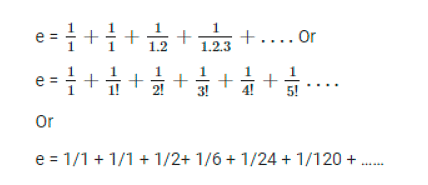
- Here are the first few terms.
- e = 1/1 + 1/1 + 1/2 + 1/6 + 1/24 + 1/120
- e = 2.71828 or e ≈ 2.72.
Also Read:
Things To Remember
- The value of e is a numerical constant used in various mathematical calculations.
- It is also known as the Euler number or Napier’s constant.
- The actual value of e is 2.718281828459045 ... and so on.
- It can be calculated up to 1000 digits.
- The value of e is primarily used to represent a non-linear increase or decrease in function.
- This is a unique and special number whose logarithm of base is given as 1.
- The main use of the value of e can be seen in the exponential distribution.
Read More: Angle of Depression
Sample Questions
Ques: How is the value of e calculated? (5 marks)
Ans: The steps to calculate the value of e are as follows:
- The formula for e to calculate that value is given as:
- You can find an approximation of the constant e by solving the previous equation.
- Here are the first few terms.
- e = 1/1 + 1/1 + 1/2 + 1/6 + 1/24 + 1/120
- e = 2.71828 or e ≈ 2.72.
Ques: What is the purpose of e? (2 marks)
Ans: e is an irrational number that is used for natural logarithms’ base. This is a numeric constant used to graphically represent an increase or decrease in any amount. This value is often used to mathematically calculate physical and economic phenomena. It is very convenient. This constant is also used for exponential functions. For example, y = ex. So if the value of x changes, you can calculate the value of y.
Ques: Explain the need for e in maths? (3 marks)
Ans: Value of e is a mathematical constant which is used to represent non-linear function. It indicates increase or decrease in a function. There are a lot of uses for the Euler number mathematics. They can be used in calculus, distributions, logarithmic functions, etc.
- It is used in compound interest and invented by Jacob Bernoulli.
- The value of e can be used in the probability theory which is related to exponential growth.
- The concept is used in the standard distribution method with zero mean value.
- It is used in the problem of dearrangements which is also known as hat check problem.
Ques: What is the value of log e and value of e when it is raised to the power of 0? (2 marks)
Ans: The value is 0.434 for loge to base 10 and the value of e when it is raised to power of 0 is 1 as one is the value of e0.
Ques: What is the power of minus infinity? (2 marks)
Ans: Most people will tell you that the answer is zero, but it's simply not completely true, it's almost true, but not accurate. Of course, the number is greater than zero. In mathematics, no matter how many times you divide a number, it will always be a finite quantity. So the answer is: 0.00000000………...0000000001 = 1 / ∞. (This is not zero, but slightly greater than zero). You can also write 0+.
Ques: What is the value of e when different value of n is placed in the sum infinite series? (5 marks)
Ans. The value of e when different value of n is placed in the sum infinite series are as follows:
| n’s value | (1+1/n)n | Constant e’s value |
|---|---|---|
| 1 | (1+1/1)1 | 2.00000 |
| 2 | (1+1/2)2 | 2.25000 |
| 5 | (1+1/5)5 | 2.48832 |
| 10 | (1+1/10)10 | 2.59374 |
| 100 | (1+1/100)100 | 2.70481 |
| 1000 | (1+1/1000)1000 | 2.71692 |
| 10000 | (1+1/10000)10000 | 2.71815 |
| 100000 | (1+1/100000)100000 | 2.71827 |
Ques: Consider the function f(x)=ex to the nearest thousandth for each value of x below? (5 marks)
Ans: f(x)=ex
- x = 2
- e2=7.389
- x = ½
- e1/2=1.649
- x = -1
- e−1=0.368
- x = 6
- e6=403.429
- x=1/3
- e1/3=1.396
- x = -2
- e−2=0.135
Ques: Determine the derivative value of y=ex? (5 marks)
Ans: y=ex
Let’s take log to base e on both sides
lny=lnex
From the properties of logarithm we know that, log10an=nlog10a
lny=xlne
lne = 1, as the base is same.
lny = x
Differentiating on both the sides,
1/y x dy/dx =d/dx(x…..[d/ dx logx=1/x]
Thus, dy/ dx = y(1) =y……..[dx/dx=1]
dy/dx=ex
Ques: Calculate the value of r if: re−3=e−2(lne−2)2? (5 marks)
Ans: re−3=e−2(lne−2)2
From the properties of logarithm we know that, log10an=nlog10a
re−3=e−2(−2lne)2
lne = 1, as the base is same.
re−3=e−2(−2)2
re−3=e−24
r=e−2+34
r=e×4
r=10.87
Ques: Yash will deposit $180 in an account at a rate of 2% that is compounded continuously. How much money will be in the account of yash after 4 years? (3 marks)
Ans: Using formula
- A=Pert
- 180e0.02×4
- 180×1.0832
- $194.99
Ques: Calculate the numerical value of e, which satisfies: 6e(e+3)=3e(2e+4)+7? (3 marks)
Ans: Given, 6e(e+3)=3e(2e+4)+5
⇒6e2+18e=6e2+12e+7 ...[By Distribution Law]
⇒18e=12e+7 ...[Cancelling 6e2 on both sides].
Transposing x terms to one side, we get,
⇒18e−12e=7
⇒6e=7
⇒e=7/ 6.
Ques: Calculate the numerical value of 2×10²+3×101+5×100+0×10−1+7×10⁻²? (2 marks)
Ans: Given: 2×10²+3×101+5×100+0×10−1+7×10⁻²
2 x 100 + 3 x 10 + 5 x 1 + 0 + 0.07
200 + 30 + 5 + 0.07
235.07
Ques: Calculate the numerical value of e, which satisfies: 6e(e+2)=3e(2e+4)+8? (3 marks)
Ans: Given, 6e(e+2)=3e(2e+4)+8
⇒6e2+12e=6e2+12e+8 ...[By Distribution Law]
⇒12e=12e+8 ...[Cancelling 6e2 on both sides].
Transposing x terms to one side, we get,
⇒12e−12e=7
⇒0e=7
⇒e=0
Read Also:



Comments