



Content Curator
Electric Current and circuit means the rate of flow of electrons in a conductor or rate of flow of charge. The electric current can flow through simple wires as well as different other components including an electric circuit. The SI unit of electric current is Ampere. Electric motors, computers, lamps and more use electric current.
The formula of electric current is:
| \(I = \frac{Q}{t}\) |
- An electric circuit, which is a way of transmitting electric current, comprises a device that provides energy to charged particles that possess current, like a battery or a generator.
- Electric Circuits are closed-loop consisting of various electrical components through which electric current will pass.
- The path is made of electric wires, which are powered by an electric source like a cell/battery.
- Electrons are tiny particles inside matter, which are negatively charged.
- With the movement of electrons, electric charge moves, which in turn generates an electric current.
- Only conducting materials or conductors can allow the free flow of electrons inside them to create a current.
Read more: Uses of Resistor
| Table of Content |
Key Terms: Electric Circuit, Electric Current, Electrons, Conductor, Ampere, Battery, Series Circuit, Domestic Electric Circuit, Parallel Circuit, Resistor
What is Electric Current?
[Click Here for Sample Questions]
Electric Current can be defined as:
| “The rate of flow of electrons in a conductor. Ampere is the SI unit of Electric Current.” |
- Electrons are minute particles that can be found within the molecular structure of a substance. These electrons are sometimes tightly held, and can also be loosely held.
- When loosely held by the nucleus, electrons can travel freely within the body limit.
- Electrons are negatively charged particles. This is why when they move, several other charges move. This movement of electrons is called electric current.
- The number of electrons that move governs the ability of a substance to conduct electricity.
- On the basis of the ability of the material to conduct electricity, they can be classified as conductors and insulators.
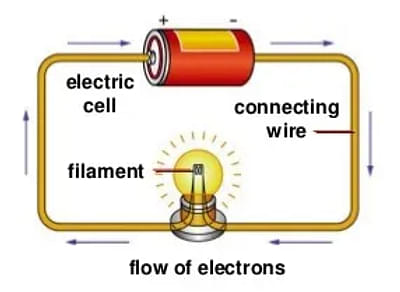
Electric Current
Conductors
Conductors can be defined as materials which enable the free flow of electrons from one particle to another.
- Conductors enable charge transfer via the free movement of electrons.
- The flow of electrons within a conducting material helps to generate an electric current.
- The force needed to drive the current flow via the conductor is known as voltage.
Insulators
Insulators are those materials which restrict free flow of electrons from one particle to another.
- Insulator particles do not enable the free flow of electrons.
- The charge is distributed across the surface of an insulator in an even manner.
Read Also: Unit of Voltage
Unit of Electric CurrentThe magnitude of electric current can be evaluated by coulombs per second. The SI unit of electric current is Ampere. It can be represented by A.
The unit Ampere is prevalently used in the electrical technology with multipliers like milliamp (0.001A), microamp (0.000001A), and more. |
The video below explains this:
Types of Circuits Detailed Video Explanation:
Electric Current Formula
[Click Here for Sample Questions]
The conventional direction of electric current can be considered as opposed to the direction of flow of electrons. In case a charge Q flows via the cross-section of a conductor in time t, the current I is then going to be,
| \(I = \frac{Q}{t}\) |
- The S.I unit of electric charge is coulomb
- The measurement of electric current takes places in units of coulomb per second, i.e. ‘ampere’.
- The flow of current is from the negative terminal to the positive terminal of the cell.
Flow of Current
When a small amount of electric charge which has been placed in the electric field experiences force due to another charge. Thus, the work has to be done on the positive charge.
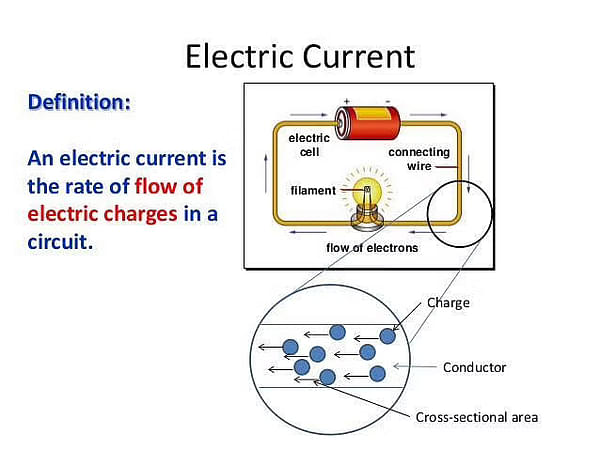
Flow of Current
- In both electrolytes and ionized gases, the positively charged ions as well as the negatively charged ions move, helping constitute electric current.
- If n electrons have been passed via the cross-section of a conductor in time t, the total charge which passes via it is:
| Q = n x e |
Classification of Electric Current
[Click Here for Sample Questions]
The classification of electric current is listed below:
- Alternating Current or AC: Electric charge periodically reverses the direction and this current is most commonly provided in residences. For example, radio and audio signals.
- Direct Current or DC: In such a system, the electric charge has a unidirectional flow. Examples of DC current include batteries, solar cells.
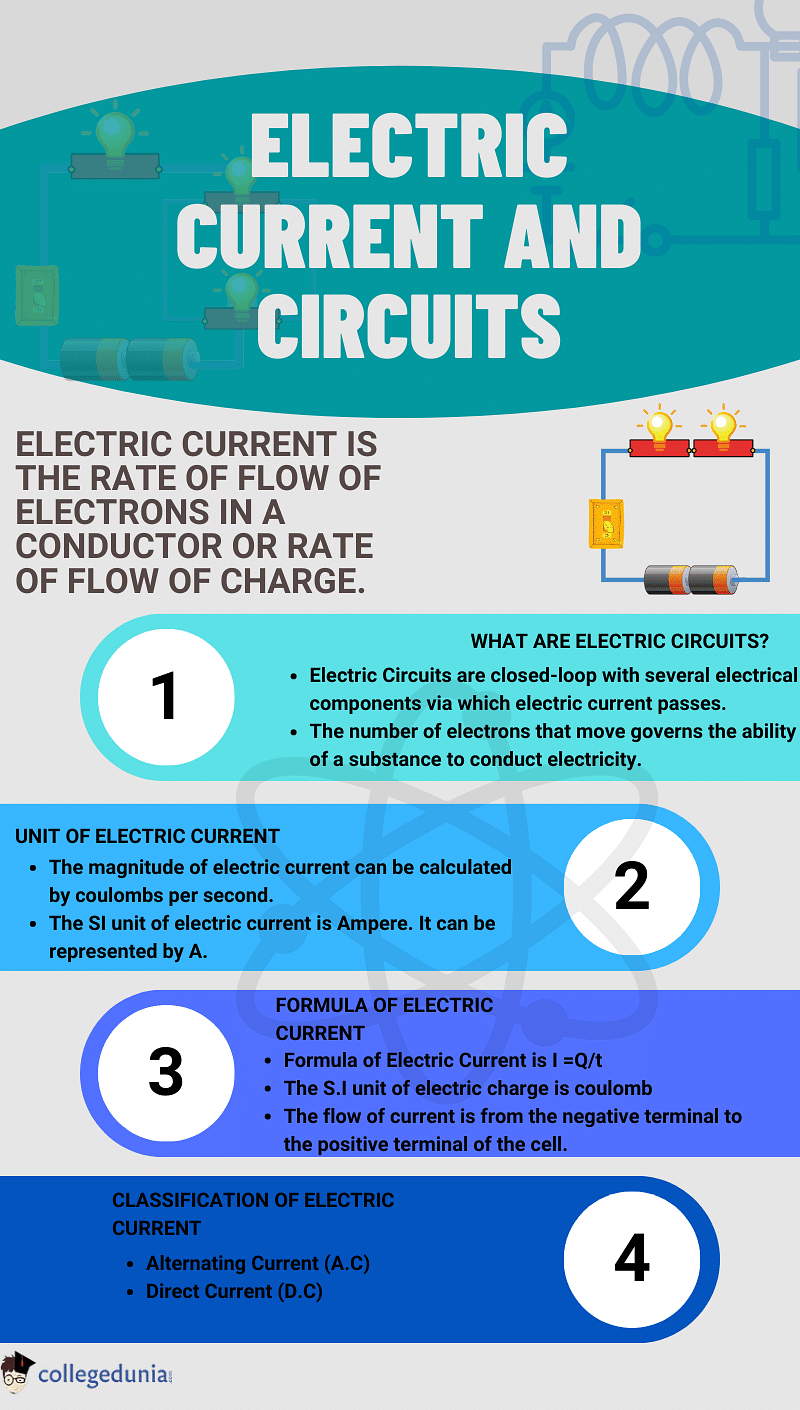
Electric Current and Circuit Infograph
Prerequisites for Current to Flow in a Conductor
The circuit, in case of the prerequisite for current to flow in a conductor, has an energy source (like a cell or battery) which produces voltage.
- Electrons, without voltage, move aimlessly and are undirected.
- Thus, the current cannot flow.
- Voltage helps to create a pressure on electrons, which enables them to flow in a single direction.
- The circuit forms a closed conducting loop via which electrons are able to flow.
- A circuit is closed or complete when a switch is turned ON.
Read More:
Types of Circuits
[Click Here for Sample Questions]
The types of circuits are:
- Series Circuit: There is only 1 path for the flow of electric charge and as the entire circuit is open or closed at a time, no charge will flow if one of the circuit components break,
- Parallel Circuit: Here different components are connected at different branches which means the flow is not restricted to one direction. If one path breaks, the electric current still passes via other paths.
- Domestic Electric Circuit: In such a circuit, power is supplied by the main supply. The circuit has 3 types of wires i.e., Earth wire (green in color and connected to a metal underground), Live wire (red in colour and a positive conductor), and Neutral wire (black in color and negative conductor)
Read Also: Conductivity
Electromotive Force
The motion of free electrons is aimless and undirected. In case force works on electrons in order to make them move in a specific direction, then the random motion of electrons is going to be eliminated.
- Thus, an overall movement in a single direction can be obtained.
- The force that acts on the electrons in order to move them in a distinct direction is termed electromotive force,
- The quantity o Electromotive force is voltage.
- It can be measured in volts.
Electric Circuit
[Click Here for Sample Questions]
Electric Circuits can be found in almost every day-to-day equipment from a basic bread toaster to complex circuits inside a smartphone. Electric current controls several daily activities including communication and transportation.
The Components of Electric Circuit:
- Power Source i.e., a cell or a battery
- Conductors made of copper wires
- A switch used to open or close a circuit
- Load or resistor which is usually a lamp or bulb that lights up with the passage of current
Before electrons were discovered, electric current was counted as the flow of positive charges, where the direction of flow was considered to be the direction of electric current. With the discovery of electrons, it was concluded that in a circuit, the direction of electric current is opposite to the direction of the flow of electrons.
Conductors are materials that allow easy flow of electrons inside them hence generating current, while materials that resist the flow of electrons are known as insulators that don’t allow passage of electric current through them. In the case of semiconductors, charge carriers can be both positive and negative.
If a charge Q, flows via a section of a conductor in time t, then, current I can be calculated as:
⇒ \(I = \frac{Q}{t}\), where Q is represented by the Coulomb unit.
Thus,
In a circuit, resistance R is represented as,
| R = p x L/A |
where,
- p = resistivity of wire,
- L = wire length,
- A = cross-sectional area,
- Resistance R is represented by a unit called ohm.
The SI unit of Potential Difference is Volts. In an electric circuit, the potential difference can be defined as work done to move a unit charge from one point to another. Thus,
| \(V = \frac{Work\ Done\ (W)}{Charge\ (Q)}\) |
According to Ohm's Law,
The Potential Difference(V) is directly proportional to the current(I). Thus, V = RI
Here, R is the constant of proportionality.
Power in an electric circuit is represented as P=E/t, where E is the energy gain or loss and t is the time period.
For a series circuit equivalent resistance Req is represented as:
⇒ Req= R1 + R2 + R3 +….
For a parallel circuit, the equivalent resistance is calculated as:
⇒ 1/Req = 1/R1 + 1/R2 + 1/R3 +…
Read more : Heating effect of Electric Current
Effects of Electric Current
[Click Here for Sample Questions]
Some effects of Electric current include:
- Heating Effect: With the flow of electric current, heat(H) is generated inside the conductor. H=I2RT. This is the heating effect of the electric current.
- Magnetic Effect: A noticeable magnetic field is developed with the flow of electric charge.
- Chemical Effect: When an electric current is passed through a solution, a chemical reaction takes place that results in a change of color or release of gas from the solution.
Visualising Electric Current
How electric current behaves in a conductor can be visualised by using a water pipe analogy of electricity. It can be shown as:

Visualising Electric Current
The electric current can be compared to the water which flows via the pipe. When pressure has been applied to one end of the pipe, the water is forced to flow via it in a single direction. The flow of water is proportional to the pressure on the end. This pressure can be compared to EMF or Electromotive Force.
Read More:
Things to Remember
- Electric Current and circuit can be expressed as the rate of flow of electrons in a conductor or rate of flow of charge.
- Conductors are the type of materials that enable the free flow of electrons from one particle to another.
- The formula of potential difference is: \(V = \frac{Work\ Done\ (W)}{Charge\ (Q)}\).
- There are three effects of electric current, Heating effect, Chemical effect, and Magnetic effect.
Sample Questions
Ques: What is Electric Current? (1 mark)
Ans: Electric current can be defined as the rate of flow of electrons in a conductor. Ampere is the SI unit of Electric Current.
Ques: What is Coulomb’s Inverse-square law in electrostatics? (1 mark)
Ans. In between two stationary point charges, the electrostatic force of attraction or repulsion can be seen to be directly proportional to the product of the magnitudes of the charges. However, it is inversely proportional to the square of the distance between them.
Ques: What are the chemical effects of electric current? (2 marks)
Ans: The chemical effects of electric current are:
- change in the solution colour
- metallic deposits on electrodes
- gas release or production of bubbles in the solution
Ques: An infinite number of charges of q coulomb each have been situated along X-axis at x = 1 m, 3 m, 9 m and so on. Thus, determine the electric field at x=0 m due to all these charges. (CBSE Delhi 2009) (2 marks)
Ans: This series of charges will form an infinite GP. Assume that the system has distance r1, r2,....r∞.
The field at x=0 can be stated as:
\([\frac{q}{4\Pi \varepsilon_0}] [\frac{1}{r_1^2} + \frac{1}{r_2^2} + \frac{1}{r_3^2} + ...] \)
Thus,
= \([\frac{q}{4\Pi \varepsilon_0}] \) [1+1/9+1/27+........]
Hence it can be said that,
= \([\frac{q}{4\Pi \varepsilon_0}] \) [9/8] (by using s∞=a/(1-r) for an infinite GP)
Ques: If 0.15 A current is drawn by a filament of an electric bulb for 600 seconds, in the circuit, what’s the amount of electric charge? (2 marks)
Ans: Given-, I = 0.15 A and t = 600 s.
I=Q/t, therefore Q=It
Q= 0.15 A × 600 s = 90 C
Ques: If the potential difference across 2 points is 15 V, then what will be the work done in moving a charge of 5 C across these points? (2 marks)
Ans: Given- V= 15V and Q=5C.
V=W/Q, therefore W=V×Q
W=15 V × 5 C = 75 J
Ques: What amount of current will a lamp draw from a 220V battery, if the filament has a resistance of 1000 ohm? (2 marks)
Ans: Given, V= 220 V, R = 1000 ohm.
As per the equation, V=I × R, therefore, I = V/R
I = 220 V/1000 ohm = 0.22 A.
Ques: A wire with length(l) and area of cross-section(A) has a resistance of 4 ohms. What would be the resistance of another wire with the same material having length l/2 and area of cross-section 2A? (2 marks)
Ans: In case of first wire, R1 = pl/A = 4 ohm (given)
For 2nd wire, R2 = pl/2/2A = 1/4 × pl/A = 1/4 R1 = 1/4 × 4 = 1
Therefore, for the 2nd wire, resistance = 1 ohm.
Ques: What are Conventional Current Flow and Electron Flow? Show its diagrammatic representation. (4 marks)
Ans: a) Conventional Current Flow can be defined as an electron flow that takes place from the positive terminal to the negative one, indicating the direction where the positive charges would flow.
b) Electron flow occurs from the negative terminal to the positive terminal.

Ques: What are the properties of Electric Current? (5 marks)
Ans: Electric current is a very important quantity in electronic circuits. The various properties of Electric Current are:
- Electric current results due to the flow of electrons.
- The work done to move an electron stream is known as electrical energy which can be converted into various different forms such as light energy and heat energy.
- The SI unit which helps to evaluate electric current is the ampere. Thus, 1 ampere = 1 coulomb / 1 second
- The instant when electrical potential distinction has been applied across a metallic wire, the approximate amount of free electrons start to move towards the positive terminal of the cell.
- This consistent progression of electrons has electrical flow. The flow from the wire is from the negative terminal of the cell to the positive terminal via the outside circuit.
- According to the electron hypothesis, when the potential contrast has been applied across the transmitter, some of the matter shifts via the circuit which provides electric flow.
A representation of Electric current is:

Also Check:



Comments