


What is multiple fission?

Collegedunia Team logo

Collegedunia Team

Content Curator

Multiple fission is a type of asexual reproduction in single-celled organisms where a single parent cell divides into multiple daughter cells, each of which will develop into a new individual.

This type of reproduction occurs in some protozoans, such as Amoeba, and is a quick and efficient way of producing offspring. Multiple fission is common in environments where there is a scarcity of resources, as it enables a single organism to multiply quickly and increase its chances of survival.

The characteristics of multiple fission include:

  • A rapid increase in population.
  • Genetic uniformity among offspring.
  • Ability to adapt to changing environments.
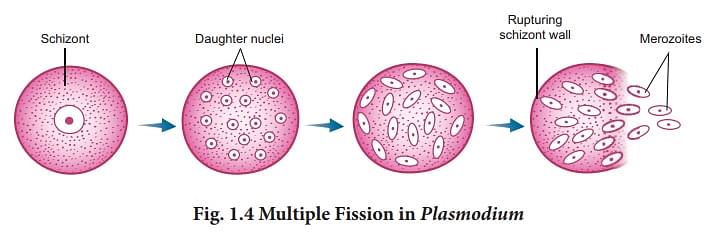
Multiple fission example

Multiple Fission

Check out:

CBSE CLASS XII Related Questions

  • 1.
    Oogenesis is a discontinuous process that begins before birth and is completed after puberty.
    Trace the development of a gamete mother cell till its release from the ovary during ovulation.
    Name the two pituitary hormones that play an important role in the process.


      • 2.
        Read the following passage and answer the questions that follow:
        India is one of the megadiverse countries housing around 8·1 per cent of global species diversity, although its land area is only 2·4 per cent of the world’s land area. Many of the species are highly threatened due to human activities like deforestation, mining and habitat fragmentation. Laws like Wildlife (Protection) Act, 1972 were enacted by the Government of India to preserve our biological wealth. Various conservation measures are being implemented to save the threatened species. The following bar graph shows the number of species conserved under different biodiversity conservation methods.

        Which other methods shown in the diagram are opposite to the one identified by you in question ? How are these two conservation approaches different?
        (c) Write two features of Biodiversity hotspots.
        (c) To which category do sacred groves belong and how do they help in bio-conservation?


          • 3.
            What is the carrying capacity of a species in a habitat?
            Explain the growth curve that takes this capacity into account.


              • 4.
                In vitro fertilization (IVF) is a popular method these days that is helping childless couples to bear a child.
                Write the different steps that are carried out in this technique.
                Would you consider gamete intra fallopian transfer as a type of IVF? Justify your answer.


                  • 5.
                    Explain any two basic principles/core techniques on which biotechnology is based.
                    Describe any three key tools used in Recombinant DNA technology.


                      • 6.
                        Describe the experiment conducted by T.H. Morgan on Drosophila melanogaster involving eye colour and body colour.
                        How did the results deviate from Mendelian inheritance pattern ?
                        (c) Explain the two genetic terms used by Morgan for his observations.

                          CBSE CLASS XII Previous Year Papers

                          Comments


                          No Comments To Show
