




The CBSE Class 12 Chemistry syllabus for 2026-27 comprises 10 units. The CBSE Class 12 exam is divided into two parts: theory for 70 marks and practical for 30 marks. The CBSE Class 12 Chemistry syllabus 2026-27 focuses on three areas: Physical Chemistry, Organic Chemistry, and Inorganic Chemistry.
- The exam consists of MCQ, short-answer, long-answer, and case-study-based questions.
- Some of the important topics for the CBSE Class 12 Chemistry syllabus 2026-27 are Electrochemistry, Aldehydes, Ketones, and Carboxylic Acids, and Coordination Compounds.
- The most weightage in the CBSE Class 12 Chemistry syllabus 2026-27 is Electrochemistry (12.86%), Biomolecules (10%), and Solutions.
- The CBSE Class 12 Chemistry syllabus 2026-27 assesses your problem-solving, basic understanding, and lab skills.
Related Links:
- CBSE Class 12 Syllabus: Check Subject-Wise PDF Links, Detailed Topics, and Weightage
- CBSE Class 12 Chemistry Practical Syllabus: Check Topics and Weightage, Marking Scheme
Key Summary
- To score better, students must focus on high-weightage topics, NCERT exercises, and previous year papers.
- The CBSE Class 12 Chemistry exam will consist of MCQ, short-answer, long-answer, and case-study questions.
- Some of the deleted chapters are: Solid State, Surface Chemistry, p-Block, Polymers.
- Some important chapters are: Electrochemistry, Chemical Kinetics, Aldehydes, Ketones & Carboxylic Acids, Amines, Biomolecules.
- The CBSE Class 12 Chemistry paper marking scheme is 70 marks for theory and 30 marks for practical.
CBSE Class 12 Chemistry Syllabus 2026-27 Topics
The CBSE Class 12 Chemistry syllabus 2026-27 includes 10 theory units divided into Physical Chemistry, Inorganic Chemistry, and Organic Chemistry, along with a practical paper.
| Section | Units Covered | Key Topics |
|---|---|---|
| Physical Chemistry | Solutions | Concentration terms, Raoult’s law, colligative properties, and abnormal molar mass |
| Electrochemistry | Redox reactions, EMF, Nernst equation, conductance, fuel cells, corrosion | |
| Chemical Kinetics | Rate of reaction, order, molecularity, Arrhenius equation, activation energy | |
| Inorganic Chemistry | d-Block Elements | Electronic configuration, oxidation states, KMnO₄, K₂Cr₂O₇, lanthanide contraction |
| Coordination Compounds | Nomenclature, bonding (VBT, CFT), isomerism, and importance in bio-systems | |
| Organic Chemistry | Haloalkanes & Haloarenes | Nomenclature, SN1/SN2, uses, and environmental effects (CFCs) |
| Alcohols, Phenols & Ethers | Preparation, reactions, dehydration, oxidation, Williamson synthesis | |
| Aldehydes, Ketones & Carboxylic Acids | Nucleophilic addition, Aldol condensation, Cannizzaro reaction, esterification | |
| Amines | Preparation, Hoffmann bromamide, diazonium salts & reactions | |
| Biomolecules | Biomolecules | Carbohydrates, proteins, enzymes, vitamins, nucleic acids (DNA & RNA) |
| Practicals | Records, Viva, Experiments | Volumetric Analysis, Salt Analysis |
Related Article: CBSE Class 12 Preparation Tips: Check Exam Preparation Strategy, Subject-Wise Guidelines
Ques. Is CBSE Class 12 Chemistry a tough paper?
Ans. No, the CBSE Class 12 Chemistry paper is generally considered under the moderate level. The questions are generally asked directly from the NCERT book. Those who prepare well and refer to good resources will be able to secure high marks.
How to Download CBSE Class 12 Chemistry Syllabus PDF?
Check out the steps to download the CBSE Class 12 Chemistry syllabus 2026-27 PDF provided below.
- Step 1: Go to the official website of NCERT - ncert.nic.in.
- Step 2: Choose the Class XII option from the drop-down menu.
- Step 3: Click on the “Chemistry” subject option there.
- Step 4: The CBSE Class 12 Chemistry syllabus 2026-27 PDF will be displayed on the screen.
- Step 5: Click on the “OK” option there.
- Step 6: Check and download the PDF.
Ques. Is 75% a good score in CBSE?
Ans. Yes, securing 75% in the CBSE is good. Securing 75% will make students eligible for the counseling rounds of engineering courses like JoSAA for IITs, NITs, and IIITs, and for other entrance examinations as well.
A Reddit user asked, Are the CBSE Class 12 Chemistry sample papers really tough?

Answering to that, another user shared his experience and discussed the difficulty level of the sample papers.

What is the CBSE Class 12 Chemistry Exam Pattern?
The CBSE Class 12 Chemistry 2026-27 exam pattern for both the theory and practical parts is shared below.
CBSE Class 12 Chemistry Exam Pattern: Types of Questions in Theory
Check out the CBSE Class 12 Chemistry paper examination structure for the theory part below. The theory part consists of 70 marks.
| Question Type | Description |
|---|---|
| Very Short Answer | 1–2 line answers, definitions, or simple equations |
| Short Answer | Explanations, derivations, or numerical problems |
| Long Answer | Detailed answers, reaction mechanisms, or calculations |
| Case-based / Integrated | Questions based on a given situation may include calculations or reasoning |

CBSE Class 12 Chemistry Exam Pattern: Topics in Practical
The practical paper exam structure for the CBSE Class 12 Chemistry paper is provided here.
The practical part consists of 30 marks.
- Volumetric Analysis (Titrations)
- Salt Analysis
- Content-Based Experiments
- Project Work
- Viva (Oral Questions)
- Maintaining Class Record
Related Links: CBSE Class 12 Chemistry Question Paper (2026 - 2019)
Ques. Which of the chapters have been removed from the CBSE Class 12 Chemistry syllabus 2026-27?
Ans. A few topics have been removed by the authority from the CBSE Class 12 Chemistry syllabus 2026-27. The topics are solid state, surface chemistry, general principles and processes of isolation of elements, p-block elements, polymers, and chemistry in everyday life.
CBSE Class 12 Chemistry Topic-Wise Weightage
The CBSE Class 12 Chemistry syllabus 2026-27 is mainly divided into three sections: Physical, Organic, and Inorganic.
Check out the topic-wise marks weightage of all the topics shared here.
CBSE Class 12 Chemistry Theory Paper Weightage
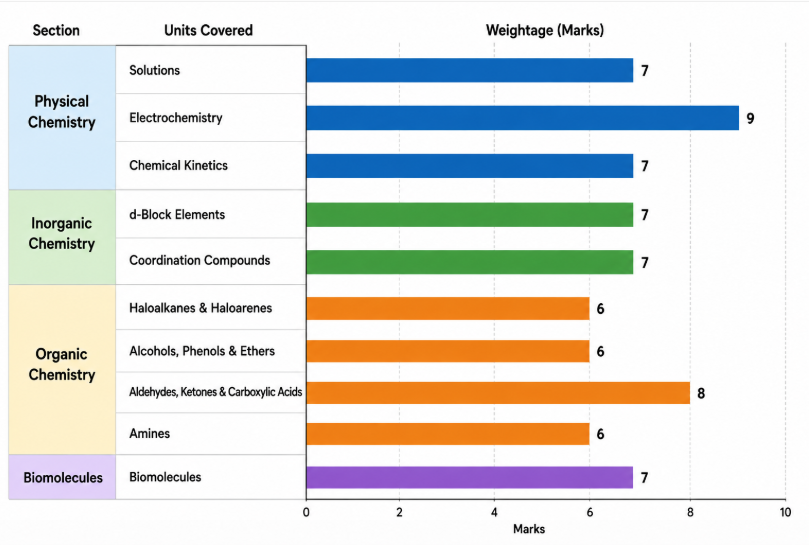
Check out the table shared below showing the topic-wise weightage of the theory portion of the CBSE Class 12 Chemistry paper.
| Section | Units Covered | Weightage (Marks) |
|---|---|---|
| Physical Chemistry | Solutions | 7 |
| Electrochemistry | 9 | |
| Chemical Kinetics | 7 | |
| Inorganic Chemistry | d-Block Elements | 7 |
| Coordination Compounds | 7 | |
| Organic Chemistry | Haloalkanes & Haloarenes | 6 |
| Alcohols, Phenols & Ethers | 6 | |
| Aldehydes, Ketones & Carboxylic Acids | 8 | |
| Amines | 6 | |
| Biomolecules | Biomolecules | 7 |
CBSE Class 12 Chemistry Last 5 Years Most Asked Questions
Check out some of the most repeated questions in the last 5 years of the CBSE Class 12 Chemistry paper provided below.
It will help students understand the weightage of the topics.
| Chapters | Most Asked Question / Concept |
|---|---|
| Solutions |
|
| Electrochemistry |
|
| Chemical Kinetics |
|
| D- and f-Block Elements |
|
| Coordination Compounds |
|
| Haloalkanes & Haloarenes |
|
| Alcohols, Phenols & Ethers |
|
| Aldehydes, Ketones & Carboxylic Acids |
|
| Amines |
|
| Biomolecules |
|
CBSE Class 12 Chemistry Practical Paper Weightage
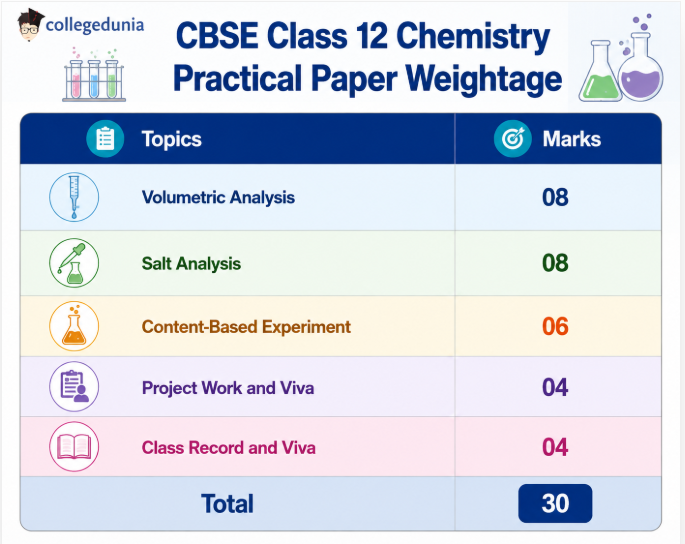
The CBSE Class 12 Chemistry practical paper topic-weightage is shared here.
| Topics | Marks |
|---|---|
| Volumetric Analysis | 08 |
| Salt Analysis | 08 |
| Content-Based Experiment | 06 |
| Project Work and Viva | 04 |
| Class Record and Viva | 04 |
| Total | 30 |
Related Link: CBSE Class 12 Mock Test 2026: Attempt for Free Mock Papers
Ques. How can I prepare well for the CBSE Class 12 chemistry exam?
Ans. To have effective preparation for the CBSE Class 12 Chemistry paper, students must begin by learning the basic concepts of the topics in detail. Then they must proceed with functional groups, named reactions, reaction mechanisms, and important conversions. Further, practicing the previous year's question papers and appearing for mock tests will help in learning the exam structure in detail and will also help in analyzing your preparation level.
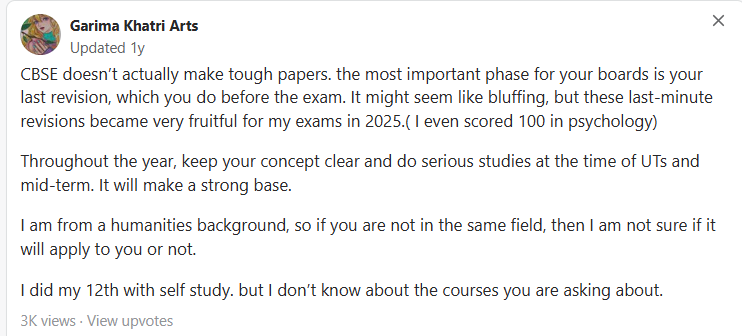
A Quora user asked, "Which of these are best for the CBSE Class 12 Chemistry paper, Arihant All in One or MTG CBSE Champion?
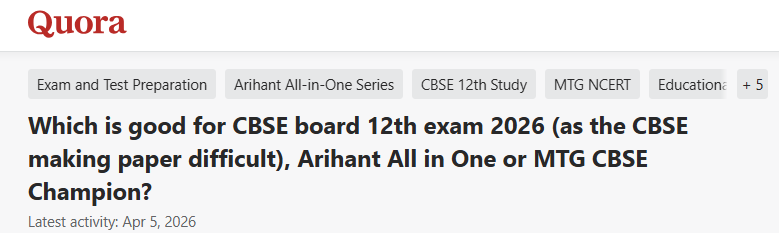
In response to that, another Quora user shared their experience and discussed the CBSE paper difficulty level.
What is the CBSE Class 12 Chemistry Marking Scheme?
The CBSE Class 12 Chemistry syllabus 2026-27 marking scheme for the theory and practical paper is shared below.
It will help students understand the number of questions, marks allotted, and total marks for each section.
| Sections | Question Types | Number of Questions | Marks per Question | Total Marks |
|---|---|---|---|---|
| Section A | Multiple Choice Questions | 16 | 1 | 16 |
| Section B | Very Short Answer Type I Questions | 5 | 2 | 10 |
| Section C | Short Answer Type II Questions | 7 | 3 | 21 |
| Section D | Case-Based Questions | 2 | 4 | 8 |
| Section E | Long Answer Questions | 3 | 5 | 15 |
| Total | 33 | 70 |

Related Link: CBSE Class 12 Sample Papers: Check Previous Year Papers
Ques. Which chapter is the hardest in the CBSE Class 12 Chemistry paper?
Ans. The hardest chapters in the CBSE Class 12 Chemistry syllabus are Aldehydes, Ketones, and Carboxylic Acids, and Electrochemistry. The organic chemistry paper consists of many reaction changes, and electrochemistry includes numerical problem-solving.
How to Prepare for the CBSE Class 12 Chemistry Paper?
Having the correct approach and guidance towards the preparation of the CBSE Class 12 Chemistry board paper is a must.
To score high marks in the examination, students can follow the listed preparation strategy.
- Refer to NCERT Books: Students must start by learning the basic concepts of the topics through the NCERT books. Students must go through each of the topics in detail once.
- Proceed Based on Topics Weightage: As per the weightage of the chapters, students must proceed with in-depth learning. Structure your learning method based on the weightage of the topics. Start with highly weighted topics, such as solutions, electrochemistry, chemical kinetics, coordination compounds, d- and f-block elements, and organic chemistry.
- Practice Numerical Problems: It is advised that students spend good time practicing the numerical problems of the Chemistry paper. Numerical problems usually take a longer time. Thus, applicants must ensure they learn time management as well.
- Practice Previous Year Papers: Solving previous year question papers has always been beneficial for students to score high. The previous year's question papers will help applicants to understand the exam structure, question pattern, and weightage of the topics in detail. Thus, students must practice at least 5 years of question papers.
- Attempt Sample Papers: The CBSE Class 12 sample papers are designed considering the actual examination format. Thus, the sample papers will help students prepare more effectively for the actual exam with hands-on experience. They will also help you analyze your preparation level and work on the weaker areas as per the requirement.
Related Link: CBSE Class 12 Chapter-Wise Weightage 2026-27: Check Important Topics
CBSE Class 12 Chemistry 2026-27 Books and Resources
Check out the list of books and resources useful for the preparation of the CBSE Class 12 Chemistry 2026-27.
| Book's Name | Author's/Publisher's Name |
|---|---|
| Chemistry Part I, Class-XI | NCERT |
| Chemistry Part II, Class-XI | NCERT |
| Manual of Microscale Chemistry Laboratory Kit | NCERT |
| One for All Class 12 Chemistry | Oswaal |
| All in One Chemistry Class 12 | Arihant |
Check out the direct download link for the NCERT books for the CBSE Chemistry Class 12 examination.
| NCERT Book PDF Download Links | |
|---|---|
| Textbook for Class 11 - Part 1 | Textbook for Class 11 - Part 2 |
| Manual of Chemistry Microscale Laboratory Kit | |
NOTE: The above-mentioned book PDF download link is the same as shared by the official authority.
What Are the Benefits of NCERT Books?
Students need to use correct resources and study materials to prepare well for the CBSE Chemistry paper for Class 12.
The NCERT book for Class 12 includes all the topics and their explanation in detail,l which will help students learn the concepts well.
Some of the benefits of using the NCERT books for the preparation of the CBSE Chemistry paper for Class 12 are as follows:
- The NCERT books cover each topic in detail.
- Provides explanations of the basic concepts of the topics in depth.
- Helps in better understanding with the help of problems for practice and examples of all topics.
- Follows the CBSE curriculum strictly.
NCERT Class 12 Chemistry Previous Year Question Paper PDF Links
Check out the previous year question papers PDF download link of the NCERT Class 12 Chemistry paper shared below.
CBSE Class 12 Chemistry Syllabus 2026-27 FAQs
Ques. What is the CBSE Class 12 Chemistry syllabus 2026-27?
Ans. The syllabus of the CBSE Class 12 Chemistry paper falls under subject code 043. The syllabus is divided into 2 sections: the theory part for 70 marks and the practical part for 30 marks. The syllabus consists of 3 sections: Physical Chemistry, Organic Chemistry, and Inorganic Chemistry.
Ques. Which chapters are important for the CBSE Class 12 Chemistry paper?
Ans. The important chapters for the CBSE Class 12 Chemistry paper are Solutions, Electrochemistry, Chemical Kinetics, d- and f-Block Elements, Coordination Compounds, and Organic Chemistry.
Ques. Is the NCERT book enough to prepare well for the CBSE Class 12 Chemistry paper?
Ans. Yes, referring to the NCERT books for the preparation of the Class 12 CBSE Chemistry paper will help students secure good marks in the examination. The questions are mainly asked from the NCERT books only. However, it is advised that students must practice the previous year papers and mock tests as well.
Ques. What type of questions are asked in the CBSE Class 12 exam?
Ans. The CBSE Class 12 exam paper consists of MCQ, short-answer, long-answer, numerical, and case-based/application-oriented questions. Students must practice all types of questions for a better experience.
Ques. Are numerical questions asked in the CBSE Class 12 Chemistry paper?
Ans. Yes, the CBSE Class 12 Chemistry paper consists of numerical questions. The sections from which the numerical questions are mainly asked are Solutions, Electrochemistry, and Chemical Kinetics. Thus, candidates must go through the formulas and the basic concepts of the topics in detail.



Comments
Found 2 Comments
You can check the syllabus of CBSE 12th Chemistry Practical in this article in the chemistry section. Some topics of Chemistry Practicals are Volumetric Analysis, Salt Analysis, Content-Based Experiment, Project Work, and Class record and viva.
For more information, refer to this link: CBSE Class 12 Chemistry Practicals
For the Chemistry section, CBSE has allocated 70% weightage to theory and the remaining 30% to practicals. For the Electrochemistry section, CBSE has allotted 9 marks. This year the two-term system has been abolished.
For more information, refer to this link: CBSE Class 12 Chemistry Syllabus