



Content Curator
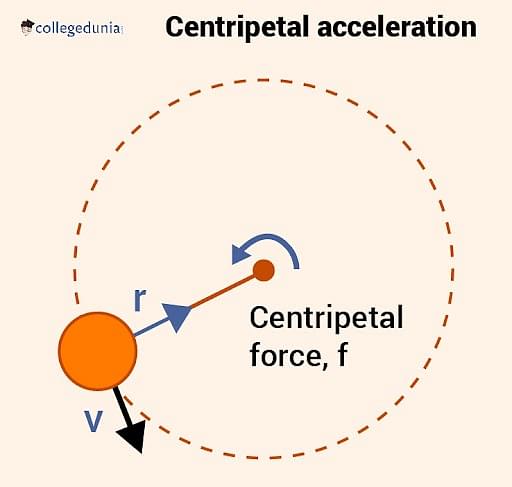
Centripetal acceleration is the rate at which the tangential velocity of a body in circular motion changes.
- The net force that accelerates an object in a circular motion is known as Centripetal force.
- The centripetal acceleration is directed toward the center, which is perpendicular to the motion of the body.
- In a curved path, the centripetal force maintains the constant velocity of a body.
- Christian Huygens provided the first mathematical explanation of centripetal acceleration in 1659.
| Table of Content |
Key Terms: Centripetal acceleration, Force, Centripetal force, Vectors, Circular motion, Tangential velocity, Dimensional formula, SI unit, Newton’s second law of motion
What Is Centripetal Acceleration?
[Click Here for Sample Questions]
The property of the motion of an object in a circular path is called centripetal acceleration.
- Centripetal acceleration is the acceleration of an object moving in a circle with its acceleration vector pointing in the direction of the center of the circle.
- In your daily life, you probably have observed many examples of centripetal acceleration.
- Centripetal acceleration occurs when you drive a car in a circle; a satellite revolving around the Earth also experiences this acceleration.
- The meaning of Centripetal is "towards the center."
- The SI unit of centripetal acceleration is m/s2.
- It is a vector quantity, and its direction is always towards the center of the circular path.
- The dimensional formula of centripetal acceleration is M0L1T-2.
Centripetal acceleration
Also check:
What Is Centripetal Force?
[Click Here for Sample Questions]
A force acting on a body moving around the center of a circular path is known as a centripetal force.
- This force keeps the body moving in a circular path.
- Whenever a body moves in a circular path, the centripetal force acts on it.
- It is directed toward the center of the circular path.
- An object experiences an increasing centripetal force toward the center of a circle when it travels around it at a constant speed.
- Centripetal refers to the tendency to move in a direction toward the center.
- In the case of a satellite, the centripetal force is always due to the force of gravity.
- For a swing ball, this force is provided by the tension in the string.
- It is the frictional force between the car and the road that provides the centripetal force.
Centripetal Acceleration Formula
[Click Here for Sample Questions]
The formula for centripetal acceleration for a body moving in a circular path is given by
\(a_c=\frac {v^2}{r}\)
Where
- ac is the centripetal acceleration
- v is the linear velocity of the body
- r is the radius of the circular path
The formula for centripetal force is given by
\(F=ma_c=\frac {mv^2}{r}\)
Where m is the mass of the body.
Derivation of Centripetal Acceleration
[Click Here for Sample Questions]
Consider the body of mass m moving in a circular path of radius r. Then according to Newton’s second law of motion, the force acting on the body is given by
\(F=ma\)
Here, a is the acceleration, the rate of change of velocity with respect to time.
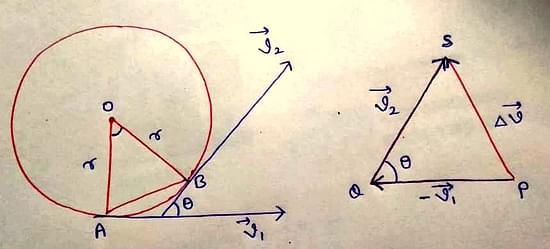
From the above diagram, we have
\(\vec {PQ}+ \vec {QS} = \vec {PS}\)
\(\Rightarrow - \vec {v_1}+ \vec {v_2}=\Delta \vec { v}\)
\(\Rightarrow \Delta v= v_2 -v_1\)
Now the triangle AOB and PQS are similar, therefore
\(\frac {\Delta v}{AB}=\frac {v}{r}\)
Also, we have
\(AB = v \Delta t\)
On substituting, we get
\(\frac {\Delta v}{v \Delta t}=\frac {v}{r}\)
\(\Rightarrow \frac {\Delta v}{\Delta t}=\frac {v^2}{r}\)
But, \(\frac {\Delta v}{\Delta t}=a\) i.e. the centripetal acceleration
Therefore, Centripetal acceleration, \(a=\frac {v^2}{r}\)
Applications of Centripetal Acceleration
[Click Here for Sample Questions]
The following are the applications of centripetal acceleration
- When a car turns, the friction force acting on the car's spun wheels generates the centripetal force required for circular motion.
- The centripetal force required for circular motion is provided by the force of gravity acting on the moon as it orbits the Earth.
- The centripetal force required for circular motion is provided by the tension force acting on a bucket of water linked to a thread and spun in a circle.
Also check:
Things to Remember
- Centripetal acceleration is the rate at which the tangential velocity of a body in circular motion changes.
- It is a vector quantity.
- The direction of centripetal acceleration is towards the center of the circle.
- Its SI unit is m/s2.
- The dimensional formula of centripetal acceleration is M0L1T-2.
- The formula of centripetal acceleration is, a = v2/r.
- A force acting on a body moving around the center of a circular path is known as a centripetal force.
- The centripetal force maintains the constant velocity of a body.
Sample Questions
Ques. Define acceleration. (1 Mark)
Ans. Acceleration of an object is defined as the rate of change of velocity of the object.
Ques. What is the unit of centripetal acceleration? (1 Mark)
Ans. The unit of centripetal acceleration is m/s2.
Ques. What is the similarity between centripetal force and centripetal acceleration? (1 Mark)
Ans. The fact that they both have the same direction is what makes centripetal acceleration and force similar.
Ques. What is the dimensional formula of centripetal acceleration? (1 Mark)
Ans. The dimensional formula of centripetal acceleration is M0L1T-2.
Ques. Is it possible to vary the speed of circular motion with centripetal acceleration? (2 Marks)
Ans. When the centripetal force is applied to a body moving in a circle at a constant speed, the force is always directed inward since the object's velocity is tangent to the circle. The object can be accelerated by changing its direction, but not by altering its speed. The speed of the item will remain constant when the imbalanced centripetal force acts perpendicular to the direction of motion.
Ques. Why isn't there any work done in a circular motion? (2 Marks)
Ans. The direction of velocity changes with time in a circular motion, and force acts in the opposite direction. The body moves at a steady speed in this position. As a result, no work is completed and the energy level remains constant.
Ques. During circular motion, what role does centripetal acceleration play? (2 Marks)
Ans. The acceleration of a body traversing a circular path is known as centripetal acceleration. Because velocity is a vector quantity (it has both a magnitude and a direction), as a body moves on a circular path, its direction changes constantly, causing its velocity to vary, resulting in acceleration.
Ques. How can you tell the difference between centripetal and angular acceleration? (3 Marks)
Ans. The circular motion is caused by a centripetal force, which causes centripetal acceleration, which points towards the center of a circular route. The change in angular velocity with respect to time is known as angular acceleration. This describes the rate at which an object rotates, either quicker or slower.
Ques. What is the other name for centripetal acceleration? (1 Mark)
Ans. Along a circular path, causes an object to shift its direction rather than its speed. It's also known as radial acceleration.
Ques. Centripetal Acceleration depends on what component? (1 Mark)
Ans. Centripetal Acceleration depends on the particle speed and on the circle size.
For Latest Updates on Upcoming Board Exams, Click Here: https://t.me/class_10_12_board_updates
Also Read:



Comments