



Content Curator
Yellow fever virus is an arbovirus under the flavivirus genus. It is transmitted by mosquitoes, which belong to the Aedes and Haemogogus species. Yellow Fever is one of the major epidemics of the tropical world. All species of primates, including humans, as well as several other small mammals, are susceptible to the flavivirus-based sickness.
- The first outbreak of Yellow Fever was in Africa.
- It later spread to tropical and subtropical countries including places like New York, England, France, Italy and more.
- Multiple types of mosquitoes spread the virus from people to animals and from humans to humans.
- A quick development of fever, shivers, migraine, discomfort, nausea, and vomiting are the symptoms of yellow fever.
- Jaundice is a disease where the eyes and the skins appear yellow.
Check out: Virology
Key terms: Yellow Fever, Aedes Aegypti, Acute Phase, Joint Phase, Mosquitoes, Vaccine, Headaches
What is Yellow Fever?
[Click Here for Sample Questions]
Yellow fever is an acute viral hemorrhagic disease which is spread by mosquitoes. Aedes aegypti acts as the vector for spreading the yellow fever and causes its outburst.
- Yellow fever is a major epidemic disease and people of Africa still suffer a lot because of yellow fever.
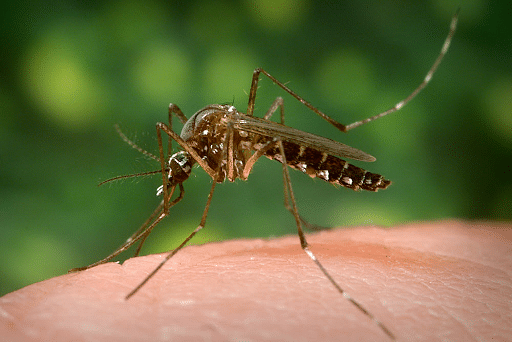
Mosquito Causing Yellow Fever
- It is called yellow fever because it causes high fever and yellowing of the skin just like Jaundice.
- The term “Yellow” in Yellow Fever is referred to the Jaundice which is known to affect several patients.
- The symptoms of Yellow fever usually improve within a span of five days.
Yellow fever can be classified further into two parts:
- Acute Phase
- Toxic Phase
Acute Phase
When the virus has just started to react. Acute symptoms can be seen which can last for 3 to 4 days. Few symptoms are:
- Fever
- Headache
- Backache
- Appetite loss
- Shivering
- Joint ache
After 3 to 4 days when the acute phase is over, symptoms may fade and people may recover. Many people recover at this stage and few enter into more serious or fatal stages.
Toxic Phase
When the symptoms of the acute phase of yellow fever start to disappear the person either heals or the condition becomes more serious or fatal and the person may enter into the Toxic Phase of Yellow Fever.
The symptoms of the acute phase may reoccur with a worsened condition. Few symptoms of Toxic Phase are:
- Abdominal pain
- Seizures
- Decrease in urination
- Vomiting with blood
Very few per cent of people enter the Toxic Phase of Yellow Fever.
Diagnosis of Yellow Fever
The diagnosis of Yellow Fever is done by taking blood tests and analyzing the presence of the virus and the antibodies that will be able to fight yellow fever.
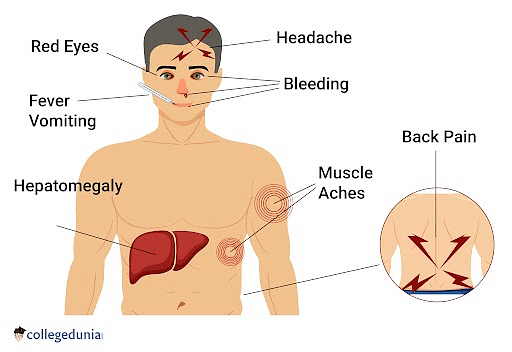
What happens in Yellow Fever?
Read More:
How does Yellow Fever Spread?
[Click Here for Previous Year Questions]
An arbovirus of the genus flavivirus, yellow fever is spread by mosquitoes of the Dengue and Haemagogus species. The various mosquito species inhabit various environments; some breed close to human habitations (domestic breeding), some in the jungle (raw breeding), and some live in both environments (semi-domestic). Three different transmission cycle types exist:
Sylvatic Yellow Fever
It is caused by wild insects of the Dengue and Haemagogus species, which bite monkeys in tropical rainforests and transmit the virus to other monkeys. Monkeys are the main yellow fever reservoir. Yellow fever can occasionally strike people who are travelling or working in the forest after being bitten by an infected mosquito.
Advanced Yellow Fever
Semi-domestic mosquitoes are used in this method of transmission. Greater transmission results from increased human-infected mosquito contact and outbreaks can occur simultaneously in multiple villages throughout an area.
Urban Yellow Fever
Due to lack of immunization or previous exposure to the disease, most people in these densely populated regions with high Aedes aegypti mosquito densities has little to no antibody against the virus, which leads to large epidemics. In these circumstances, the virus is transmitted from individual to individual by infected mosquitoes.
Read Also: Scientific Name of Mosquito
Symptoms of Yellow Fever
[Click Here for Sample Questions]
The main symptoms of yellow fever are:
- Yellowing of the complexion and fever are two of yellow fever's most obvious symptoms.
- Hepatitis, which damages the liver.
- Initial yellow fever symptoms might occur anywhere between three and six days after a mosquito bite, with some people experiencing no symptoms at all.
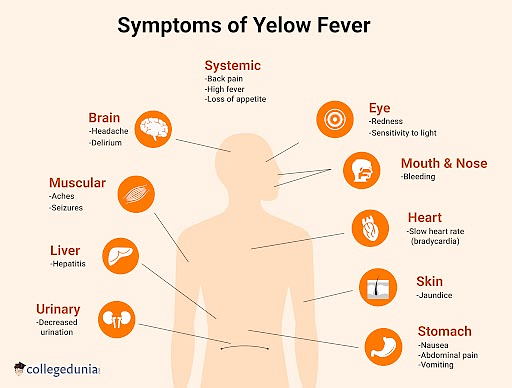
Symptoms of Yellow Fever
- Yellow fever infections often have three stages. Most people have the first phase of symptoms for three to four days before they go away.
- The initial stage is typically non-specific and difficult to separate from other viral infections.
Yellow fever's earliest signs and symptoms include:
- Chills and fever or flu-like symptoms like headache, nausea, and muscular aches.
- Viral hemorrhagic fever, which has internal bleeding (hemorrhaging), a high fever, and harm to the kidneys, organs, or circulatory system, may ultimately manifest.
Examples of yellow fever third-phase symptoms:
- Jaundice (liver disease), which results in the eyes and skin turning yellow.
- Hepatitis (infection of the liver) (inflammation of the liver).
- Bleeding inside (hemorrhaging)
- Blood in the vomit Shock.
- Failure of multiple organ systems resulting in death.
Read Also: Largest Organ in Human Body
Prevention of Yellow Fever
[Click Here for Previous Year Questions]
Different ways to prevent the spread or severe attack of yellow fever:
- The most crucial method for prevention of yellow fever is vaccination.
- A single dosage of the yellow fever vaccination offers lifetime protection against the disease and is both inexpensive and safe.
- Regular baby immunization, widespread vaccination drives, and immunization of travellers entering yellow fever endemic regions are just a few of the vaccine tactics used to reduce yellow fever transmission.
- Rapid epidemic detection and containment through mass vaccination is essential in high-risk locations with poor vaccination coverage.
- To stop transmission in a place where yellow fever is on the rise, it's critical to immunize the majority (80% more than) of the people at risk.
- People over 60, those with severe immunodeficiency brought on by clinical HIV/AIDS or other conditions, as well as those with thymus disorders, are at a higher risk of developing AEFI. So, the vaccine should be administered to anyone over 60.
People who are typically not vaccinated include:
- Those who have severe egg protein allergies.
- Severe immunodeficiency brought on by symptoms of HIV/AIDS or other conditions, or people with thymus disorders.
International Health Standards (IHR) give governments the authority to request a proof of yellow fever immunization from visitors.
Also read: Retrovirus: Structure, Replication and Retroviral Vectors
Vector Management
[Click Here for Sample Questions]
By removing possible mosquito breeding grounds, especially by spraying larvicides to water containers and other areas where standing water accumulates, the danger of yellow fever spread in urban settings can be decreased.
The eradication and management of vector-borne diseases include vector surveillance and control, particularly for the prevention of disease transmission during epidemics.
- In order to determine whether there is a risk of an urban epidemic of yellow fever, viral surveillance focusing on A. aegypti and other Aegypti species will be helpful.
- Knowing the spread of these mosquitoes within a nation can help that nation identify priority regions for improving human disease testing and surveillance while also taking into account vector control initiatives.
- Only a small number of safe, effective, and reasonably priced insecticides are now available for use against adult vectors.
- The main causes of this are the general insecticide resistance of key vectors and the removal or abandonment of specific pesticides due to safety concerns or prohibitive costs associated with re-registration.
- In order to stop the spread of forest (or sylvatic) yellow fever, it is not viable to execute mosquito control programmes that target wild mosquitoes in wooded areas.
- To prevent mosquito bites, individuals are advised to wear clothing that minimizes skin exposure and use repellents.
- The reality that Aedes mosquitoes bite during the daytime restricts the usage of bed nets treated with pesticide.
- Controlling epidemics requires an early diagnosis of yellow fever and a quick reaction through emergency vaccination efforts.
- WHO advises that each at-risk nation have at least one central laboratory where simple blood testing for yellow fever can be carried out.
- Investigation teams must evaluate the outbreak and take immediate action as well as develop longer-term immunization strategies.
Treatment of Yellow Fever
[Click Here for Previous Year Questions]
Here are some ways to treat yellow fever:
- There is no medication to prevent or treat yellow fever illness.
- To lower temperature and ease soreness, rest, hydrate, and take painkillers and medication.
- Avoid taking medications that may increase bleeding risk, such as aspirin and other nonsteroidal anti-inflammatory drugs, such as Motrin or naproxen (Aleve).
- Yellow fever infection patients who exhibit severe symptoms should be admitted to the hospital for close monitoring and supportive care.
- Protect oneself from mosquitos for up to 5 days after experiencing symptoms of yellow fever, which typically appear around a week after you've been bitten by an infected insect.
Things to Remember
- Acute viral hemorrhagic disease called yellow fever is spread by infected mosquitoe.
- Yellow fever symptoms include a fever, migraine, jaundice, muscle aches, nauseousness, vomiting, and exhaustion.
- Only a small percentage of persons who catch the virus experience severe symptoms, and around half of them pass away between 7 to 10 days.
- When Aedes aegypti mosquitoes transfer the disease from person to person in a densely populated area it may cause outbreak of yellow fever.
- Yellow fever vaccination only needs to be administered once to provide lifelong immunity and protection from the disease. There is no standardized protocol of the vaccine.
- In hospitals, good supportive care increases life expectancies. Yellow fever does not presently have a specific antiviral medication.
Read More:
| Chapter Related Topics | ||
|---|---|---|
| Infectious disease | Vitamin B12 Deficiency | Pneumonia |
| Common cold | Filariasis | HIV and AIDS |
| Ascariasis | Lung Cancer | Diphtheria |
Previous Year Questions
- A person likely to develop tetanus is immunized by….[NEET 2009]
- A person suffering from a disease caused by Plasmodium...[NEET 2010]
- Which of the following is a pair of viral diseases?...[NEET 2009]
- In which disease does mosquito transmitted...[NEET 2018]
- Antibodies in our body are complex..[NEET 2006]
- Antigens are present...[NEET 1995]
- Antivenom injection contains preformed antibodies….[NEET 2016]
- Cancer cells are more easily damaged...[NEET 2004]
- Cancerous cells can easily be destroyed...[NEET 2002]
- Carcinoma refers to...[NEET 2003]
Sample Questions
Ques. How can yellow fever be determined? (1 mark)
Ans. Blood tests that check for viruses or antibodies that a person's immune system produces in response to a viral infection are typically used to make the diagnosis.
Ques. Which mosquito is responsible for Yellow Fever? (1 mark)
Ans. The Aedes aegypti mosquito is responsible for the Yellow Fever. It is caused by the flavivirus.
Ques: Who is not required to get the yellow fever vaccine? (2 marks)
Ans. The vaccine should not be given to infants under the age of six months. Additionally, the vaccine should not be administered to anyone who has a serious allergy to any component, particularly eggs, chicken protein, or gelatin. It is not recommended to vaccinate someone again if they had a serious reaction to a standard dose of the yellow fever vaccine.
Ques. How long does the protection against yellow fever last? (2 marks)
Ans. Most people receive a single dose of the vaccination, which offers lifelong protection. Due to immune system issues or being in environments with higher risks, some patients may benefit from receiving the vaccine again.
Ques. What is yellow fever treatment? (2 marks)
Ans. Individuals with yellow fever have not been proven to benefit from any specific therapies. Yellow fever sufferers should, if at all feasible, be hospitalized for the management of their illness and strict supervision by medical personnel.
Fever and hurting symptoms may be relieved with rest, drinks, painkillers, and fever-reducers. Aspirin and other non-steroidal anti-inflammatory medications (such as ibuprofen and naproxen) should be avoided because they may increase the risk for bleeding.
Ques. What are the signs and symptoms of yellow fever? (3 marks)
Ans. Yellow fever's initial signs and symptoms include a swiftly rising temperature, chills, light-headedness, back pain, generalized muscle aches, vomiting and nausea, exhaustion, and weakness.
After these first symptoms, the majority of patients get better.
However, about 15% of individuals will go for a few hours or even a day without experiencing any symptoms before developing a more severe type of yellow fever.
In severe situations, a person may experience high fever, bleeding (particularly out from gastrointestinal tract), jaundice (yellow coloring of a skin and the whites of eyes), shock, and eventual organ failure. About 20–50% of patients who have severe sickness may pass away.
Ques. How to lessen the risk of contracting the yellow fever virus? (5 marks)
Ans. Steps to lessen the risk of contracting yellow fever:
- Vaccination can prevent the spread of yellow fever. The virus in the vaccination is still alive but has been weakened (attenuated). Additionally, when visiting regions of Africa and South America where the yellow fever virus is spread, travelers should take precautions to avoid mosquito bites.
- Apply repellant on the skin. Use an EPA-registered mosquito repellent, such as those with DEET, picaridin, or oil of eucalyptus, on exposed skin when you are outside. Even a brief period of time spent outside can be long enough to attract a mosquito. See the use and safety of the repellent for more information.
- To prevent mosquito bites, dress appropriately. Wear long sleeves, long pants, and socks outside when the weather allows. Spraying garments with a pesticide comprising permethrin or the other EPA-registered repellent would provide additional protection because mosquitoes can bite through thin clothing. Commercially accessible permethrin-treated clothing is available. Permethrin-containing insect repellents are not permitted to be applied directly to the skin.
- Be mindful of the peak mosquito time. Many mosquito species bite most frequently between dusk and sunrise. The mosquito that spreads the yellow fever virus, Aedes aegypti, however, feeds throughout the day. Use particular caution to wear protective clothing and insect repellent throughout the day as well as at night and in the morning. During the busiest biting times, staying in lodgings with air-conditioned or screen-enclosed rooms will further lessen your risk of getting bitten.
Ques. Who needs the yellow fever vaccination? (2 marks)
Ans. 9 months and older aged people who are traveling to or residing in South America or Africa where the yellow fever virus is in danger of being transmitted are advised to have the yellow fever vaccine.
Yellow fever is only a concern in specific regions of some countries; for those nations, more detailed information is provided in the chart to help inform the advice for vaccination.
Ques. Is the yellow fever vaccine advised for anyone over 60 who will be visiting regions where yellow fever is a risk? (4 marks)
Ans. Compared to younger people, people over the age of 60 may be at an increased risk for significant adverse events (serious illness or, very infrequently, death).
This is especially true if it is their first immunization against yellow fever. Travellers under the age of 60 should speak with their doctor about the risks and advantages of the vaccine in light of their itinerary.
Travellers to endemic regions should protect themselves against yellow fever and other vector-borne infections in addition to contemplating the vaccine.
Wearing long sleeves and pants and applying an efficient insect repellent containing DEET, picaridin, IR3535, or similar ingredients are preventative methods.
Ques. Where is the yellow fever virus found? (1 mark)
Ques. What negative consequences might the yellow fever vaccine cause? (1 mark)
Ans. Yellow fever vaccine reactions are often modest. Mild headaches, aches in the muscles, and low-grade fevers can be among them. Following a yellow fever vaccination, exceedingly rare but serious incidents have been reported.
Read More:



Comments