



Content Curator
Retroviruses are the viruses that belong to the family of Retroviride. These viruses carry their genetic material in the form of Ribonucleic acid (RNA) and use reverse transcriptase to translate its genetic information into DNA. The process involved in this constitutes a reverse process of usual cellular transcription.
| Table of Content |
Keyterms: Virus, DNA, RNA, Retroviride, Ribonucleic acid, Transcription, Genome, Human Immunodeficiency Virus, HIV, AIDS
Read More: Acquired Immunodeficiency Syndrome
Retrovirus
[Click Here for Sample Questions]
Retrovirus is a type of virus that has RNA as its genetic material. It makes a DNA copy of its genome with the help of an enzyme called reverse transcriptase and inserts this DNA copy into the host cell to replicate. For Example: Human Immunodeficiency Virus (HIV)
Structure of Retrovirus
[Click Here for Previous Year Questions]
Retrovirus comprises proteins, envelope, and single-stranded RNA molecules.
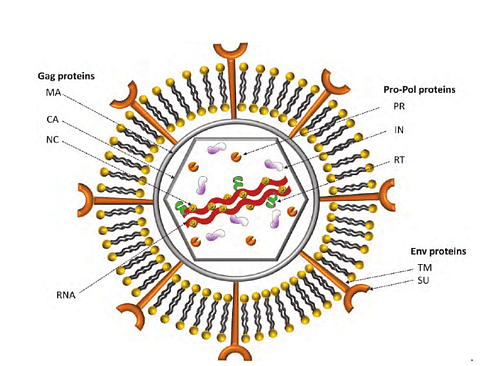
Single-stranded RNA molecules
- Envelop- It is composed of lipids as well as glycoproteins encoded by env genes. It is responsible for the following three functions.
- The lipid bilayer provides protection to the retrovirus from the extracellular environment.
- It permits the entry and exit of retrovirus through the host’s cell via endothermal membrane trafficking.
- It enables retrovirus to directly enter the cell by fusing with their membrane.
- RNA- It consists of a dimer RNA which has a 5’ cap at and a 3’ poly-A tail. At the terminal, it has non-coding regions which help in replication. The internal regions encode virion proteins for gene expression.
- Proteins- It consists of four kinds of proteins, gag proteins, pol proteins, protease, and env proteins.
- Group-specific antigen (gag) proteins- It is the major component of viral capsid and possesses matrix (MA) and nucleocapsid (NC) as the two nucleic acid binding domains.
- Protease- Its appearance is different in different viruses. It is responsible for proteolytic cleavages during virion maturation to form mature gag and pol protein.
- Pol proteins- It functions for the synthesis of viral DNA and integration into host cell DNA after infection.
- Env proteins- It plays the role in the entrance of virion into the host's cell. It is the env proteins that make the retrovirus infectious.
Also Read:
| Related Articles | ||
|---|---|---|
| Food Variety | Transport of Nutrients | Genetics |
| Difference Between Micronutrients and Macronutrients | Nutrients | Heart |
| Typhoid | Thyroid | Leprosy |
| Tuberculosis | Dengue Fever | Hepatitis |
Replication of retrovirus
[Click Here for Sample Questions]
Following steps are involved in the life cycle of the retrovirus.
- Binding- The virus attaches to the surface of the host’s cell.
- Invasion- The envelope around the virus merges with the membrane of the host's cell and the viral RNA moves into the cell.
- Reverse Transcription- Viral RNA turns into the DNA to become compatible with the host's cell genome. Viral DNA is incorporated into the host's genome.
- Genome Integration- Inside the nucleus, a special viral enzyme integrates the viral DNA with the host’s cell DNA.
- Replication- The virus uses the host's machinery to transcribe and translate viral genes and produce new viral components. Each end of the viral genome has a repeated sequence of “R” that enhances the integration and the host's cells transcribe at a faster rate. Packaging signal sequence of “P” in the viral genome allows incorporation of the newly synthesized RNA into the new virus. The host’s ribosome translates the viral gene into protein, translation takes place in the cytosol of the host’s cell.
- gag gene is translated into capsid protein
- pol gene is transcribed into reverse transcriptase
- env gene is translated into envelope protein
- Assembly- The new viral components formed are assembled near the cell surface and form new viruses.
- Release- New viruses formed come out of the host’s cell and it can infect other cells of the host. Infected cells can survive while viruses are being replicated and released.
Sometimes retrovirus picks up proto-oncogene from the mammalian host and converts it into the oncogene, this causes cancer in animals.
Retroviral Vectors
[Click Here for Previous Year Questions]
Retroviral is the genetically engineered retrovirus that is used as a tool to transfer genes of interest into the target cell. These vectors are used for gene therapy and are based on murine viruses. Moloney murine leukemia retrovirus (MMLV) was the first to be used in gene therapy.
The production of retroviral vectors requires a packaging cell line that contains DNA plasmids. In these packaging cells, viral gag, pol, and env genes are created.
Difference between Retrovirus and Virus
[Click Here for Sample Questions]
Retrovirus-
- They have RNA as genetic material.
- Retroviruses do not destroy the host cell.
- Retrovirus undergoes reverse transcription to convert the RNA into DNA.
Virus-
- They have RNA as well as DNA as genetic material
- Virus can destroy host cell once they start replicating
- Viruses do not undergo reverse transcription processes.
Read More: Deficiency symptoms
Examples of Retrovirus
[Click Here for Previous Year Questions]
There are three types of retrovirus that can infect humans.
HIV (Human Immunodeficiency Virus)
Human Immunodeficiency Virus also known as HIV, causes AIDS. HIV can be transmitted by sexual contact, transfusion of blood, infected needles, and infected mother through the placenta. HIV does not spread by mere touch or physical contact. There is always a time period of a few months to many years (5-10 years) between infection and the appearance of AIDS symptoms. The patient becomes immune-deficient as HIV attacks T-lymphocytes (TH). The repeated attack of HIV decreases the number of TH and the infected person gets weaker and weaker.
Human T-cell Lymphotropic Virus (HTLV) type I and type II
HTLV type I and HTLV type II are closely connected with each other. Both can spread through sexual contact, blood transfusion, breastfeeding, and needle sharing. HTLV-I virus causes acute T-cell leukemia and neurological disorder (tropical spastic paraparesis). It is mostly found in Japan, the Caribbean, and parts of Africa. HTLV-II causes neurodegenerative disease and certain blood cancers. It is mostly found in North, Central, and South America.
Endogenous Retrovirus
About 5% of the human genome is composed of the sequences found in endogenous retrovirus. They are relics of ancient infections that were inherited from one generation to another.
Treatment of Retroviral Infection
[Click Here for Sample Questions]
- There is no cure for AIDS as the virus mutates easily. Antiretroviral therapy (ART) is available for the management of AIDS. This therapy hinders the replication process. It can reduce the number of HIV in the infected body of a patient. It can only prolong the life of the patient but cannot prevent death.
- T-cell leukemia can be managed with chemotherapy and hematopoietic stem cell transplant in combination with drugs. Drugs prevent the attack and replication.
Also Read:
Things to Remember
- Retrovirus has RNA as genetic material and an enzyme reverse transcriptase converts this RNA into DNA when retrovirus enters into the host body.
- A retrovirus uses the host machinery to replicate and produce new viral components that assemble and form new retrovirus inside the host body.
- HIV is a well-known example of a retrovirus that causes AIDS in humans by attacking T-lymphocytes (TH).
- AIDS is incurable but the life of the patient can be prolonged by using antiretroviral therapy (ART).
- Retroviruses are used in gene therapy and they are used as vectors to transfer genes of interest to the target cells.
Previous Year Questions
- Deficiency symptoms of nitrogen and potassium are visible first in...[NEET 2014]
- For its activity, carboxypeptidase requires..[NEET 2012]
- Gray spots of oat are caused by deficiency of….[NEET 2003]
- If by radiation all nitrogenase enzyme is inactivated, then there will be no...[NEET 2004]
- In which of the following forms is iron absorbed by plants ?...[NEET 2018]
- Which one of the following statements is not correct during this process of nitrogen fixation?...[NEET 2010]
- which group of three elements shall affect most, both photosynthetic and mitochondrial electron transport?[NEET 2005]
- What is true for cyanobacteria...[NEET 2001]
- Which one of the following is a micronutrient for plants?...[NEET 1996]
- Mg is a component of….[NEET 2000]
- A plant requires magnesium for...[NEET 2007]
- A prokaryotic autotrophic nitrogen fixing symbiont is found in..[NEET 2011]
- A system of rotating crops with legume or grass pasture to improve soil structure and fertility is called -...[NEET 2016]
- Best defined function of manganese in green plants is...[NEET 2012]
- Boron in green plants assists in...[NEET 2003]
Important Questions
Ques: What are retroviruses? (2 Marks)
Ans: Retrovirus is a type of virus that has RNA as its genetic material. It makes a DNA copy of its genome with the help of an enzyme called reverse transcriptase and inserts this DNA copy into the host cell to replicate.
Ques: Differentiate between retrovirus and virus. (2 Marks)
Ans: Retroviruses have RNA as their genetic material which turns into viral DNA when it enters the host's cell to infect. Other viruses have DNA as their genetic material.
Examples of DNA based virus is herpes and RNA based virus is HIV.
Ques: What causes AIDS? How does it spread? How can it be treated? (3 Marks)
Ans: Human Immunodeficiency Virus (HIV) is the causing agent of AIDS. It can be transmitted by sexual contact, transfusion of blood, infected needles, and infected mother through the placenta. HIV does not spread by mere touch or physical contact. There is no cure for AIDS as the virus mutates easily. Antiretroviral therapy (ART) is available for the management of AIDS. This therapy hinders the replication process.
Ques: What are the symptoms of AIDS? (2 Marks)
Ans: Within a few weeks of infection symptoms like fever and fatigue may occur. There is always a time period of a few months to many years (5-10 years) between infection and the appearance of AIDS symptoms. The patient becomes immune-deficient and the infected person gets weaker and loses weight.
Ques: Why does the patient with AIDS become immunodeficient? (2 Marks)
Ans: The patient becomes immune-deficient as HIV attacks T-lymphocytes (TH). This repeated attack decreases the number of TH.
Ques: What is the role of the reverse transcriptase enzyme in the life cycle of retrovirus? (2 Marks)
Ans: The reverse transcriptase copies the single-stranded RNA into double-stranded DNA that enters into the body of the host and integrates into the host chromosome.
Ques: How does antiretroviral therapy work? (2 Marks)
Ans: Antiretroviral therapy involves a combination of HIV drugs. These drugs inhibit the replication of HIV in the host body. This gives time to the immune system to repair. A combination of drugs is used instead of single drugs as HIV can quickly adapt and become resistant.
Ques: Name a retrovirus other than HIV that can infect humans. (2 Marks)
Ans: Human T-cell Lymphotropic Virus (HTLV) type I and II are the type of retroviruses that cause T-cell leukemia, certain blood cancer, and neurodegenerative disease in humans.
For Latest Updates on Upcoming Board Exams, Click Here:https://t.me/class_10_12_board_updates
Check Out:



Comments