



Content Curator
Yield strength or Yield stress is the stress corresponding to the yield point where the material ends its elastic properties and starts to behave as a plastic material. It is the property of the material and is often used to determine the maximum allowable load in a mechanical component.
- In a stress-strain graph, the yield point indicates the boundary of elastic behavior and the start of plastic behavior.
- At this point, no permanent deformation of the material takes place.
- It is the level of stress corresponding to the yield point and is referred to as the yield strength of the material.
- It is generally difficult to determine the exact yielding point.
| Table of Content |
Key Terms: Yield strength, Stress-strain curve, Proportional limit, Elastic limit, Yield point, Ultimate stress point, Necking, Fracture point.
Also Read: Mechanical properties of solids
Yield strength
[Click Here for Sample Questions]
Yield strength is the stress corresponding to the point of maximum stress that is developed in a material without causing plastic deformation. This point is known as the Yield point.
- Below the yield point, a material will deform elastically and return to its original shape, when deforming stress is removed.
- When deforming stress applied is beyond the yield point, then the deformation will be permanent and non-reversible and is known as plastic deformation.
- The yield strength of a material determines the force that can be applied without permanently deforming it.
Read More:
Stress-Strain Graph
[Click Here for Sample Questions]
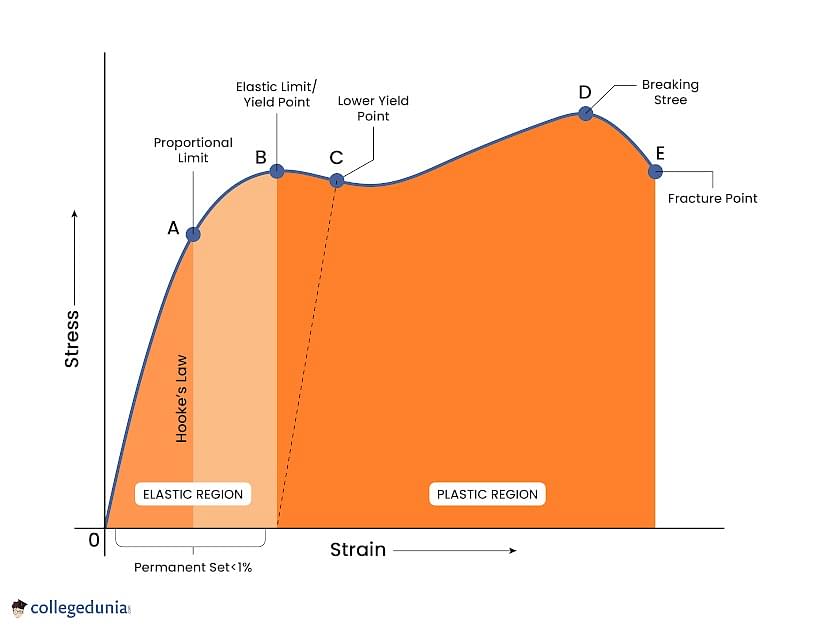
The graph showing the relationship between stress and strain for a material is called stress–strain curve or stress-strain graph. The tensile test is used to determine the yield strength of several materials. The substance is pulled from both ends to find the relationship between stress and strain.
- Stress is the measure of the force applied on both ends of the material.
- The stretching gained by the material is the strain.
The two aspects can be drawn into a stress-strain curve as follows.

Stress-Strain Graph
Read More:
From the above stress-strain graph curve, we can observe the behavior of the material during stress and strain processes.
- When force is applied, the material behaves like an elastic substance.
- During this elastic limit, the material can regain its original size and shape. So, the strain within the elastic limit is reversible.
- Beyond the elastic limit, the strain becomes irreversible.
- Excessive application of force leads to excessive stress on the substance. It breaks the elastic limit. The material gets deformed permanently.
- This point of deformity is called the neck.
- If the stress exceeds the neck point, the breaking of the material occurs.
- This breaking is called a fracture.

Necking and Fracture

Necking
Also Read: Physical properties of metals and non-metals
Explanation of Stress-Strain Graph
[Click Here for Sample Questions]
The stress-strain graph curve represents different points or region
- Proportional limit
- Elastic limit
- Yield point
- Ultimate stress point
- Fracture point or breaking point
Proportional Limit
The proportional limit is the stress corresponding to the point up to which the material obeys Hooke’s Law i.e. proportionality of stress and strain is obeyed only up to a limited range of force for a given material.
- According to Hooke’s law, stress is directly proportional to strain.
- That means the ratio of stress to strain is a constant, known as elastic modulus or Young's modulus.
- The first portion of the stress-strain curve is a straight line which indicates Hooke’s law behavior.
- This straight ends at point A. The stress at this point is called the Proportional limit.
Elastic Limit
The point where the material can regain its original shape and size when the load or force acting on it is completely removed.
- Permanent deformation in the material will occur, beyond the elastic limit.
- The elastic limit is much larger than the proportionality limit.
Yield Point
The point in the stress-strain curve beyond which a material starts losing its original shape and size due to excessive force or load is called the Yield point.
- The material undergoes deformity from the lower to the upper level.
- Here the material gets transformed into plastic from its elastic nature.
- There are two yield points: 1) Offset yield point and proof stress 2) Upper and lower yield points
- When a yield point is not easily defined for a material on the basis of the shape of the stress-strain curve, then an arbitrary point is defined known as an offset yield point.
- In structural engineering, the lower yield point is used as a conservative value since the material response is linear up to the upper yield point.
Ultimate Stress Point
The point to which material has elasticity is called the ultimate stress point. This is the maximum stress that a material can sustain before failure occurs.
Fracture or Breaking Point
The point till which a material loses its elasticity is called the fracture or breaking point. This is the point where a failure cannot sustain and failure occurs.
Read More:
Stress-Strain Graph for Different Materials
[Click Here for Sample Questions]
The common term used for the purpose of identifying the stress at which plastic deformation take place is Yield strength. It is the stress at which permanent deformation occurs in a material.
- Ductile materials have higher yield strength values.
- A material in which a large amount of plastic deformation takes place between the elastic limit and the fracture point is called Ductile material.
- Examples of ductile materials are aluminum, copper, iron, etc.
- Brittle materials have lower or do not have yield strength values.
- A material in which fracture occurs soon after the elastic limit is passed is called Brittle material.
- Examples of brittle materials are glass, ceramic, graphite, etc.
Below is the stress-strain graph of different materials

Stress-Strain graph for different materials
Read More:
The yield strength of different metals is tabulated below.
| Material | Yield Strength (megapascal/MPa) |
|---|---|
| Steel | 180 |
| Stainless Steel | 520 |
| Copper | 69 |
| Brass | 75 |
| Aluminium | 35 |
| Aluminum Alloy | 414 |
| Iron | 130 |
| Nickel | 138 |
| Titanium | 450 |
| Molybdenum | 565 |
Read More:
Things to Remember
- The point of stress level where the material ends elasticity and starts to behave with plasticity is defined as yield stress.
- Stress is the measure of the force applied on both ends of the material The stretching gained by the material is the strain.
- During the elastic limit, the material can regain its original size and shape.
- The point beyond which a material starts losing its original shape and size due to excessive force or load is called the yield point.
- The point to which material has elasticity is called the ultimate stress point.
- The point till which a material loses its elasticity is called the fracture or breaking point.
- The point at which the material transforms from elastic to plastic is known as the yield point.
- The measure of the stress at which the transition from the elastic to plastic phase occurs is known as yield strength.
- Yield strength is a constant. Metals have higher yield strength than non-metals.
- The yield strength of a material can be increased by adding impurities.
Sample Questions
Ques. What is the yield strength of a material? (2 marks)
Ans. The yield strength of a material is the point of maximum stress that is developed in a material without causing plastic deformation. Beyond this point, there will be deformation in the shape and size of the material.
Ques. Define proportional limit, elastic limit, and yield point. (2 marks)
Ans.
Proportional Limit: The proportional limit is the point where transitions occur from elastic to plastic. It is also called yield strength or yield point.
Elastic Limit: The point where the material can regain its original shape and size when the load or force acting on it is completely removed.
Yield Point: The point beyond which a material starts losing its original shape and size due to excessive force or load is called the yield point.
Ques. What is Hooke’s law? (2 marks)
Ans. Hooke's law states that the strain (deformation) of an elastic object or material is proportional to the stress. Hooke’s law is useful in determining yield strength.
Ques. What is Young’s modulus? (2 marks)
Ans. Young's modulus (E) is a property of the material which describes how easily the material can stretch and deform. It is defined as the ratio of tensile stress (σ) to tensile strain (ε). Stress is the amount of force applied per unit area (σ = F/A). Strain is extension per unit length (ε = dl/l).
Ques. What is the use of knowing yield strength? (2 marks)
Ans. The yield strength is useful in determining the maximum allowable load in the material. As it shows the upper limit to forces or loads that can be applied without producing permanent deformation.
Ques. What are the four factors that affect yield strength? (3 marks)
Ans. The yield strength of a material is affected by four different factors namely –
- Strain hardening
- Strain rate
- The temperature of the metal
- Microstructure
Ques. Give the yield strength of different metals in a tabular form. (5 marks)
Ans. The yield strength of different metals is variable. It is tabulated as follows.
| S. No. | Material | Yield Strength (megapascal/MPa) |
|---|---|---|
| 1 | Steel | 180 |
| 2 | Stainless Steel | 520 |
| 3 | Copper | 69 |
| 4 | Brass | 75 |
| 5 | Aluminium | 35 |
| 6 | Aluminum Alloy | 414 |
| 7 | Iron | 130 |
| 8 | Nickel | 138 |
| 9 | Titanium | 450 |
| 10 | Molybdenum | 565 |
Ques. Draw the stress-strain graph. (3 marks)
Ans. The tensile test is used to determine the yield strength of several materials. The substance is pulled from both ends to find the relationship between stress and strain. Stress is the measure of the force applied on both ends of the material The stretching gained by the material is the strain. The two aspects can be drawn into a stress-strain graph as follows.
Also Read:



Comments