



Education Content Expert
Stress is the restoring force per unit area of a substance or material. Stress is the force applied to an object that can deform its original shape and size.
- Stress is a quantity that describes the magnitude of the force that causes solid deformation in a unit area.
- It is denoted by the symbol ‘σ’.
- It is a scalar quantity measured in Pascal or N/m2.
Stress Formula is given as σ = F / A. Here, σ refers to the stress, F is the force applied and A denotes the area of the surface. Stress Formula is used to find stress applied on any given body if force and area on which force is exerted are provided.
Read More: NCERT Solutions for Class 11 Physics Mechanical Properties of Solids
Related Links
- Appearing for JEE Main, Download JEE Mains PYQ for all sabjects
- Appearing for NEET, Download NEET PYQ for all subjects
Key Terms: Stress, Deformation, Strain, Force, Area, Pascal, Stress Formula, Normal Stress, Shearing Stress, Bulk Stress
What is Stress?
[Click Here for Sample Questions]
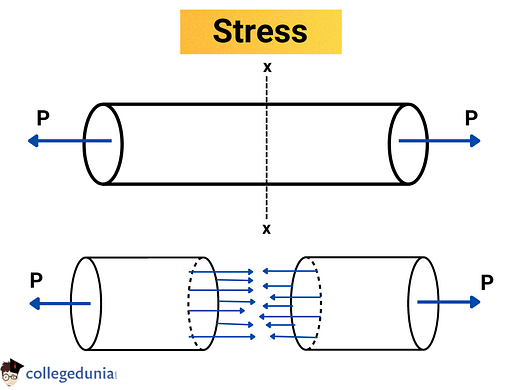
Stress is the force exerted on the unit area of a substance. The effect of stress on a body is referred to as Strain. Stress causes deformations in the body to which it is being applied.
- When a deforming force is applied to an object, the material deforms and loses its original shape.
- There will be an opposing force generated inside the object in order to restore its previous shape and size.
- The restoring force will have the same magnitude as the deforming force and would be in the opposite direction.
- Stress is the measurement of this restorative force per unit area of the material.
- Stress is denoted by σ and is measured in Pascal or N/m2.
Read More:
| Relevant Concepts | ||
|---|---|---|
| Tensile Stress | Thermal Stress | Yield Strength |
| Young's Modulus | Stress and Strain | Strain Energy |
Stress Formula
[Click Here for Previous Years' Questions]
Stress is the external restoring force acting on per unit area. We can calculate the stress on an object using the Stress Formula if the area and force applied are given.
Stress Formula is given as:
| \(σ = {F \over A}\) |
Where
- σ: Stress
- F: Restoring Force
- A: Area of Cross-Section
Read More: Important MCQs on Mechanical Properties of Solids
Solved ExampleExample: Calculate the stress if a force of 40 N is applied on an object with an area of 4mm2. Solution: It is given that,
Using the Stress Formula, σ = F / A
Thus, the stress on the surface of the object is 10×106 N/m2. |
Types of Stress
[Click Here for Sample Questions]
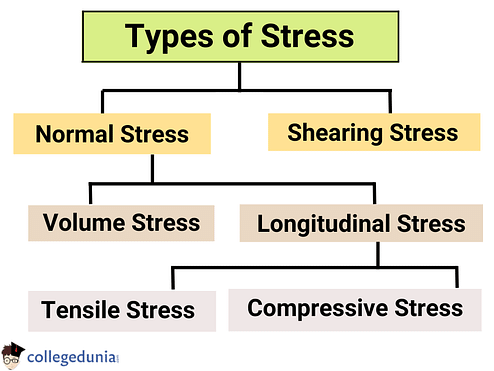
Stress is mainly categorized into two types namely Normal Stress and Tangential or Shearing Stress. The various types of stress are discussed below in brief.
Normal Stress
Stress is referred to as Normal stress when the direction of the deforming force is perpendicular to the cross-sectional area of the body. The length of the wire or the volume of the body changes stress will be at the normal.
| Normal Stress = Axial Force / Cross-sectional Area |
Normal stress is further classified into two types:
- Longitudinal Stress: Longitudinal Stress either stretches the object or compresses the object along its length.
- Bulk Stress or Volumetric Stress: When the volume of the body changes due to the deforming force, it is termed Volumetric Stress.

Read More: Mechanical Properties of Solids Important Questions
Shearing Stress
Shearing Stress refers to the force applied tangentially across the surface area of a plane. The surface is said to be tangent when the forces operating on the surface are parallel to it and the stress acting on the surface traces a tangent. Shearing stress results in a change in the shape of the body.
| Shearing Stress = Force / Surface Area |
Solved Examples on Stress Formula
[Click Here for Previous Years' Questions]
Example 1: Calculate the stress on a spring with an area of 0.35m2 which is pulled with a force of 500 N.
Solution: It is given that,
- Force (F) = 500N
- Area (A) = 0.35 mm2
Using the Stress Formula,
σ = F / A
- σ = 600N / 0.3 mm2
- σ = 2000 N/m2
Therefore, the stress acting upon the surface is 2000 N/m2.
Example 2: A force of 1000 N is applied to an elastic spring over an area of 0.2 m2. What will be the stress?
Solution: Given that,
- Force (F) = 1000 N,
- Area (A) = 0.2 m2
Using the Stress Formula,
σ = F / A
- σ = 1000N/0.2
- σ = 5000 N/m2
Thus, the stress is calculated as 5000 N/m2.
Check More:
Handwritten Notes on Mechanical Properties of Solids
[Click Here for Sample Questions]
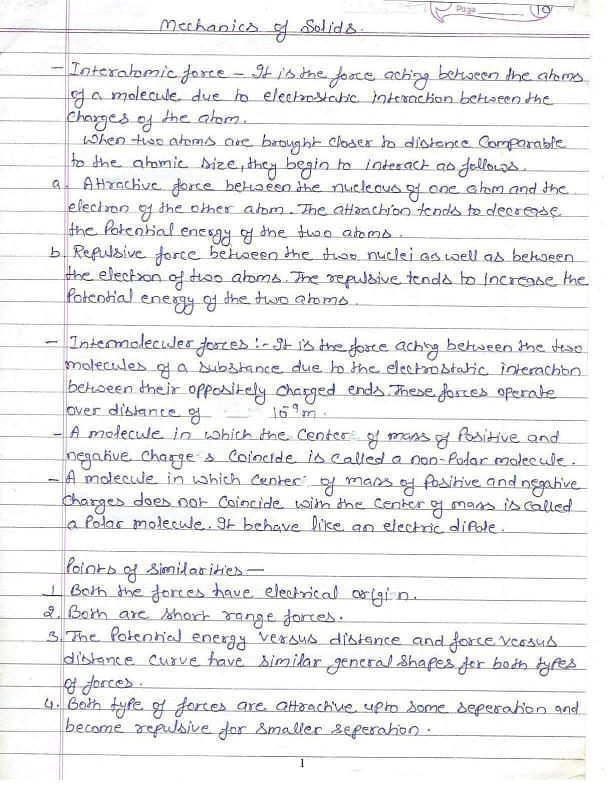
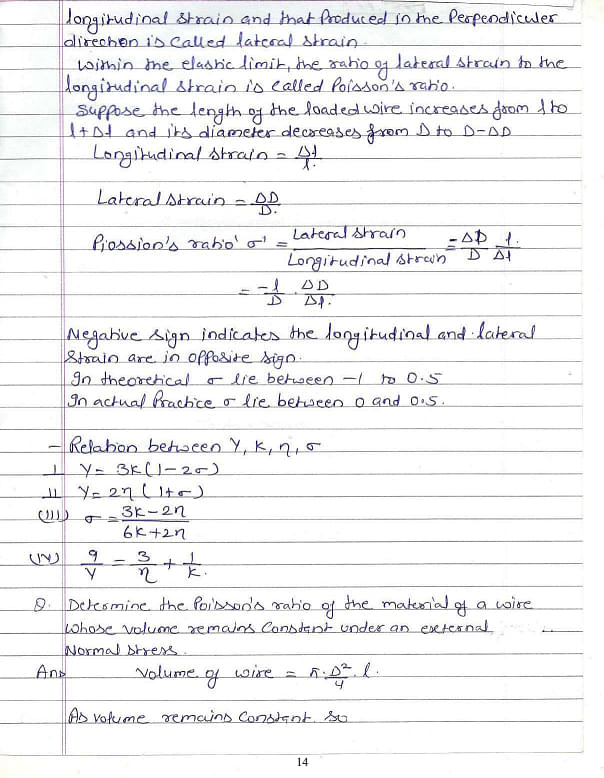
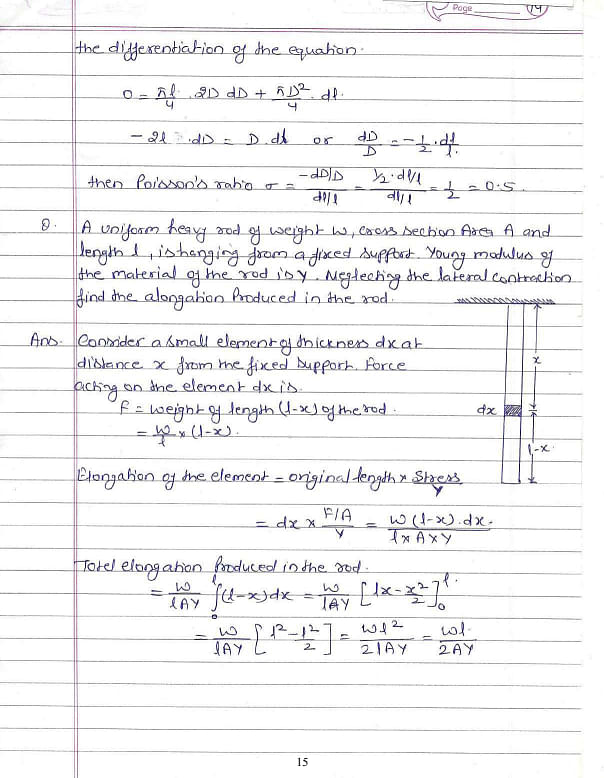
Here are the handwritten notes on Mechanical Properties of Solid and relevant concepts:


Things to Remember
- Stress is defined as the external restoring force acting per unit area of a body.
- Stress describes the magnitude of forces that cause deformation in an object.
- The symbol of stress is σ and it is a scalar quantity.
- There are two major types of stress namely Normal Stress and Shearing Stress.
- Normal Stress is categorized into two subtypes called Longitudinal Stress and Bulk Stress.
- Stress Formula is given as σ = F / A, where F is the force applied, and A is the area on which the force is acting upon.
Previous Years’ Questions
- Dimensions of stress are… (NEET 2020)
- Shear stress is related to… (Manipal 1980)
- If S' is stress and Y' is Young’s modulus of material…
- The slope of the stress versus strain curve is…
- According to Hooke’s law of elasticity, if stress is increased…
- If a solid has a sharp melting point, then it means that the…
- Which of the following substances has the highest elasticity… (KCET 2010)
- The length of elastic string, obeying Hooke’s law…
- Hooke's law states that…
- An elastic string has length β when subjected to 5 N tension… (AMUEEE 1999)
Sample Questions
Ques. What will be the stress if a force of 50 N is acting on an area of 5 mm2? (3 Marks)
Ans. It is given that,
- Force (F) = 50 N
- Area A = 5mm2
Using the Stress Formula,
σ = F / A
σ = 50/(5 x 10-6)
σ = 10 x 106 N/m2
Thus, the stress on the object will be 10 x 106 N/m2.
Ques. What will be the area if the stress is 1000N/m2 and the force is 500 N? (3 Marks)
Ans. According to the question,
- Stress (σ) = 1000 N/m2
- Force (F) = 500 N
Using the Stress Formula,
σ = F / A
Rearrange the formula for area,
A = F / σ
A = 500/1000
A = 0.5
Therefore, the area on which the stress is being applied is 0.5 m2
Ques. What is Stress Formula? (3 Marks)
Ans. Stress Formula is used to calculate the stress on any object or body if the force and area on which force is exerted are given. Stress Formula is as follows:
σ = F / A
Here
- σ refers to stress.
- F refers to the restoring force.
- A refers to the area of cross-section.
Ques. What will be the force if stress is 800N/m2 and the area is given as 0.2m2? (3 Marks)
Ans. We are given that,
- Stress (σ) = 800N/m2
- Area (A) = 0.2 m2
Using the Stress Formula,
σ = F / A
Rearrange the formula for the force,
F = σ×A
F = 800×0.2
F = 160 N
Thus, the force applied is 160 N.
Ques. What is Stress? Name the types of stress. (3 Marks)
Ans. Stress is the force applied per unit area in a deformed solid or material. The SI unit of stress is N/m2.
Stress can be categorized widely into two types:
- Normal Stress
- Shearing Stress
Ques. What is Hooke’s Law? (3 Marks)
Ans. Hooke’s Law is the foundational law of elasticity in Physics. According to Hooke’s Law, the force required to extend or compress a spring by a certain distance is directly proportional to that distance. Hooke’s Law states that the amount of stress applied to an object is equal to the amount of strain observed on it.
Mathematically, Hooke’s Law is expressed as follows:
Stress ∝ Strain
Ques. What is Volume Stress? (3 Marks)
Ans. Volume stress refers to stress that causes the volume of the body to fluctuate. Normal stress leads to a change in length or volume, whereas tangential stress causes a change in the shape of the body. This stress is referred to as volume stress. A body encounters a force that is perpendicular to the body’s surface when a body is submerged in a liquid and is under the force of pressure. Volume stress is also referred to as Bulk Stress.
Volume Stress = Force / Area
Ques. What are the various types of Stress in Physics? (3 Marks)
Ans. The various types of stress in Physics are as follows:
- Normal Stress
- Longitudinal Stress
- Volume Stress
- Shearing Stress
- Hydraulic Stress
- Radial Stress
- Tensile Stress
- Compression Stress
Ques. Why is stress generated in an object? (3 Marks)
Ans. Whenever a force is applied to an object or a body, it is deformed. The intermolecular distance of separation changes from its equilibrium value which causes intermolecular forces to be generated. These forces restore the body to its original state once the deforming external forces are removed. The total intermolecular restoring forces per unit area are referred to as stress.
Ques, What do you mean by deformation? (2 Marks)
Ans. Deformation is defined as a change in the shape of an object or a body due to the application of a force. Some sort of deformation is caused even when minimal forces are applied. Deformation is experienced by objects due to the action of external forces such as squashing, ripping, squeezing, twisting, shearing, or pulling the objects apart.
Check-Out:



Comments