




The Class 9 Social Science Handwritten Notes Chapter 1 Understanding Social Science are a topper's own neat revision of the first chapter of the new Understanding Society book. Every big idea, from the four core disciplines to the four types of historical sources, is written by hand with each key term boxed in the margin. You revise the whole chapter in one short sitting.






- What you get: the meaning of Social Science, Indian knowledge traditions, the four core disciplines, and the four types of historical sources, all in clear handwriting.
- Colour-coded: new sub-topics in red, each definition and key term in a hand-drawn box, and examples written in blue.
- Why by hand: writing each discipline and each source type by hand helps you recall the names and questions fast in the exam.
Student Feedback
In a Collegedunia study of 1,180 Class 9 students, 81% said hand-written pages of the four disciplines and the four source types were easier to recall than typed notes. About 4 out of 5 rated the boxed key terms and the red-marked mistakes as the most useful part before a test.
Why Use Handwritten Notes for Class 9 Social Science Chapter 1 Understanding Social Science
Chapter 1 is full of new terms, four disciplines, five elements, and four source types, so a clean hand-written page saves time. These Class 9 Social Science Handwritten Notes Chapter 1 Understanding Social Science keep one idea per line, with a small diagram or example beside it, so nothing runs together. You revise the full chapter in one sitting without flipping through the Understanding Society book.
- Each key term, like Panchamahabhutas or Arthashastra, sits in its own hand-drawn box.
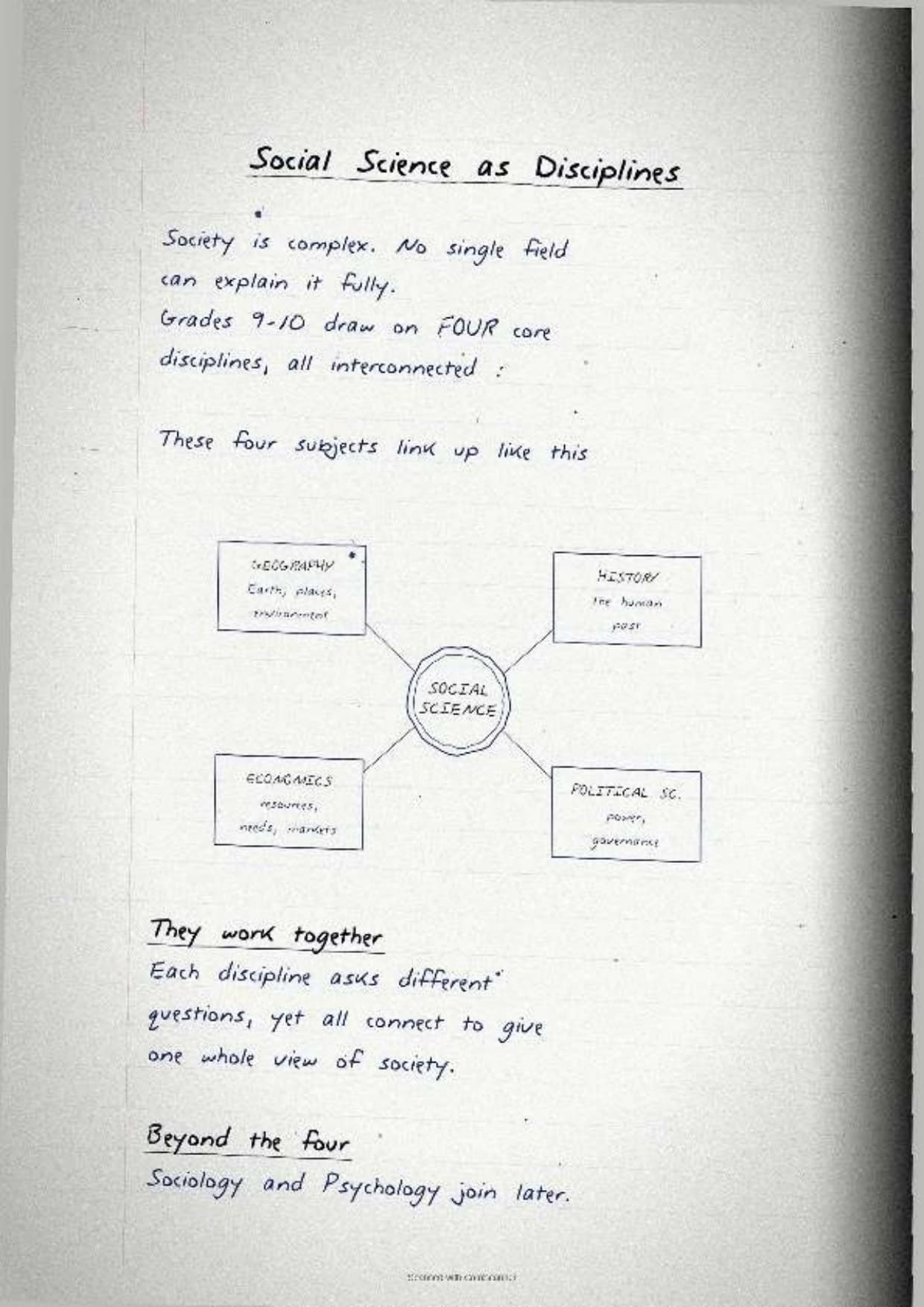
- A quick sketch is drawn next to the idea it explains, such as the disciplines wheel.
- Red sub-headings split the chapter into short, easy parts.
- The wording is plain, like a senior showing you the method.
What Is Inside the Understanding Social Science Handwritten Notes
The Class 9 Social Science Handwritten Notes Chapter 1 Understanding Social Science run to 20 pages of neat, hand-written revision. They move from the meaning of Social Science, to Indian knowledge traditions, then the four core disciplines, and finally how historians read sources. The colour code below explains every mark.
- Red: new sub-topic headings, such as Continuity and Change, Geography, or Numismatic Sources.
- Boxes: each definition and key term, like Vasudhaiva Kutumbakam, drawn by hand.
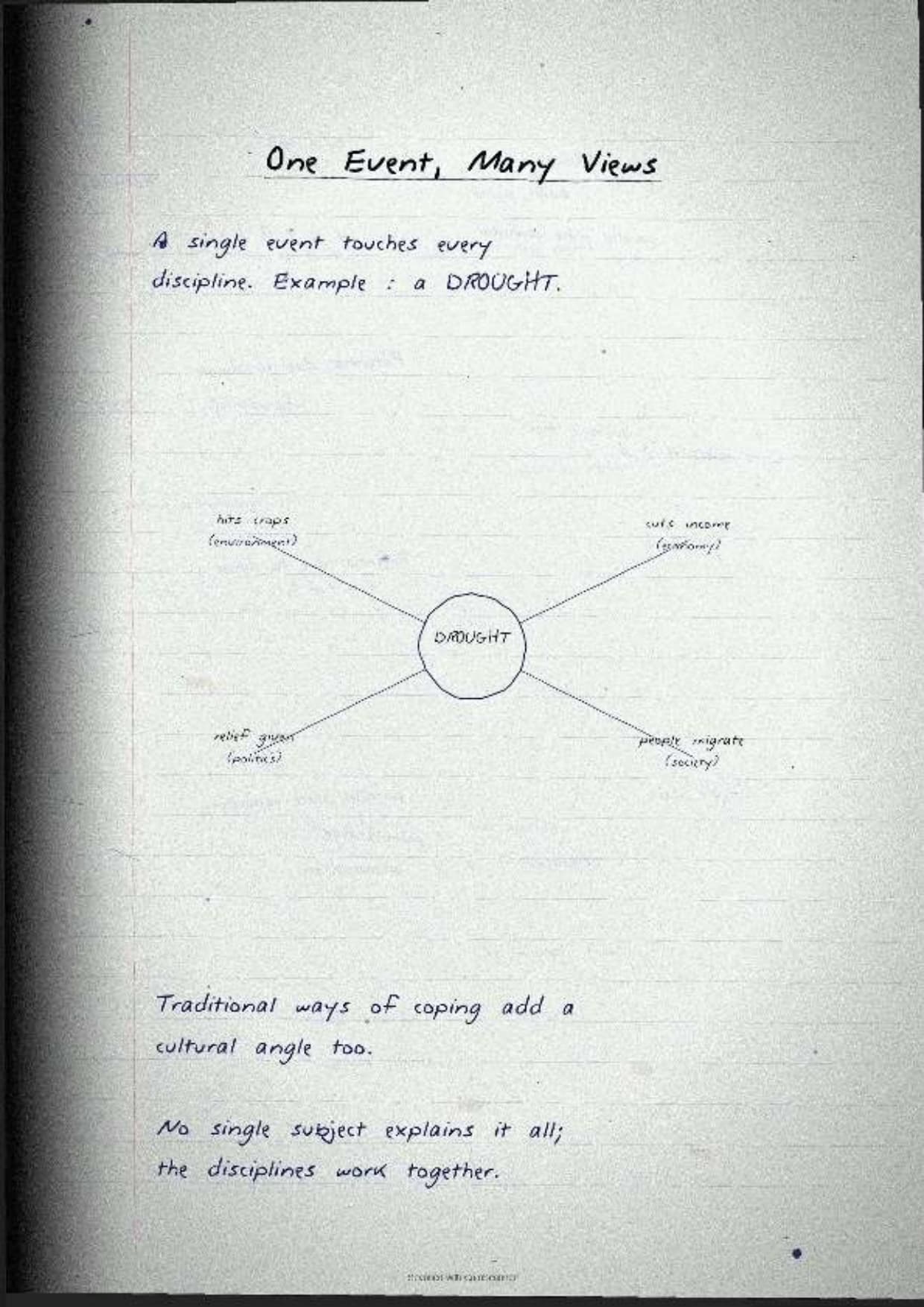
- Blue: real examples, such as the drought seen through many disciplines.
What Is Social Science, Explained in the Understanding Social Science Notes
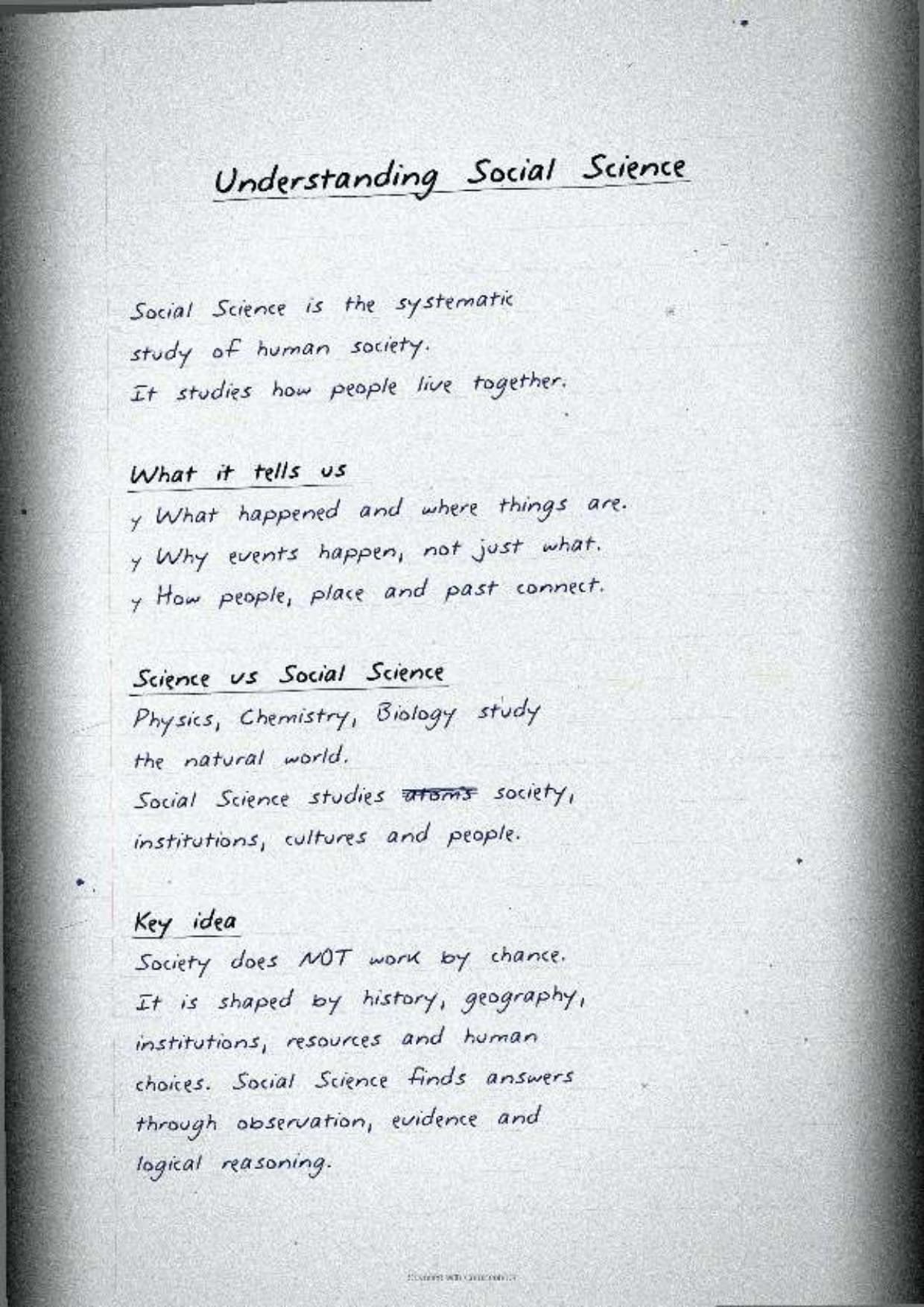
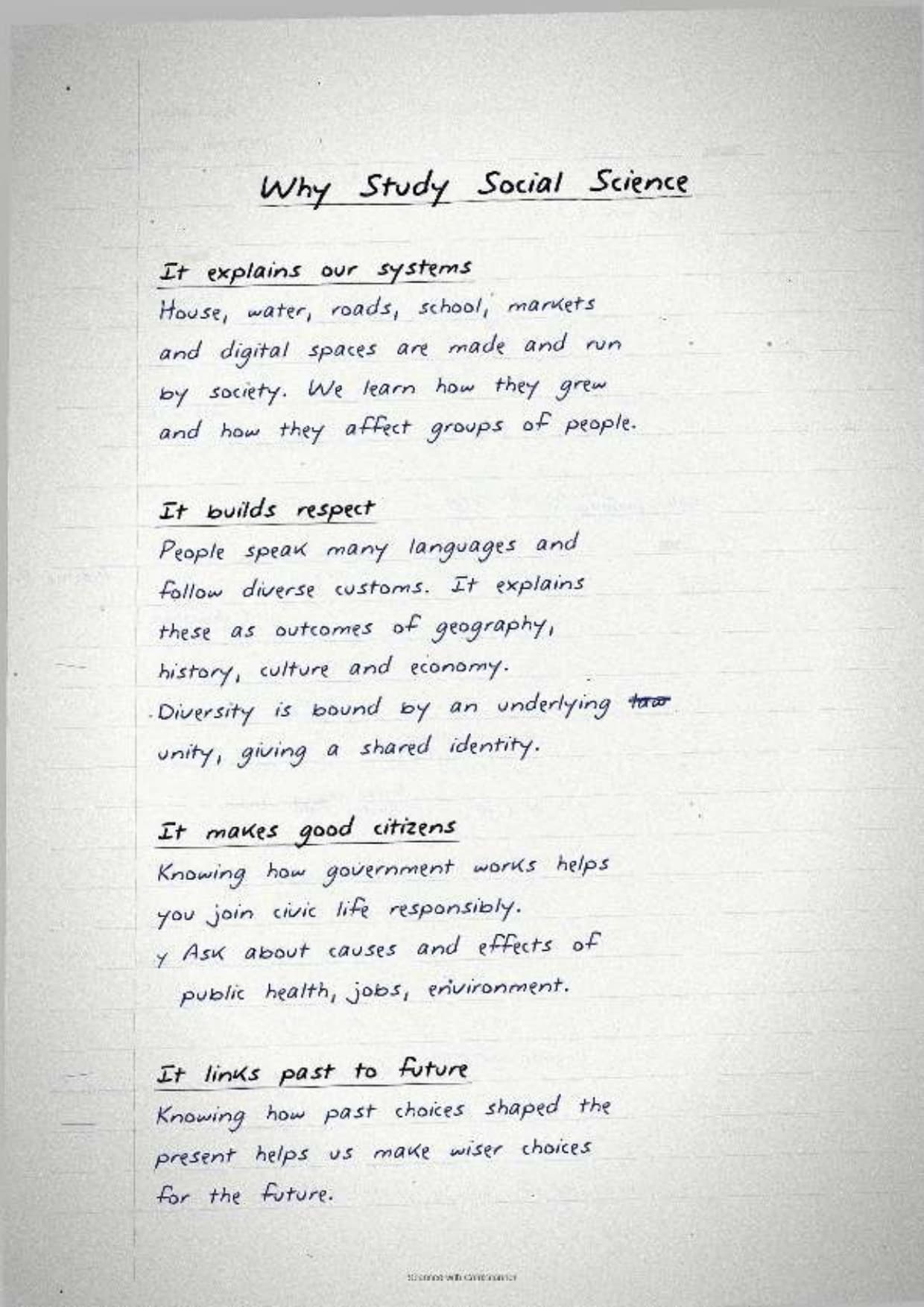
The chapter opens with a simple idea, so the notes box it first. Social Science is the organised study of human society. It does not only ask what happened or where things are. It asks why events occur and how the parts of life connect. Natural sciences study the natural world, while Social Science studies society, its institutions, and its cultures.
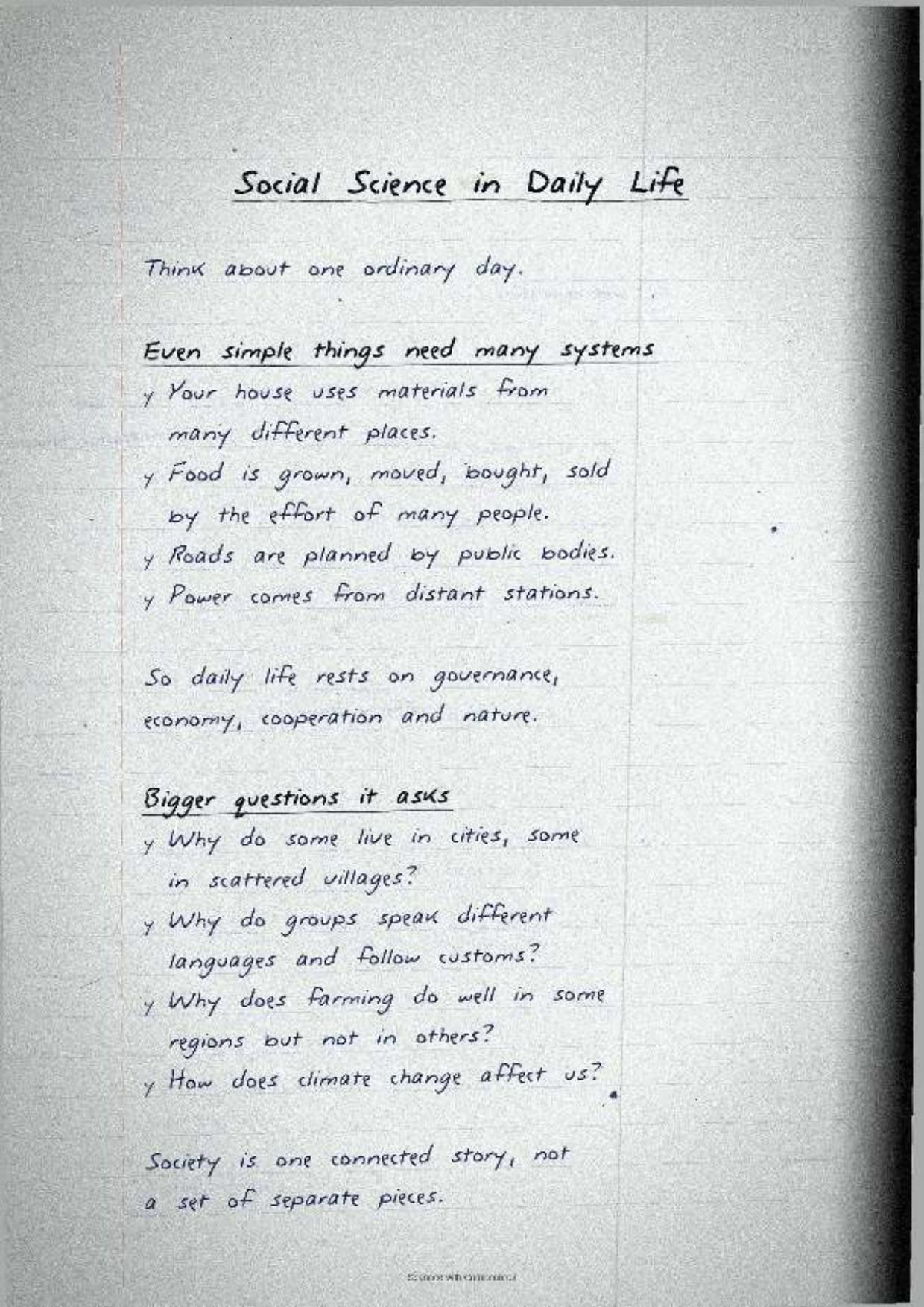
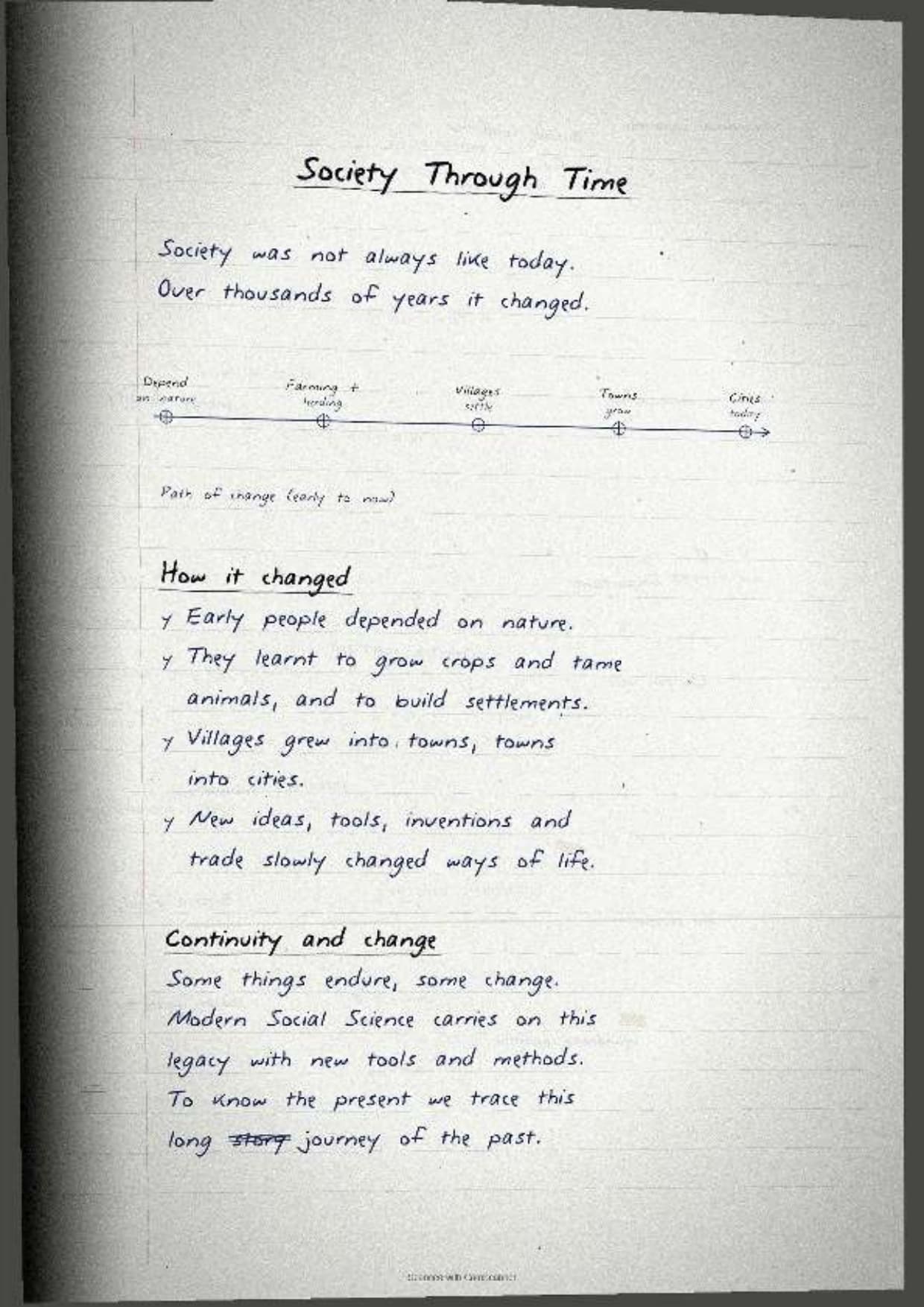
The notes draw one ordinary day at the centre of many systems, showing how much Social Science touches. The margin also flags continuity and change, the theme of the whole subject.
- Environment shapes where and how we live.
- Economy moves goods and services to us.
- Governance plans roads, schools, and services.
- Society and culture give us language and customs.
Indian Knowledge Traditions in the Understanding Social Science Notes
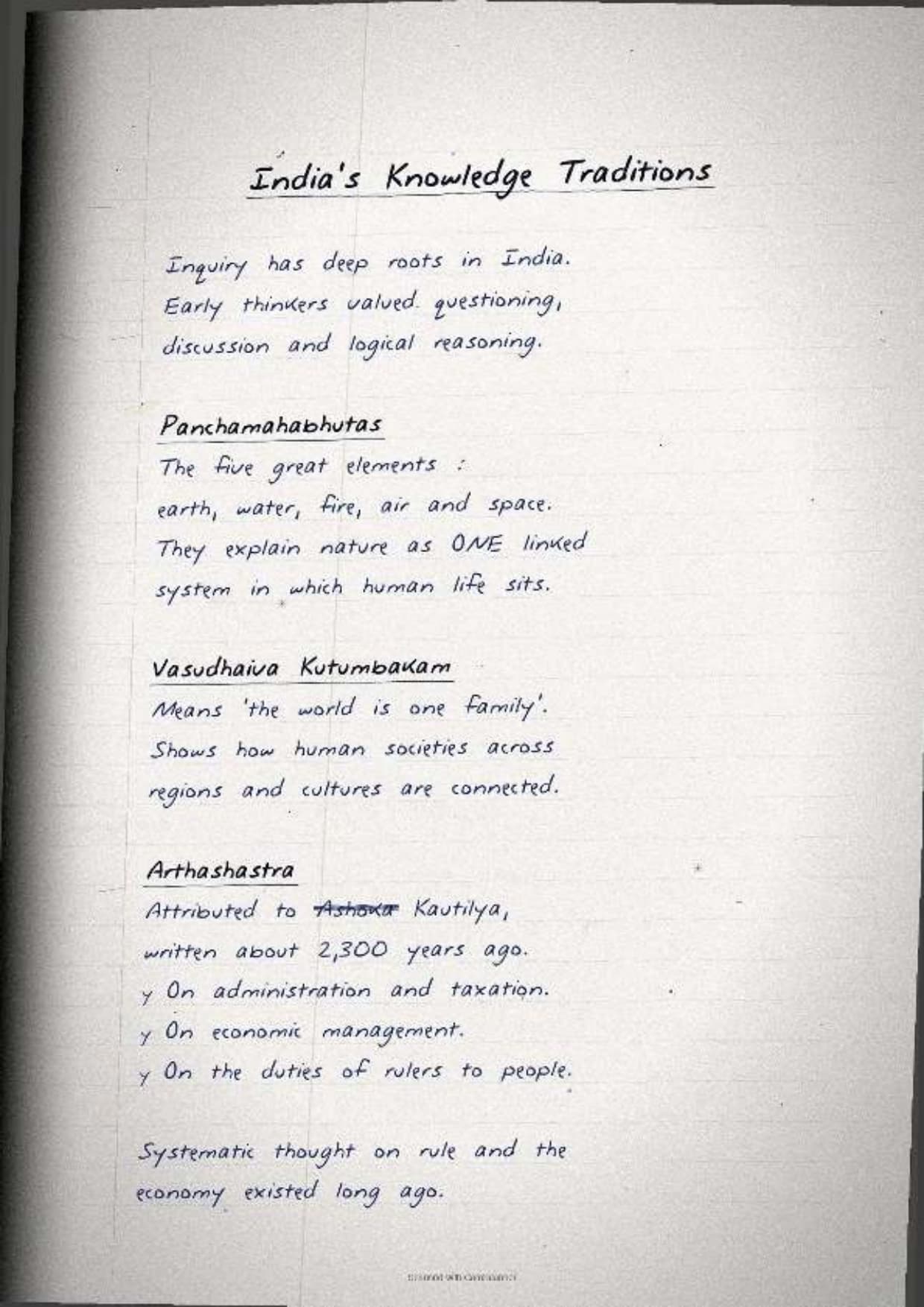
Asking questions about society is very old in India, so the notes give this section its own boxed terms. Two ideas stand out, and an old text shows early thinking on rule and money.
- Panchamahabhutas: the five great elements, earth, water, fire, air, and space, seen as one connected system. This explains how the environment shapes where people settle and how they live.
- Vasudhaiva Kutumbakam: "the world is one family". It shows how trade, migration, and shared festivals link people across regions.
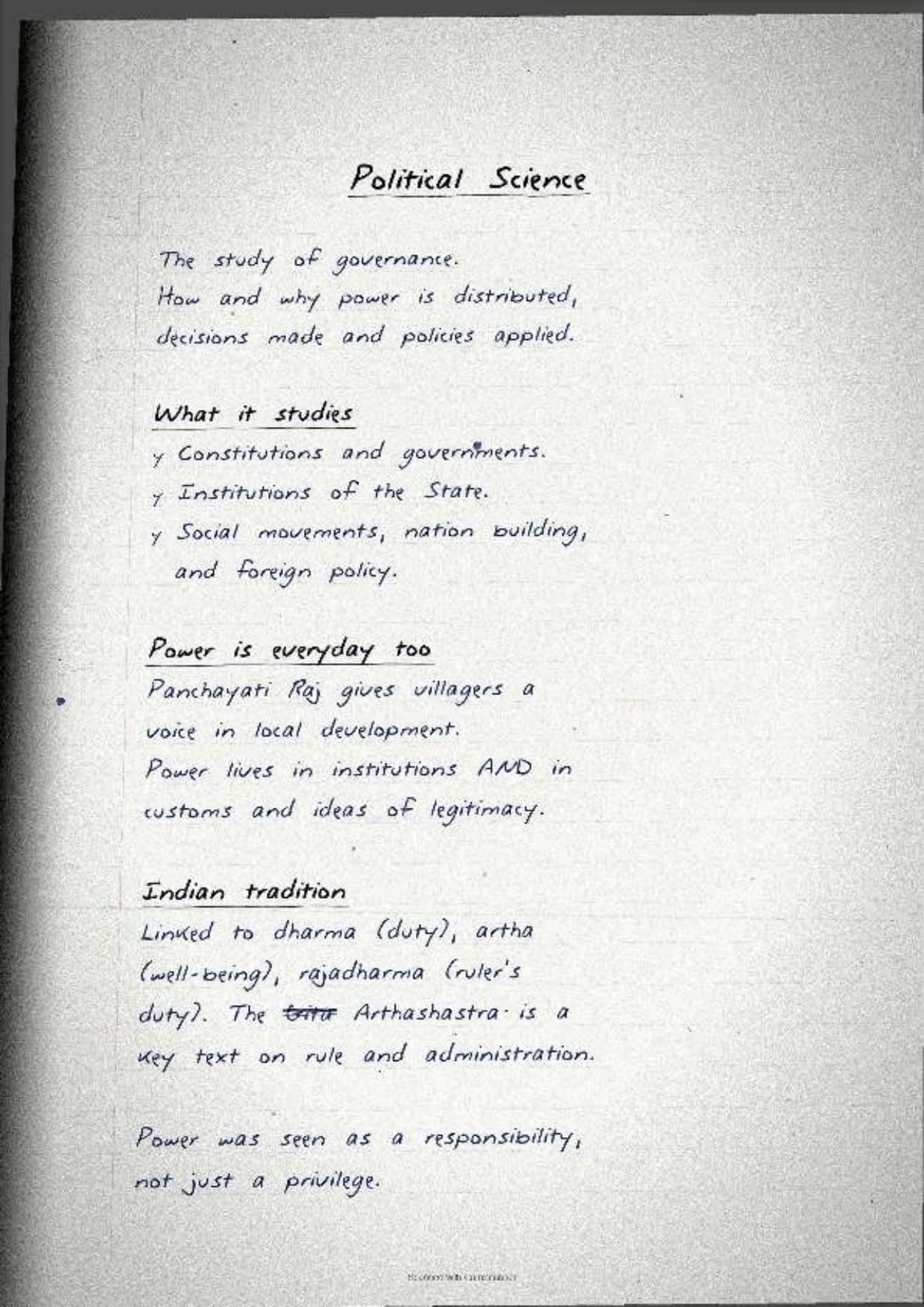
- Arthashastra: a text attributed to Kautilya, written about 2,300 years ago, on administration, taxation, and the duties of a ruler.
Four Core Disciplines in the Understanding Social Science Handwritten Notes
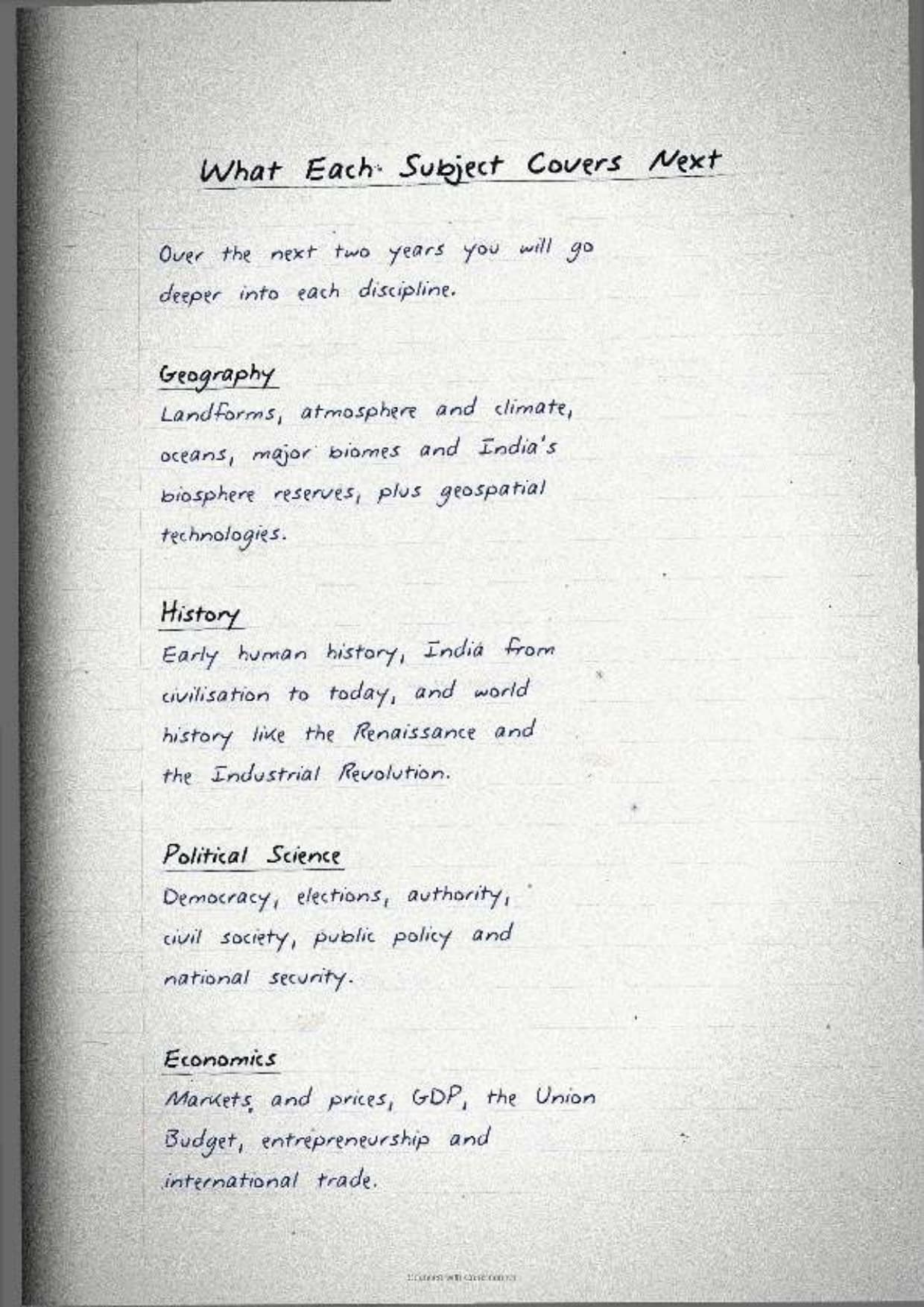
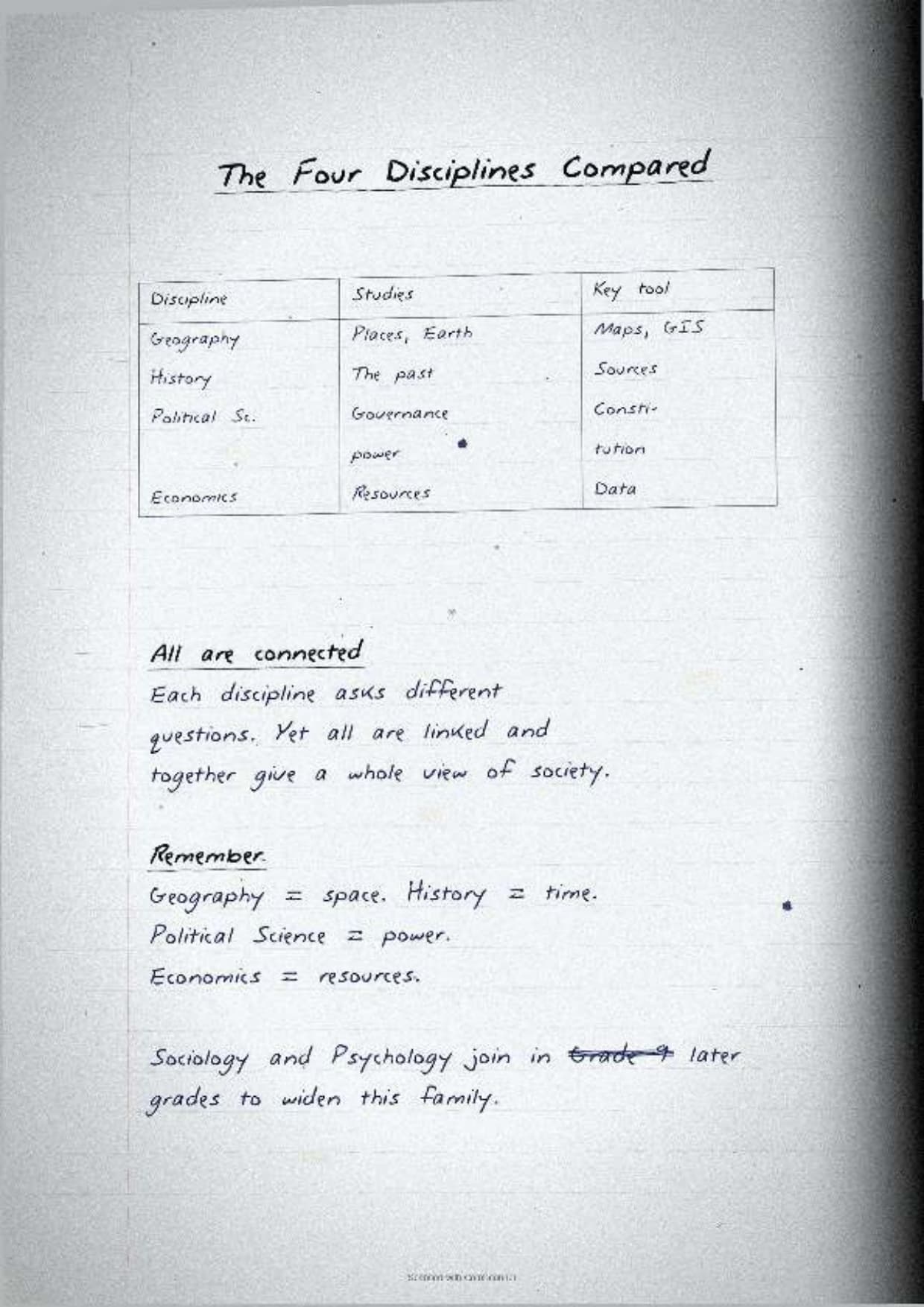
Human society is complex, so no single subject can explain it fully. Social Science is a family of related subjects, and in Grades 9 and 10 it draws mainly from four. The notes put them in a hand-drawn table, each with the main question it asks.
| Discipline | Main question | Sample topic |
|---|---|---|
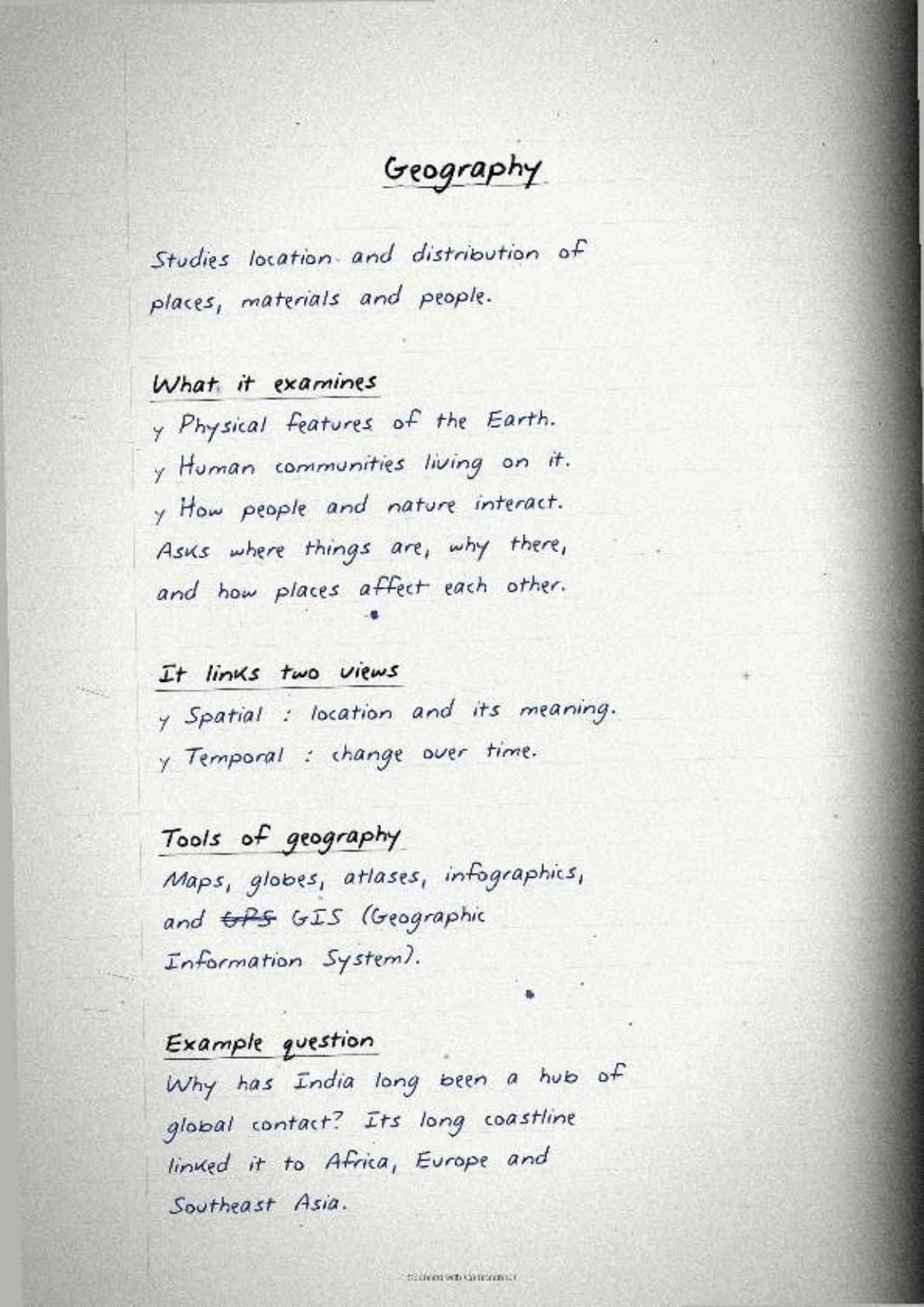
| Geography | Where and why there? | Landforms, climate, maps, GIS |
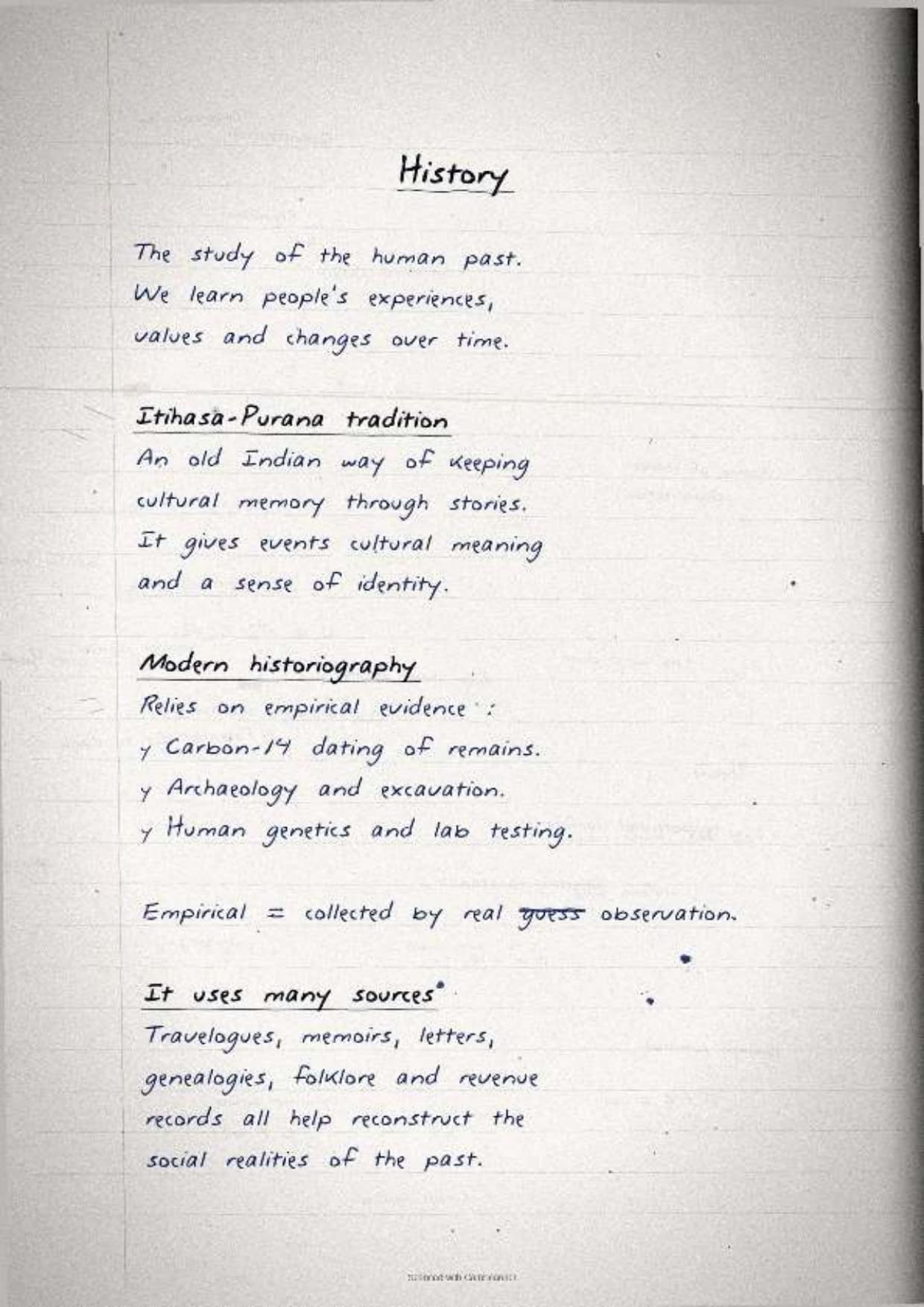
| History | What changed over time? | Early humans, sources, world history |
| Political Science | Who governs, and how? | Democracy, elections, Panchayati Raj |
| Economics | How are resources used? | Markets, prices, GDP, the Budget |
The notes draw a drought in blue to show why you need all four. A drought hits crops (Geography), incomes (Economics), relief measures (Political Science), and migration (Society). Sociology and Psychology also belong to the wider family and come later.
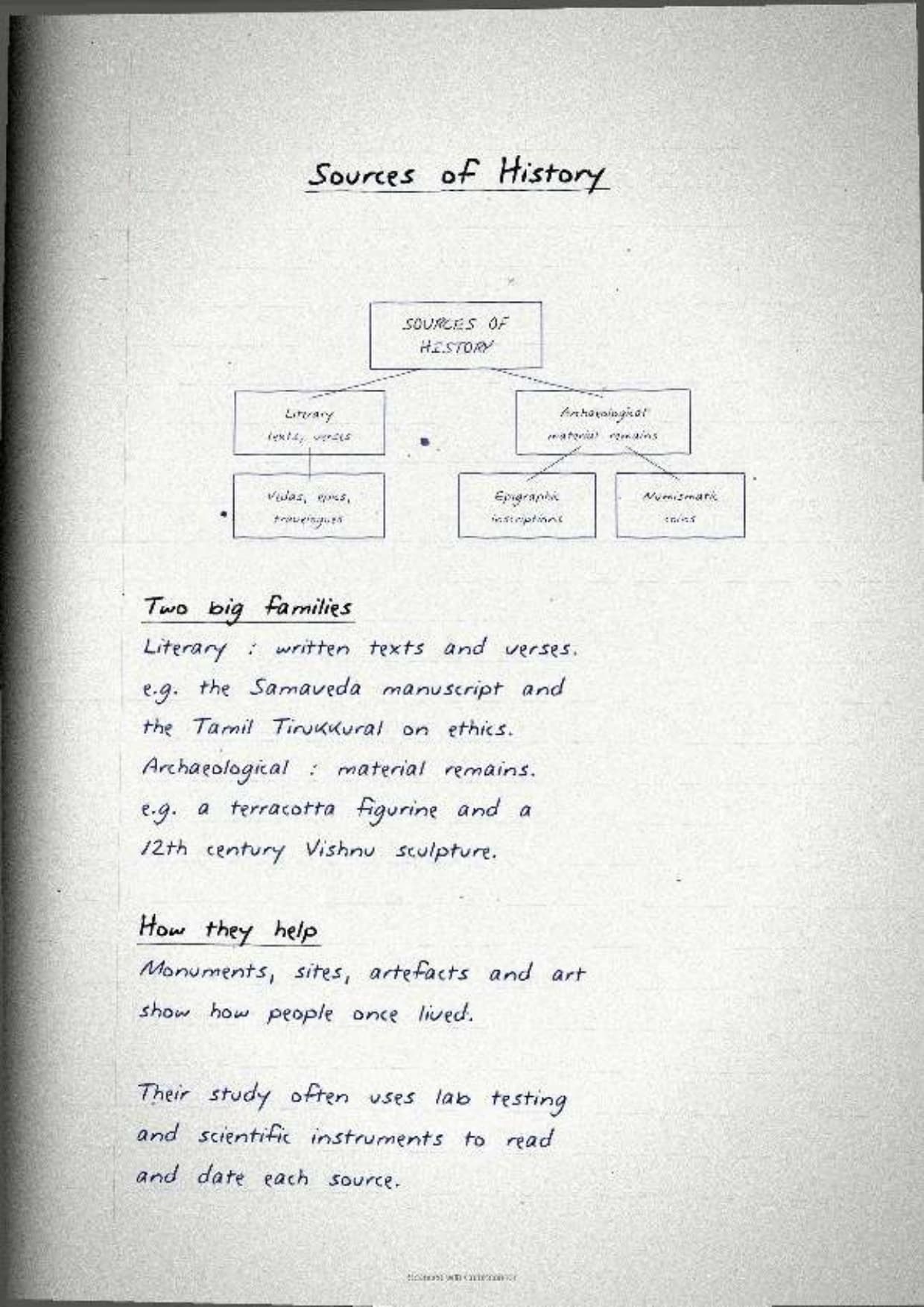
Four Types of Historical Sources Marked in the Notes
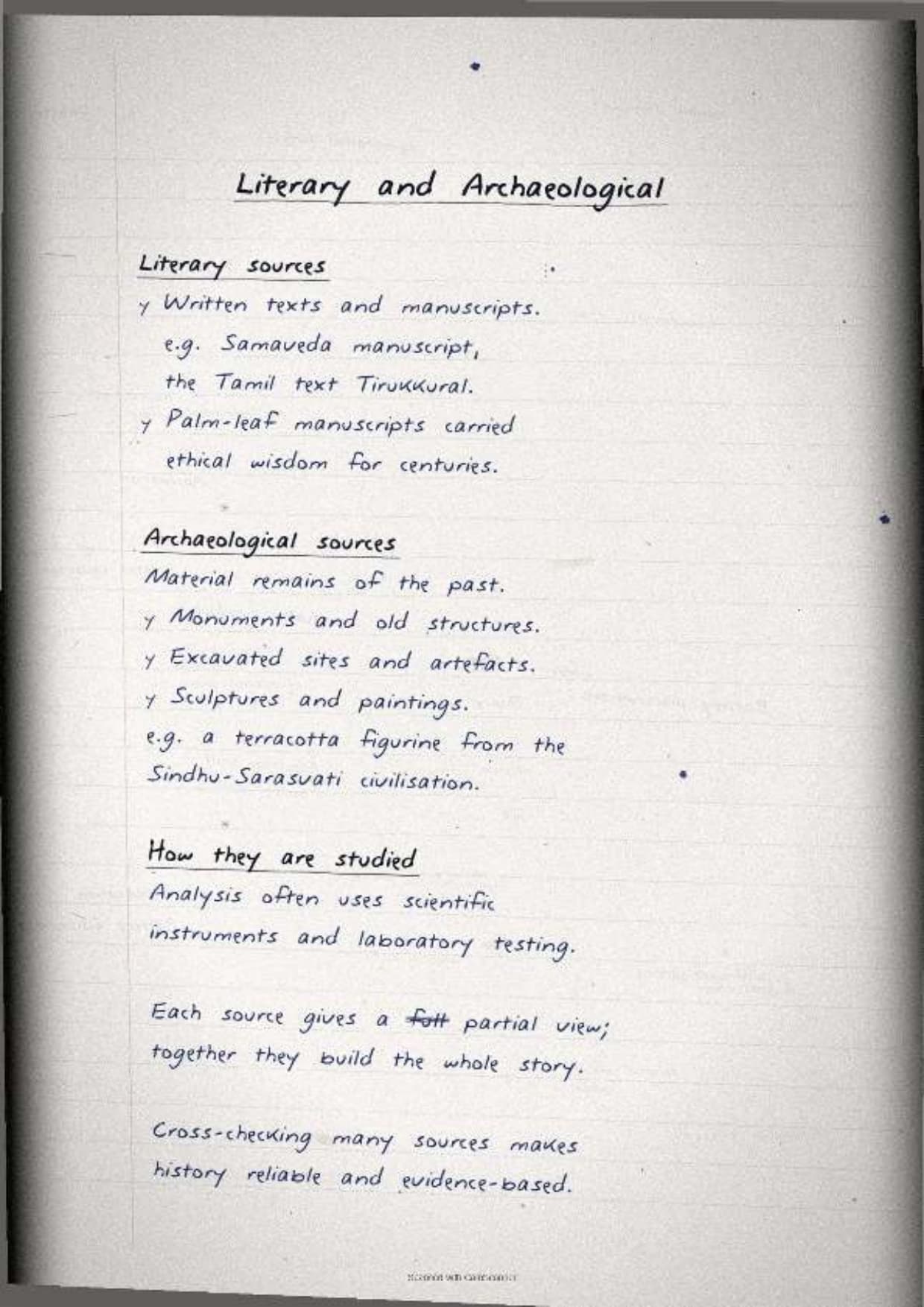
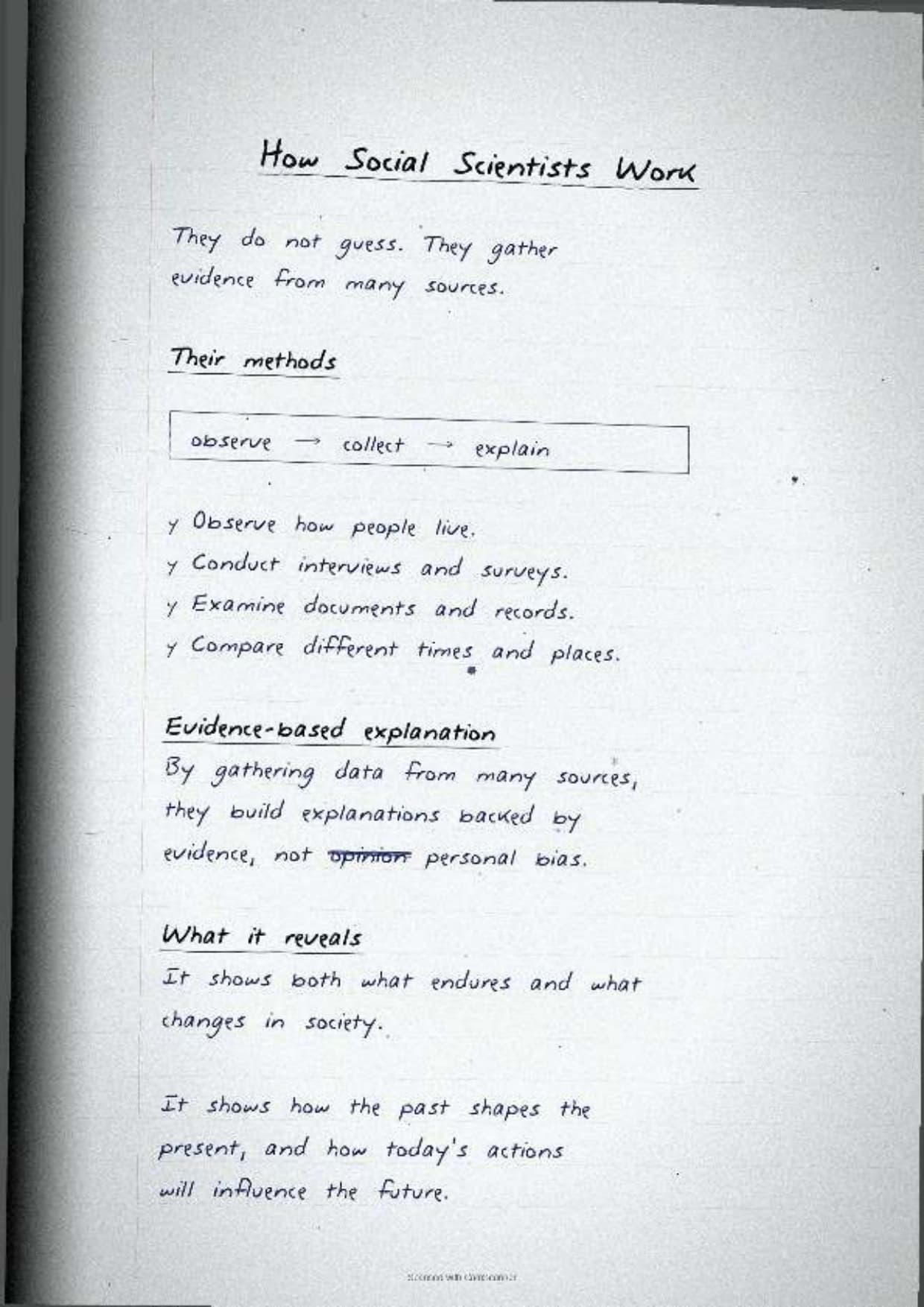
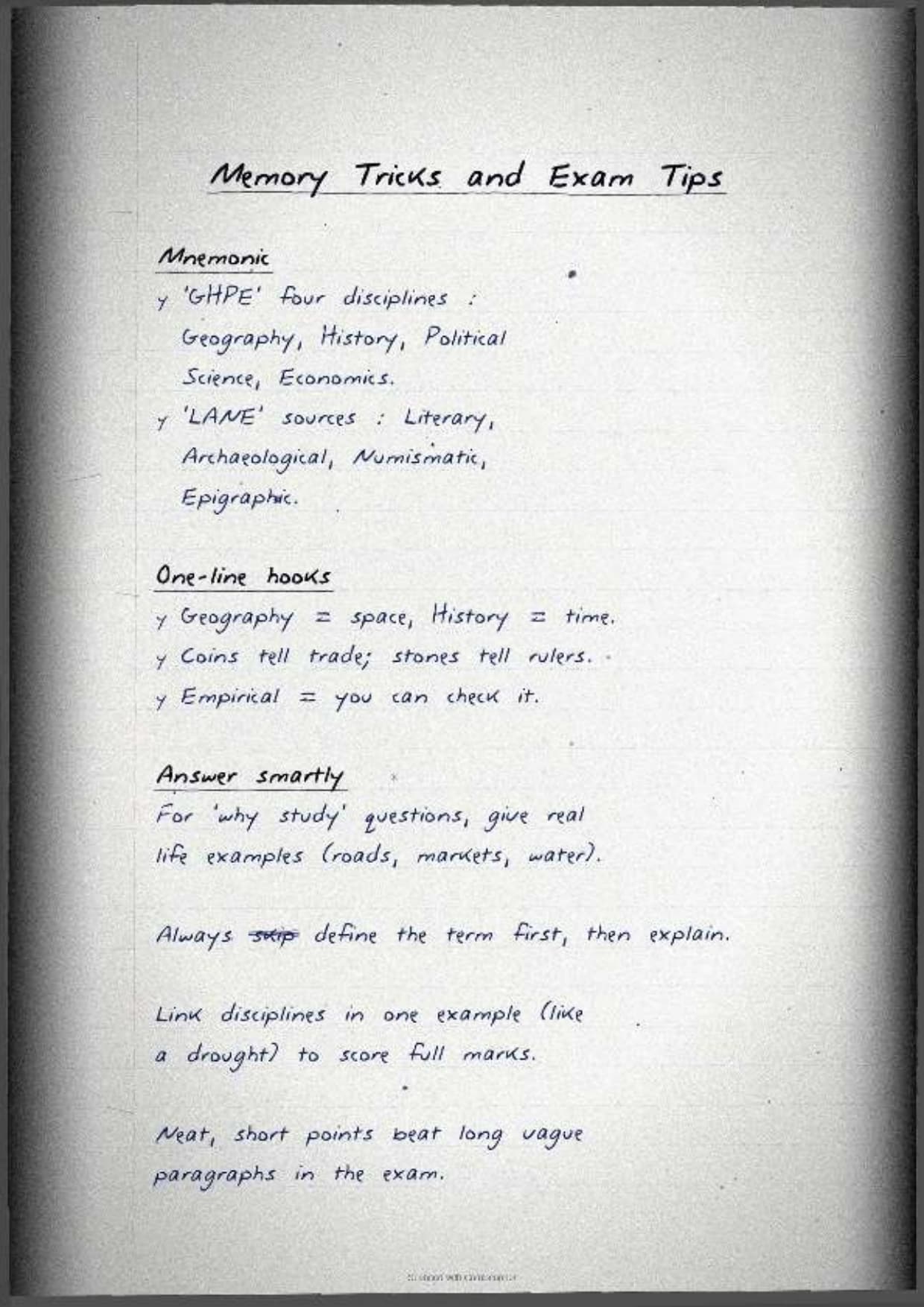
To study the past, historians gather evidence and compare times and places. The notes sort the main source types into a small tree, one example each, so the names stay easy to keep apart.
| Source type | What it is | Example |
|---|---|---|
| Literary | Written texts | Manuscripts, travelogues, revenue documents |
| Archaeological | Material remains | Monuments, artefacts, sculptures |
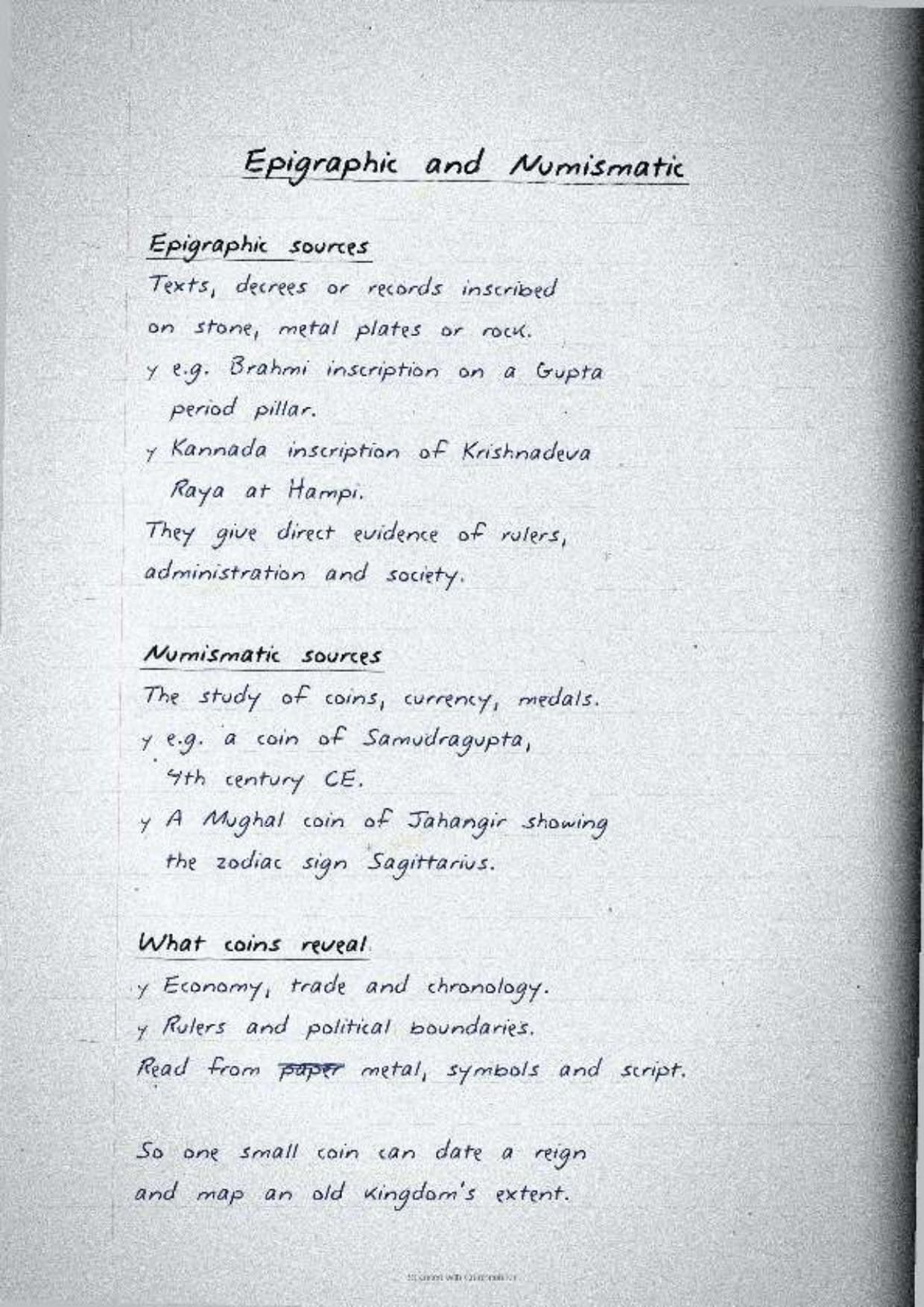
| Epigraphic | Writing on hard surfaces | Inscriptions on stone, metal, or rock |
| Numismatic | Coins and money | Coins and medals of past rulers |
The notes flag one trap in red, since students often mix the last two. An epigraphic source is writing carved on stone or metal, while a numismatic source is a coin. Both can carry inscriptions, so read the question with care before naming the type.
Common Mistakes Flagged in Red in the Understanding Social Science Notes
Most lost marks in this chapter come from small slips, not hard ideas. The Collegedunia handwritten notes circle these in red so you fix them while you revise.
- Confusing an epigraphic source (inscription) with a numismatic source (coin).
- Describing history as a "story"; every claim needs a source and evidence.
- Studying the four disciplines in isolation instead of connecting them in one answer.
- Forgetting that the Panchamahabhutas idea sees nature as one connected system.
Last-Minute Revision with These Understanding Social Science Handwritten Notes
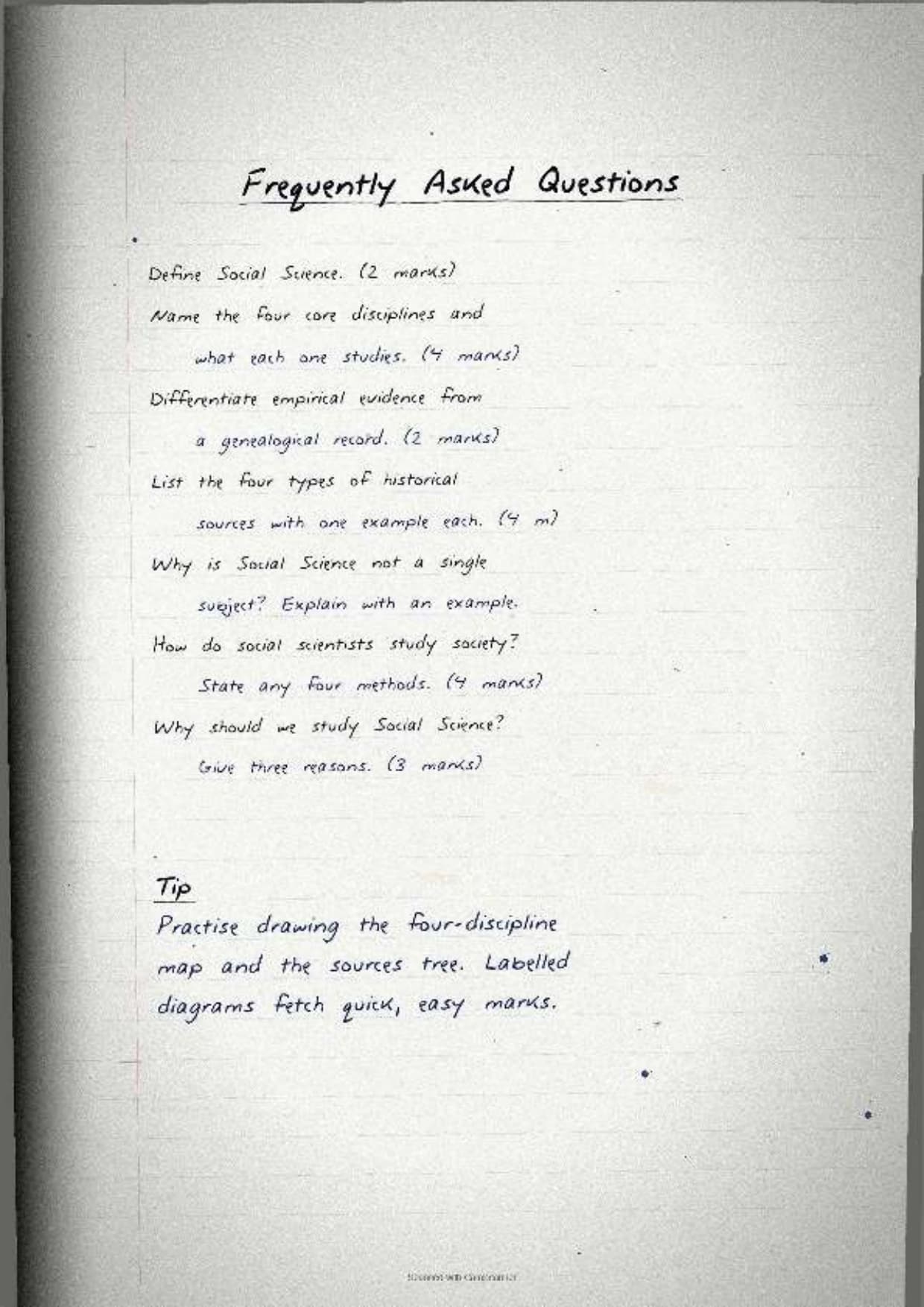
The night before your exam, the Class 9 Social Science Handwritten Notes Chapter 1 Understanding Social Science work as a quick skim. Every boxed term and red heading is a checkpoint, so you can cover the whole chapter in well under an hour.
- Define Social Science in one sentence.
- Name the four core disciplines and the question each one asks.
- Explain the Panchamahabhutas and Vasudhaiva Kutumbakam ideas.
- List the four types of historical sources with one example each.
- Give three reasons why studying Social Science matters.
- Read the red mistake note before you close the notes.
Other Understanding Social Science Class 9 Social Science Resources
Use the table below to open the other resources for this chapter.
| Resource | Open |
|---|---|
| Handwritten Notes | Understanding Social Science Class 9 Social Science Handwritten Notes |
| NCERT Solutions | Understanding Social Science Class 9 Social Science NCERT Solutions |
| Revision Notes | Understanding Social Science Class 9 Social Science Notes |
| NCERT Book PDF | Understanding Social Science Class 9 Social Science NCERT Book PDF |
NCERT Handwritten Notes for Class 9 Social Science: All Chapters
Use the table below to open the handwritten notes for any other chapter.
| Chapter | Handwritten Notes |
|---|---|
| Chapter 1 | Understanding Social Science |
| Chapter 2 | Shaping of the Earth's Surface |
| Chapter 3 | Atmosphere and Climate |
| Chapter 4 | Early Humans and Beginning of Civilisation |
| Chapter 5 | State and Society up to 1000 CE |
| Chapter 6 | Democracy |
| Chapter 7 | Elections |
| Chapter 8 | Building Blocks in Economics: The Problem of Choice |
| Chapter 9 | The Price Puzzle: What Drives the Market |
Understanding Social Science Class 9 Social Science Handwritten Notes FAQs
Ques. How many pages are the Understanding Social Science Class 9 Social Science handwritten notes?
Ans. The handwritten notes run to 20 pages. They cover the full chapter, from the meaning of Social Science and Indian knowledge traditions to the four core disciplines and the four types of historical sources, with a clear example after each idea.
Ques. Are these real handwritten notes?
Ans. Yes. They are a topper's own clear handwritten revision notes, with each key term boxed, small sketches drawn by hand, and sub-headings colour-coded in red for every new sub-topic.
Ques. What are the four core disciplines in Chapter 1?
Ans. The four core disciplines are Geography, History, Political Science, and Economics. Each asks a different question: where and why there, what changed over time, who governs and how, and how resources are used.
Ques. Is Understanding Social Science part of the new Class 9 Social Science book?
Ans. Yes. Understanding Social Science is Chapter 1 of the new Understanding Society textbook for the 2026-27 syllabus. It is an integrated book that brings Geography, History, Political Science, and Economics together.



Comments