




If you are starting the history half of Class 6 Social Science, Timeline and Sources of History is the chapter that sets up everything after it. The NCERT Book PDF below carries the full printed chapter from Exploring Society: India and Beyond for the 2026-27 session, with the CE and BCE rules, both timelines, the four kinds of experts and the sources diagram exactly as NCERT prints them. Nothing is shortened or reworded.
- 16-page official file: Chapter 4 runs from printed page 59 to printed page 74 of the Class 6 textbook.
- Covers CE and BCE, the Gregorian calendar, centuries, millenniums, sources of history and the life of early humans.
- Carries 3 numbered figures, 6 LET'S EXPLORE boxes, 3 THINK ABOUT IT boxes, 2 DON'T MISS OUT boxes and 5 numbered questions at the end.
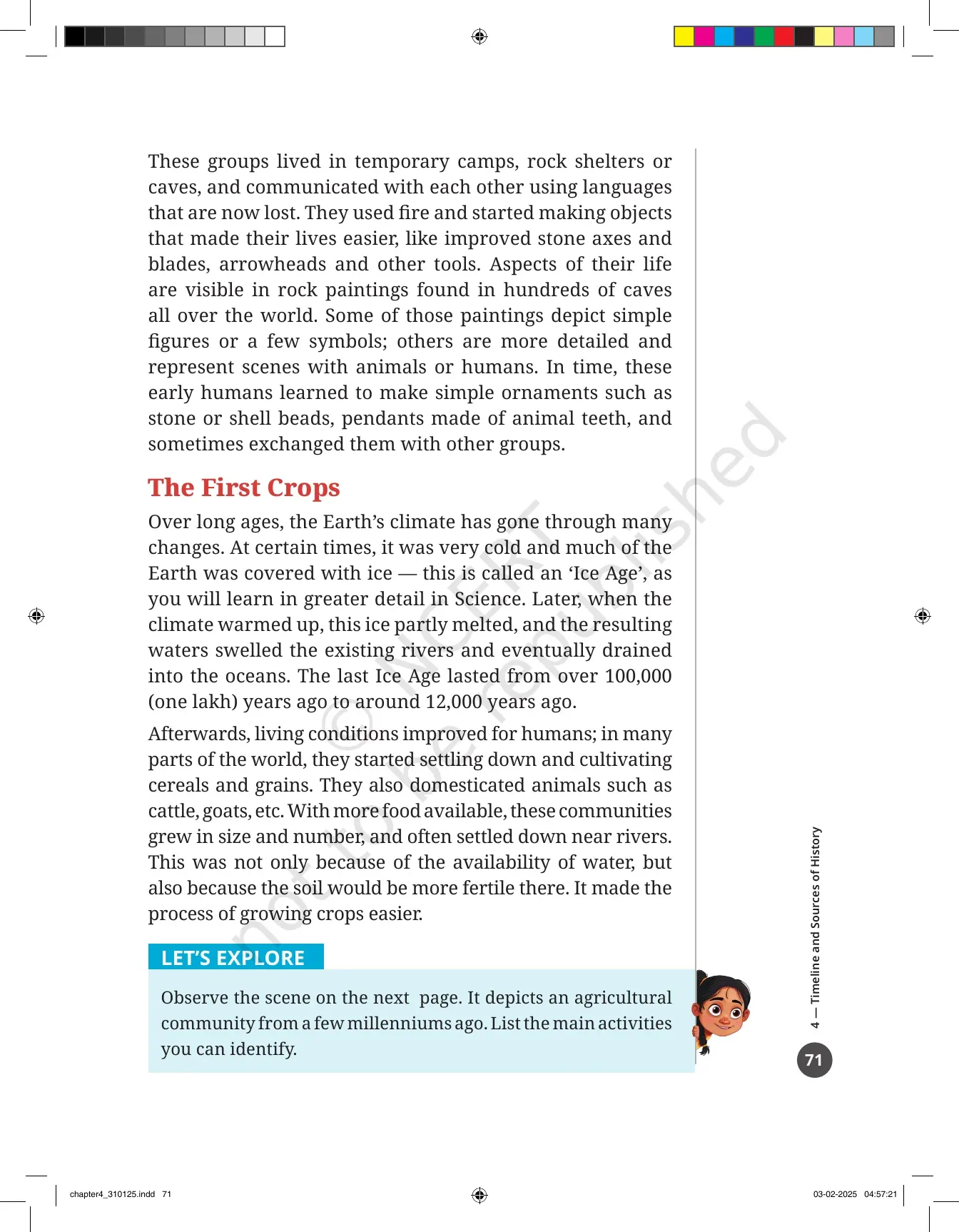
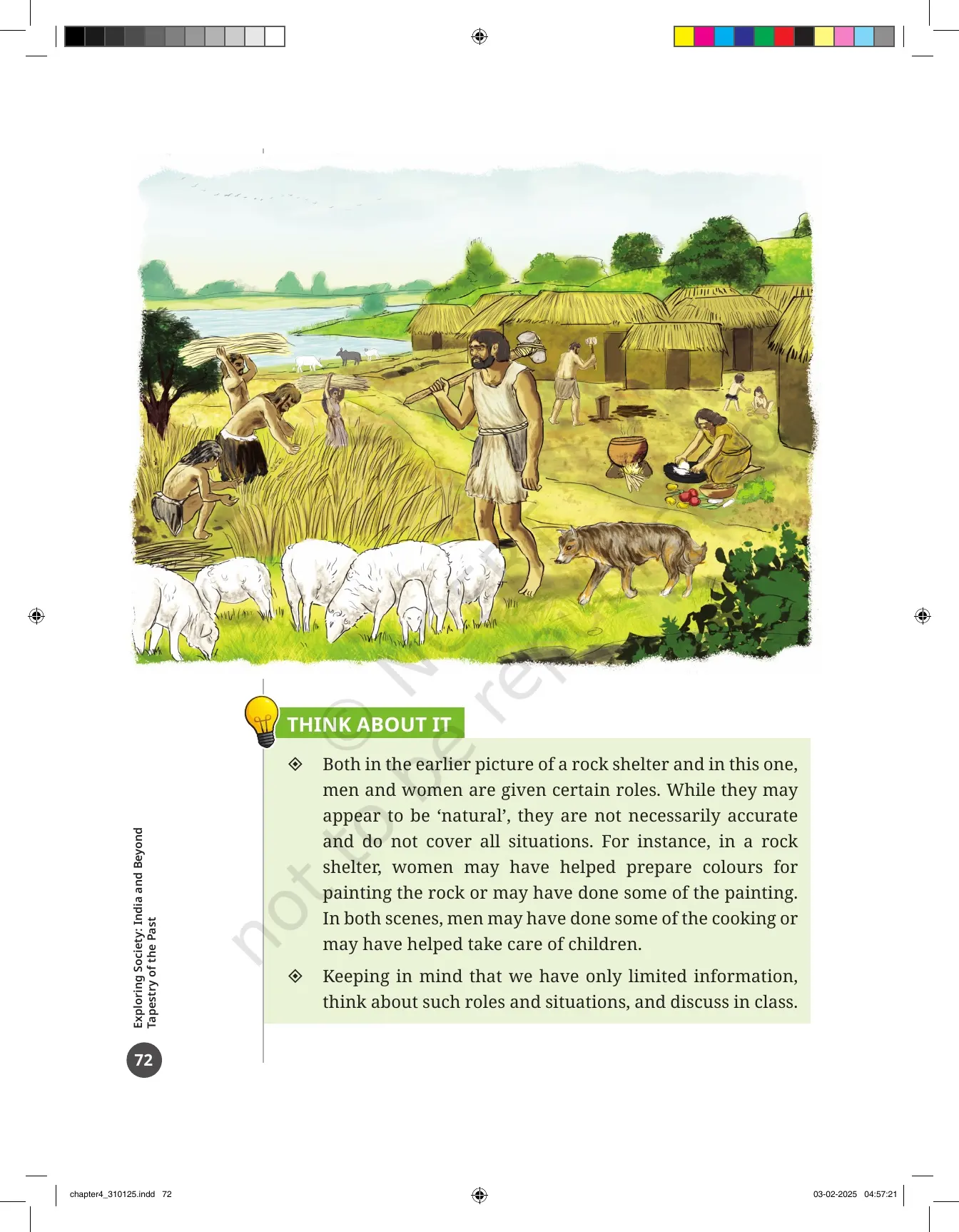
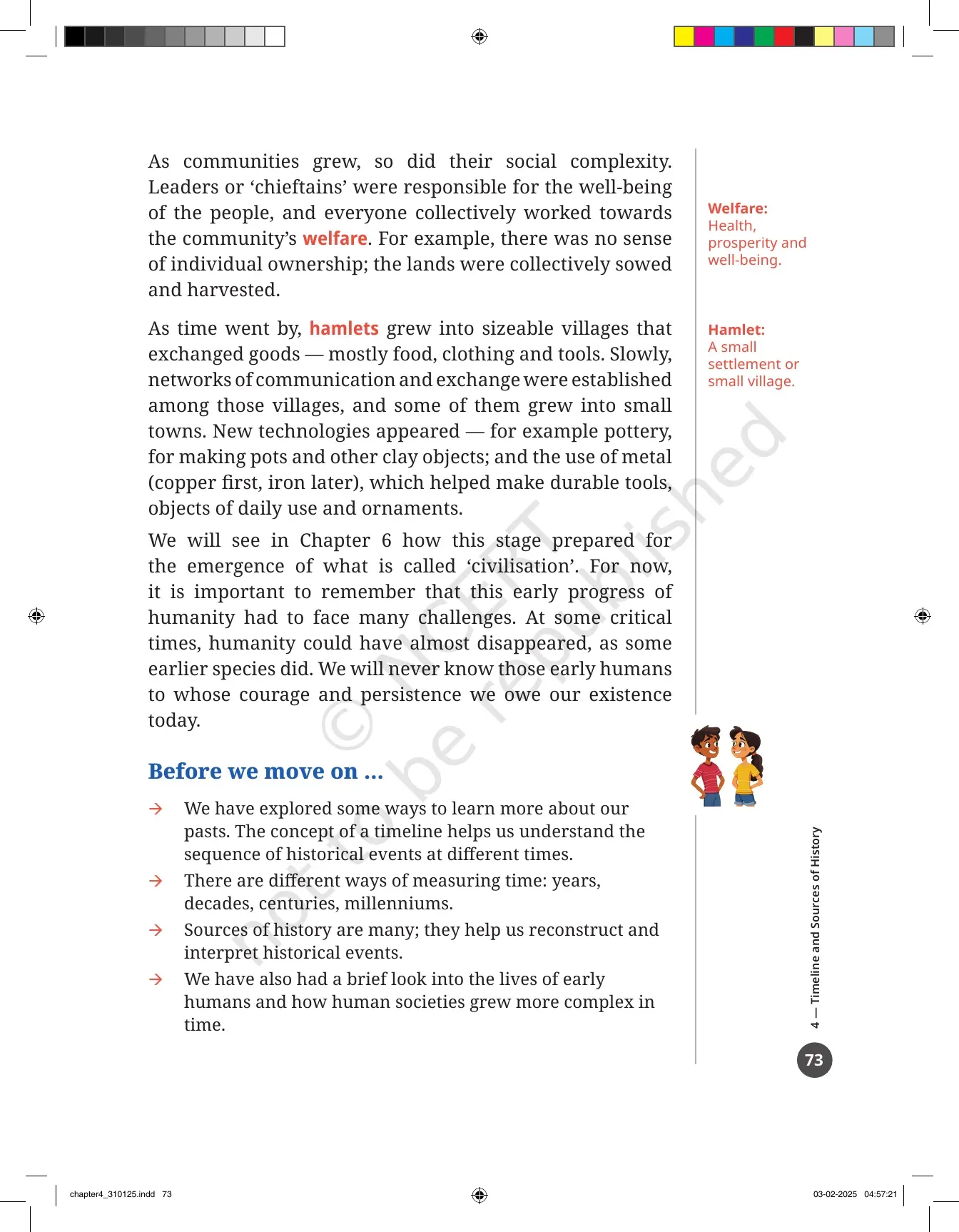
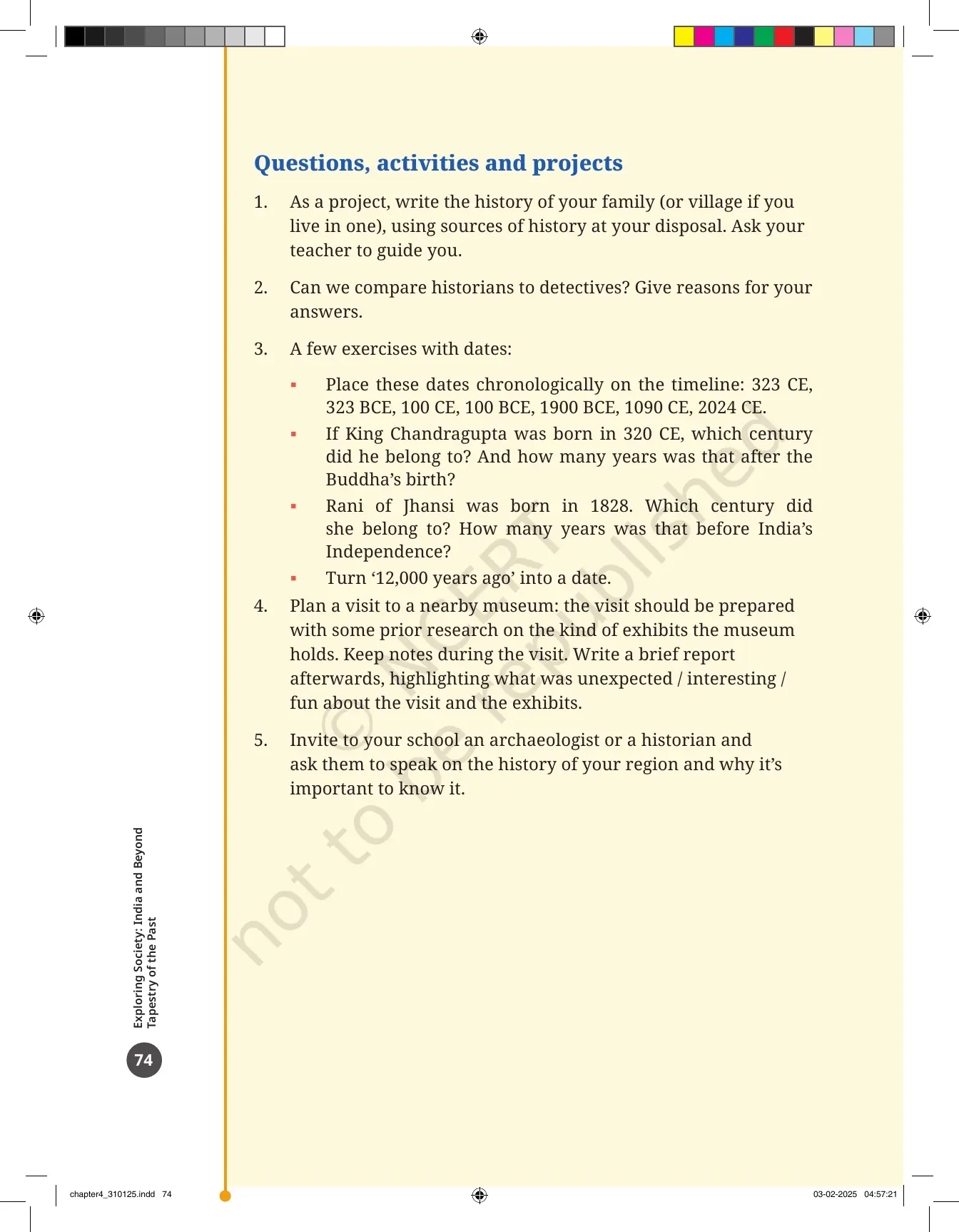
This is the unedited NCERT chapter file for the 2026-27 print run, checked page by page against the official Exploring Society: India and Beyond release before it was put on this page.
Student Feedback
What 14,180 students told us about the Timeline and Sources of History chapter, in a Collegedunia poll taken during the 2026-27 session.
- 71% of students said the date sums in question 3 were the part they got wrong most often.
- Most-skipped part: the sources of history diagram on printed page 67, left out by about 6 in 10 students.
- Students reported that drawing their own timeline on one long strip of paper fixed the CE and BCE order faster than re-reading the pages.
Source: 2026-27 Class 6 Social Science student poll. Sample of 14,180 students from CBSE schools across 22 states.
What the Timeline and Sources of History Class 6 PDF Contains, Page by Page
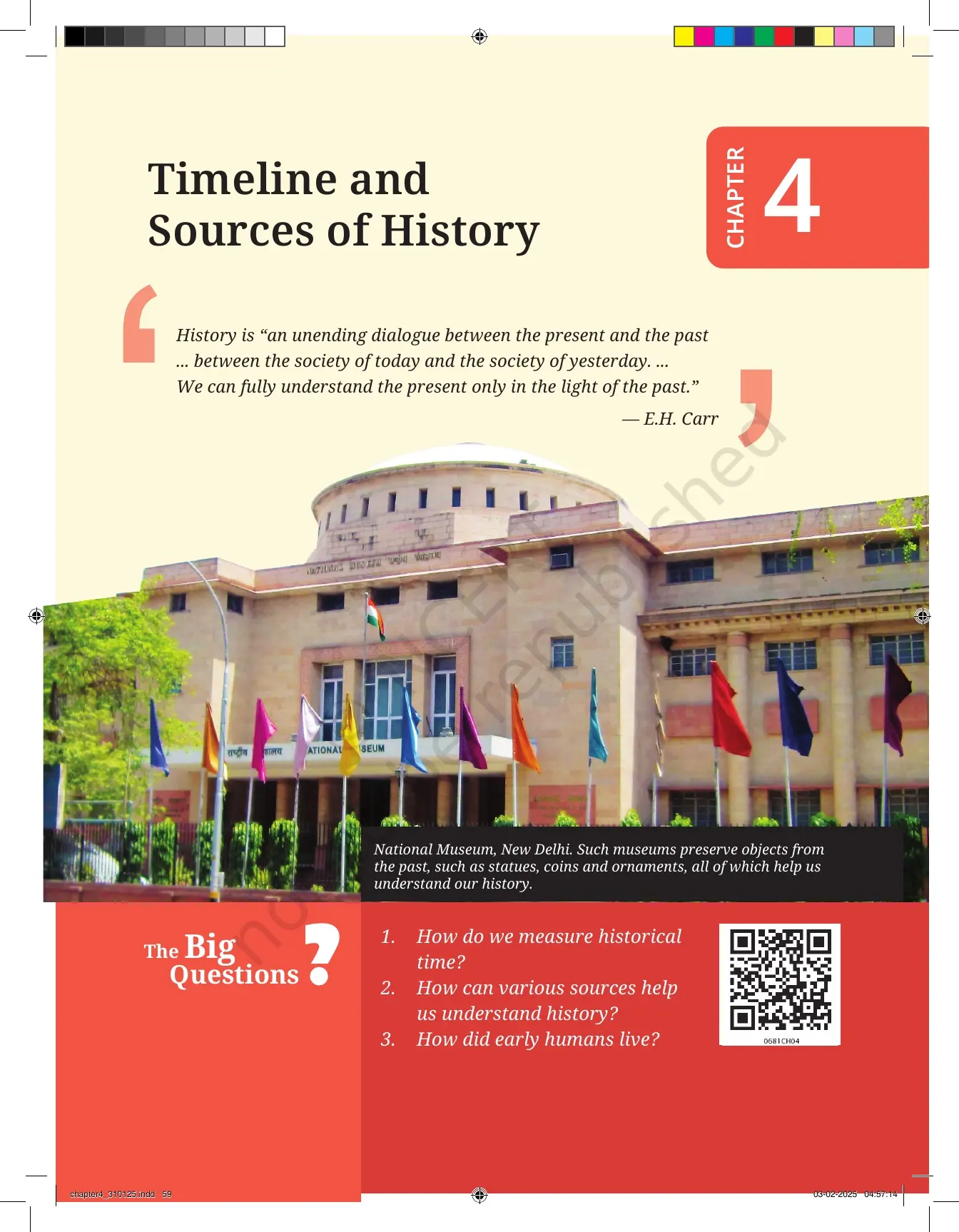
The file is the full chapter as NCERT prints it, not a summary sheet. It opens with a line from the historian E.H. Carr, who called history "an unending dialogue between the present and the past", and closes with the museum and archaeologist projects on printed page 74. Use the table below to jump straight to the part you need.
| Section in the PDF | Printed pages | What is on these pages |
|---|---|---|
| Chapter opener | 59 | The E.H. Carr quotation, the photograph of the National Museum in New Delhi and the three Big Questions of the chapter |
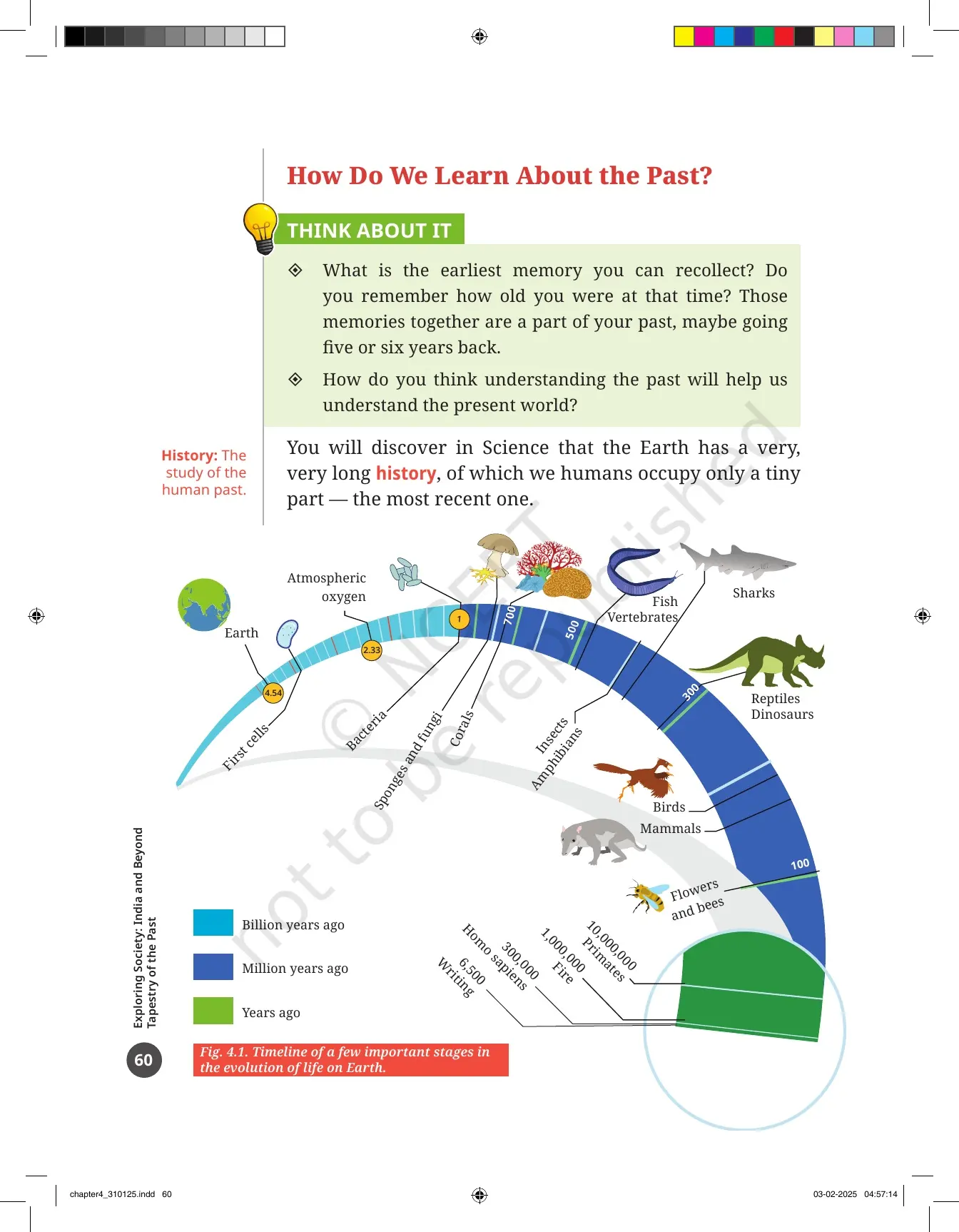
| How Do We Learn About the Past? | 60 | The THINK ABOUT IT box on your earliest memory, the margin word History, and Fig. 4.1, the timeline of life on Earth |
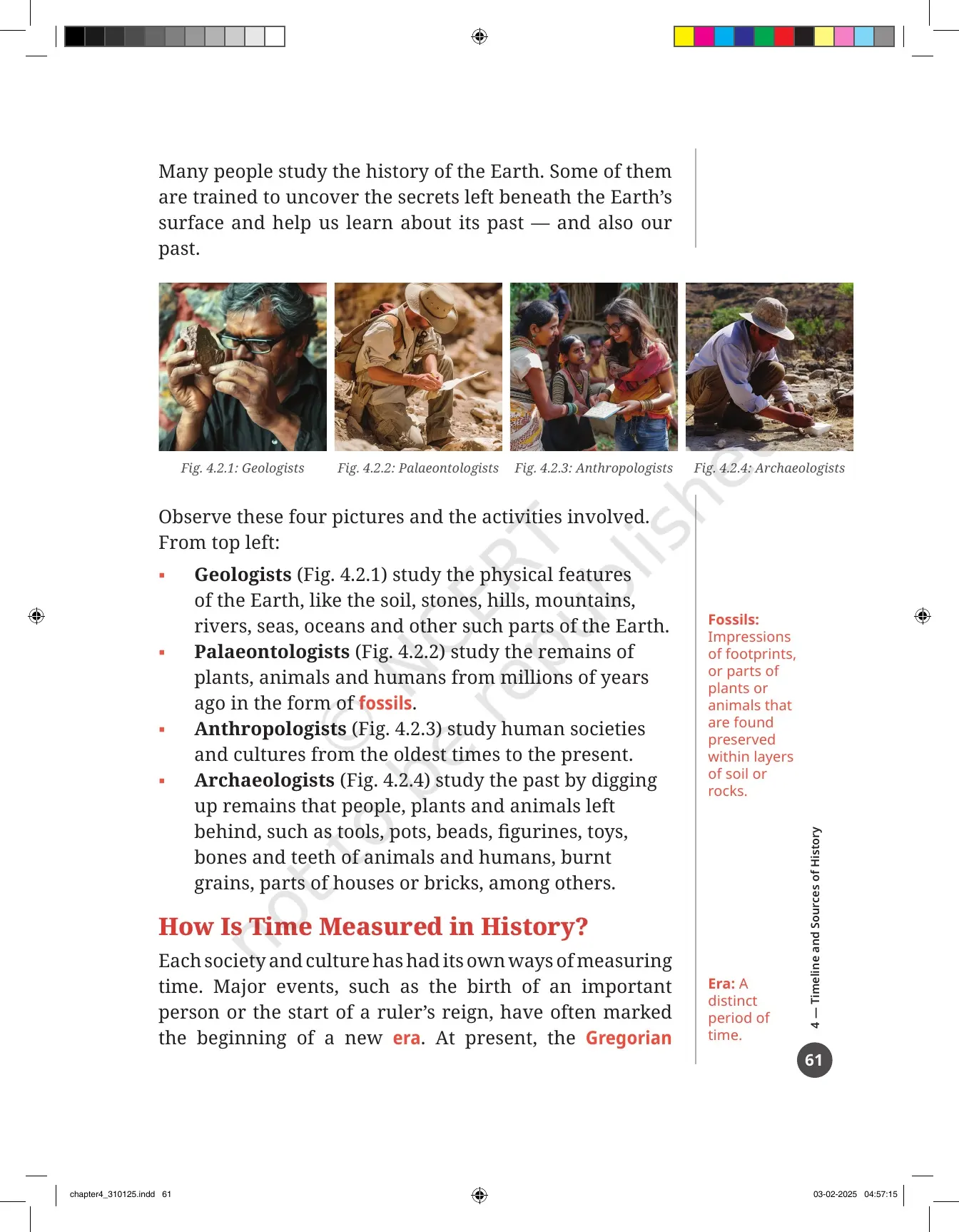
| Four kinds of experts | 61 | Fig. 4.2.1 to Fig. 4.2.4 on geologists, palaeontologists, anthropologists and archaeologists, plus the margin word Fossils |
| How Is Time Measured in History? | 61 to 62 | Eras, the Gregorian calendar, other Indian and world calendars, and the shift from AD and BC to CE and BCE |
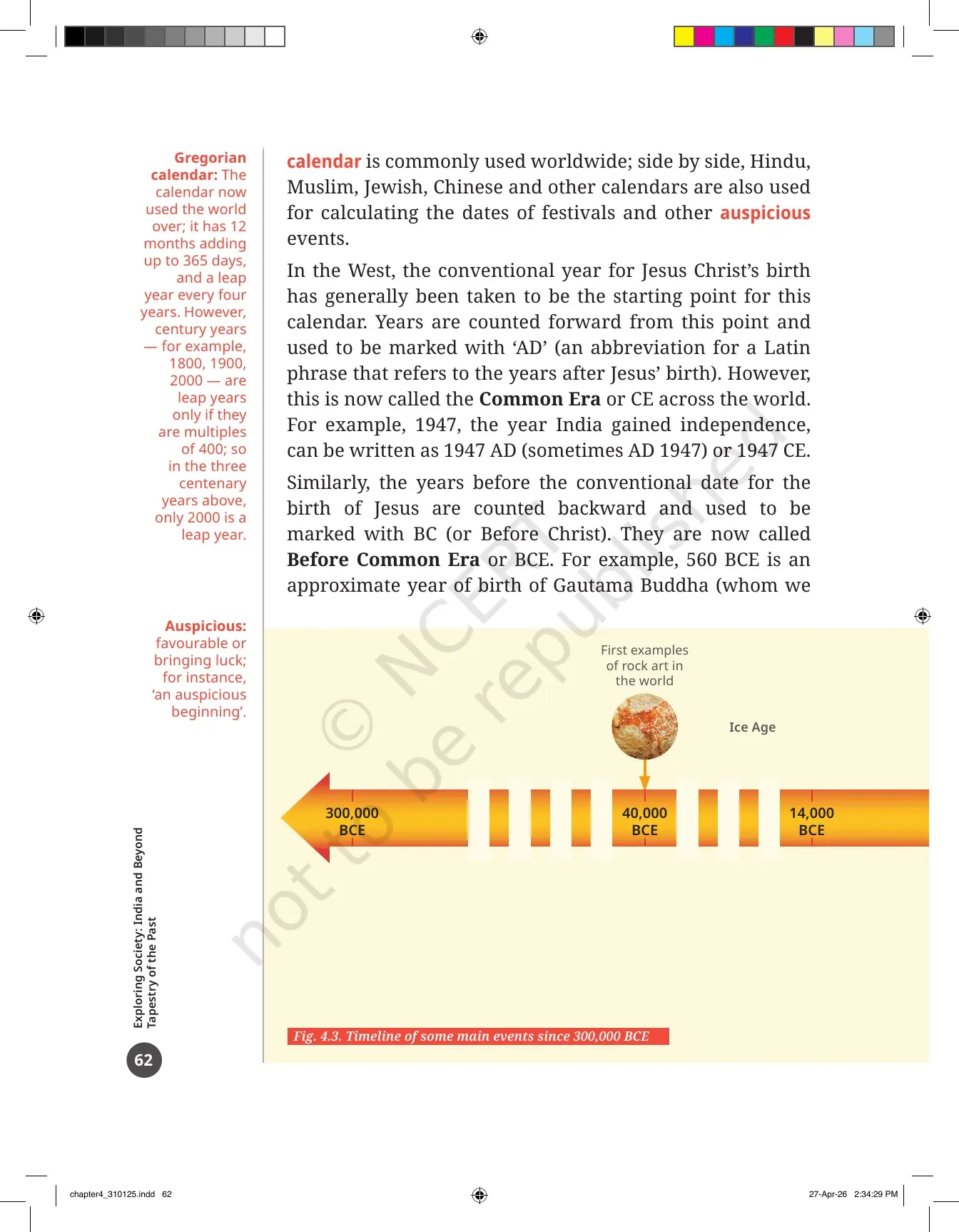
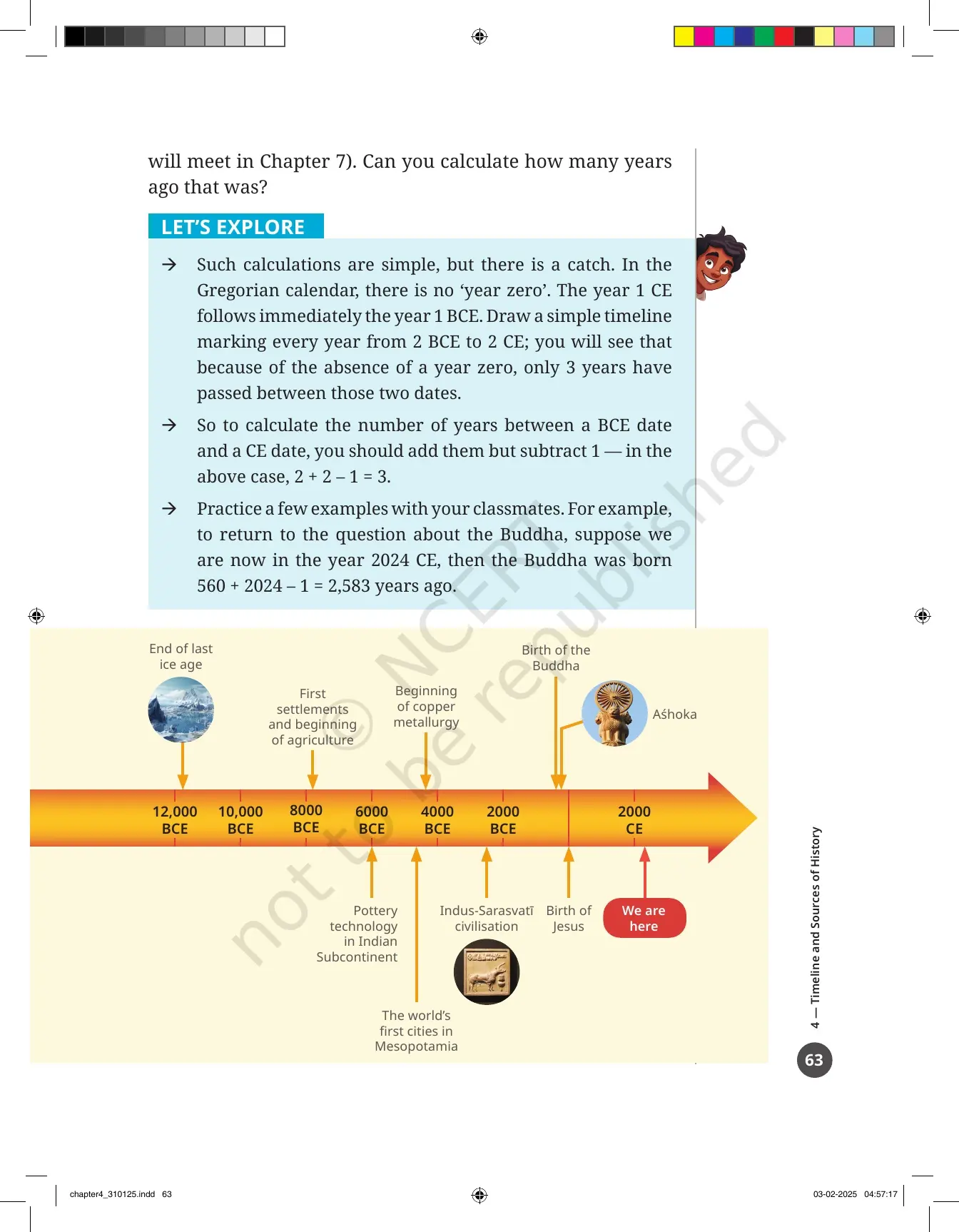
| Fig. 4.3, the long timeline | 62 to 63 | A double-page timeline of main events from 300,000 BCE to the present, with a dotted skipped portion |
| Counting years across BCE and CE | 63 to 64 | The LET'S EXPLORE box on the missing year zero, the add-then-subtract-one rule, and why a timeline shows order at a glance |
| Centuries, millenniums and calendars | 64 to 65 | Two DON'T MISS OUT boxes, one on centuries and millenniums, one on the pañchānga used in India |
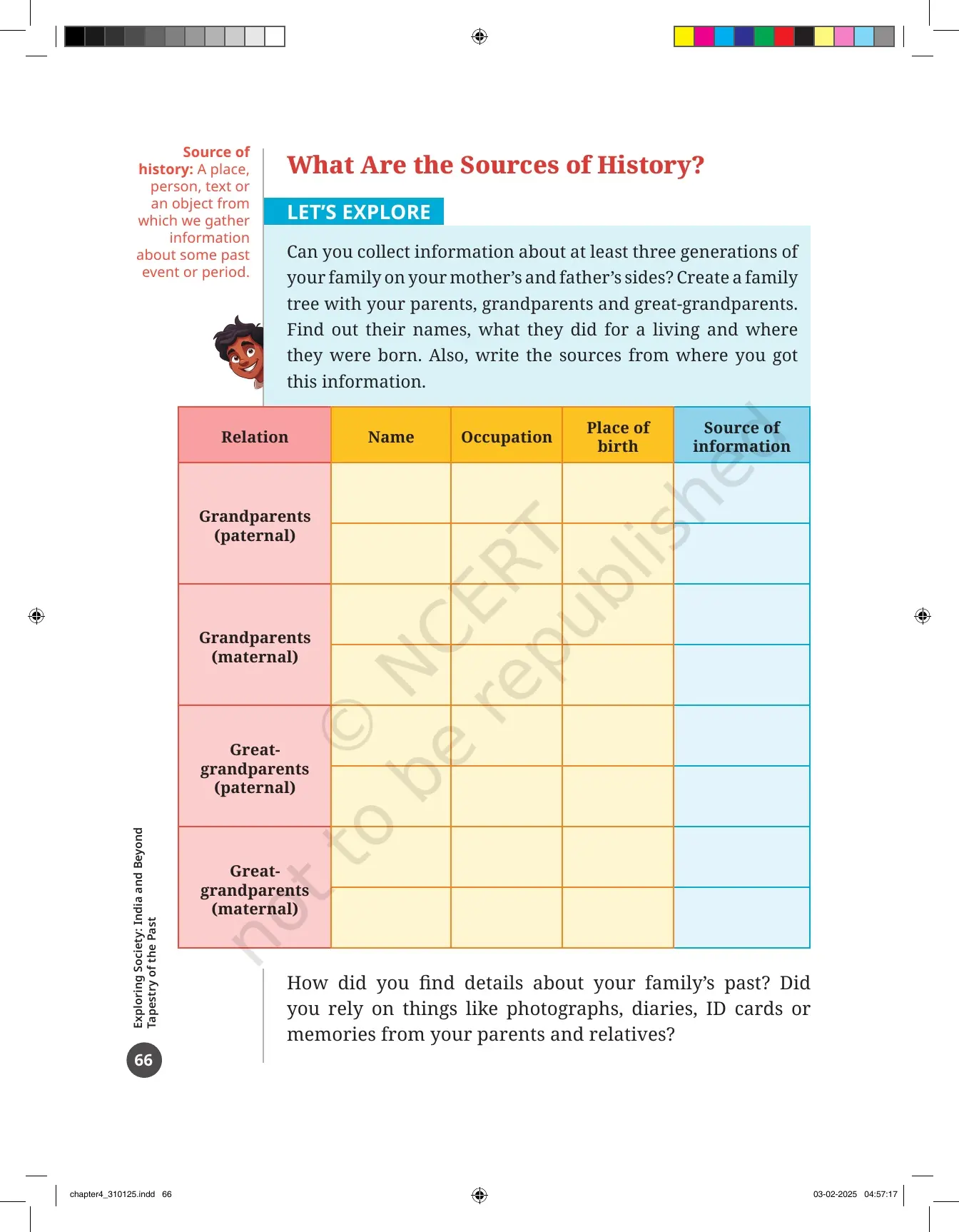
| What Are the Sources of History? | 66 to 67 | The family tree activity with its blank table, the THINK ABOUT IT box on old objects, and the sources of history diagram |
| Who builds the sources | 68 to 69 | Historians, epigraphists, scientific studies, newspapers and electronic media, plus a full page of source photographs |
| The Beginnings of Human History | 70 to 71 | The rock shelter scene, hunting and gathering, fire, stone tools, rock paintings and the first ornaments |
| The First Crops | 71 to 72 | The last Ice Age, farming, domesticated animals, settlement near rivers and the agricultural scene with its THINK ABOUT IT box |
| Growing communities | 73 | Chieftains, collective welfare, hamlets growing into villages and towns, pottery and metal, and the Before we move on recap |
| Questions, activities and projects | 74 | 5 numbered items, including a four-part set of date exercises and two project tasks |
Also Check:
- Timeline and Sources of History Class 6 NCERT Solutions
- Timeline and Sources of History Class 6 Revision Notes
How Historians Date Events in This Class 6 Chapter
Source: Magnet Brains on YouTube
How Do We Learn About the Past: The Four Experts Shown in Fig. 4.2
The chapter defines history in the margin as the study of the human past. It then makes one point that students often miss. The Earth has a very long history, and humans occupy only a tiny and very recent part of it. Fig. 4.1 on printed page 60 shows that scale on three bands, billion years ago, million years ago and years ago.
The figure starts with the Earth itself at 4.54 billion years and then marks atmospheric oxygen, bacteria and fungi, corals, sponges, fish, sharks, vertebrates, insects, amphibians, reptiles, dinosaurs, birds, mammals, flowering plants and bees, and finally Homo sapiens. Placed on that band, the whole of human history is a thin line at the very end.
Printed page 61 then introduces the people who dig out that past. Four photographs, numbered Fig. 4.2.1 to Fig. 4.2.4, carry one expert each, and the chapter asks you to observe the pictures and the activity in them.
| Expert | Figure | What they study, in the book's words |
|---|---|---|
| Geologists | Fig. 4.2.1 | The physical features of the Earth, such as soil, stones, hills, mountains, rivers, seas and oceans |
| Palaeontologists | Fig. 4.2.2 | The remains of plants, animals and humans from millions of years ago, in the form of fossils |
| Anthropologists | Fig. 4.2.3 | Human societies and cultures from the oldest times right up to the present |
| Archaeologists | Fig. 4.2.4 | The past, by digging up tools, pots, beads, figurines, toys, bones and teeth, burnt grains, bricks and parts of houses |
The margin word on this page is fossils, which the book defines as impressions of footprints, or parts of plants or animals, found preserved within layers of soil or rocks. Learn the four experts with their figure numbers, because a one-mark question usually gives you the work and asks for the name.
How Time Is Measured in History: Eras, the Gregorian Calendar, CE and BCE
Every society has had its own way of measuring time. The chapter says a major event, such as the birth of an important person or the start of a ruler's reign, has often marked the beginning of a new era, which the margin defines as a distinct period of time.
- The Gregorian calendar is the one used across the world today, with 12 months adding up to 365 days.
- A leap year comes every four years, but century years are leap years only if they are multiples of 400.
- So of the three century years the book names, 1800, 1900 and 2000, only 2000 is a leap year.
- Hindu, Muslim, Jewish, Chinese and other calendars are used side by side for festival dates and auspicious events.
- The margin word auspicious means favourable or bringing luck, as in an auspicious beginning.
The naming change is the part school tests love. In the West the conventional year of the birth of Jesus Christ was taken as the starting point, and years counted forward from it were marked AD. That count is now called the Common Era, or CE, so the year India gained independence can be written as 1947 AD or 1947 CE.
Years counted backward from the same point used to be marked BC, short for Before Christ. They are now called Before Common Era, or BCE. The chapter's own example is the Buddha, whose approximate year of birth is given as 560 BCE, with a promise that you will meet him again in Chapter 7.
The Missing Year Zero and the Add-Then-Subtract-One Rule
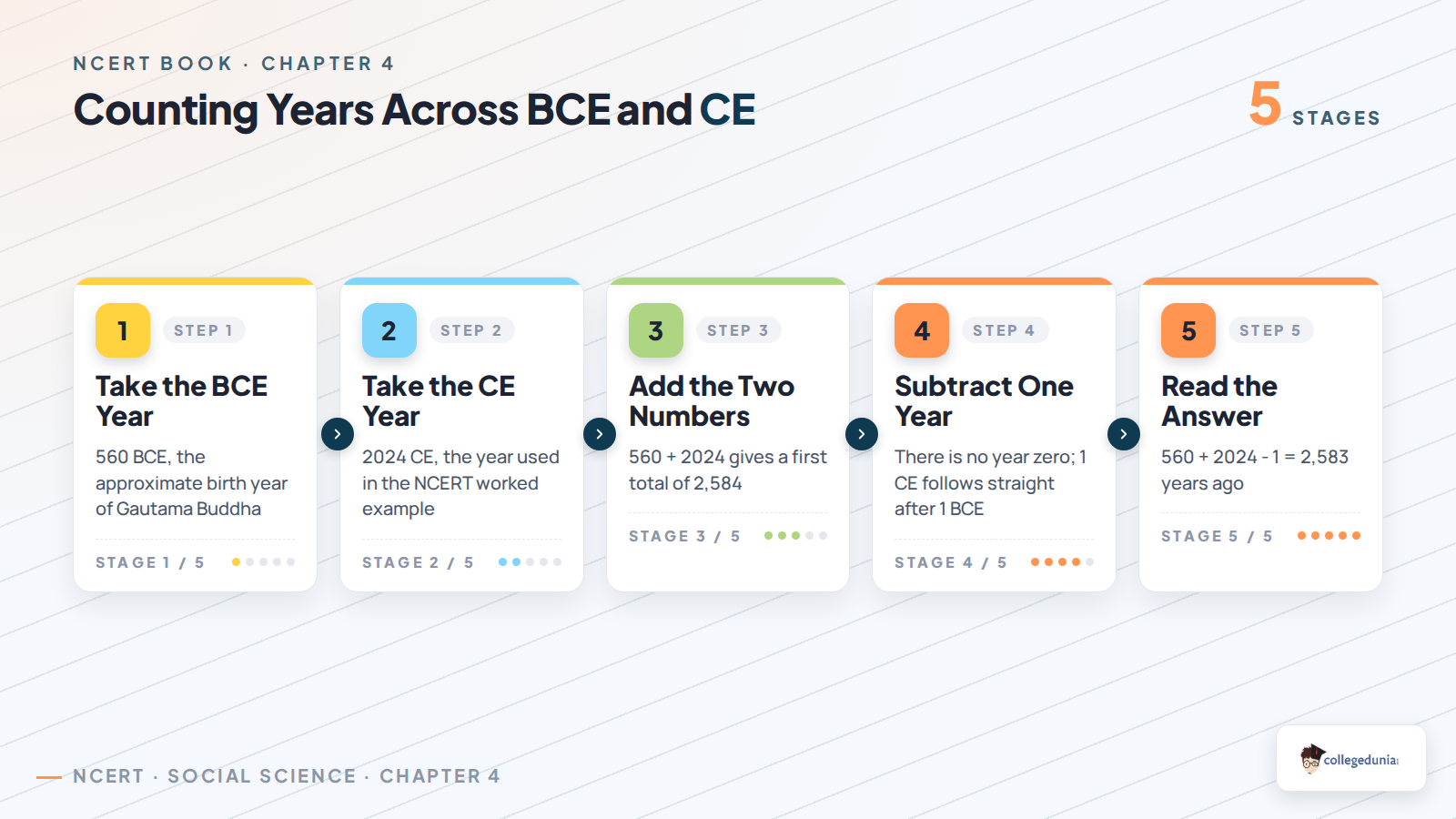
Counting across the CE and BCE line looks easy and is not. The LET'S EXPLORE box on printed page 63 gives the reason and the fix in three steps, and this is the single most tested idea in the chapter.
- There is no year zero in the Gregorian calendar. The year 1 CE follows immediately after the year 1 BCE.
- Draw a timeline from 2 BCE to 2 CE and count. Only 3 years have passed, not 4, because that zero is missing.
- So the rule is add the two dates, then subtract 1. In that small example, 2 plus 2 minus 1 gives 3.
- The book works the Buddha example the same way: 560 plus 2024 minus 1 gives 2,583 years ago.
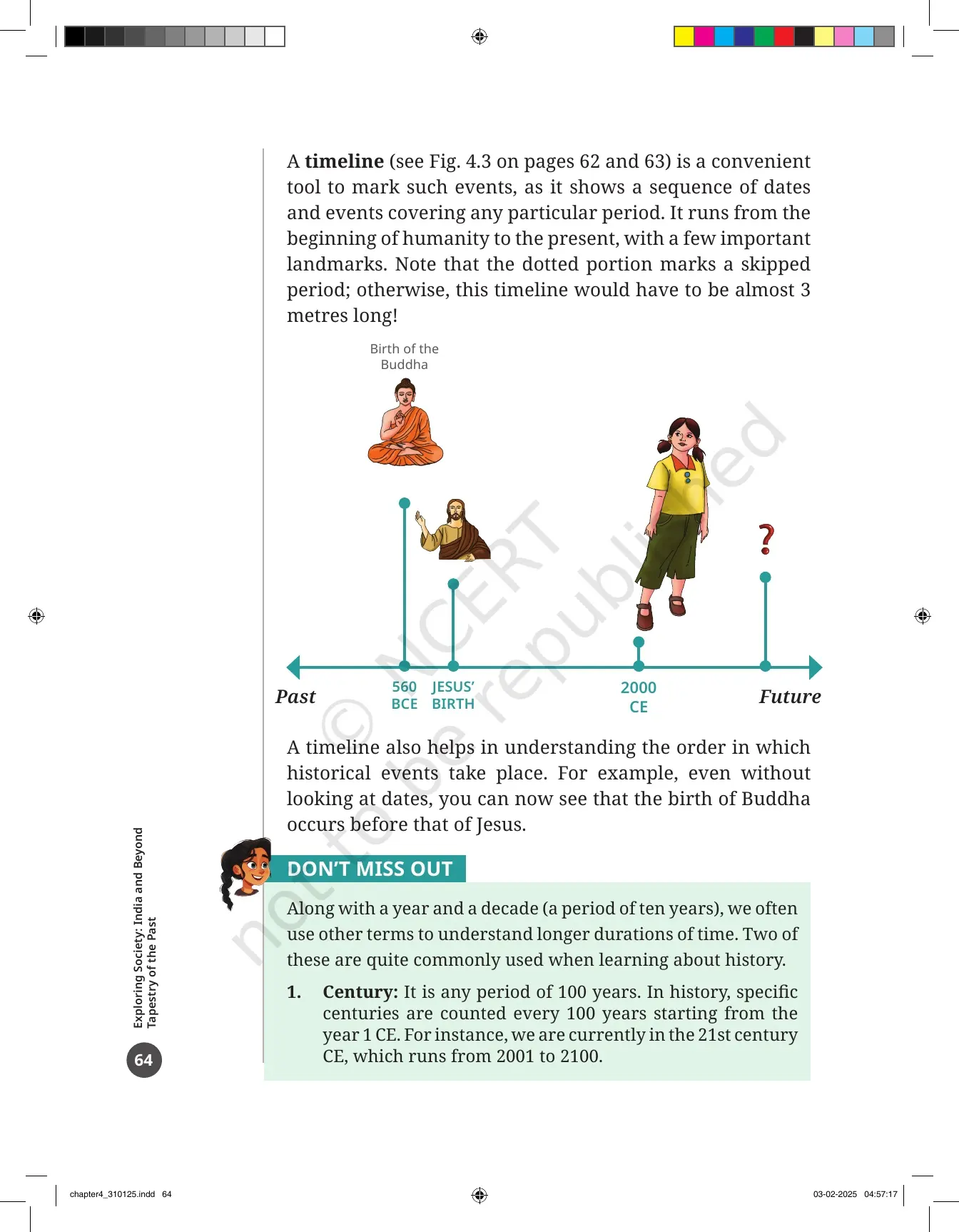
Printed page 64 explains why a timeline is worth drawing at all. It shows a sequence of dates and events over any period, and it runs from the beginning of humanity to the present with a few landmarks marked. A timeline also shows order without any arithmetic, which is how you can see at a glance that the Buddha was born before Jesus.
Centuries, Millenniums and the Pañchānga in the Class 6 Chapter
Along with the year and the decade, a period of ten years, the chapter adds two longer units in a DON'T MISS OUT box. Both are counted from the year 1 CE forward and from the year 1 BCE backward, and both are easy marks once the counting direction is clear.
| Unit | Length | The book's own examples |
|---|---|---|
| Decade | 10 years | Named alongside the year as a common way of grouping time |
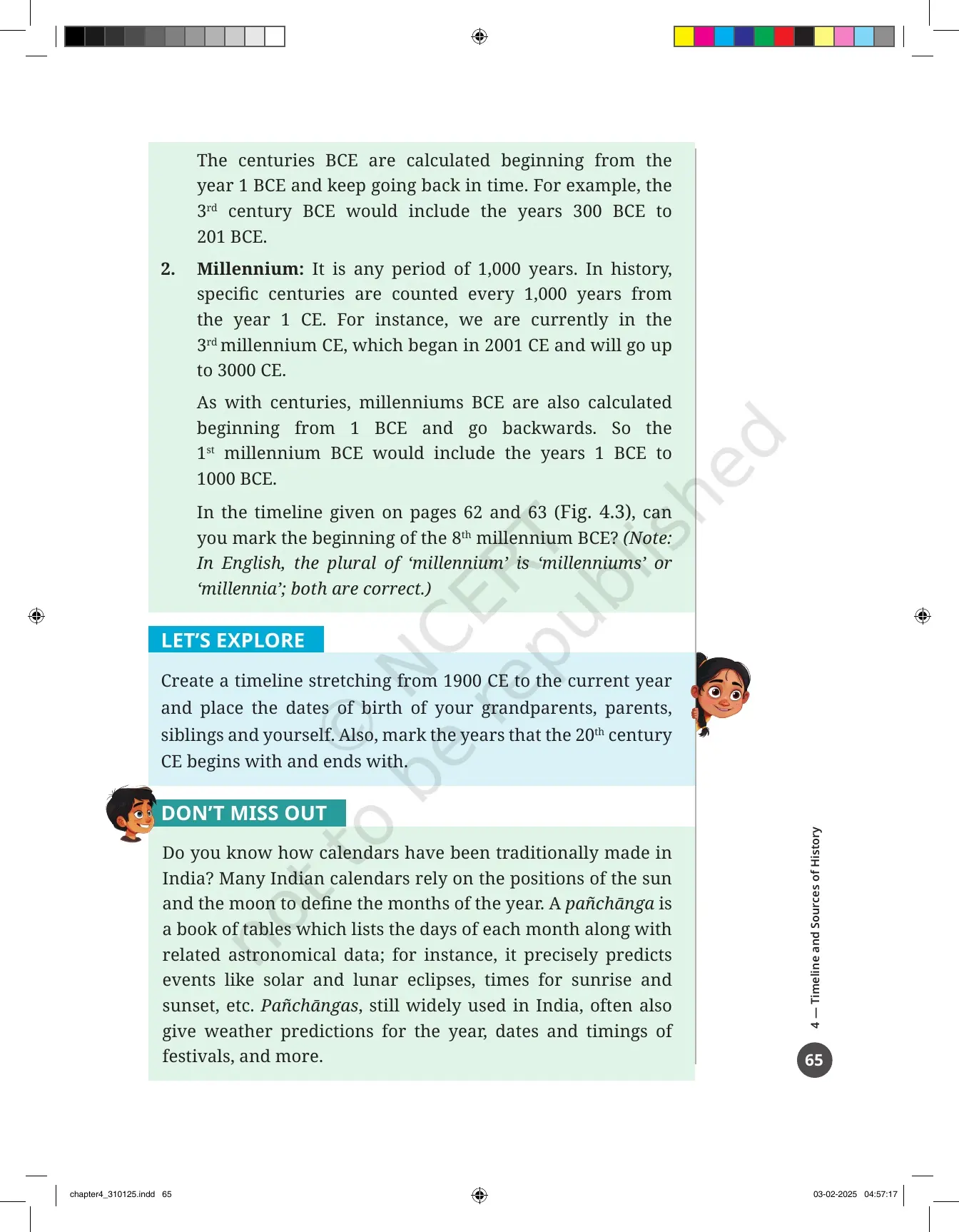
| Century | 100 years | We are in the 21st century CE, which runs from 2001 to 2100. The 3rd century BCE covers 300 BCE to 201 BCE |
| Millennium | 1,000 years | We are in the 3rd millennium CE, which began in 2001 CE and goes up to 3000 CE. The 1st millennium BCE covers 1 BCE to 1000 BCE |
The box adds a small language note that is worth keeping. The plural of millennium can be written as millenniums or millennia, and both are correct. It then sends you back to Fig. 4.3 with a task: mark where the 8th millennium BCE begins on that timeline.
The second DON'T MISS OUT box turns to India. Many Indian calendars use the positions of the sun and the moon to fix the months of the year. A pañchānga is a book of tables listing the days of each month with related astronomical data, and it predicts solar and lunar eclipses, sunrise and sunset times. Pañchāngas are still widely used and often carry weather predictions and festival dates too.
Reading Fig. 4.3, the Timeline of Main Events Since 300,000 BCE
Fig. 4.3 spreads across printed pages 62 and 63 and is the picture to copy into your notebook. The scale is not even, and the book says so plainly. A dotted portion marks a skipped period, and without that skip the timeline would have to be almost 3 metres long.
| Marker on the timeline | Event shown |
|---|---|
| 300,000 BCE | The starting point of the timeline, close to the age of modern humans |
| 40,000 BCE | First examples of rock art in the world |
| 14,000 BCE | The Ice Age |
| 12,000 BCE | End of the last ice age |
| 10,000 BCE | First settlements and the beginning of agriculture |
| 6000 BCE onwards | Pottery technology in the Indian Subcontinent and the beginning of copper metallurgy |
| 4000 BCE onwards | The world's first cities in Mesopotamia |
| 2000 BCE onwards | The Indus-Sarasvatī civilisation |
| Around 560 BCE | Birth of the Buddha, followed on the same band by Aśhoka and the birth of Jesus |
| 2000 CE | Marked on the timeline as "We are here" |
The Four Families of Sources of History Shown on Printed Page 67
The chapter defines a source of history as a place, person, text or object from which we gather information about some past event or period. Its own picture for this is a jigsaw puzzle, with one honest warning attached. In history, quite a few pieces of the puzzle may remain missing.
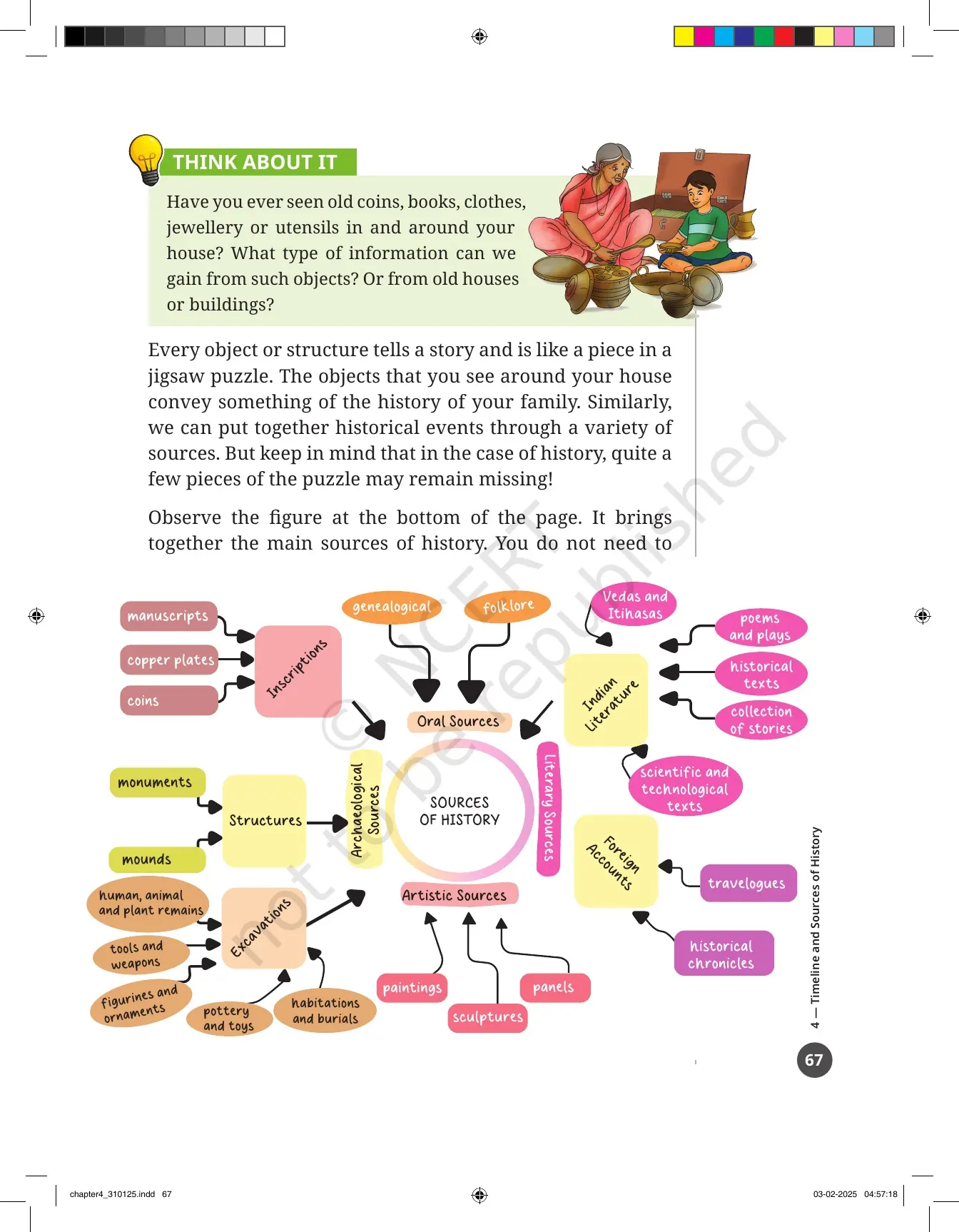
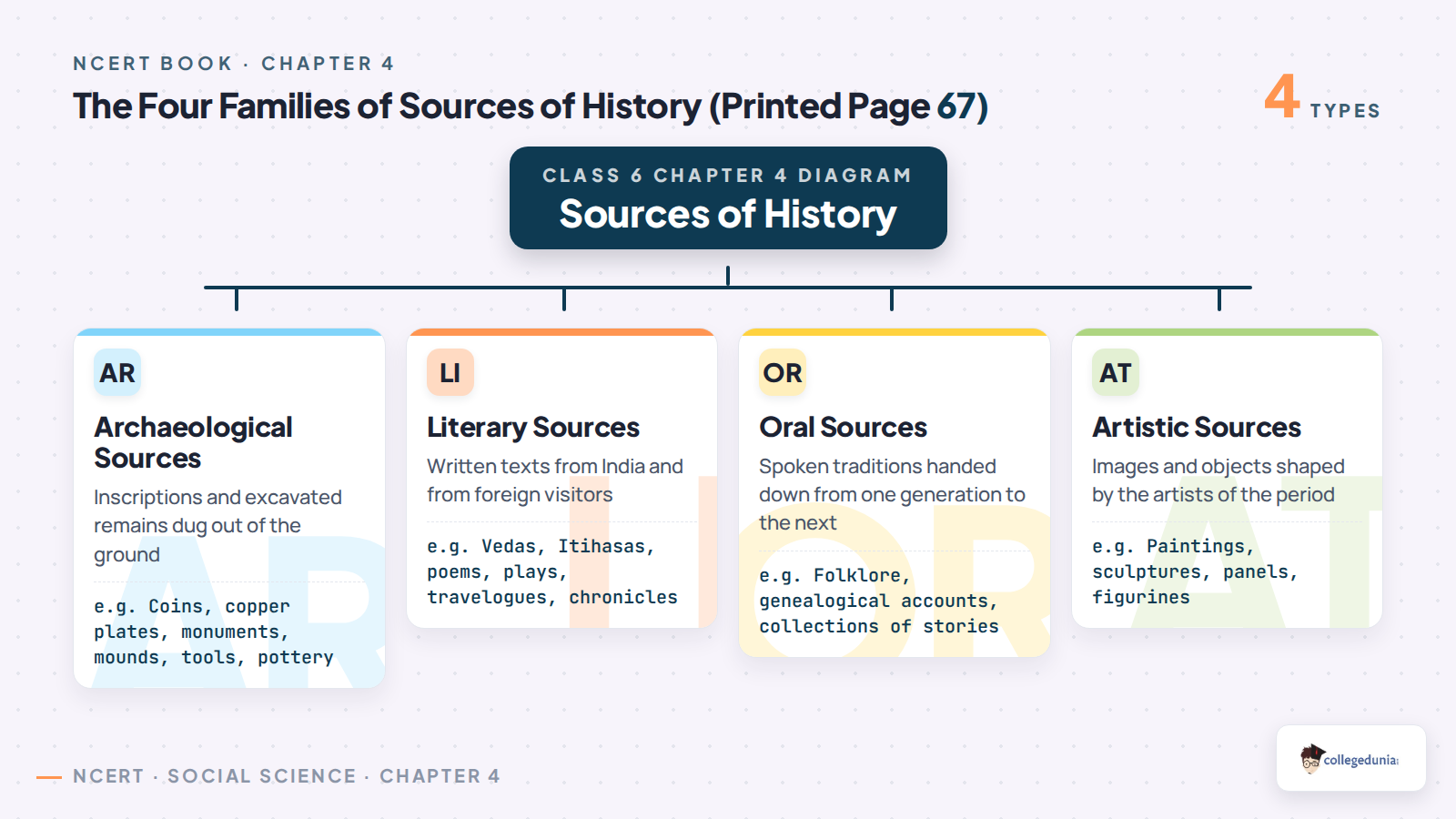
The large unnumbered diagram on printed page 67 groups every source into four families. The book says you do not need to remember them all now, but the four family names are worth learning at once.
| Family of sources | What the diagram lists under it |
|---|---|
| Archaeological Sources | Inscriptions, copper plates, coins, manuscripts, monuments, structures, mounds, excavations, habitations and burials, tools and weapons, pottery and toys, figurines and ornaments, and human, animal and plant remains |
| Literary Sources | The Vedas and Itihasas, other literature in India, poems and plays, historical texts, collections of stories, scientific and technological texts, foreign accounts, travelogues and historical chronicles |
| Oral Sources | Folklore and genealogical accounts passed down by word of mouth |
| Artistic Sources | Paintings, panels and sculptures |
Two activities sit around this diagram. The LET'S EXPLORE box on printed page 66 asks you to build a family tree across three generations on both your mother's and your father's side, filling a five-column table of relation, name, occupation, place of birth and source of information. The THINK ABOUT IT box on the next page asks what old coins, books, clothes, jewellery or utensils at home can tell you.
Who Builds the Sources: Historians, Epigraphists and the Newer Scientific Studies
A historian, the margin says, is a person who studies and writes about the past. The chapter then explains the method, and it is the answer to the popular question about historians and detectives.
- Historians gather information from as many sources as they can find before writing about a king, a monument, a war or an item of trade.
- Sometimes the sources confirm each other, which is when the jigsaw pieces match.
- Sometimes sources give contradictory information, and the historian must decide which one to trust more.
- Working this way is how they re-create the history of the period they are studying.
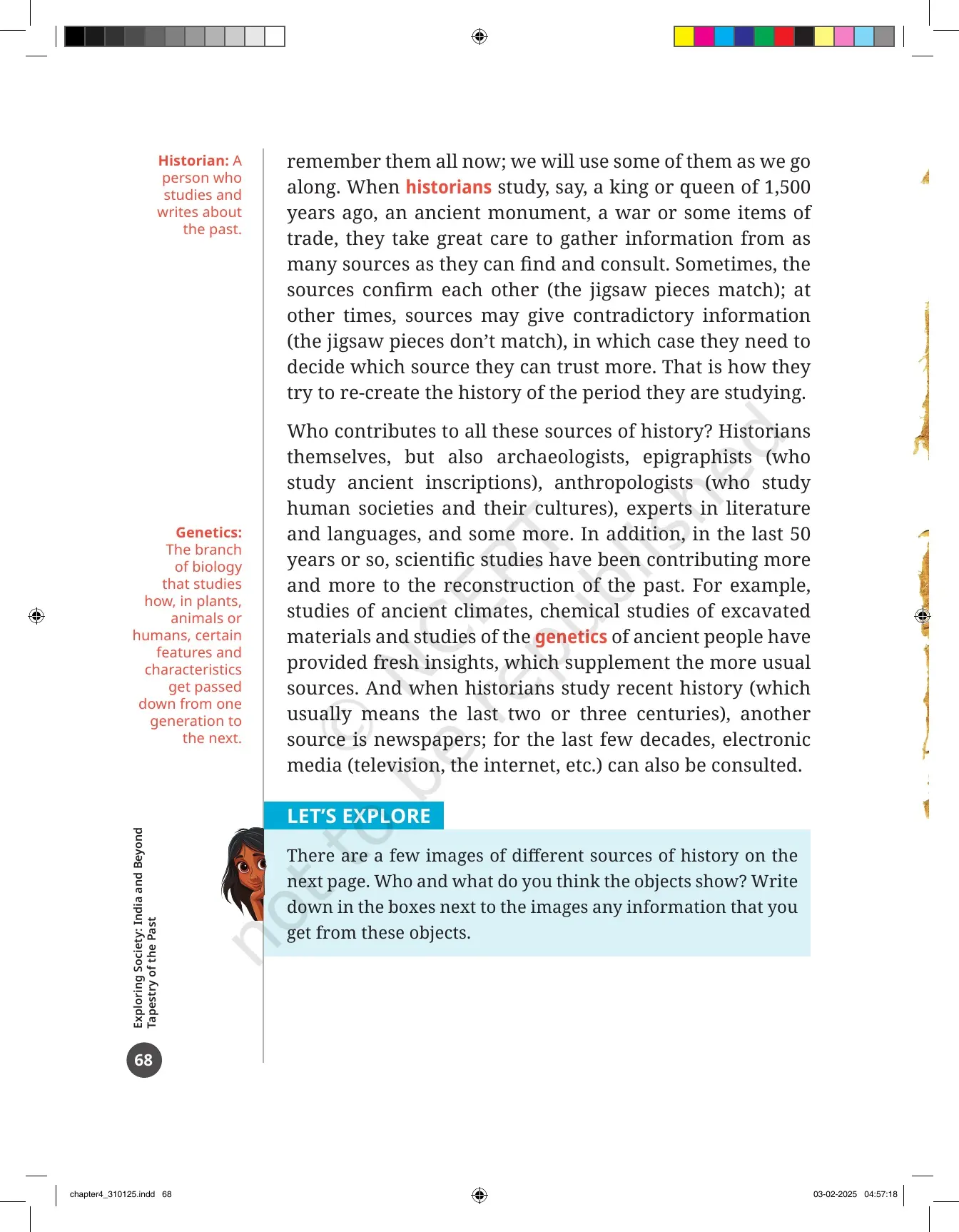
Many other people feed those sources. The chapter names archaeologists, epigraphists, who study ancient inscriptions, anthropologists, and experts in literature and languages. Over roughly the last 50 years, scientific work has been added to the list, including studies of ancient climates, chemical studies of excavated materials and studies of the genetics of ancient people.
For recent history, which usually means the last two or three centuries, the chapter adds one more source. Newspapers are a source for recent history, and for the last few decades electronic media such as television and the internet can also be consulted.
The Beginnings of Human History: Rock Shelters, Fire and the First Crops
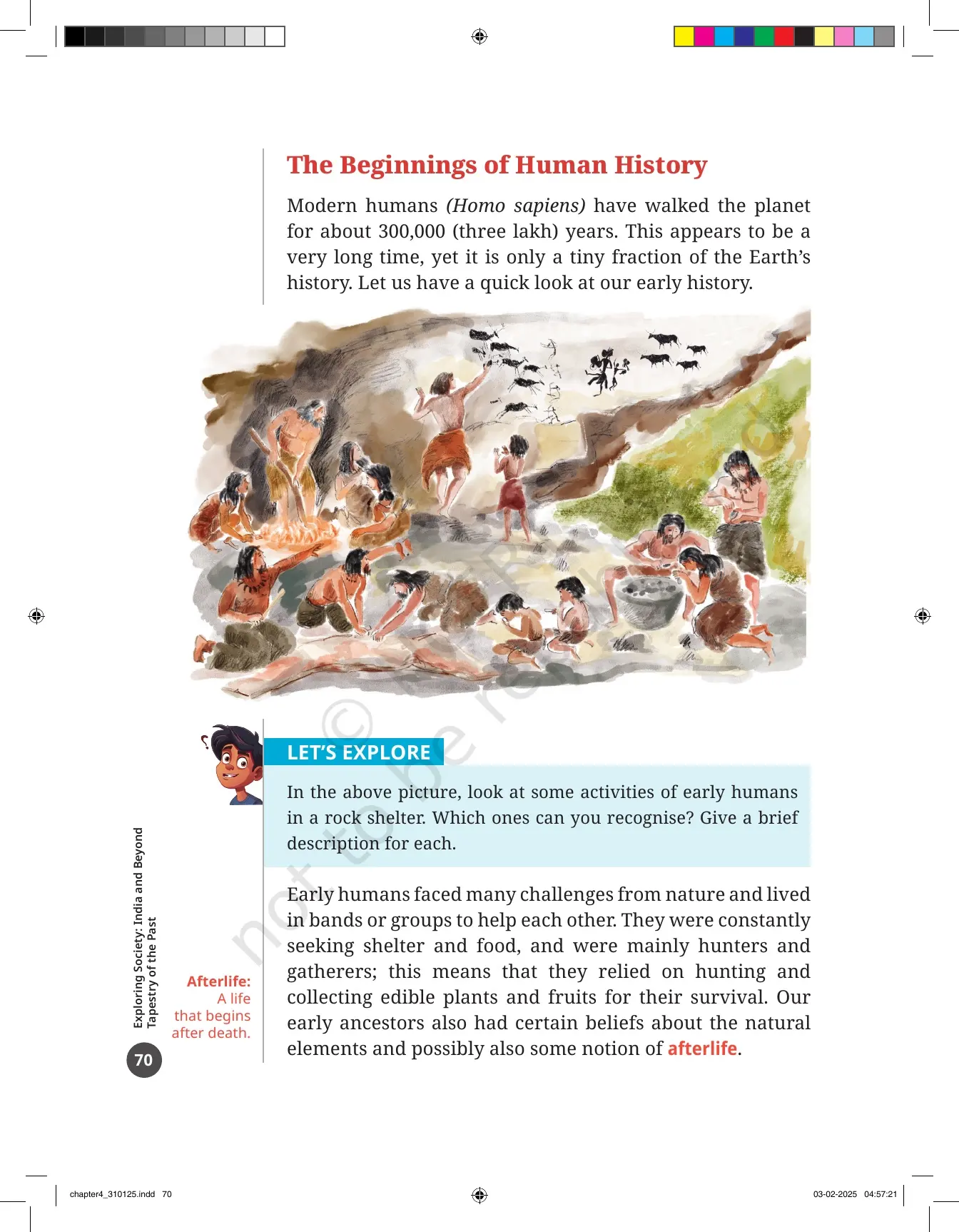
Modern humans, Homo sapiens, have walked the planet for about 300,000 years, which the book also writes as three lakh years. Set against Fig. 4.1, that is still only a tiny fraction of the Earth's history. The rock shelter scene on printed page 70 is the picture that goes with this section.
- Early humans lived in bands or groups so they could help each other against the challenges of nature.
- They were mainly hunters and gatherers, living on hunted animals and collected edible plants and fruits.
- They stayed in temporary camps, rock shelters or caves and spoke languages that are now lost.
- They used fire and made improved stone axes and blades, arrowheads and other tools.
- Rock paintings in hundreds of caves show their life, some as simple figures or symbols, others as detailed scenes with animals or humans.
- They made ornaments such as stone or shell beads and pendants of animal teeth, and sometimes exchanged them with other groups.
- They held beliefs about the natural elements and possibly some notion of an afterlife, defined in the margin as a life that begins after death.
Then the climate changed. The chapter explains an Ice Age as a time when much of the Earth was covered with ice, and gives the dates for the most recent one. The last Ice Age lasted from over 100,000 years ago, one lakh years, to around 12,000 years ago. When the ice partly melted, the water swelled the rivers and drained into the oceans.
Living conditions improved after that. People in many parts of the world started settling down, cultivating cereals and grains, and domesticating animals such as cattle and goats. With more food available, communities grew in size and number and often settled near rivers, both for the water and for the more fertile soil that made growing crops easier.
From Hamlets to Small Towns: Chieftains, Pottery and the First Metals
As communities grew, their social life grew more complex too. Printed page 73 traces that growth in a few short steps, and this is the bridge the chapter builds towards Chapter 6 and the idea of civilisation.
- Leaders called chieftains became responsible for the well-being of the people.
- Everyone worked collectively towards the community's welfare, defined in the margin as health, prosperity and well-being.
- There was no sense of individual ownership, and the lands were sowed and harvested collectively.
- Hamlets, meaning small settlements or small villages, grew into sizeable villages that exchanged food, clothing and tools.
- Networks of communication and exchange linked those villages, and some of them grew into small towns.
- New technologies appeared, first pottery for pots and other clay objects, then metal, copper first and iron later, for durable tools, daily objects and ornaments.
The section ends on a sober note that is easy to quote in an answer. This early progress faced many challenges, and at some critical times humanity could have almost disappeared, as some earlier species did. The book says we will never know those early humans to whose courage and persistence we owe our existence today.
Every Figure, Activity Box and Margin Word Inside the Timeline and Sources of History PDF
This chapter teaches through timelines, activity boxes and margin words as much as through paragraphs. Three numbered figures do the visual work, eleven boxes turn the reading into tasks, and eleven margin words supply the vocabulary. Tick them off as you go.
| Figure or box | Printed page | What it shows or asks |
|---|---|---|
| Fig. 4.1 | 60 | A timeline of important stages in the evolution of life on Earth, on three bands from billion years ago to years ago |
| Fig. 4.2.1 to Fig. 4.2.4 | 61 | Four photographs of geologists, palaeontologists, anthropologists and archaeologists at work |
| Fig. 4.3 | 62 to 63 | A double-page timeline of main events since 300,000 BCE, with a dotted skipped portion |
| Sources of history diagram | 67 | An unnumbered wheel grouping every source into archaeological, literary, oral and artistic families |
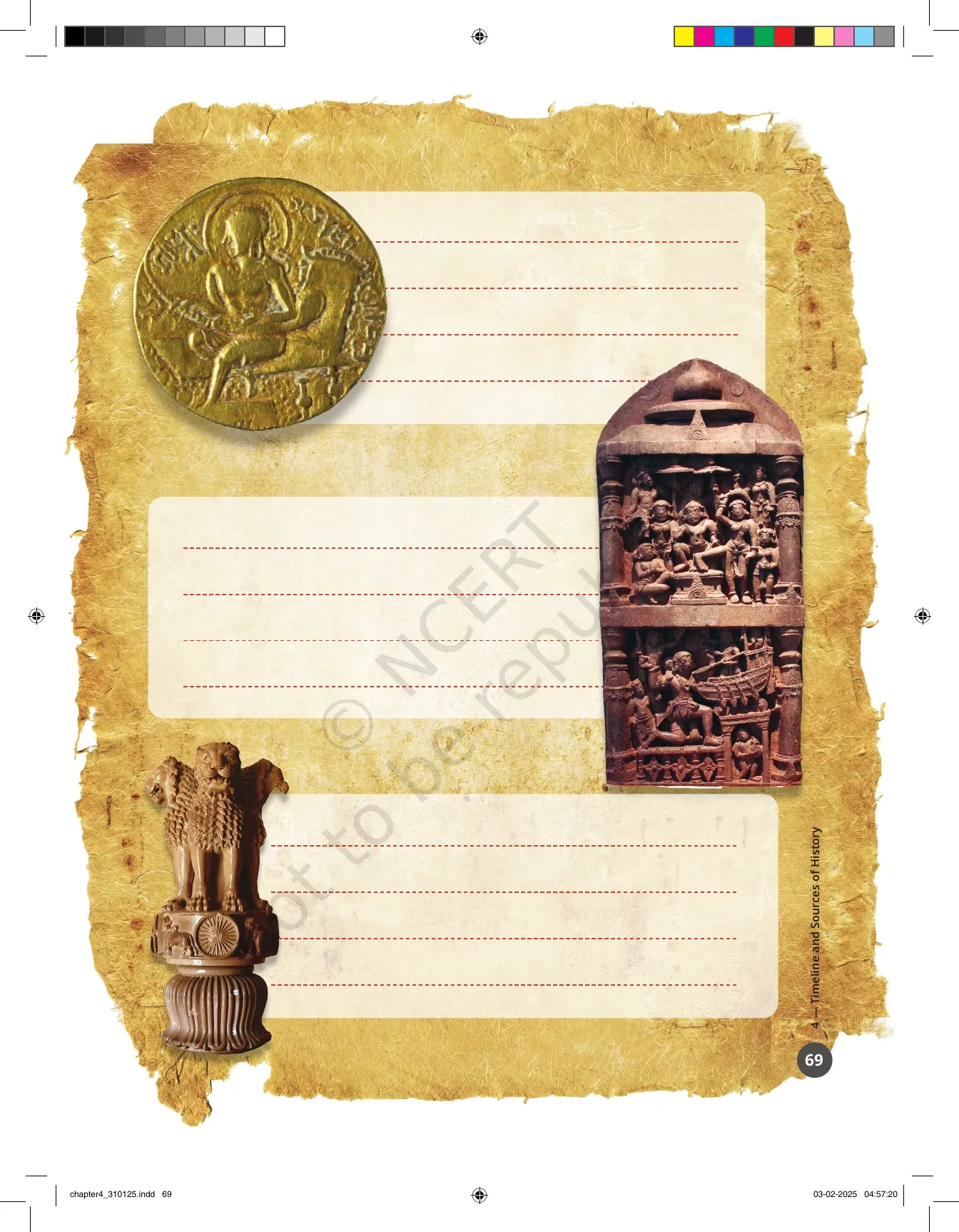
| Full-page source photographs | 69 | Images of different sources, with blank boxes to write what you can learn from each |
| Scene pictures | 70 and 72 | A rock shelter with early humans, and an agricultural community from a few millenniums ago |
| LET'S EXPLORE boxes | 63, 65, 66, 68, 70, 71 | The year zero exercise, a family timeline from 1900 CE, the three-generation family tree, reading the source photographs, naming activities in the rock shelter, and listing activities in the farming scene |
| THINK ABOUT IT boxes | 60, 67, 72 | Your earliest memory, what old objects at home can tell you, and how far the roles shown for men and women can be trusted |
| DON'T MISS OUT boxes | 64 to 65, and 65 | Centuries and millenniums with worked examples, and the pañchānga tradition of Indian calendars |
| Before we move on ... | 73 | A four-point recap on timelines, units of time, sources of history and the life of early humans |
| Margin words | 60 to 73 | History, fossils, era, Gregorian calendar, auspicious, source of history, historian, genetics, afterlife, welfare and hamlet |
Questions, Activities and Projects at the End of the Timeline and Sources of History Chapter
Printed page 74 carries 5 numbered items, and the school test is usually built straight out of them. Two are projects, one is a discussion question, one is a visit plan and one is the set of date exercises that decides most of the marks.
- Write your family history. A project on the history of your family, or of your village if you live in one, using the sources of history available to you, with your teacher guiding the work.
- Historians and detectives. Can we compare historians to detectives? The answer has to give reasons, and the jigsaw passage on printed page 68 supplies them.
- A few exercises with dates. Four parts, listed separately below.
- Plan a museum visit. Research the exhibits first, keep notes during the visit, then write a brief report on what was unexpected, interesting or fun.
- Invite an expert. Ask an archaeologist or a historian to your school to speak on the history of your region and why knowing it matters.
Question 3 is the one to practise twice, because every part of it needs the no-year-zero rule from printed page 63.
- Place these dates in order on a timeline: 323 CE, 323 BCE, 100 CE, 100 BCE, 1900 BCE, 1090 CE and 2024 CE.
- If King Chandragupta was born in 320 CE, which century did he belong to, and how many years was that after the Buddha's birth?
- Rani of Jhansi was born in 1828. Which century did she belong to, and how many years was that before India's Independence?
- Turn "12,000 years ago" into a date.
Common Mistakes Students Make in the Timeline and Sources of History Chapter
- Forgetting to subtract 1. There is no year zero, so a gap across the BCE and CE line is the two dates added, then reduced by one.
- Counting BCE years forward. BCE years get bigger as you go further back, so 1900 BCE is older than 100 BCE.
- Putting the 21st century as 2000 to 2099. The book fixes it at 2001 to 2100, because centuries are counted from the year 1 CE.
- Mixing up palaeontologists and archaeologists. Fossils of plants and animals go to palaeontologists. Tools, pots and beads left by people go to archaeologists.
- Treating every century year as a leap year. Only century years that are multiples of 400 qualify, so 2000 is a leap year while 1800 and 1900 are not.
Related Links:
How to Read the Class 6 Timeline and Sources of History PDF in One 45-Minute Sitting
This chapter is short but dense with dates, so plan one sitting with the PDF open, a long strip of paper for your own timeline and a pencil. Follow the order below and you will finish the reading, both timelines and the activity boxes together.
- Minutes 0 to 5: read the E.H. Carr quotation and the three Big Questions on printed page 59. They tell you what to look for.
- Minutes 5 to 15: read printed pages 60 and 61 and copy the four experts from Fig. 4.2 with one line each.
- Minutes 15 to 27: read the CE and BCE pages, then work the year zero exercise from 2 BCE to 2 CE on your paper strip.
- Minutes 27 to 35: copy Fig. 4.3 in short form and mark the century and millennium examples from the DON'T MISS OUT box.
- Minutes 35 to 45: read the sources diagram on printed page 67, then the early humans pages and the Before we move on recap.
Come back the next day for question 3, because the date sums need a second pass to catch the missing year zero every time. That second pass is what turns a chapter you have read into a chapter you can answer, and it is why students who keep the official PDF on their phone finish this theme faster than students working from guide books alone.
More Timeline and Sources of History Class 6 Resources
The book PDF gives you the printed chapter. These pages give you the answers, the revision layer and the last-day recap for the same chapter.
| Resource | What it gives you |
|---|---|
| Timeline and Sources of History Class 6 NCERT Solutions | Step-by-step answers to all 5 questions, activities and projects, including every part of the date exercises in question 3 |
| Timeline and Sources of History Class 6 Revision Notes | CE and BCE, centuries and millenniums, the four families of sources and the early human story in one short read |
| Timeline and Sources of History Class 6 Handwritten Notes | A topper's handwritten pages with a hand-drawn timeline and colour-coded sub-headings for a last-day recap |
| Timeline and Sources of History Class 6 NCERT Book PDF | This page. The official 2026-27 chapter file, printed pages 59 to 74 of Exploring Society: India and Beyond |
NCERT Book PDF for Class 6 Social Science: All 14 Chapters
Exploring Society: India and Beyond runs to 14 chapters across five themes. Download the ones your school has taught, or take the full set in one go.
| Chapter | Resource |
|---|---|
| Chapter 1 | Locating Places on the Earth NCERT Book PDF |
| Chapter 2 | Oceans and Continents NCERT Book PDF |
| Chapter 3 | Landforms and Life NCERT Book PDF |
| Chapter 4 | Timeline and Sources of History NCERT Book PDF (this page) |
| Chapter 5 | India, That Is Bharat NCERT Book PDF |
| Chapter 6 | The Beginnings of Indian Civilisation NCERT Book PDF |
| Chapter 7 | India's Cultural Roots NCERT Book PDF |
| Chapter 8 | Unity in Diversity, or 'Many in the One' NCERT Book PDF |
| Chapter 9 | Family and Community NCERT Book PDF |
| Chapter 10 | Grassroots Democracy Part 1: Governance NCERT Book PDF |
| Chapter 11 | Grassroots Democracy Part 2: Local Government in Rural Areas NCERT Book PDF |
| Chapter 12 | Grassroots Democracy Part 3: Local Government in Urban Areas NCERT Book PDF |
| Chapter 13 | The Value of Work NCERT Book PDF |
| Chapter 14 | Economic Activities Around Us NCERT Book PDF |
Timeline and Sources of History Class 6 Social Science NCERT Book PDF FAQs
Common Questions on the Class 6 Social Science Chapter 4 File
Ques. Where can I download the NCERT Class 6 Social Science Chapter 4 Timeline and Sources of History PDF?
Ans. You can download it directly from this page. It is the official NCERT chapter file for the 2026-27 print of Exploring Society: India and Beyond, and it is free.
Ques. How many pages is the Timeline and Sources of History chapter PDF?
Ans. The file runs to 16 pages. It covers printed pages 59 to 74 of the textbook, from the E.H. Carr quotation on the opening page to the museum and archaeologist projects on the last page.
Ques. What is a timeline?
Ans. A timeline is a tool that shows a sequence of dates and events covering any particular period. Fig. 4.3 in this chapter runs from the beginning of humanity to the present with a few landmarks marked, and it also shows the order of events without any arithmetic.
Ques. What do CE and BCE mean?
Ans. CE stands for Common Era and replaces the older AD, used for years counted forward from the conventional date of the birth of Jesus. BCE stands for Before Common Era and replaces the older BC, used for years counted backward from the same point. So 1947 AD is now written as 1947 CE.
Ques. Why is there no year zero in the Gregorian calendar?
Ans. The calendar simply runs the year 1 CE straight after the year 1 BCE, with no zero in between. That is why only 3 years pass between 2 BCE and 2 CE, and why you add the two dates and then subtract 1 when finding the gap between a BCE date and a CE date.
Ques. How many years ago was the Buddha born, according to the chapter?
Ans. The chapter gives 560 BCE as the approximate year of birth of Gautama Buddha and works the sum as 560 plus 2024 minus 1, which gives 2,583 years ago. The 1 is subtracted because there is no year zero.
Ques. What is the difference between a century and a millennium?
Ans. A century is any period of 100 years and a millennium is any period of 1,000 years. We are in the 21st century CE, which runs from 2001 to 2100, and in the 3rd millennium CE, which began in 2001 CE and goes up to 3000 CE. Both are counted backward from 1 BCE for the BCE side.
Ques. What are the sources of history in the Class 6 chapter?
Ans. A source of history is a place, person, text or object that gives us information about a past event or period. The diagram on printed page 67 groups them into four families: archaeological, literary, oral and artistic sources.
Ques. Who are geologists, palaeontologists, anthropologists and archaeologists?
Ans. Geologists study the physical features of the Earth such as soil, stones and rivers. Palaeontologists study fossils of plants, animals and humans from millions of years ago. Anthropologists study human societies and cultures from the oldest times to the present. Archaeologists dig up remains such as tools, pots, beads, bones and bricks.
Ques. How long have modern humans been on the planet?
Ans. About 300,000 years, which the chapter also writes as three lakh years. Compared with Fig. 4.1, which starts with the Earth at 4.54 billion years, that is only a tiny fraction of the planet's history.
Ques. When did the last Ice Age end?
Ans. The last Ice Age lasted from over 100,000 years ago to around 12,000 years ago. After it ended, living conditions improved, and people in many parts of the world began settling down, cultivating cereals and grains, and domesticating animals such as cattle and goats.
Ques. What is a pañchānga?
Ans. A pañchānga is a book of tables that lists the days of each month with related astronomical data. It predicts solar and lunar eclipses and the times of sunrise and sunset, and the ones used in India today often add weather predictions and festival dates.
Ques. How many questions are there at the end of the Timeline and Sources of History chapter?
Ans. There are 5 numbered items under "Questions, activities and projects" on printed page 74. They cover a family history project, the historians and detectives question, a four-part set of date exercises, a museum visit report and an invitation to an archaeologist or historian.
Ques. Do I need the NCERT Solutions if I already have the book PDF?
Ans. The book PDF carries the questions but not the answers. Use the Timeline and Sources of History Class 6 NCERT Solutions to check every part of the date exercises and each activity box.



Comments