




Inside the Class 6 Social Science Chapter 10 file you will find the Mahabharata line on dharma, the three organs of government, the three levels of government, and the picnic-voting example that explains direct democracy. This is the full printed chapter from Exploring Society: India and Beyond for the 2026-27 session, with nothing shortened or reworded.
- 14-page official file: Chapter 10 runs from printed page 149 to printed page 162 of the Class 6 textbook.
- Covers the four section heads Introduction, Three Organs of Government, Three Levels of Government and Democracy.
- Carries 5 LET'S EXPLORE boxes, 1 DON'T MISS OUT box, 5 numbered figures, a profile of Dr. A.P.J. Abdul Kalam and 4 end questions.

This is the unedited NCERT chapter file for the 2026-27 print run, checked page by page against the official Exploring Society: India and Beyond release before it was put on this page.
Student Feedback
What 13,480 students told us about the Grassroots Democracy Part 1 Governance chapter, in a Collegedunia poll taken during the 2026-27 session.
- 71% of students said they mixed up governance and government at least once in a class test.
- Most-confused pair: direct democracy and representative democracy, swapped by about 4 in 10 students surveyed.
- Students reported that drawing the three-organ triangle from Fig. 10.3 once fixed the legislature, executive and judiciary roles in a single sitting.
Source: 2026-27 Class 6 Social Science student poll. Sample of 13,480 students from CBSE schools across 19 states.
What the Grassroots Democracy Part 1 Governance Class 6 PDF Contains, Page by Page
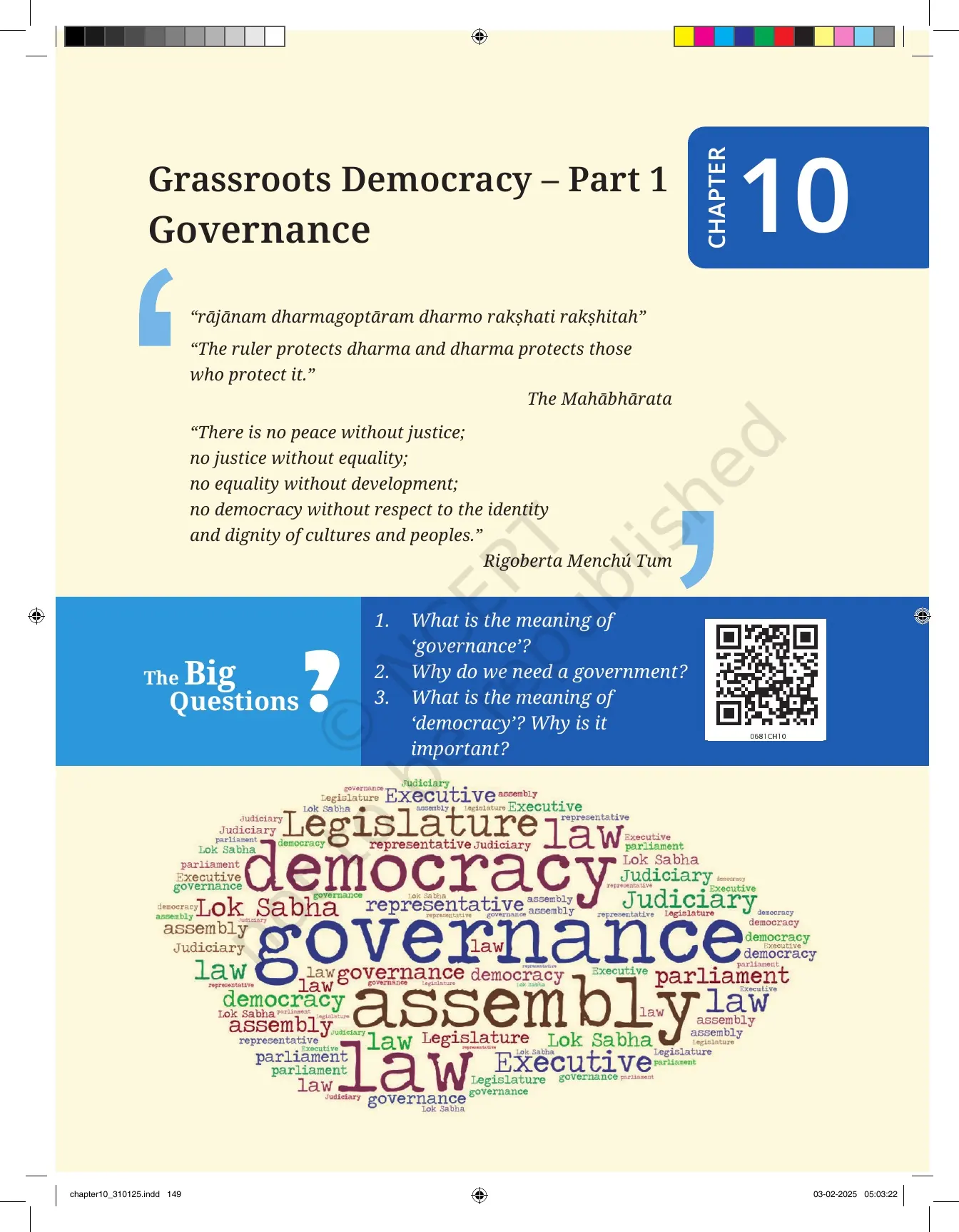
The file is the printed chapter in full, not a summary sheet. It opens with two quotations on printed page 149 and closes with the Noodles page on printed page 162. Use the table below to jump straight to the part you need.
| Section in the PDF | Printed pages | What is on these pages |
|---|---|---|
| Chapter opener | 149 | The Mahabharata verse on dharma, the Rigoberta Menchu Tum quotation on peace and justice, and the three Big Questions |
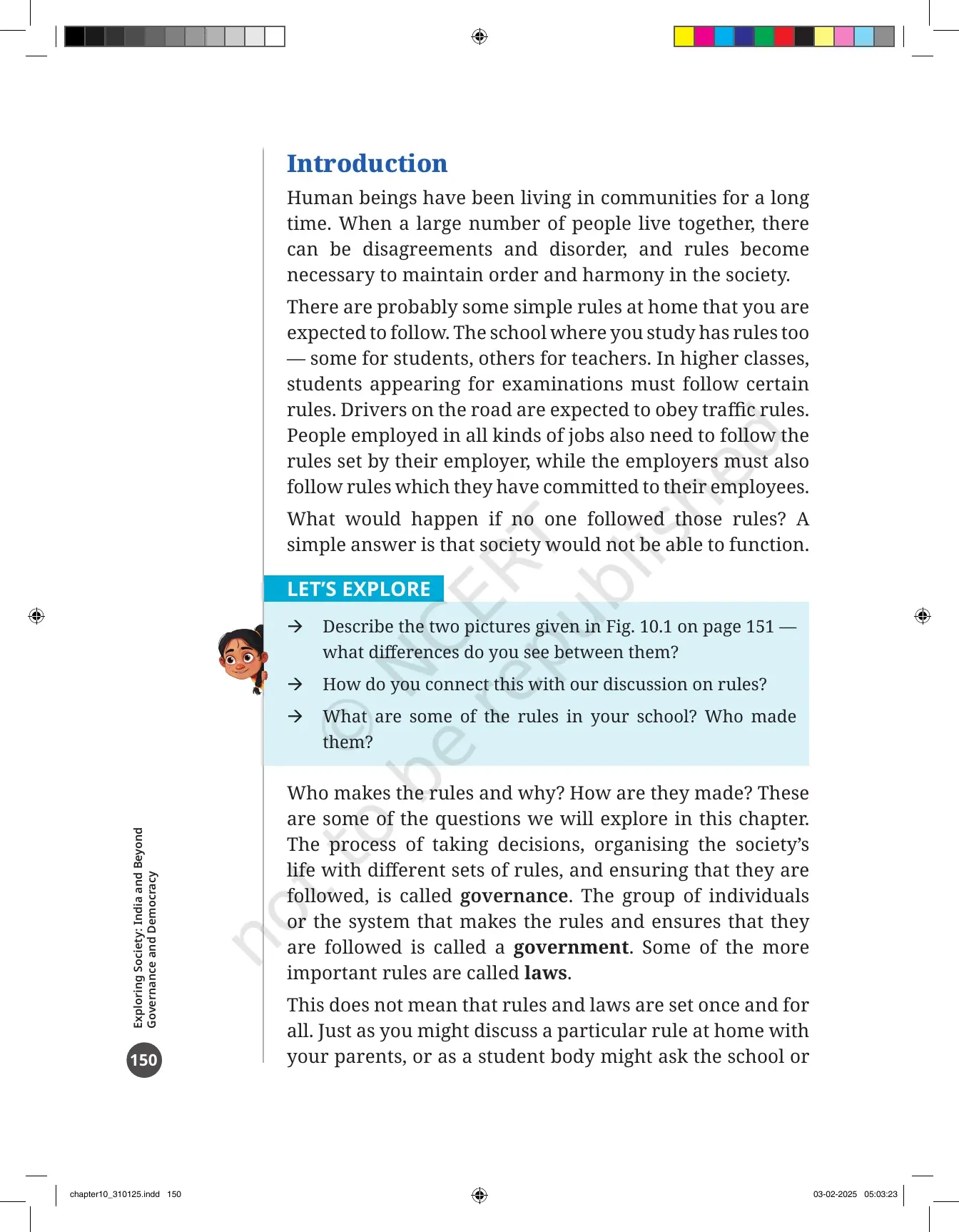
| Introduction | 150 | Why rules are needed, the school and traffic examples, the first LET'S EXPLORE box, and the definitions of governance, government and laws |
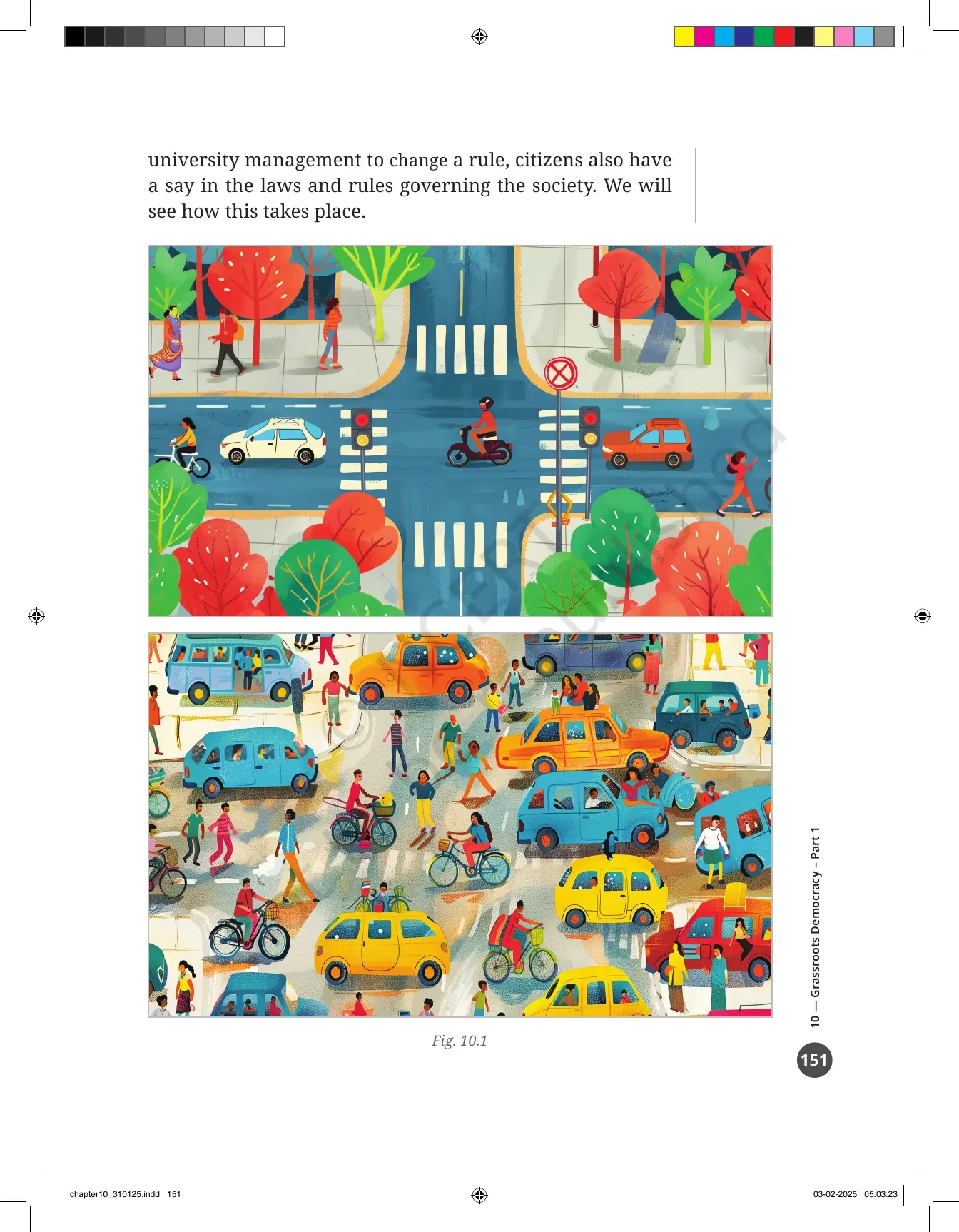
| Fig. 10.1 | 151 | A full page carrying the two pictures you are asked to compare in the first activity box |
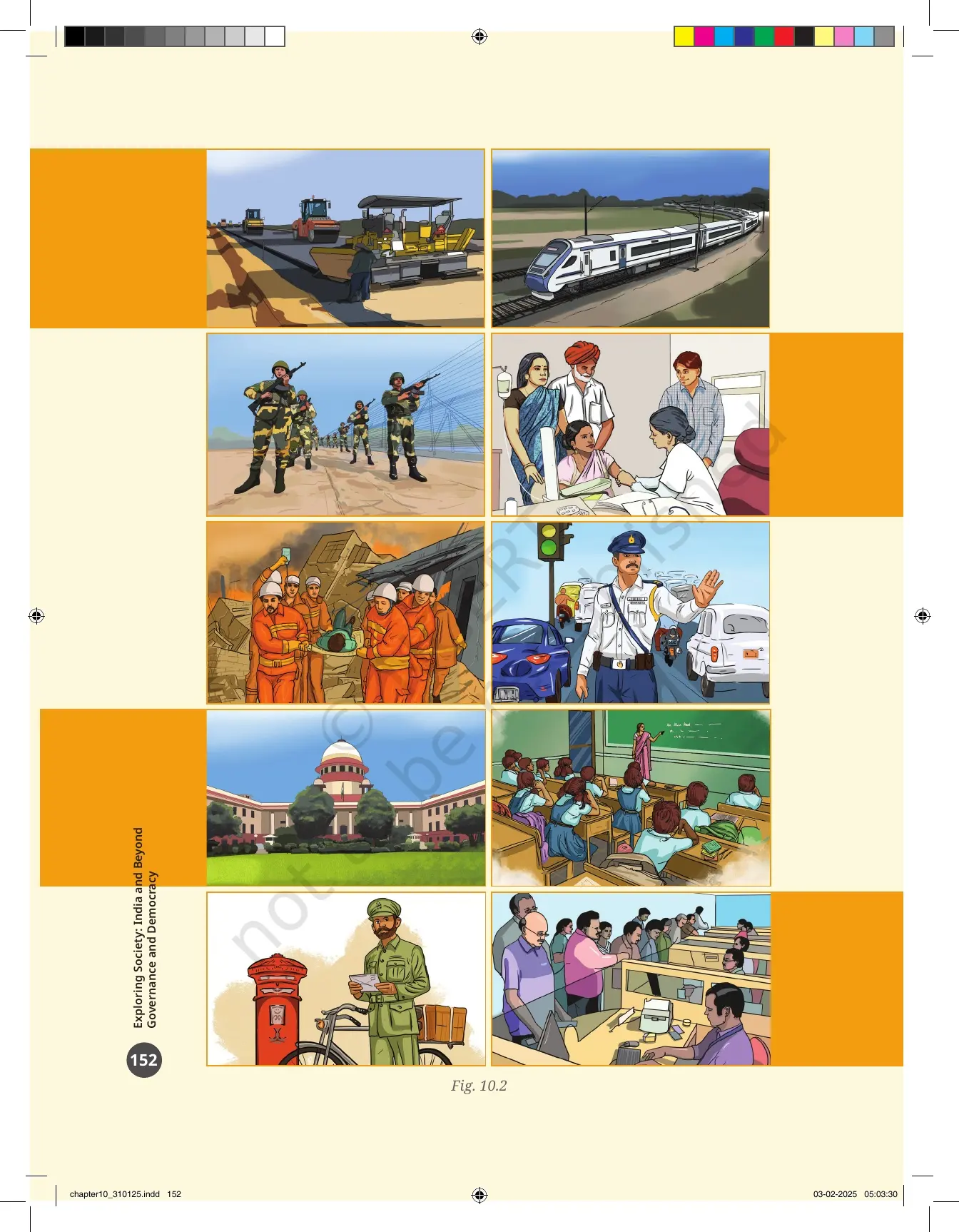
| Fig. 10.2 | 152 | A full page of ten pictures showing categories of public service |
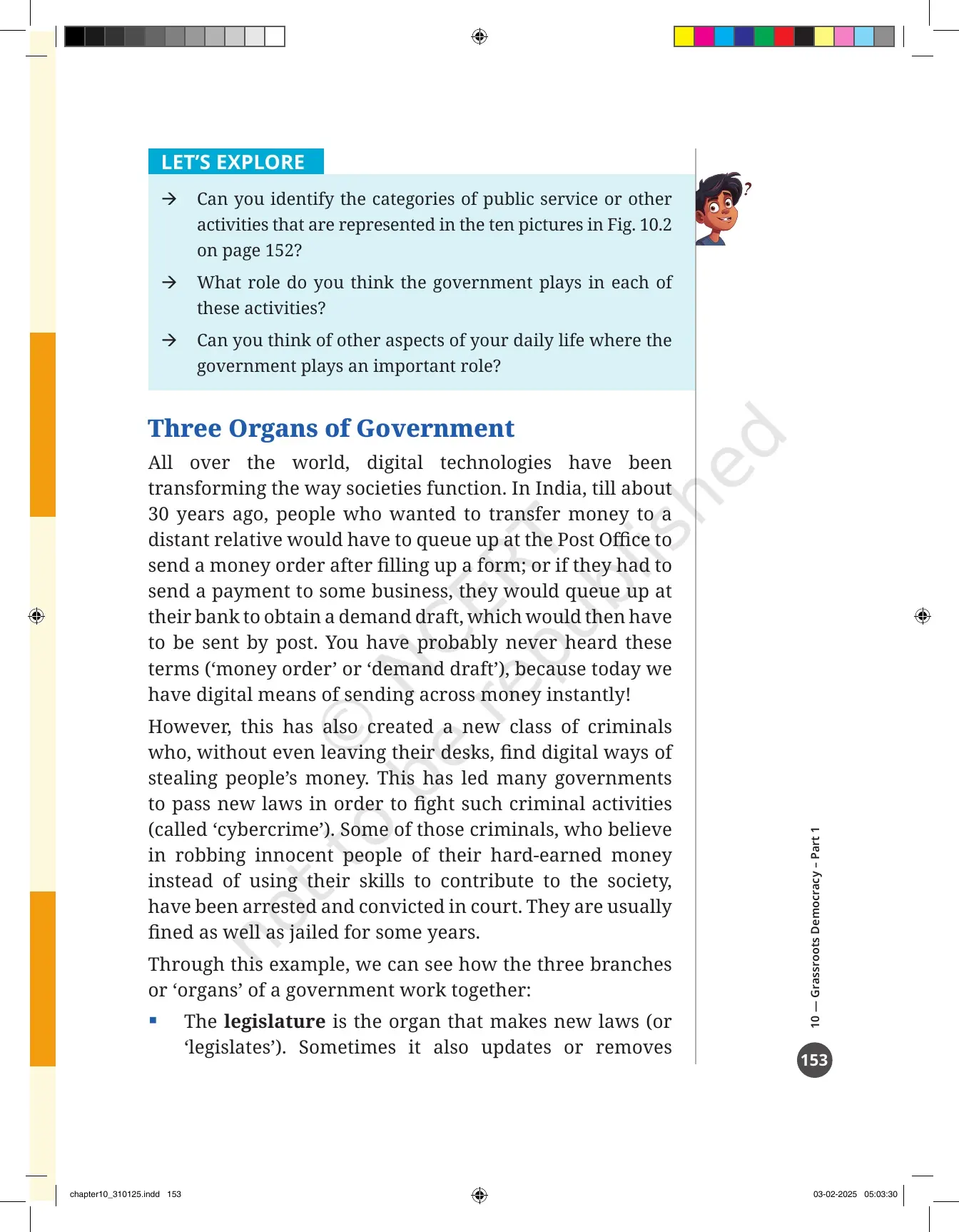
| Three Organs of Government | 153 | The LET'S EXPLORE box on the ten pictures, the money order and demand draft story, the cybercrime example, and the legislature defined |
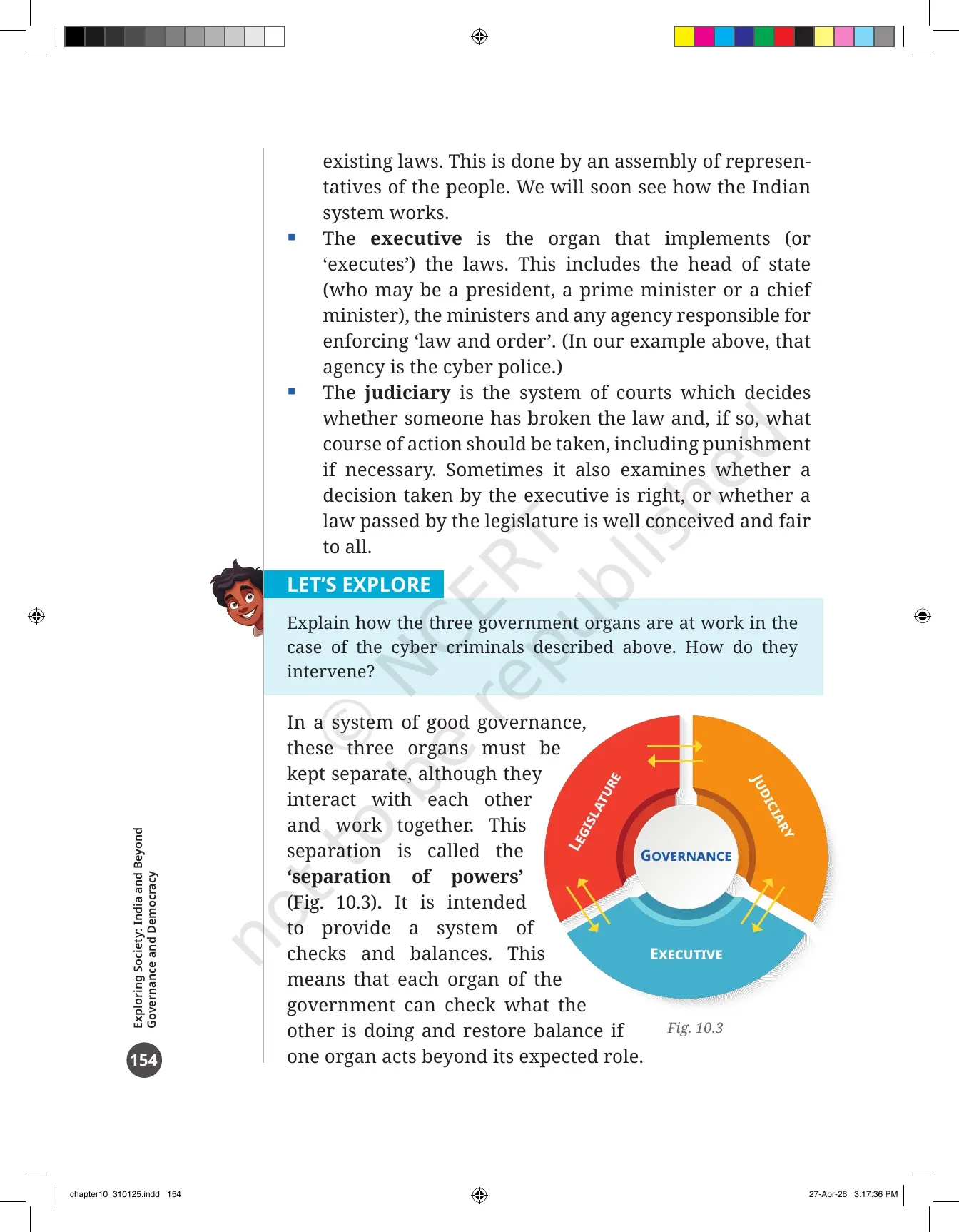
| Executive, judiciary and separation of powers | 154 | The executive and the judiciary defined, a LET'S EXPLORE box on the cyber criminals, checks and balances, and Fig. 10.3 |
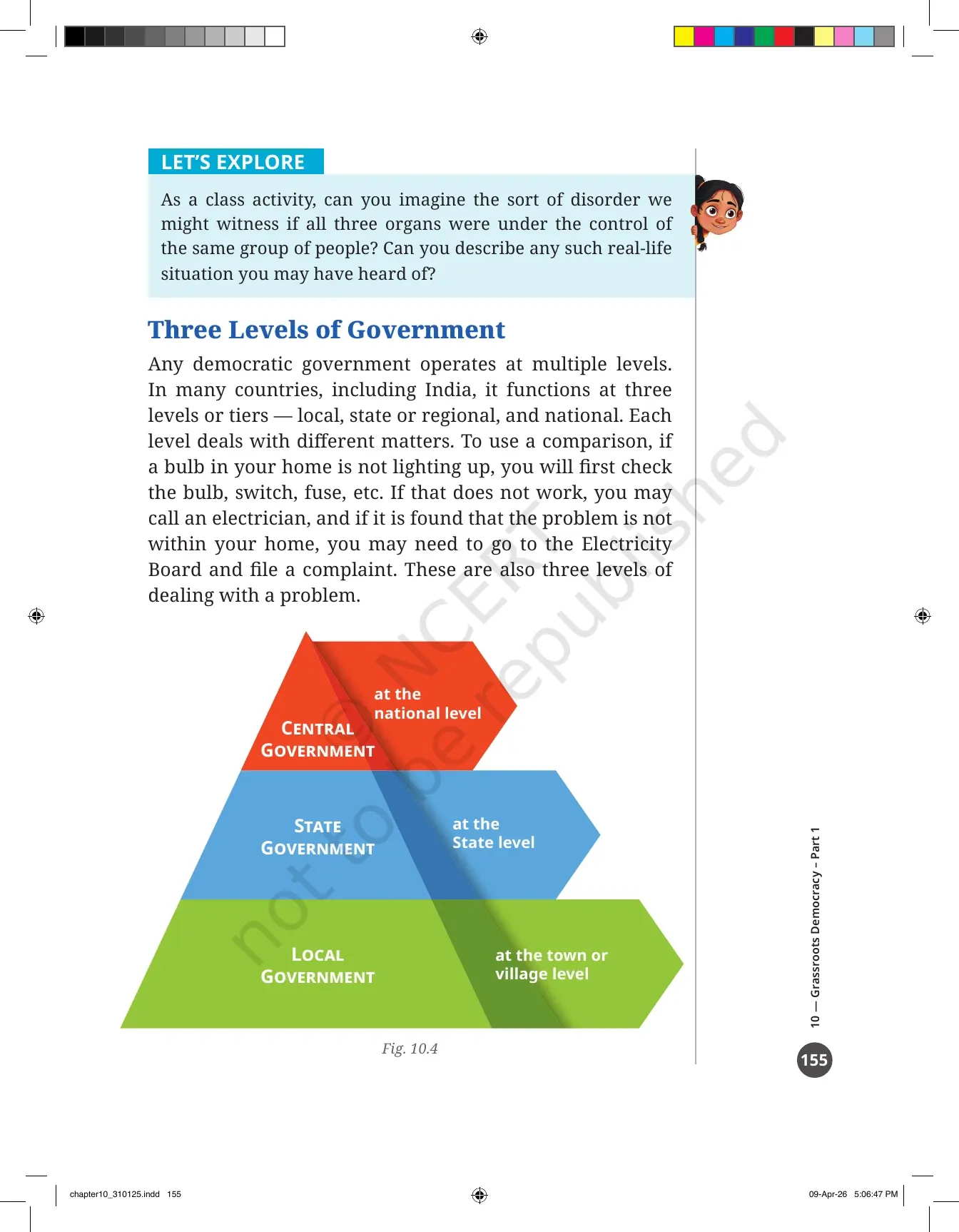
| Three Levels of Government | 155 | A LET'S EXPLORE class activity, the three tiers introduced, the electric bulb comparison, and Fig. 10.4 |
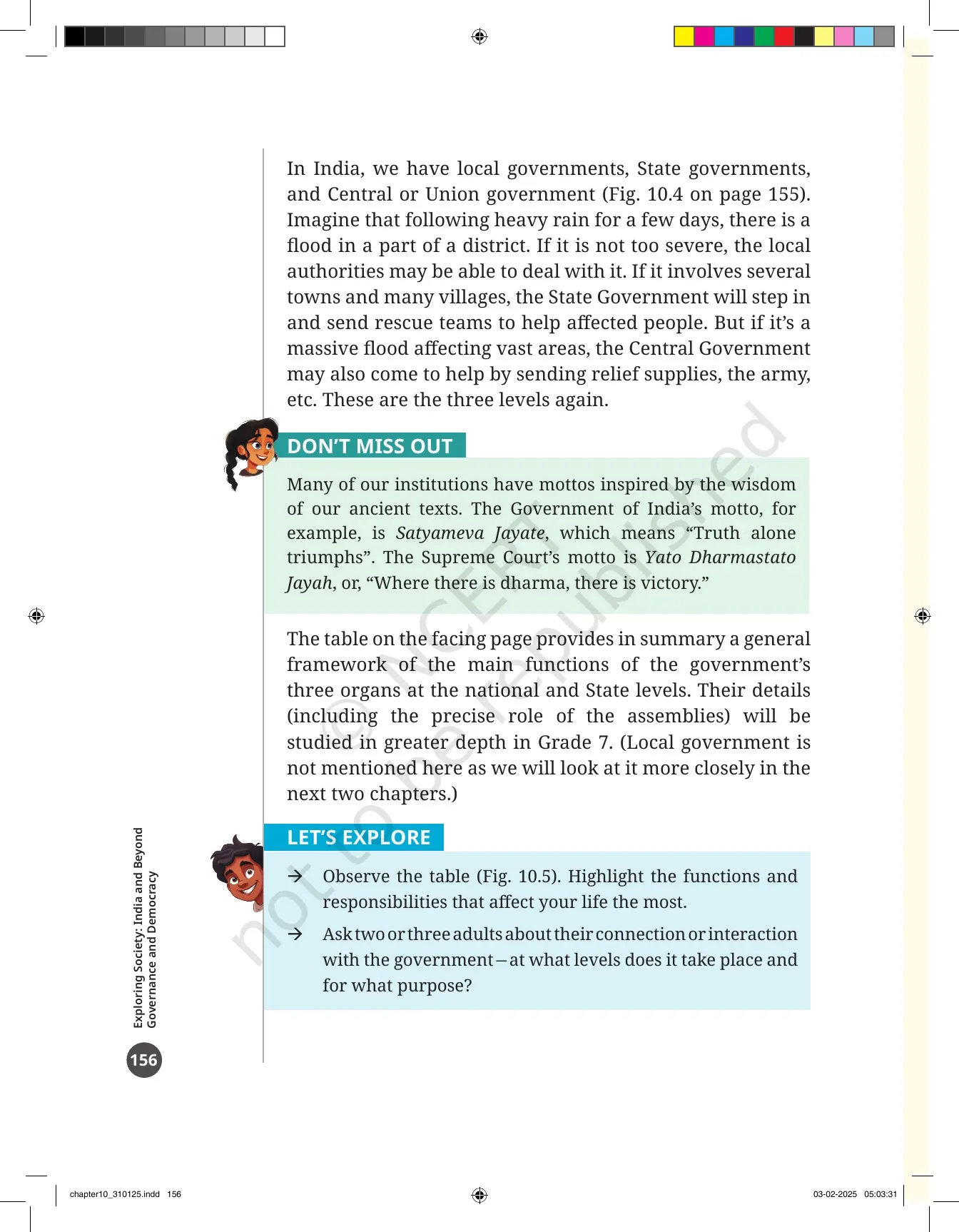
| The flood example and the mottos | 156 | The flood at three levels, the DON'T MISS OUT box on Satyameva Jayate and Yato Dharmastato Jayah, and a LET'S EXPLORE box on the table |
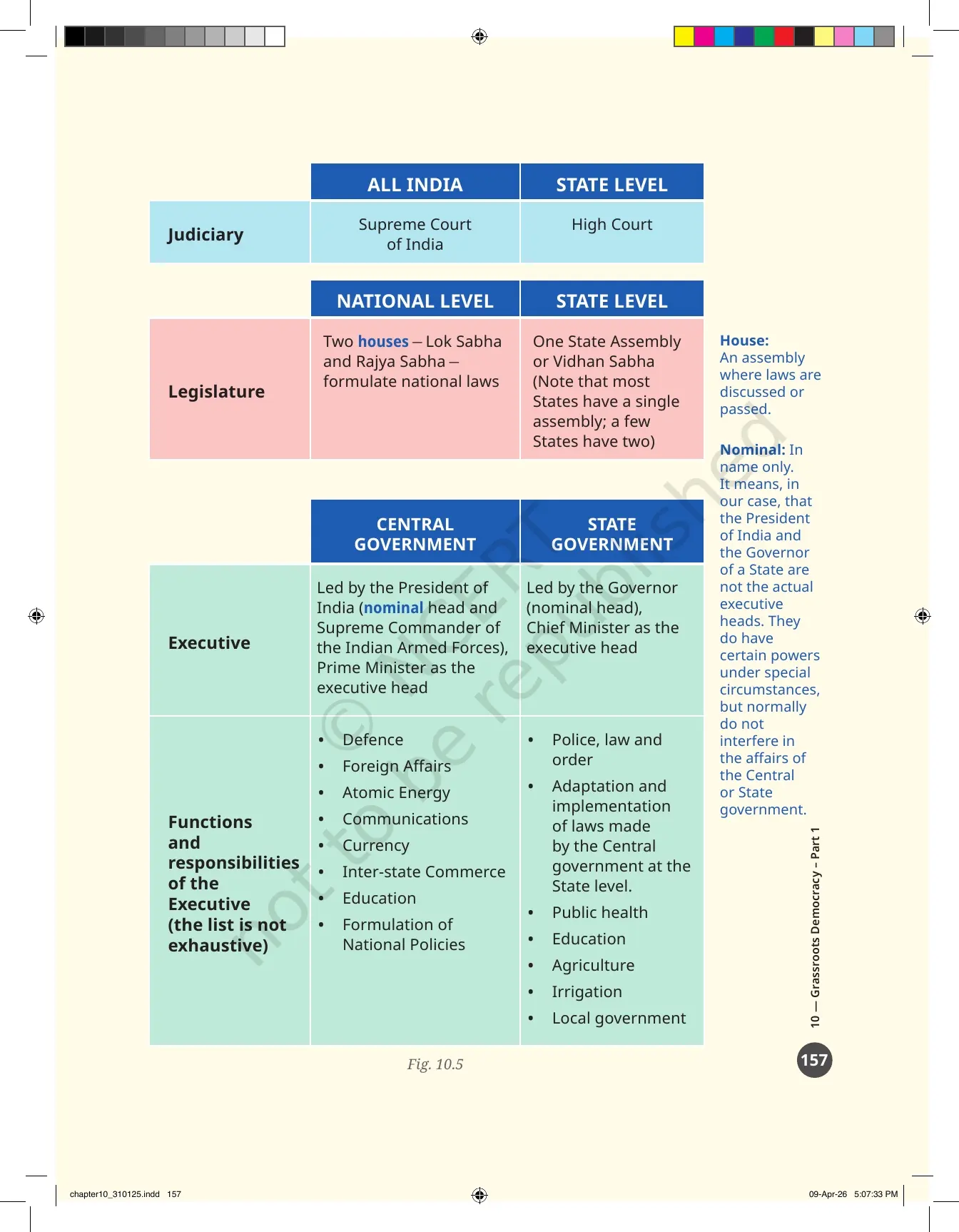
| Fig. 10.5 | 157 | The framework table of the three organs at the national and State levels, with the margin glossary for Nominal and House |
| Dr. A.P.J. Abdul Kalam | 158 | A full-page profile of the 11th President of India and five of his thoughts |
| Democracy | 159 | The Greek roots of the word, the class monitor example, and how MLAs and MPs are elected |
| Direct and grassroots democracy | 160 | India as the world's largest democracy, the picnic voting example, grassroots democracy defined, and the Before we move on recap |
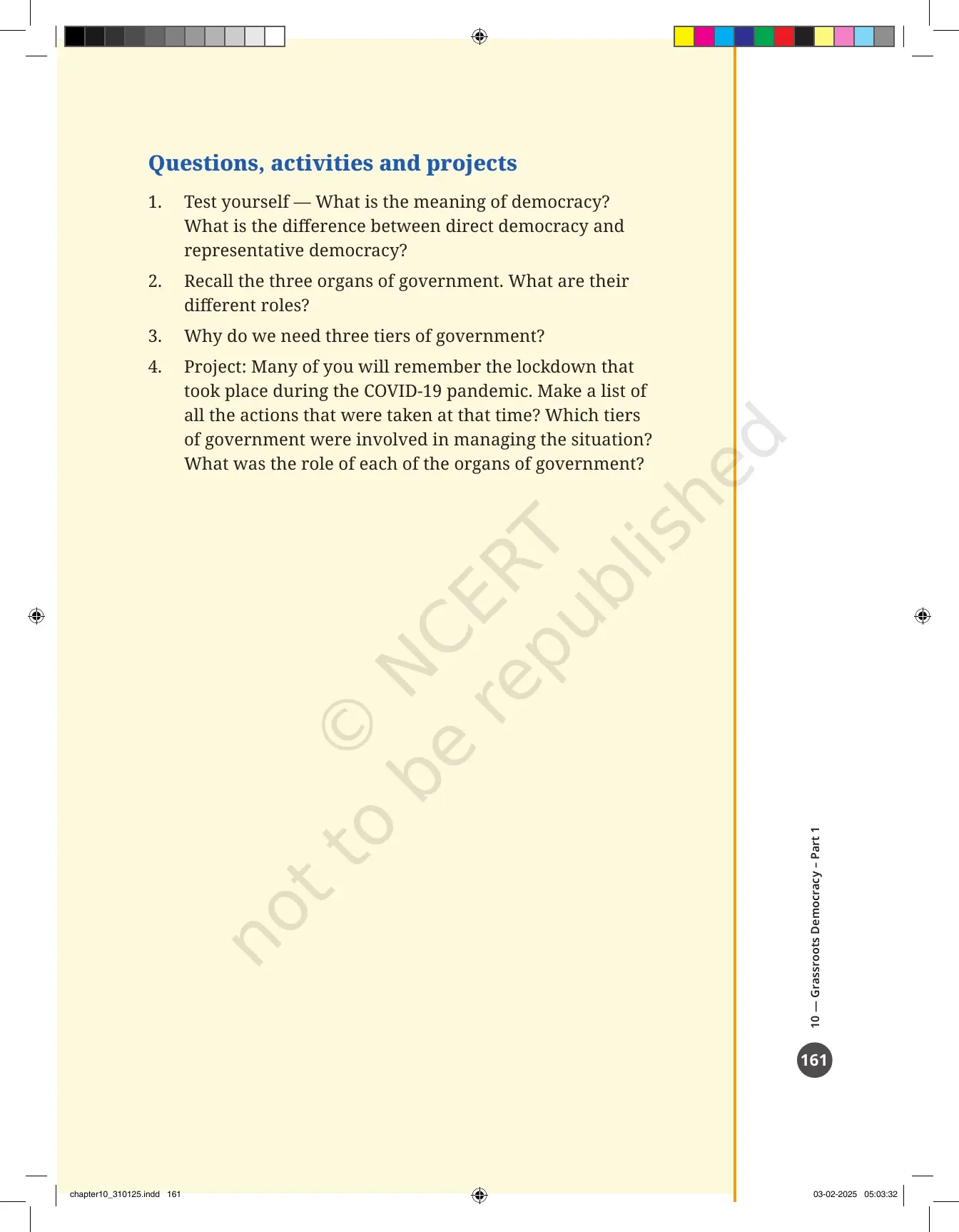
| Questions, activities and projects | 161 | 4 numbered items, including the COVID-19 lockdown project |
| Noodles | 162 | A blank Notes and Doodles page for your own rough work |
Also Check:
- Grassroots Democracy Part 1: Governance Class 6 NCERT Solutions
- Grassroots Democracy Part 1: Governance Class 6 Revision Notes
The Two Quotations and the Three Big Questions on Page 149 of the Governance Chapter
The chapter does not open with a definition. It opens with two quotations, one from an ancient Indian text and one from a modern activist. Three Big Questions are printed on the same page, and every section of the chapter answers one of them.
- The Mahabharata verse: "rajanam dharmagoptaram dharmo rakshati rakshitah", translated in the book as "The ruler protects dharma and dharma protects those who protect it."
- Rigoberta Menchu Tum: "There is no peace without justice; no justice without equality; no equality without development; no democracy without respect to the identity and dignity of cultures and peoples."
- Big Question 1: What is the meaning of 'governance'? Answered by the Introduction on printed page 150.
- Big Question 2: Why do we need a government? Answered by the Three Organs and Three Levels sections.
- Big Question 3: What is the meaning of 'democracy'? Why is it important? Answered by the Democracy section from printed page 159 onwards.
Learn the two quotations with the names attached. A one-mark question often asks who said the second line, and the answer is Rigoberta Menchu Tum, not the textbook.
Governance and the Three Organs Explained on Video
Source: Magnet Brains on YouTube
What Governance Means and How It Is Different From Government
This is the single most important paragraph in the chapter, and the one students most often blur. The book gives three separate definitions in three lines on printed page 150. Copy them exactly as they are printed, because the words do different jobs.
| Term | What the chapter says it is | How to remember it |
|---|---|---|
| Governance | The process of taking decisions, organising the society's life with different sets of rules, and ensuring that they are followed | Governance is the work being done |
| Government | The group of individuals or the system that makes the rules and ensures that they are followed | Government is the people doing the work |
| Laws | Some of the more important rules are called laws | Every law is a rule, but not every rule is a law |
Governance is a process and government is a body. The chapter also makes a second point right after these definitions, and it is worth a mark on its own: rules and laws are not set once and for all. Just as you might discuss a rule at home with your parents, or a student body might ask the school management to change a rule, citizens also have a say in the laws and rules governing the society.
Why Rules Are Needed at Home, in School and on the Road
Before defining anything, the chapter builds the case for rules using places you already know. Human beings have been living in communities for a long time, and when a large number of people live together, there can be disagreements and disorder. Rules become necessary to maintain order and harmony.
- At home: there are probably some simple rules you are expected to follow.
- At school: the school has rules too, some for students and others for teachers.
- In examinations: students in higher classes appearing for examinations must follow certain rules.
- On the road: drivers are expected to obey traffic rules.
- At work: people in all kinds of jobs follow the rules set by their employer, and employers must also follow the rules they have committed to their employees.
The chapter then asks what would happen if no one followed those rules. Its own answer is one line: society would not be able to function. The first LET'S EXPLORE box on printed page 150 turns this into work. Describe the two pictures in Fig. 10.1 and say what differences you see, connect that with the discussion on rules, and then list some rules in your own school along with who made them.
The Cybercrime Example That Introduces the Three Organs of Government
The chapter does not define the three organs first. It tells a story about money and then points at the organs inside it. This is the example a class test uses when it asks you to show the three organs at work, so keep the sequence in order.
- Thirty years ago in India: to send money to a distant relative, people queued at the Post Office and filled a form for a money order.
- To pay a business: they queued at their bank for a demand draft, which then had to be sent by post.
- Today: digital technologies let us send money instantly, which is why most Class 6 students have never heard the words money order or demand draft.
- The new problem: a new class of criminals steals people's money digitally without even leaving their desks. This is called cybercrime.
- What governments did: many governments passed new laws to fight such criminal activities.
- What happened to the criminals: some were arrested and convicted in court, and are usually fined as well as jailed for some years.
The LET'S EXPLORE box on printed page 154 asks you to explain how the three government organs are at work in this case and how they intervene. The short answer: the legislature passed the new law, the cyber police under the executive arrested the criminals, and the judiciary convicted them and set the fine and the jail term.
The Three Organs of Government: Legislature, Executive and Judiciary Defined
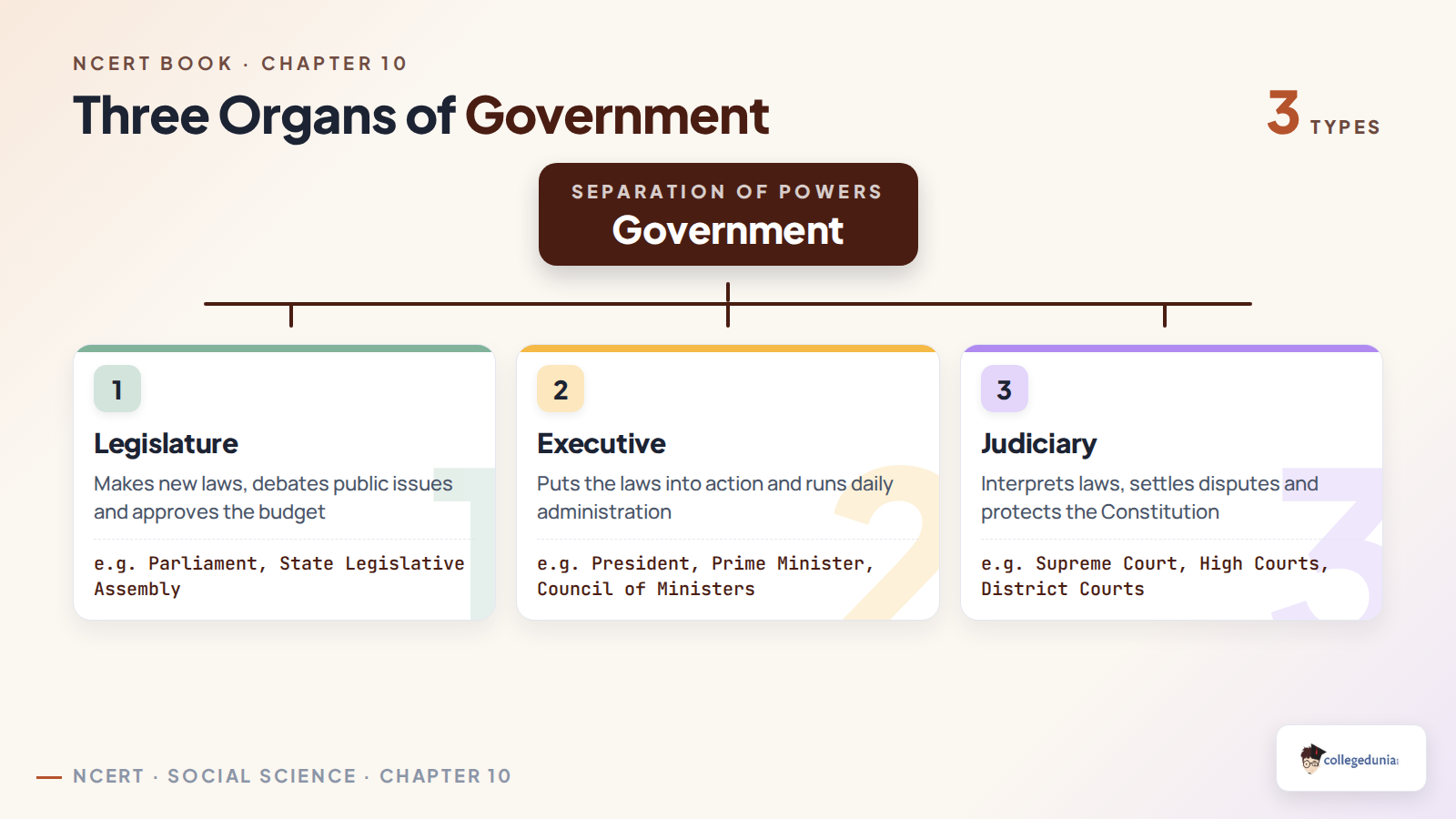
Printed pages 153 and 154 define the three organs in one paragraph each. These are the definitions the examiner wants word for word, and question 2 at the end of the chapter asks for exactly this.
| Organ | What it does | Who is in it |
|---|---|---|
| Legislature | Makes new laws, or 'legislates'. Sometimes it also updates or removes existing laws | An assembly of representatives of the people |
| Executive | Implements, or 'executes', the laws | The head of state, who may be a president, a prime minister or a chief minister, the ministers, and any agency responsible for enforcing law and order |
| Judiciary | Decides whether someone has broken the law and, if so, what course of action should be taken, including punishment if necessary | The system of courts |
| The judiciary's extra job | Sometimes it also examines whether a decision taken by the executive is right, or whether a law passed by the legislature is well conceived and fair to all | The same courts, acting as a check on the other two organs |
Notice the small detail in the executive row. The chapter names the cyber police as the law-and-order agency in its own example, so if a question asks which organ the cyber police belong to, the answer is the executive.
Separation of Powers and the Checks and Balances Idea in Fig. 10.3
Once the three organs are defined, the chapter adds the rule that keeps them honest. In a system of good governance, these three organs must be kept separate, although they interact with each other and work together.
- The name of the idea: this separation is called the 'separation of powers'.
- What it is meant to provide: a system of checks and balances.
- What that means: each organ of the government can check what the other is doing and restore balance if one organ acts beyond its expected role.
- What Fig. 10.3 shows: a triangle with Legislature, Executive and Judiciary at the three corners and the word Governance in the middle.
The LET'S EXPLORE box on printed page 155 is a class activity built on this. Imagine the sort of disorder we might witness if all three organs were under the control of the same group of people, and describe any such real-life situation you may have heard of.
Three Levels of Government: Local, State and Central, With the Bulb and the Flood
Any democratic government operates at multiple levels. In many countries, including India, it functions at three levels or tiers, and each level deals with different matters. The chapter proves it twice, once with a household example and once with a disaster.
| Level | Where it works | What the chapter calls it |
|---|---|---|
| Local Government | At the town or village level | Local governments, studied closely in the next two chapters |
| State Government | At the State level | State governments |
| Central Government | At the national level | Central or Union government |
The first example is the electric bulb. If a bulb in your home is not lighting up, you first check the bulb, the switch and the fuse. If that does not work, you may call an electrician. If the problem is not within your home, you go to the Electricity Board and file a complaint. Those are three levels of dealing with one problem.
The second example is a flood after heavy rain, and it maps onto the three tiers exactly.
- If it is not too severe: the local authorities may be able to deal with it.
- If it involves several towns and many villages: the State Government steps in and sends rescue teams to help affected people.
- If it is a massive flood affecting vast areas: the Central Government may also help by sending relief supplies, the army and so on.
Question 3 at the end of the chapter asks why we need three tiers of government. The flood example is the fastest way to answer it: each tier handles the size of problem it is built for.
The DON'T MISS OUT Box on Satyameva Jayate and Yato Dharmastato Jayah
Printed page 156 carries the chapter's only DON'T MISS OUT box, and it is short enough to learn in a minute. It says that many of our institutions have mottos inspired by the wisdom of our ancient texts, and it names two.
| Institution | Motto | What it means |
|---|---|---|
| The Government of India | Satyameva Jayate | "Truth alone triumphs" |
| The Supreme Court | Yato Dharmastato Jayah | "Where there is dharma, there is victory" |
Students routinely swap these two in tests. The link that stops the mistake: the Supreme Court is the judiciary, so it gets the motto with dharma in it, the same word that appeared in the Mahabharata verse on printed page 149.
Reading the Fig. 10.5 Table: Who Does What at the National and State Levels
Fig. 10.5 on printed page 157 is the densest page in the chapter. It sets out a general framework of the main functions of the three organs at the national and State levels. The chapter itself says the details, including the precise role of the assemblies, will be studied in Grade 7, and that local government is not shown here because the next two chapters cover it.
| Organ | Central Government, at the national level | State Government, at the State level |
|---|---|---|
| Judiciary | Supreme Court of India, marked All India | High Court |
| Legislature | Two houses, the Lok Sabha and the Rajya Sabha, which formulate national laws | One State Assembly or Vidhan Sabha. Most States have a single assembly and a few States have two |
| Executive | Led by the President of India, the nominal head and Supreme Commander of the Indian Armed Forces, with the Prime Minister as the executive head | Led by the Governor, the nominal head, with the Chief Minister as the executive head |
| Functions of the executive (the chapter says the list is not exhaustive) | Defence, Foreign Affairs, Atomic Energy, Communications, Currency, Inter-state Commerce, Education, and Formulation of National Policies | Police and law and order, adaptation and implementation of laws made by the Central government at the State level, Public health, Education, Agriculture, Irrigation, and Local government |
Two words are explained in the margin of the same page, and both are commonly asked.
- Nominal: in name only. It means that the President of India and the Governor of a State are not the actual executive heads. They do have certain powers under special circumstances, but normally do not interfere in the affairs of the Central or State government.
- House: an assembly where laws are discussed or passed.
- Education appears on both sides of the table, which is the detail students miss most often.
The LET'S EXPLORE box on printed page 156 sends you into this table with two tasks. Highlight the functions and responsibilities that affect your life the most, then ask two or three adults about their connection or interaction with the government, at what levels it takes place and for what purpose.
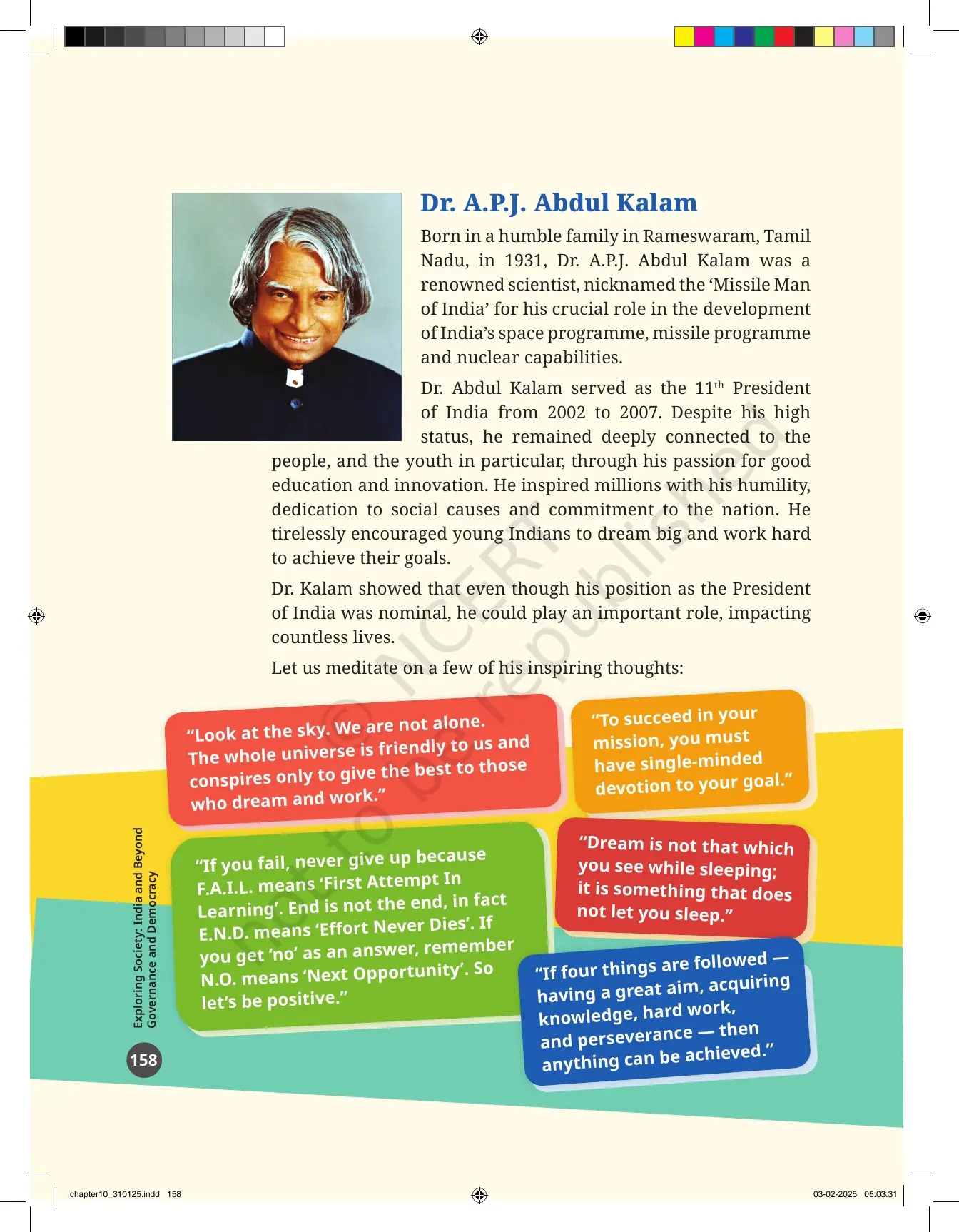
Dr. A.P.J. Abdul Kalam's Profile and the Five Thoughts Printed in the Chapter
Printed page 158 is given entirely to Dr. A.P.J. Abdul Kalam, and it is placed here for a reason. It is the chapter's proof that a nominal head can still matter. Keep the dates and the nickname straight, because those are the one-mark facts.
| Detail | What the chapter says |
|---|---|
| Born | In a humble family in Rameswaram, Tamil Nadu, in 1931 |
| Known as | A renowned scientist, nicknamed the 'Missile Man of India' |
| Why | His crucial role in the development of India's space programme, missile programme and nuclear capabilities |
| The office he held | The 11th President of India, from 2002 to 2007 |
| What he was known for | Staying deeply connected to the people, and the youth in particular, through his passion for good education and innovation |
| The point of the box | Even though his position as President was nominal, he could play an important role, impacting countless lives |
Five of his thoughts are printed on the same page. The one about failure is quoted most often in school assemblies, so it is worth learning in full.
- "Look at the sky. We are not alone. The whole universe is friendly to us and conspires only to give the best to those who dream and work."
- "To succeed in your mission, you must have single-minded devotion to your goal."
- "Dream is not that which you see while sleeping; it is something that does not let you sleep."
- "If four things are followed, having a great aim, acquiring knowledge, hard work, and perseverance, then anything can be achieved."
- "If you fail, never give up because F.A.I.L. means 'First Attempt In Learning'. End is not the end, in fact E.N.D. means 'Effort Never Dies'. If you get 'no' as an answer, remember N.O. means 'Next Opportunity'. So let's be positive."
What Democracy Means: the Greek Roots and the Class Monitor Example
The Democracy section on printed page 159 starts by picking up a phrase the chapter used earlier, 'representatives of the people'. That phrase is the doorway into the whole idea, and the word itself comes from Greek.
- demos: the Greek word meaning 'people'.
- kratos: the Greek word meaning 'rule' or 'power'.
- So 'democracy' literally means the 'rule of the people'.
- The follow-up question the chapter asks: can all people actually rule? Its own answer is that it is clearly not possible.
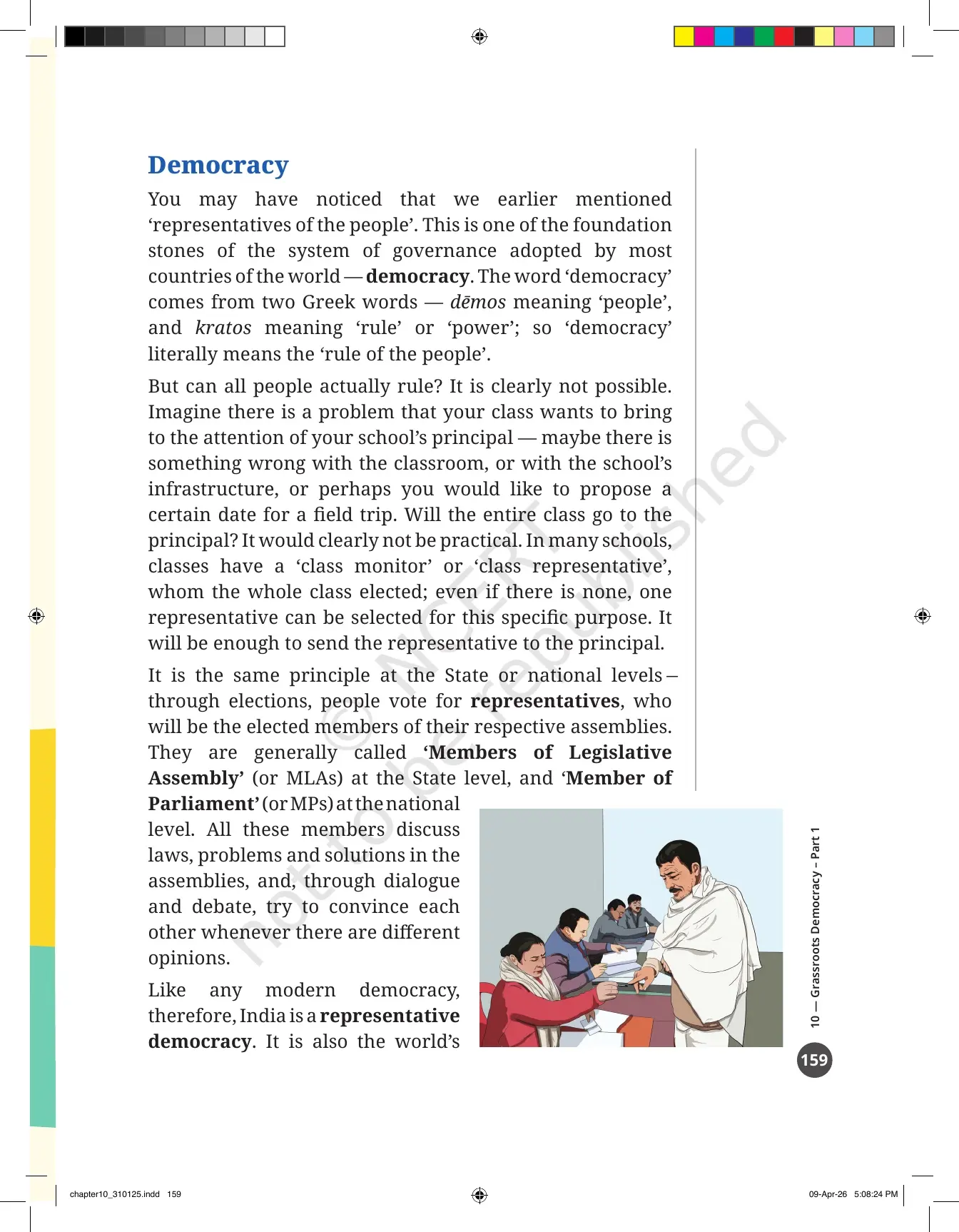
The class monitor example explains the way around that problem. Imagine your class wants to bring something to the principal, perhaps a problem with the classroom or the school's infrastructure, or a proposed date for a field trip. Sending the entire class would not be practical. In many schools the class has elected a 'class monitor' or 'class representative', and it is enough to send that one person.
The same principle works at the State and national levels, and it gives you two abbreviations worth memorising.
| Title | Short form | Level |
|---|---|---|
| Member of Legislative Assembly | MLA | The State level |
| Member of Parliament | MP | The national level |
What these elected members do is the part students skip. They discuss laws, problems and solutions in the assemblies, and through dialogue and debate they try to convince each other whenever there are different opinions.
Direct Democracy, Representative Democracy and Grassroots Democracy Compared
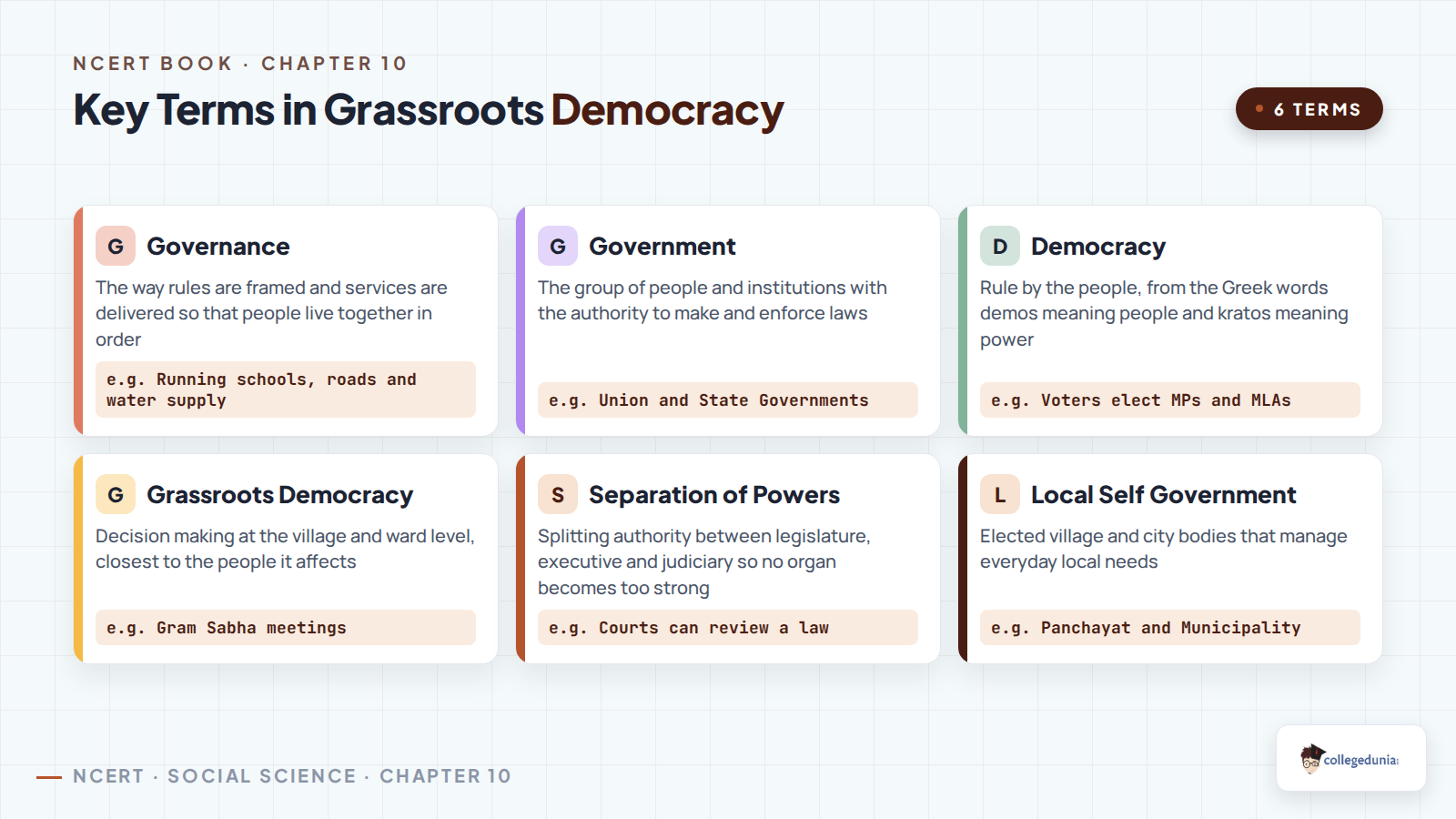
Printed page 160 names three kinds of democracy in quick succession. This is the comparison question 1 asks for at the end of the chapter, and it is the pair our student poll found students swap most often.
| Kind | What the chapter says | The example it uses |
|---|---|---|
| Direct democracy | A case where every person's opinion is taken to finalise the decision | The class picnic. Students weigh place A against place B on distance, time, cost and basic facilities, then raise hands. The option with more raised hands wins. That process is called voting |
| Representative democracy | People vote for representatives through elections, and those elected members sit in the assemblies | India. The chapter says India is a representative democracy, like any modern democracy |
| Grassroots democracy | A system that enables and encourages the participation of ordinary citizens, the base of the pyramid in Fig. 10.4, so that citizens can have a say in decisions which affect them | The idea the next two chapters build on, in rural and then urban local government |
Two numbers from the same page are easy marks. India is the world's largest democracy, with some 970 million voters in 2024. In principle, all Indian citizens above the age of 18 have the right to take part in these elections.
Every Figure, Activity Box and Special Page Inside the Governance PDF
This chapter numbers its figures, from Fig. 10.1 to Fig. 10.5, so you can quote a figure number in an answer. Five activity boxes and two full-page features carry the rest. The checklist below is the fastest way to make sure you have not skipped one.
| Figure, box or feature | Printed page | What it shows or asks |
|---|---|---|
| The two opening quotations | 149 | The Mahabharata verse on the ruler and dharma, and Rigoberta Menchu Tum on peace, justice, equality and development |
| The Big Questions | 149 | Three questions on governance, why we need a government, and the meaning and importance of democracy |
| LET'S EXPLORE 1 | 150 | Describe the two pictures in Fig. 10.1, connect them with rules, and list rules in your school and who made them |
| Fig. 10.1 | 151 | The two contrasting pictures used in the first activity |
| Fig. 10.2 | 152 | Ten pictures showing categories of public service |
| LET'S EXPLORE 2 | 153 | Identify the categories in the ten pictures, say what role the government plays in each, and name other parts of daily life where it matters |
| LET'S EXPLORE 3 | 154 | Explain how the three organs work in the cyber criminals case and how they intervene |
| Fig. 10.3 | 154 | The triangle of Legislature, Executive and Judiciary around the word Governance |
| LET'S EXPLORE 4 | 155 | A class activity on the disorder that follows if all three organs are controlled by the same group of people |
| Fig. 10.4 | 155 | The pyramid of Local Government, State Government and Central Government |
| DON'T MISS OUT | 156 | Satyameva Jayate and Yato Dharmastato Jayah with their meanings |
| LET'S EXPLORE 5 | 156 | Highlight the functions in Fig. 10.5 that affect you most, and ask two or three adults about their interaction with the government |
| Fig. 10.5 | 157 | The framework table of the three organs at the national and State levels, with the Nominal and House glossary in the margin |
| Dr. A.P.J. Abdul Kalam | 158 | A full-page profile of the 11th President of India with five of his thoughts |
| Before we move on ... | 160 | A four-point recap of governance, the three organs, the three levels and democracy |
| Noodles | 162 | A page for Notes and Doodles, which is what the chapter says the word stands for |
Questions, Activities and Projects at the End of the Governance Chapter
Printed page 161 carries 4 numbered items. There is no true or false set and no multiple-choice set in this chapter. The fourth item is a project, and it is the one that carries the most work.
- Test yourself. What is the meaning of democracy? What is the difference between direct democracy and representative democracy? Answer from printed pages 159 and 160, using the Greek roots and then the picnic example against the class monitor example.
- Recall the three organs of government. What are their different roles? Give the legislature, executive and judiciary definitions from printed pages 153 and 154, and add the cyber police as the executive's agency.
- Why do we need three tiers of government? Use the flood on printed page 156. Each tier is built for a different size of problem.
- Project on the COVID-19 lockdown. Make a list of all the actions taken at that time, say which tiers of government were involved in managing the situation, and describe the role of each of the organs of government.
Before the questions, the 'Before we move on ...' box on printed page 160 gives a four-point recap that works as a ready-made summary answer.
- No country can run without governance and government.
- A modern government has three organs, legislative, executive and judiciary, which need to work together.
- The Indian government functions at three levels, Centre or national, State and local.
- Democracy is the overall framework for this system. It works through elected representatives, both at the State and the national levels.
Common Mistakes Students Make in the Grassroots Democracy Part 1 Governance Chapter
- Using governance and government as the same word. Governance is the process of taking decisions and making sure rules are followed. Government is the group or system that does it.
- Saying every rule is a law. The chapter says only some of the more important rules are called laws.
- Giving the judiciary the job of making laws. The legislature makes laws, the executive implements them, and the judiciary decides whether a law has been broken.
- Writing that the President runs the Central Government. The President is the nominal head. The Prime Minister is the executive head, and at the State level the Governor is nominal while the Chief Minister is the executive head.
- Swapping direct and representative democracy. The picnic vote is direct democracy. India is a representative democracy.
- Swapping the two mottos. Satyameva Jayate belongs to the Government of India and Yato Dharmastato Jayah to the Supreme Court.
- Forgetting the third tier. The three levels are local, State and Central, and Fig. 10.4 puts local government at the base of the pyramid.
Related Links:
- Grassroots Democracy Part 1: Governance Class 6 Handwritten Notes
- Family and Community Class 6 NCERT Book PDF
How to Read the Class 6 Governance PDF in One Sitting
This is a 14-page chapter with five numbered figures, two glossary words and only 4 end items. One focused sitting of about 35 minutes is enough. Keep a rough sheet beside you for the three organs and the three levels.
- Minutes 0 to 5: read printed pages 149 and 150, then write the two quotations, the three Big Questions and the definitions of governance, government and laws.
- Minutes 5 to 12: read printed pages 153 and 154 and write one line each on the legislature, the executive and the judiciary, using the cybercrime story as the example.
- Minutes 12 to 16: copy the Fig. 10.3 triangle and write the phrases separation of powers and checks and balances beside it.
- Minutes 16 to 22: read printed pages 155 and 156 and draw the Fig. 10.4 pyramid, then note the bulb and the flood as the two examples of three levels.
- Minutes 22 to 28: work through Fig. 10.5 on printed page 157, marking who is nominal and who is the executive head at each level, and learn the two mottos.
- Minutes 28 to 35: read printed pages 159 and 160 and write demos, kratos, MLA, MP, and the three kinds of democracy with one example each.
Come back the next day for the four end items on printed page 161. The COVID-19 project is the one that makes the chapter stick, because it forces you to place real actions against the right tier and the right organ. That second pass turns a chapter you have read into a chapter you can answer.
More Grassroots Democracy Part 1: Governance Class 6 Resources
The book PDF gives you the printed chapter. These pages give you the answers, the revision layer and the last-day recap for the same chapter.
| Resource | What it gives you |
|---|---|
| Grassroots Democracy Part 1: Governance Class 6 NCERT Solutions | Step-by-step answers to all 4 end items and every LET'S EXPLORE box, including the cyber criminals task and the COVID-19 lockdown project |
| Grassroots Democracy Part 1: Governance Class 6 Revision Notes | The three definitions, the three organs, the three levels, the Fig. 10.5 framework and the three kinds of democracy in one short read |
| Grassroots Democracy Part 1: Governance Class 6 Handwritten Notes | A topper's handwritten pages with the organ triangle and the tier pyramid drawn out in colour-coded boxes for a last-day recap |
| Grassroots Democracy Part 1: Governance Class 6 NCERT Book PDF | This page. The official 2026-27 chapter file, printed pages 149 to 162 of Exploring Society: India and Beyond |
NCERT Book PDF for Class 6 Social Science: All 14 Chapters
Exploring Society: India and Beyond runs to 14 chapters across five themes. Download the ones your school has taught, or take the full set in one go.
| Chapter | Resource |
|---|---|
| Chapter 1 | Locating Places on the Earth NCERT Book PDF |
| Chapter 2 | Oceans and Continents NCERT Book PDF |
| Chapter 3 | Landforms and Life NCERT Book PDF |
| Chapter 4 | Timeline and Sources of History NCERT Book PDF |
| Chapter 5 | India, That Is Bharat NCERT Book PDF |
| Chapter 6 | The Beginnings of Indian Civilisation NCERT Book PDF |
| Chapter 7 | India's Cultural Roots NCERT Book PDF |
| Chapter 8 | Unity in Diversity, or 'Many in the One' NCERT Book PDF |
| Chapter 9 | Family and Community NCERT Book PDF |
| Chapter 10 | Grassroots Democracy Part 1: Governance NCERT Book PDF (this page) |
| Chapter 11 | Grassroots Democracy Part 2: Local Government in Rural Areas NCERT Book PDF |
| Chapter 12 | Grassroots Democracy Part 3: Local Government in Urban Areas NCERT Book PDF |
| Chapter 13 | The Value of Work NCERT Book PDF |
| Chapter 14 | Economic Activities Around Us NCERT Book PDF |
Grassroots Democracy Part 1: Governance Class 6 Social Science NCERT Book PDF FAQs
Common Questions on the Class 6 Social Science Chapter 10 File
Ques. Where can I download the NCERT Class 6 Social Science Chapter 10 Grassroots Democracy Part 1 Governance PDF?
Ans. You can download it directly from this page. It is the official NCERT chapter file for the 2026-27 print of Exploring Society: India and Beyond, and it is free.
Ques. How many pages is the Grassroots Democracy Part 1 Governance chapter PDF?
Ans. The file runs to 14 pages. It covers printed pages 149 to 162 of the textbook, from the Mahabharata quotation to the Noodles page at the end.
Ques. What is the meaning of governance in the Class 6 chapter?
Ans. Governance is the process of taking decisions, organising the society's life with different sets of rules, and ensuring that they are followed. It is a process, not a body of people.
Ques. What is the difference between governance and government?
Ans. Governance is the process of making rules and making sure they are followed. A government is the group of individuals or the system that makes those rules and ensures they are followed. The chapter adds that some of the more important rules are called laws.
Ques. What are the three organs of government?
Ans. The legislature, which makes new laws and sometimes updates or removes existing ones. The executive, which implements the laws and includes the head of state, the ministers and law-and-order agencies. The judiciary, the system of courts that decides whether someone has broken the law and what should follow.
Ques. What does separation of powers mean in Chapter 10?
Ans. In good governance the three organs are kept separate, even though they interact and work together. This separation is called the separation of powers, and it provides a system of checks and balances so that each organ can check what the other is doing and restore balance if one acts beyond its expected role.
Ques. What are the three levels of government in India?
Ans. Local government at the town or village level, State government at the State level, and the Central or Union government at the national level. Fig. 10.4 on printed page 155 shows all three as a pyramid with local government at the base.
Ques. Why do we need three tiers of government?
Ans. Because each tier handles a different size of problem. The chapter uses a flood. Local authorities deal with a small flood, the State Government sends rescue teams when several towns and villages are affected, and the Central Government sends relief supplies and the army for a massive flood over vast areas.
Ques. What is the meaning of democracy according to the chapter?
Ans. The word comes from two Greek words, demos meaning people and kratos meaning rule or power. So democracy literally means the rule of the people. The chapter then asks whether all people can actually rule and answers that it is clearly not possible, which is why representatives are elected.
Ques. What is the difference between direct democracy and representative democracy?
Ans. In direct democracy every person's opinion is taken to finalise a decision, like the class raising hands to pick a picnic place. In representative democracy people vote in elections for representatives who sit in the assemblies and take decisions for them. India is a representative democracy.
Ques. What is grassroots democracy?
Ans. Grassroots democracy is a system that enables and encourages the participation of ordinary citizens, the base of the pyramid shown in Fig. 10.4. In such a system citizens can have a say in decisions which affect them. Chapters 11 and 12 build on this idea in rural and urban local government.
Ques. What is an MLA and what is an MP?
Ans. MLA stands for Member of Legislative Assembly, elected at the State level. MP stands for Member of Parliament, elected at the national level. Both discuss laws, problems and solutions in their assemblies and try to convince each other through dialogue and debate.
Ques. How many voters does India have, according to the chapter?
Ans. The chapter says India is the world's largest democracy, with some 970 million voters in 2024. In principle, all Indian citizens above the age of 18 have the right to take part in elections.
Ques. What does nominal mean in the Fig. 10.5 table?
Ans. Nominal means in name only. The President of India and the Governor of a State are nominal heads, not the actual executive heads. They do have certain powers under special circumstances, but normally do not interfere in the affairs of the Central or State government. The Prime Minister and the Chief Minister are the executive heads.
Ques. What are the mottos in the DON'T MISS OUT box?
Ans. The Government of India's motto is Satyameva Jayate, which means "Truth alone triumphs". The Supreme Court's motto is Yato Dharmastato Jayah, which means "Where there is dharma, there is victory".
Ques. Why is Dr. A.P.J. Abdul Kalam in the governance chapter?
Ans. He is the chapter's example that a nominal head can still matter. Born in Rameswaram, Tamil Nadu, in 1931, he was nicknamed the Missile Man of India and served as the 11th President of India from 2002 to 2007. The chapter says that even though his position was nominal, he played an important role and impacted countless lives.
Ques. How many questions are there at the end of the Grassroots Democracy Part 1 Governance chapter?
Ans. Printed page 161 carries 4 numbered items. There is no true or false set in this chapter. They ask about the meaning of democracy and the two kinds of it, the three organs and their roles, why we need three tiers, and a project on the COVID-19 lockdown.
Ques. Do I need the NCERT Solutions if I already have the book PDF?
Ans. The book PDF carries the questions but not the answers. Use the Grassroots Democracy Part 1: Governance Class 6 NCERT Solutions to check all 4 end items and every activity box.



Comments