




The NCERT Class 6 Social Science Chapter 7 India's Cultural Roots PDF brings together every school of thought the Class 6 test actually asks about: the four Vedas, the Upaniṣhads, Buddhism, Jainism, the Chārvāka school and India's folk and tribal traditions. This is the full printed chapter from Exploring Society: India and Beyond for the 2026-27 session, with nothing shortened or reworded.
- 20-page official file: Chapter 7 runs from printed page 105 to printed page 124 of the Class 6 textbook.
- Covers the four Vedas, janas, the Upaniṣhads, brahman and ātman, Buddhism, Jainism and tribal belief systems.
- Carries 3 LET'S EXPLORE boxes, 3 THINK ABOUT IT boxes, 2 DON'T MISS OUT boxes, 5 story boxes, 11 margin words and 15 end items.
This is the unedited NCERT chapter file for the 2026-27 print run, checked page by page against the official Exploring Society: India and Beyond release before it was put on this page.
Student Feedback
What 14,730 students told us about the India's Cultural Roots chapter, in a Collegedunia poll taken during the 2026-27 session.
- 68% of students said the three Jain terms, ahimsa, anekāntavāda and aparigraha, were the part they lost marks on.
- Most-mixed-up pair: brahman and the god Brahmā, swapped by nearly 4 in 10 students.
- Students reported that writing the five story boxes as one-line summaries fixed Nachiketa, Gārgī and Rohineya faster than re-reading the pages.
Source: 2026-27 Class 6 Social Science student poll. Sample of 14,730 students from CBSE schools across 19 states.
What the India's Cultural Roots Class 6 PDF Contains, Page by Page
The file is the printed chapter in full, not a summary sheet. It opens with a Subhāṣhita, a wise saying about the wealth of true knowledge, and closes with a full-page banyan tree photograph on printed page 124. Use the table below to jump straight to the part you need.
| Section in the PDF | Printed pages | What is on these pages |
|---|---|---|
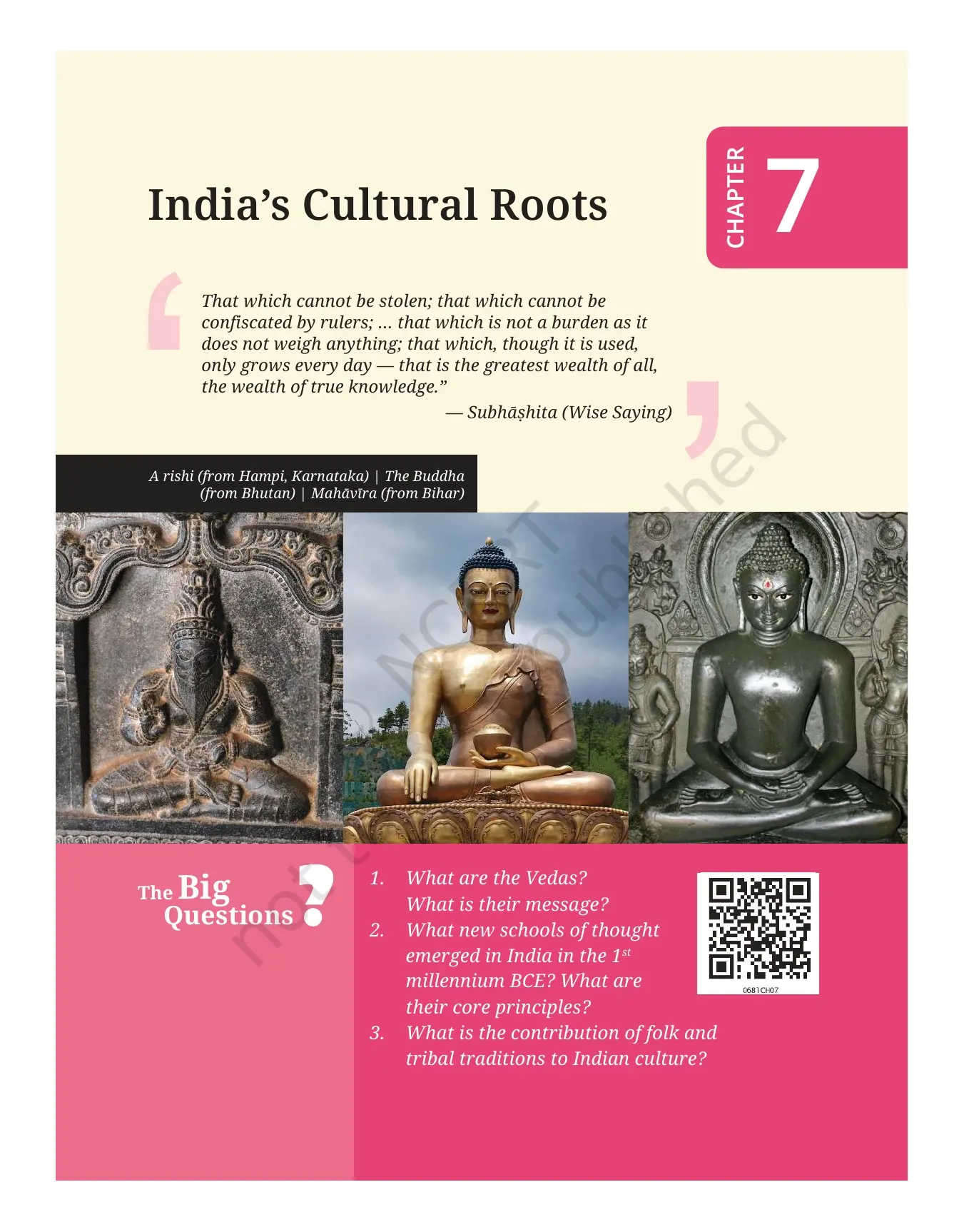
| Chapter opener | 105 | The Subhāṣhita on true knowledge, three photographs of a rishi from Hampi in Karnataka, the Buddha from Bhutan and Mahāvīra from Bihar, and the three Big Questions |
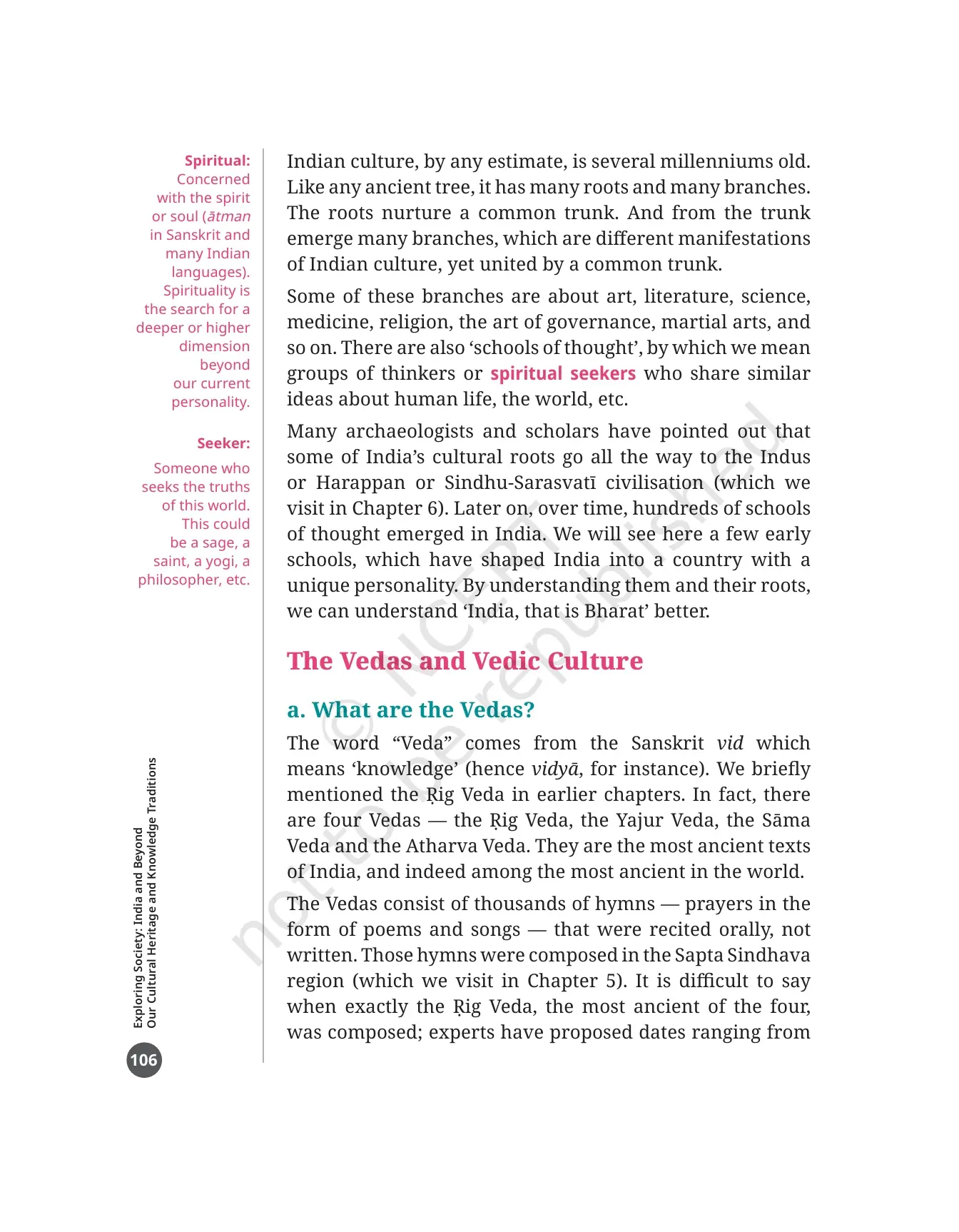
| The tree of Indian culture | 106 | Roots, trunk and branches, what a 'school of thought' means, the link back to the Sindhu-Sarasvatī civilisation, and the margin words Spiritual and Seeker |
| a. What are the Vedas? | 106 and 107 | The Sanskrit word vid, the four Vedas, oral transmission, the UNESCO DON'T MISS OUT box, and the margin words UNESCO, Cosmos and Worldview |
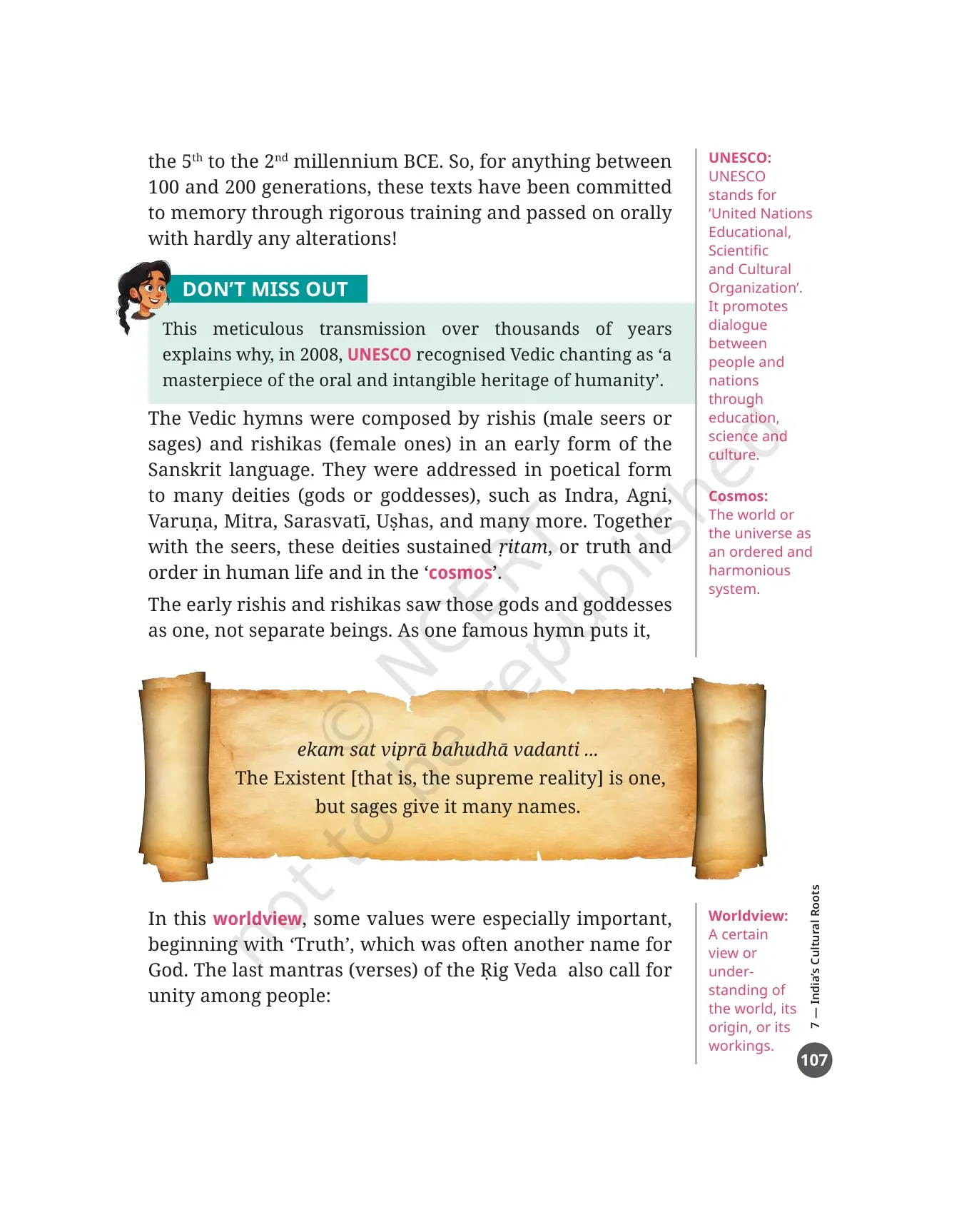
| The two Ṛig Veda quotations | 107 and 108 | ekam sat viprā bahudhā vadanti on one scroll panel, and the closing call for unity on the other |
| b. Vedic society | 108 and 109 | The janas, the timeline from 1500 BCE to 500 CE, rājā, sabhā and samiti, the list of professions, the margin word Healer and a LET'S EXPLORE box |
| c. Vedic schools of thought | 109 and 110 | Yajña, the Upaniṣhads, karma and rebirth, brahman, aham brahmāsmi, tat tvam asi, ātman, Yoga, a THINK ABOUT IT box and the margin word Consciousness |
| Three Upaniṣhad stories | 111 and 112 | Śhvetaketu and the seed of reality, Nachiketa and his quest, and the debate of Gārgī and Yājñavalkya |
| Buddhism | 110, and 113 to 115 | Lumbini, the four sights outside the palace, Bodh Gaya, ahimsa, the Buddha's saying, the Sangha, two stone panels and a LET'S EXPLORE box |
| Jainism | 115 and 116 | Prince Vardhamāna, the name Mahāvīra, the jina DON'T MISS OUT box, and ahimsa, anekāntavāda and aparigraha |
| The Jātaka tale and a Jain story | 116 and 117 | The monkey-king who made a bridge of his own body, and Rohineya the burglar who became a monk |
| Panels, caves and the Chārvāka school | 118 and 119 | The panel from a Jain temple in New Delhi, the Ellora caves of Maharashtra, two THINK ABOUT IT boxes and the Chārvāka or Lokāyata school |
| Folk and Tribal Roots | 120 and 121 | The shared trunk of dharma and karma, oral traditions, the definition of a tribe, the 2011 figures, Jagannath at Puri and the Toda tribals of the Nilgiris |
| Supreme tribal deities and André Béteille | 121 and 122 | Donyipolo, Khandoba, Singbonga, the Béteille quotation and the four-point Before we move on recap |
| Questions, activities and projects | 123 | 7 numbered questions, 7 true or false statements and 1 class activity |
| The banyan tree page | 124 | A full-page photograph explaining why the banyan is a fine symbol for Indian civilisation |
Also Check:
The Tree Image on Page 106 That Holds the Whole India's Cultural Roots Chapter Together
The chapter starts with one picture and returns to it twice. Indian culture is several millenniums old, and the book compares it to an ancient tree. Many roots feed a common trunk, and from the trunk grow many branches. Those branches are art, literature, science, medicine, religion, the art of governance and martial arts.
Two definitions from this page keep coming back in later sections, so learn them first.
- Schools of thought: groups of thinkers or spiritual seekers who share similar ideas about human life and the world.
- Spiritual (margin word): concerned with the spirit or soul, called ātman in Sanskrit and many Indian languages.
- Seeker (margin word): someone who seeks the truths of this world, such as a sage, a saint, a yogi or a philosopher.
The book says many archaeologists and scholars trace some of India's cultural roots all the way back to the Indus or Harappan or Sindhu-Sarasvatī civilisation, which Chapter 6 covers. Hundreds of schools of thought grew up later. This chapter picks only a few early ones, the ones that gave India its unique personality.
The Vedas, Buddhism and Jainism in One Quick Revision
Source: Magnet Brains on YouTube
The Vedas and Vedic Culture: Why the Four Vedas Were Never Written Down
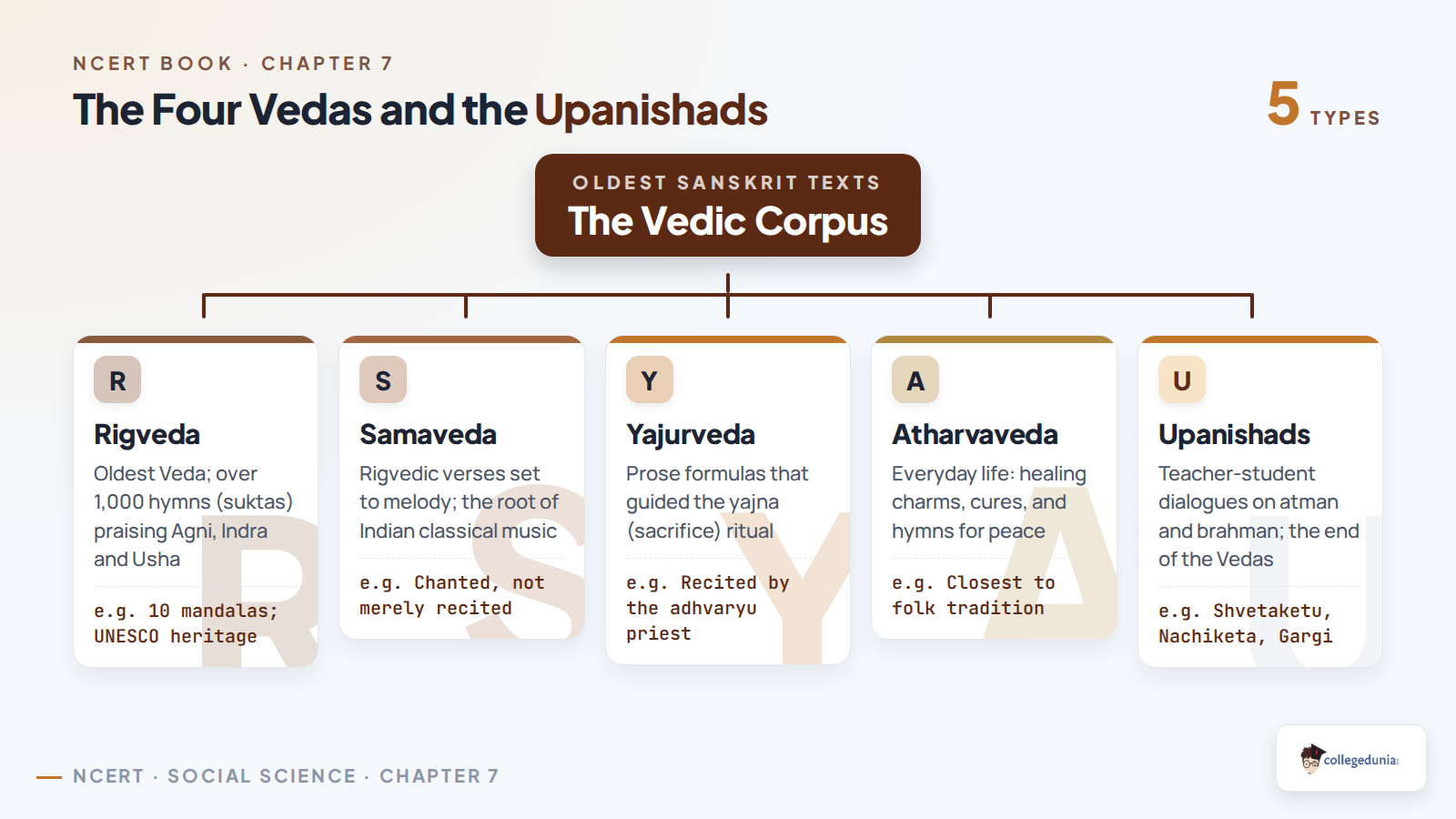
The word Veda comes from the Sanskrit vid, which means knowledge. The same root gives us the word vidyā. There are four Vedas, and the Class 6 test almost always asks you to name them in order.
- The Ṛig Veda, the most ancient of the four.
- The Yajur Veda.
- The Sāma Veda.
- The Atharva Veda.
They are the most ancient texts of India and among the most ancient in the world. The Vedas hold thousands of hymns, which are prayers in the form of poems and songs. The key point is how they travelled: the hymns were recited orally, not written. They were composed in the Sapta Sindhava region, which Chapter 5 covers.
Dating the Ṛig Veda is hard, and the book says so plainly. Experts have proposed dates ranging from the 5th to the 2nd millennium BCE. Between 100 and 200 generations committed these texts to memory through rigorous training and passed them on with hardly any changes.
The hymns were composed by rishis, who were male seers or sages, and rishikas, the female ones, in an early form of Sanskrit. They were addressed to many deities, and the six the book names are worth copying once.
- Indra, Agni, Varuṇa, Mitra, Sarasvatī and Uṣhas, with many more besides.
- Together with the seers, these deities sustained ṛitam, meaning truth and order in human life and in the cosmos.
- The margin word cosmos is defined as the world or the universe as an ordered and harmonious system.
- The margin word worldview is a certain view or understanding of the world, its origin or its workings.
The early rishis and rishikas saw those gods and goddesses as one, not as separate beings. The famous hymn ekam sat viprā bahudhā vadanti says it in one line: "The Existent [that is, the supreme reality] is one, but sages give it many names." The last mantras of the Ṛig Veda then call for unity among people: "Come together, speak together; common be your mind, may your thoughts agree."
Vedic Society: Janas, Rājā, Sabhā and Samiti on Printed Pages 108 and 109
Early Vedic society was organised in janas, or clans, meaning larger groups of people. The Ṛig Veda alone lists over 30 such janas. Each clan was tied to a particular region of the northwest part of the Subcontinent.
| Term from the chapter | What the book says it means |
|---|---|
| Jana | A clan, that is, a larger group of people. Examples named are the Bharatas, the Purus, the Kurus, the Yadus and the Turvaśhas |
| Rājā | A king or ruler |
| Sabhā | A collective gathering or assembly |
| Samiti | Also a collective gathering or assembly |
| Healer (margin word) | Someone who uses traditional practices to relieve or heal diseases |
The book is honest about the limits of the evidence. Not much is known of how these janas governed their society, and the Vedas give only a few clues through the words above. What the texts do give freely is a list of jobs: agriculturist, weaver, potter, builder, carpenter, healer, dancer, barber and priest.
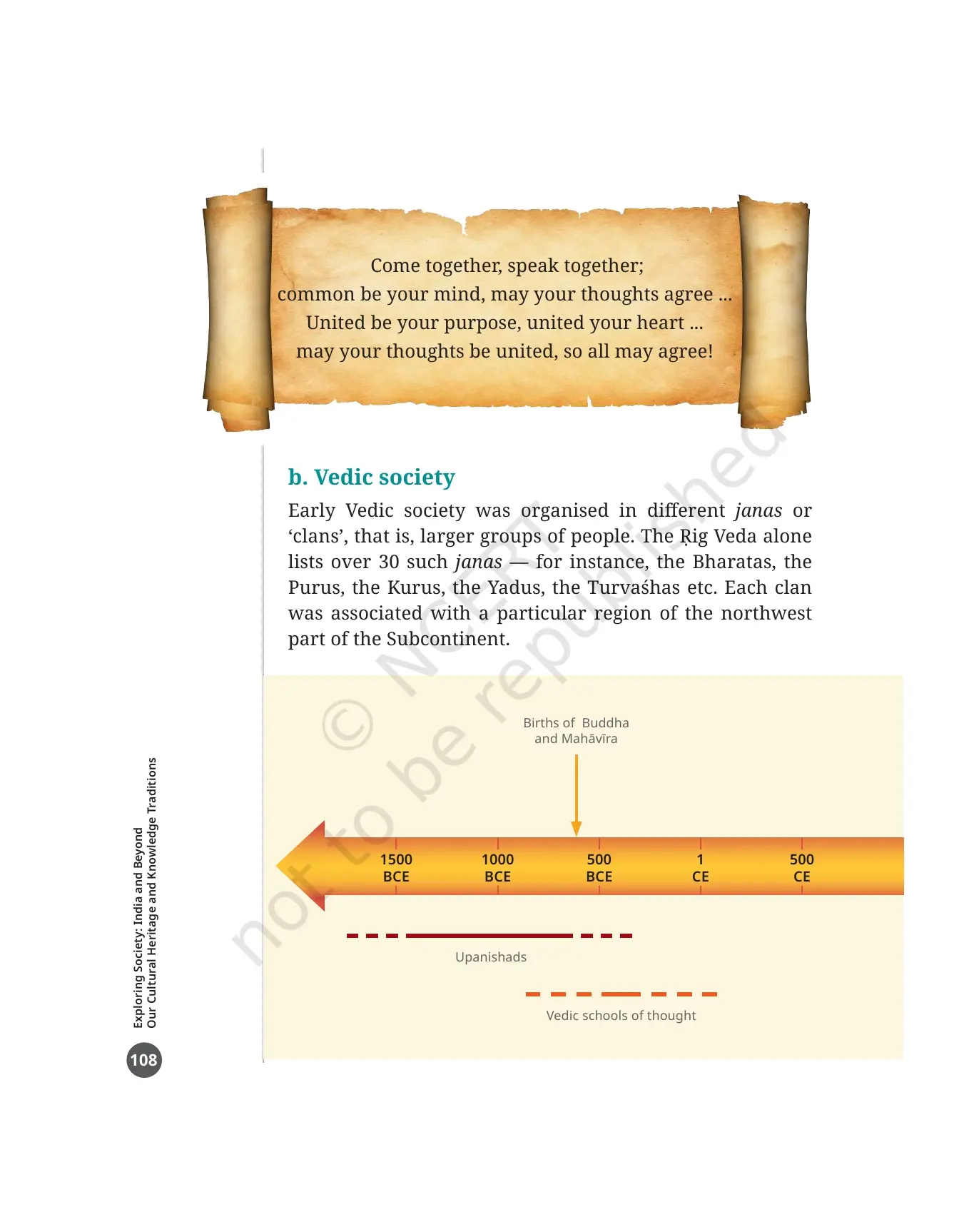
The timeline on printed page 108 runs from 1500 BCE to 500 CE. It marks the births of the Buddha and Mahāvīra near 500 BCE, and shows two long bands, one for the Upaniṣhads and one for the Vedic schools of thought. The LET'S EXPLORE box on printed page 109 then asks for the term used for a society where people select their leaders, and for a 100 to 150 word paragraph on how people benefit from it.
Vedic Schools of Thought: The Upaniṣhads, Karma, Brahman, Ātman and Yoga
Vedic culture also developed many rituals, called yajña and often read as 'yagya'. These were directed at various deities for individual or collective wellbeing. Daily rituals were usually prayers and offerings to Agni, the deity of fire, and over time they became more and more complex.
A group of texts called the Upaniṣhads built on Vedic ideas and added new ones. Four concepts come out of this section, and every one of them turns up in school tests.
- Rebirth: taking birth again and again.
- Karma: our actions, or the results of those actions.
- Brahman: the one divine essence in human life, nature and the universe, sometimes called just tat, meaning 'that'. This is the idea of the school known as Vedanta.
- Ātman, or Self: the divine essence that lives in every being and is ultimately one with brahman.
The book warns in brackets that brahman is not to be confused with the god Brahmā. Two short mantras carry the Vedanta idea: aham brahmāsmi, "I am brahman", that is, I am divine, and tat tvam asi, "You are That". Because the ātman is one with brahman, everything in this world is connected and interdependent.
That is why a common prayer begins with sarve bhavantu sukhinah, "May all creatures be happy", and goes on to wish them free from disease and sorrow. Early in the 1st millennium BCE, several more schools grew out of the Vedas. One was Yoga, which developed methods to realise brahman in one's consciousness. Together, these schools became the foundations of what we call Hinduism today.
Buddhism: From Prince Siddhārtha Gautama to the Buddha and the Sangha
Other schools of thought did not accept the authority of the Vedas and built their own systems. Buddhism is one of them. About two-and-a-half millenniums ago, a young prince named Siddhārtha Gautama was born in Lumbini, which is in present-day Nepal. Scholars disagree on the exact year, and the book notes that Chapter 4 chose 560 BCE as an approximate date.
The story of his change follows five clear steps, and school papers usually ask for them in order.
- He grew up living a protected life inside the palace.
- At the age of 29 he was driven through the city in a chariot and saw, for the first time, an old man, a sick man and a dead body.
- He also saw an ascetic who appeared to be happy and at peace.
- He left his palace life, his wife and his son, and travelled on foot as an ascetic, looking for the root cause of suffering.
- After meditating for many days under a pipal tree at Bodh Gaya in present-day Bihar, he attained enlightenment.
What he realised is the line to memorise: avidyā, meaning ignorance, and attachment are the source of human suffering. He then worked out a method to remove those two causes. He became known as the Buddha, which means the 'enlightened' or 'awakened' one.
| Term | What the chapter says |
|---|---|
| Ahimsa | Generally translated as 'non-violence', but it originally means 'non-hurting' or 'non-injuring' |
| Sangha | The community founded by the Buddha for those who practised and spread his teachings |
| Bhikṣhus | Monks. The margin word monk is a man who gives up the usual life in the world and takes vows for a disciplined life |
| Bhikṣhuṇīs | Nuns, added later. The margin word nun is simply the female equivalent of a monk |
| Ascetic (margin word) | Someone who engages in a rigorous discipline to attain a higher consciousness |
| Attachment (margin word) | The condition of having a bond with someone or something, usually through sentiment or habit |
The Buddha also insisted on sincere inner discipline. His saying on printed page 114 is set as end question 3, so quote it exactly: "Not by water is one made pure, though many people may bathe here [in sacred rivers]. But one is pure in whom truth and dharma reside. Conquering oneself is greater than conquering a thousand men on the battlefield a thousand times." His influence on India and on the whole of Asia was enormous, and the book says it is still felt today.
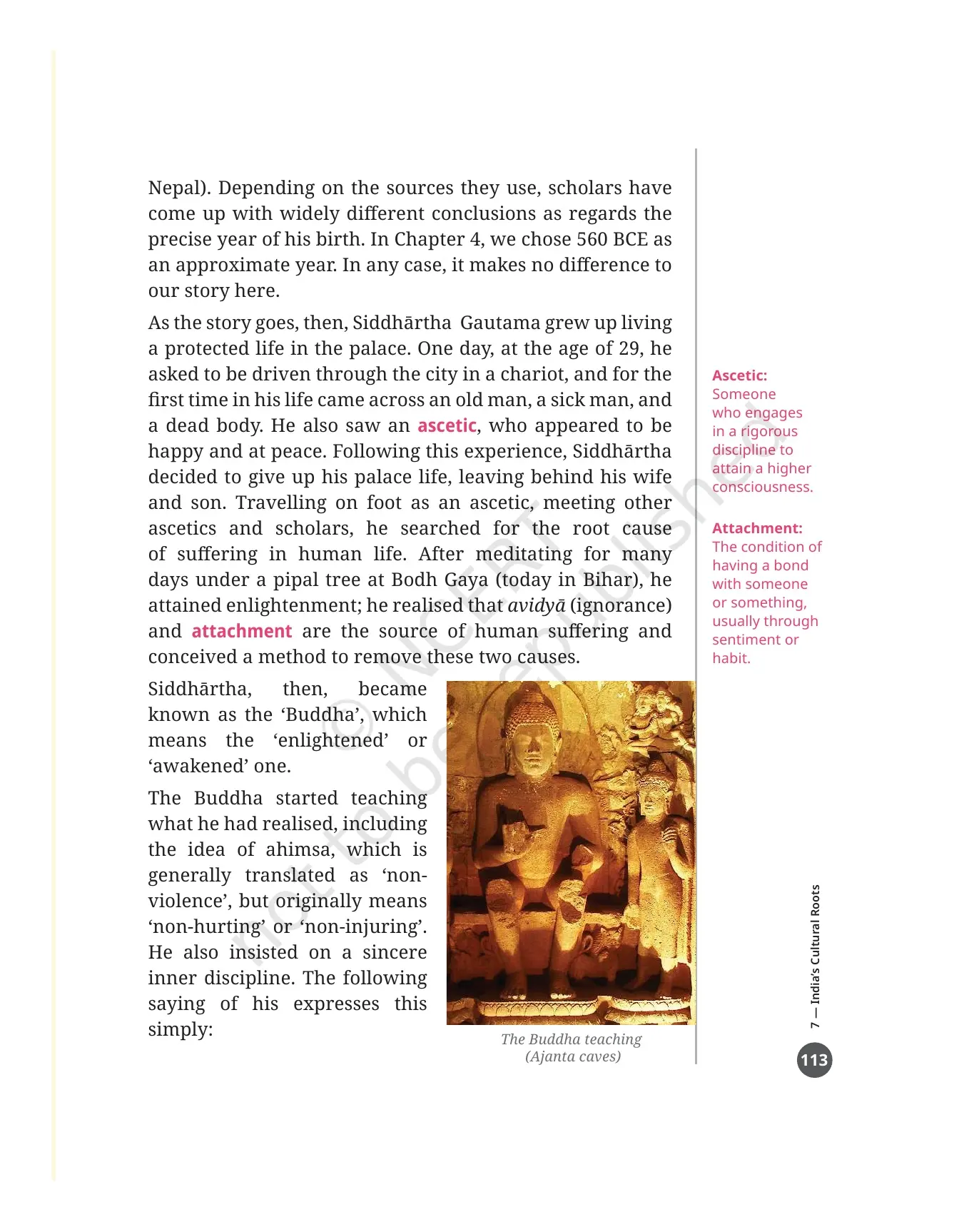
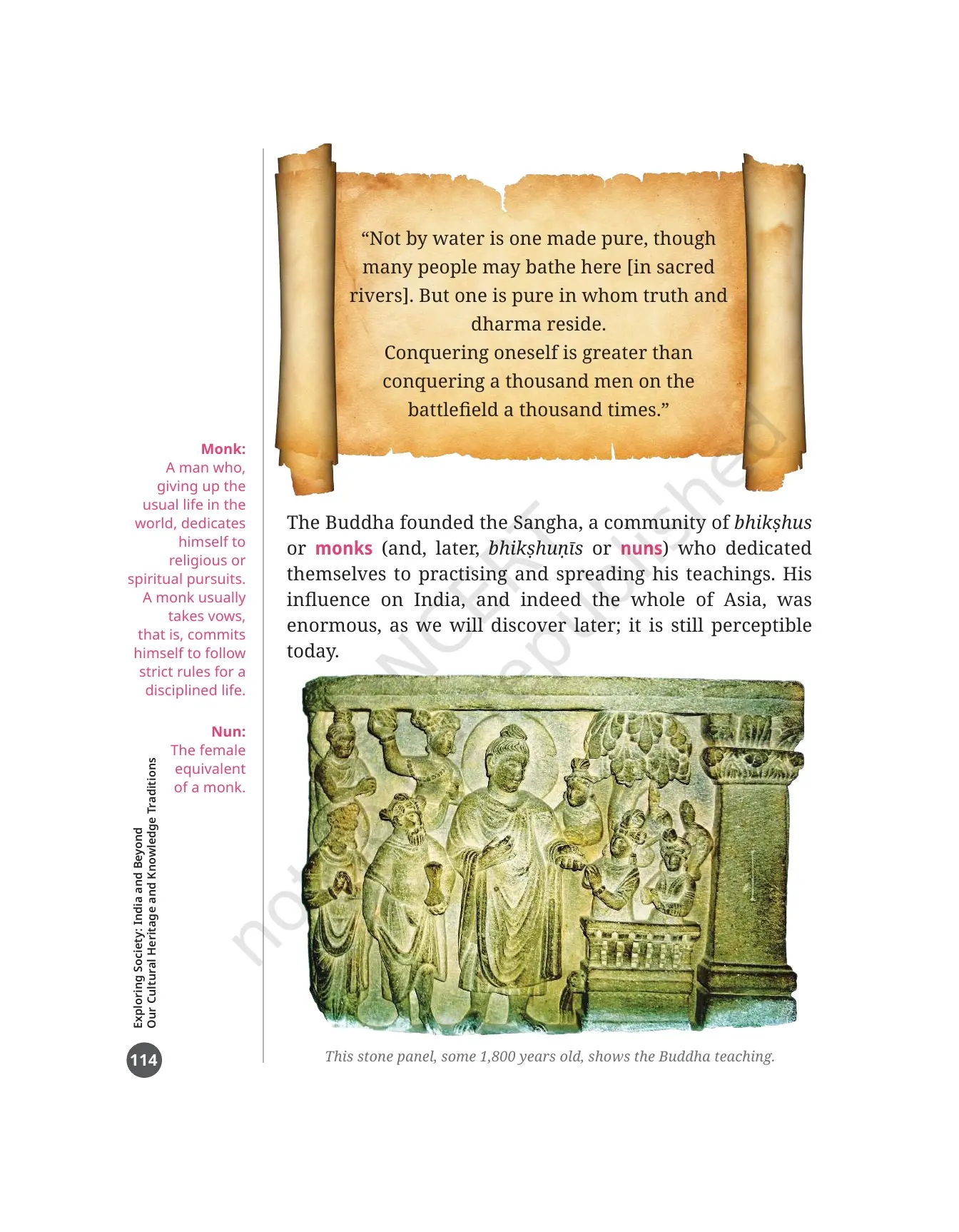
Two photographs support this section. Printed page 113 shows the Buddha teaching, from the Ajanta caves. Printed page 114 shows a stone panel some 1,800 years old of the Buddha teaching, and the LET'S EXPLORE box on printed page 115 asks you to discuss how the Buddha is shown in it, then name states of India or other countries where Buddhism is a major religion today and plot them on a world map.
Jainism: Mahāvīra and the Three Ideas of Ahimsa, Anekāntavāda and Aparigraha
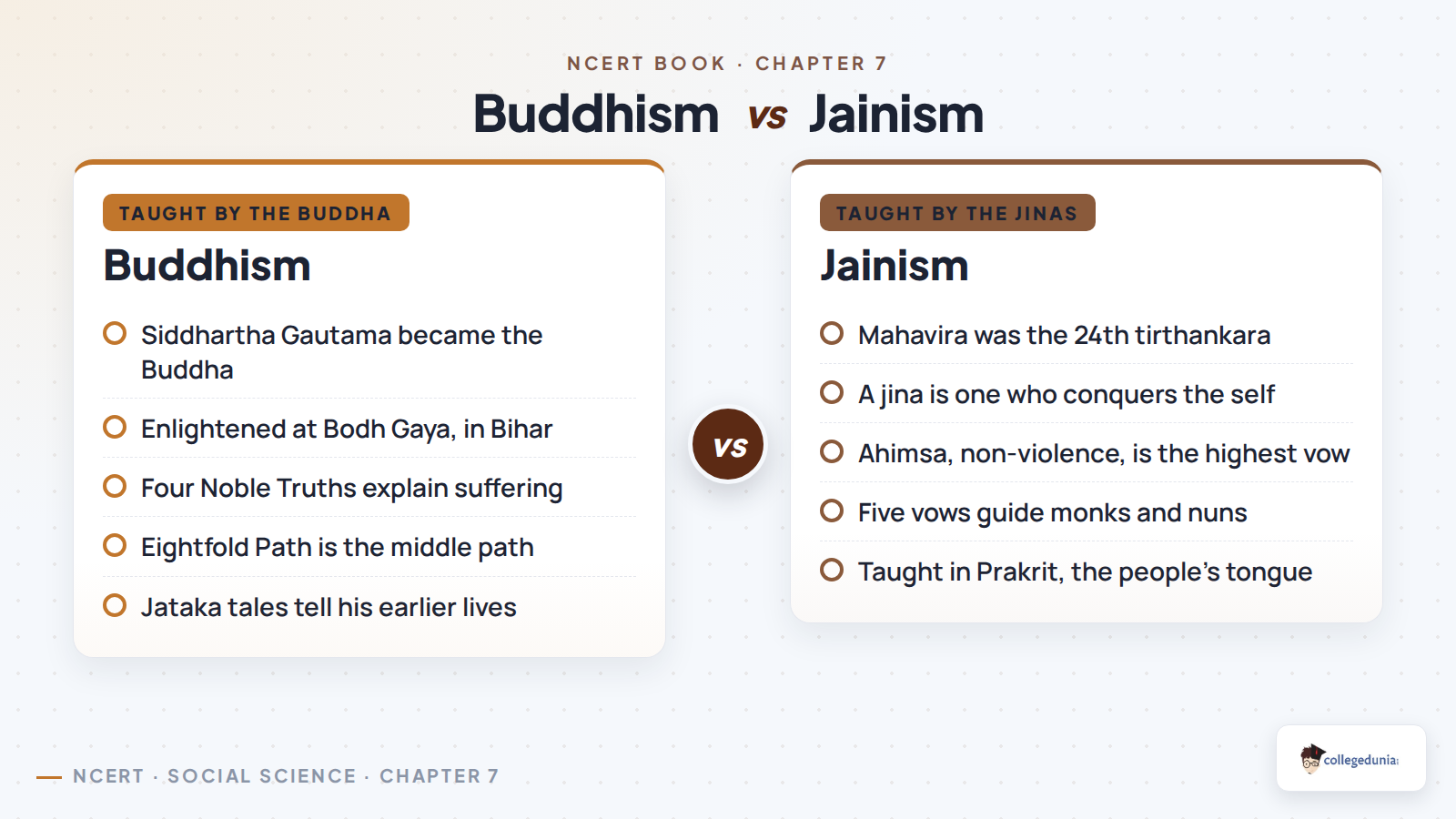
Jainism spread at the same time as Buddhism, although the book says its roots are much more ancient. Prince Vardhamāna was born into a royal family in the early 6th century BCE, near the city of Vaiśhālī in modern-day Bihar. At the age of 30 he left home to look for spiritual knowledge.
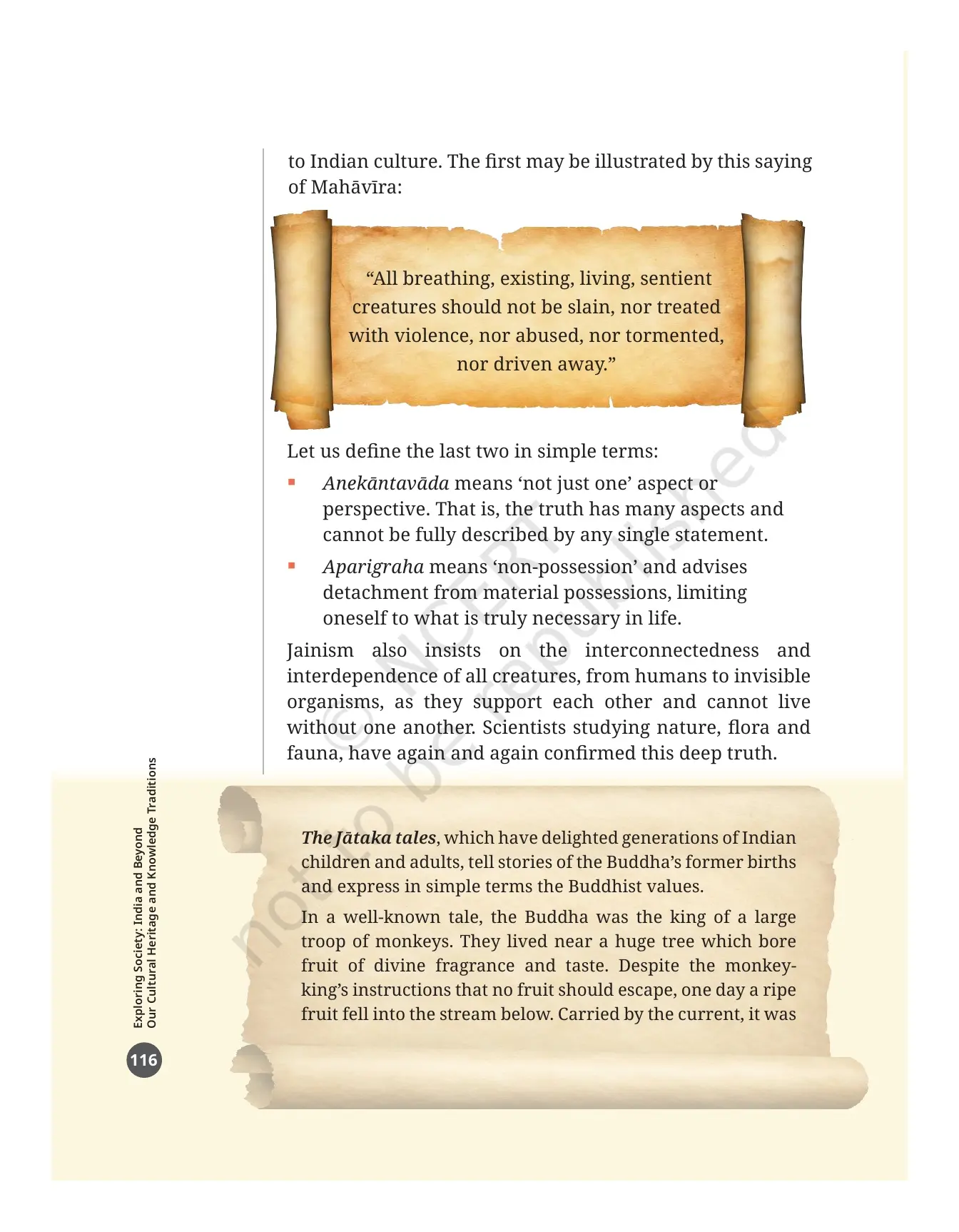
He practised an ascetic discipline and, after 12 years, achieved 'infinite knowledge' or supreme wisdom. He became known as Mahāvīra, which means 'great hero', and began preaching. A traditional painting of Mahāvīra sits on printed page 115.
Three Jain teachings are named, and the survey above shows they are the biggest mark-loser in the chapter. The book defines the last two for you in simple terms.
- Ahimsa, illustrated by Mahāvīra's saying: "All breathing, existing, living, sentient creatures should not be slain, nor treated with violence, nor abused, nor tormented, nor driven away."
- Anekāntavāda means 'not just one' aspect or perspective. The truth has many aspects and cannot be fully described by any single statement.
- Aparigraha means 'non-possession'. It advises detachment from material possessions and limiting oneself to what is truly necessary in life.
These ideas are shared to a large extent with Buddhism and with the Vedantic school, and the book calls them central to Indian culture. Jainism also insists on the interconnectedness and interdependence of all creatures, from humans to invisible organisms, and the book adds that scientists studying nature, flora and fauna have confirmed this again and again.
The Chārvāka School and the Shared Trunk of Dharma, Karma and Rebirth
Printed page 119 adds one more school so that you see how wide the choice was. The Chārvāka school, sometimes also called Lokāyata, held that this material world is the only thing that exists, so there can be no life after death. It did not gain much popularity and disappeared with time.
The book explains why it is mentioned at all: to show that there was a wide diversity of intellectual and spiritual belief systems, and that people were free to choose what suited them. Two more points close this part of the chapter.
- In both Buddhism and Jainism, monks and sometimes nuns travelled across the land to spread their teachings. Some built new monasteries far away, others led ascetic lives in caves cut in the rock.
- Archaeological findings have revealed many traces of those monasteries, sometimes even the names of the monks who lived in the rock-cut caves and slept on stone beds.
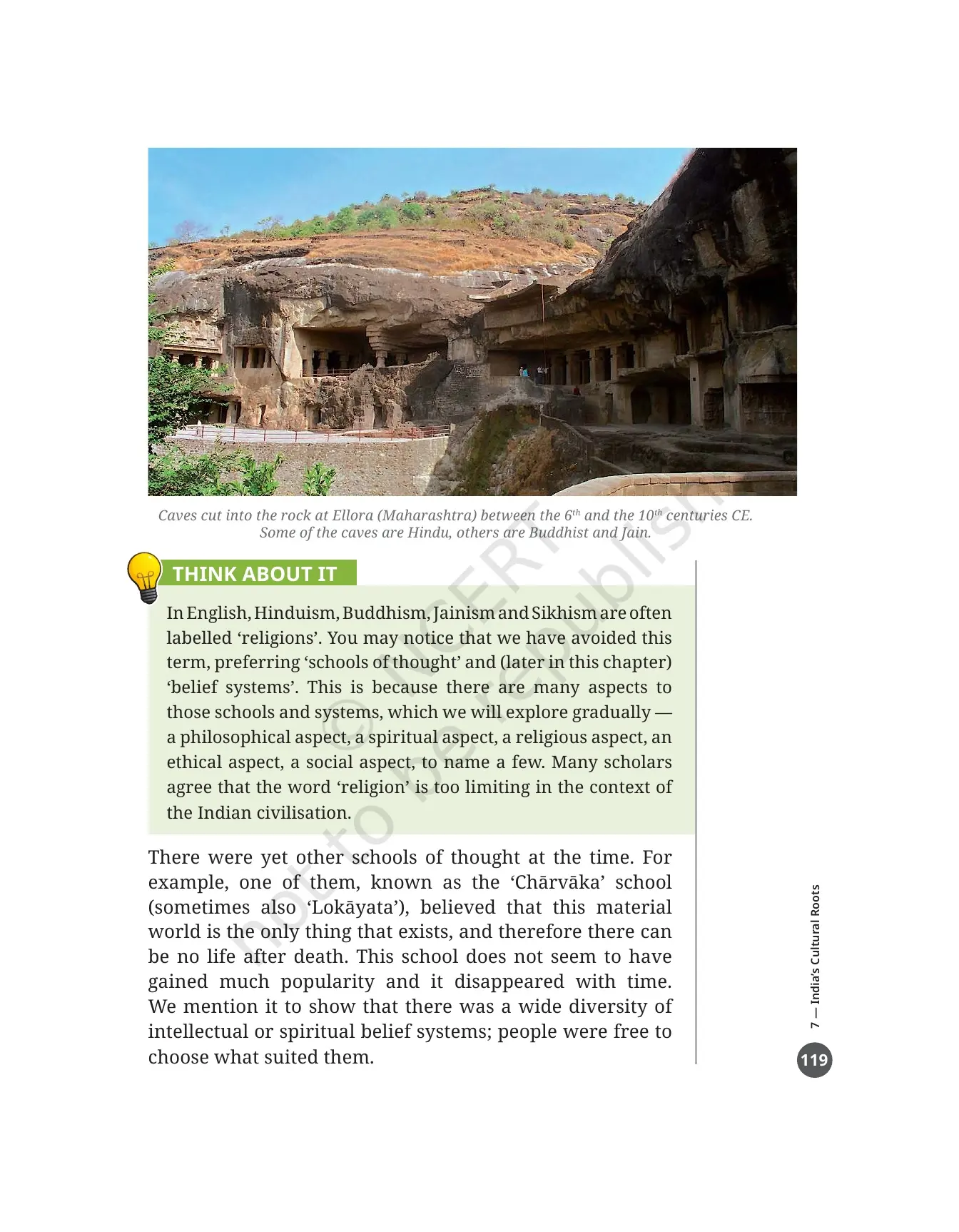
- The photograph on printed page 119 shows the caves at Ellora in Maharashtra, cut between the 6th and the 10th centuries CE. Some are Hindu, others are Buddhist and Jain.
- The Vedic, Buddhist and Jain schools had important differences, but shared dharma, karma, rebirth, the search for an end to suffering and ignorance, and many values. That shared set is the trunk of the tree.
A THINK ABOUT IT box on printed page 119 explains a choice of words that puzzles many students. In English, Hinduism, Buddhism, Jainism and Sikhism are often called 'religions', but the chapter avoids that word and says 'schools of thought' and 'belief systems' instead. The reason given is that these systems have philosophical, spiritual, religious, ethical and social aspects, and many scholars agree that the word 'religion' is too limiting for the Indian civilisation.
Folk and Tribal Roots: What a Tribe Is and the 705 Tribes Counted in 2011
The roots seen so far are well documented in texts. India also has rich oral traditions, meaning teachings or practices passed on through everyday practice without written texts, exactly as the Vedas were. Among them are folk traditions, carried by common people, and tribal traditions, carried by tribes.
The book gives the working definition anthropologists use today, and the numbers that go with it.
| Point | What the chapter says on printed page 120 |
|---|---|
| Definition of a tribe | A group of families or clans sharing a tradition of common descent, a culture and a language, living as a close-knit community under a chief and holding no private property |
| The ancient Indian word | There was none. Tribes were just different janas that lived in a specific environment, such as forests or mountains |
| The words used today | The Constitution of India uses 'tribes' and 'tribal communities' in English, and janjāti in Hindi |
| Official figures for 2011 | 705 tribes spread over most States, with a population of about 104 million people |
| The comparison the book draws | That is more than the populations of Australia and the United Kingdom together |
| A correction the book makes | In the 19th century anthropologists often called tribes 'primitive' or 'inferior'. Deeper study of their rich and complex cultures has mostly ended such biased judgments |
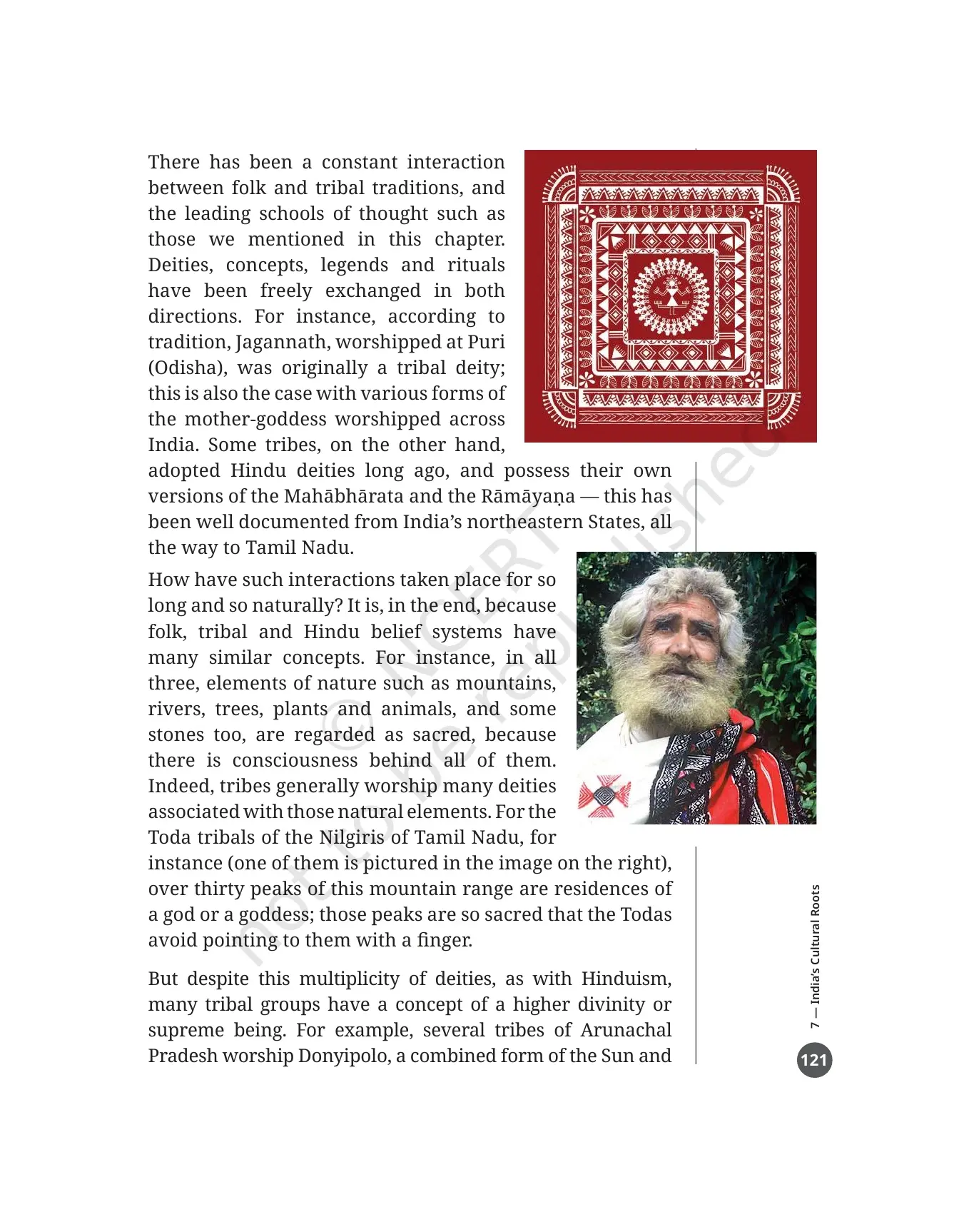
Folk and tribal traditions have not stayed separate from the big schools of thought. Deities, concepts, legends and rituals have been freely exchanged in both directions. According to tradition, Jagannath, worshipped at Puri in Odisha, was originally a tribal deity, and so were various forms of the mother-goddess worshipped across India. Some tribes adopted Hindu deities long ago and hold their own versions of the Mahābhārata and the Rāmāyaṇa, documented from the northeastern States all the way to Tamil Nadu.
Tribal Deities and Supreme Beings: The Todas, Donyipolo, Khandoba and Singbonga
The chapter answers its own question about why the exchange happened so naturally. Folk, tribal and Hindu belief systems share many concepts. In all three, elements of nature such as mountains, rivers, trees, plants, animals and some stones are regarded as sacred, because there is consciousness behind all of them.
Four examples carry this section, and each one pairs a name with a place. Learn them as pairs.
| Tribe or deity | Where | What the chapter says |
|---|---|---|
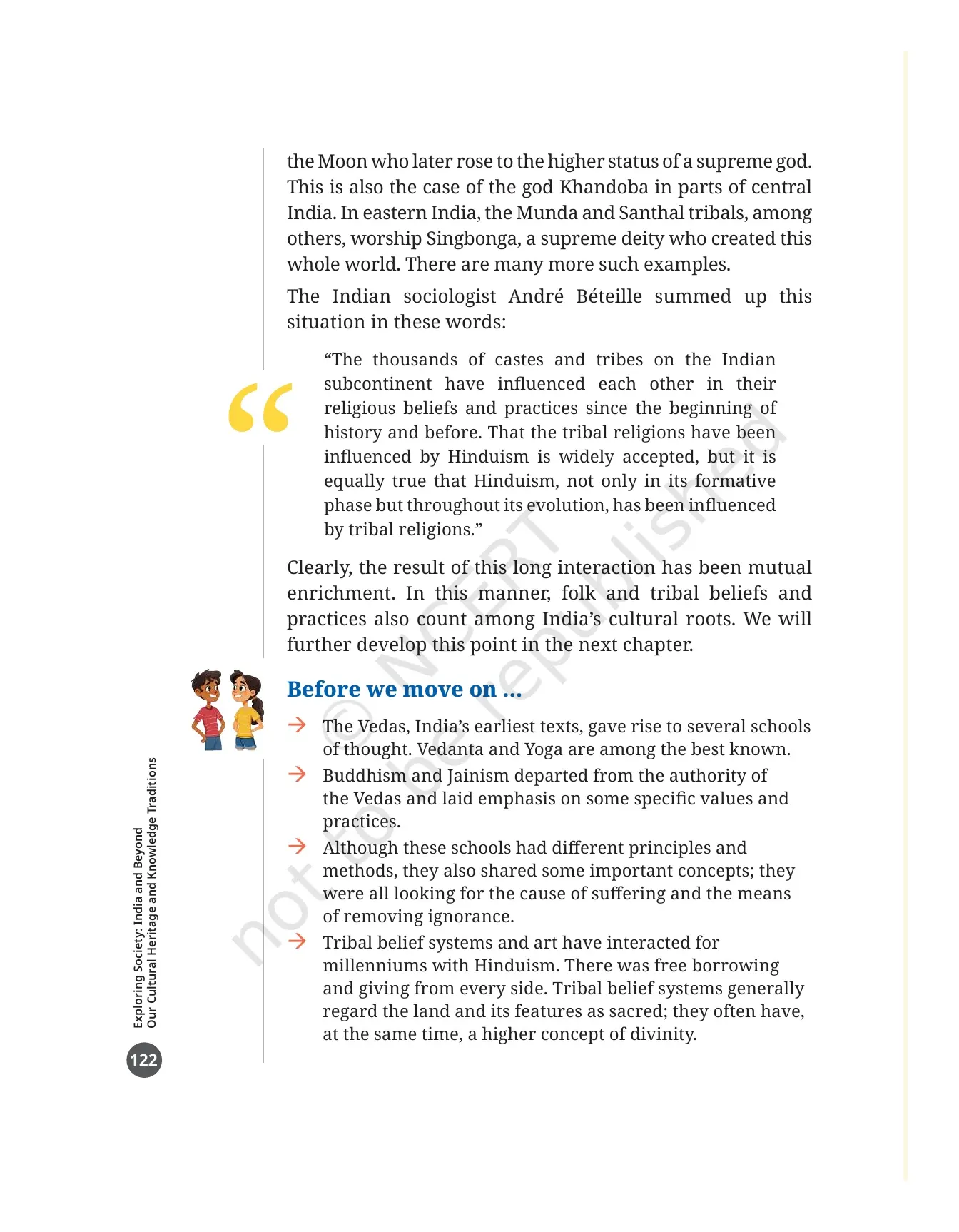
| The Toda tribals | The Nilgiris, Tamil Nadu | Over thirty peaks of this range are residences of a god or a goddess. Those peaks are so sacred that the Todas avoid pointing at them with a finger |
| Donyipolo | Arunachal Pradesh | A combined form of the Sun and the Moon, who later rose to the higher status of a supreme god |
| Khandoba | Parts of central India | Another example of a tribal deity raised to the rank of a supreme being |
| Singbonga | Eastern India, worshipped by the Munda and Santhal tribals | A supreme deity who created this whole world |
The section closes with a quotation from the Indian sociologist André Béteille, and end question 5 sends you straight back to it. He wrote that the thousands of castes and tribes on the Indian subcontinent have influenced each other in their religious beliefs and practices since the beginning of history. His key point is that the influence ran both ways: tribal beliefs were shaped by Hinduism, and Hinduism was shaped by tribal beliefs throughout its evolution. The result of this long interaction, the book says, has been mutual enrichment.
The Five Story Boxes from the Upaniṣhads, the Jātaka Tales and Jain Tradition
Five illustrated stories sit on their own pages, and students skim them because they look like decoration. They are not. End questions 1 and 3 both come straight out of them, so read them slowly once.
| Story | Source and page | What happens and what it teaches |
|---|---|---|
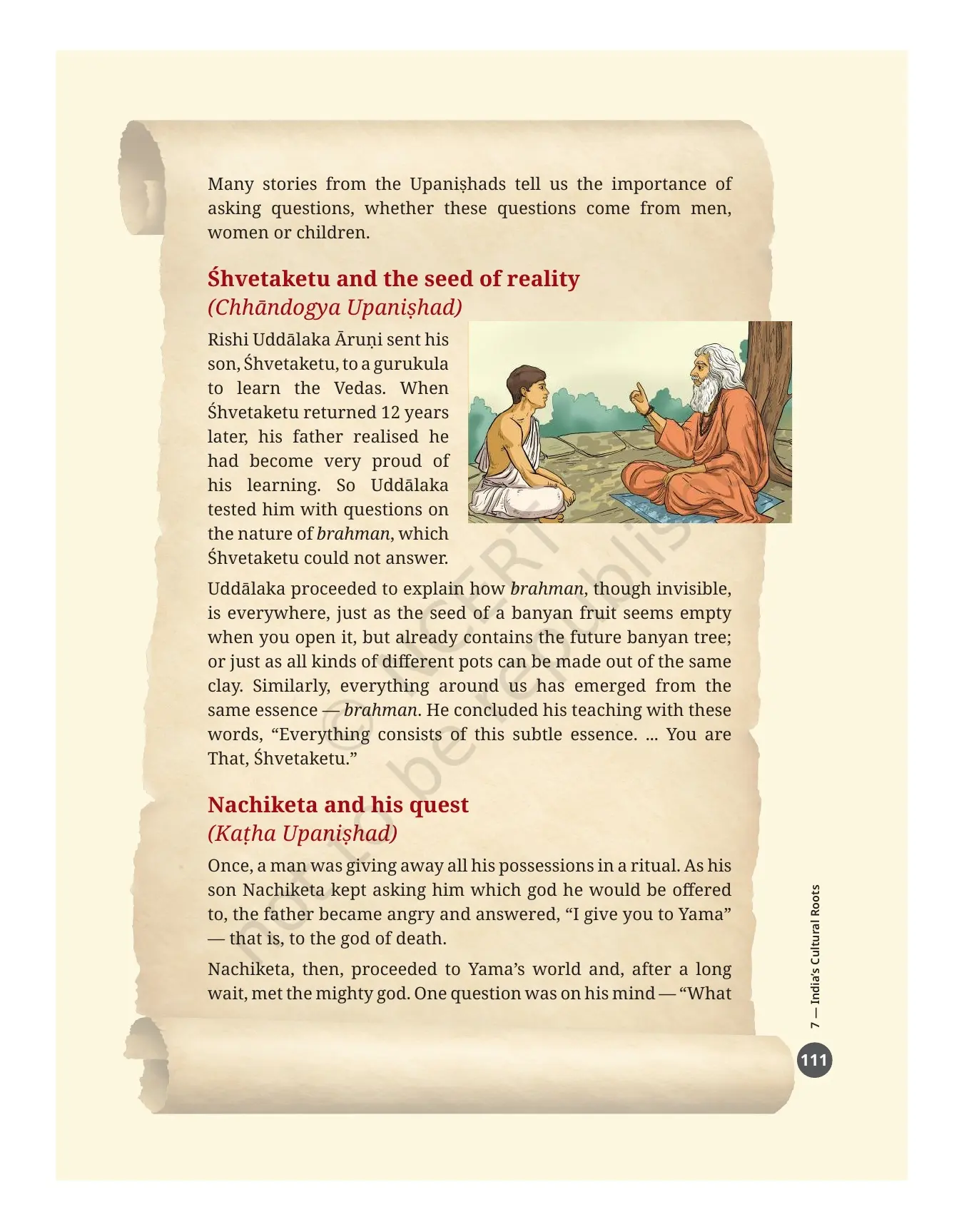
| Śhvetaketu and the seed of reality | Chhāndogya Upaniṣhad, page 111 | Rishi Uddālaka Āruṇi sends his son to a gurukula for 12 years. The proud son cannot answer questions on brahman, so the father explains it through a banyan seed that looks empty but holds a whole tree, and through clay that becomes many pots. He ends with "You are That, Śhvetaketu" |
| Nachiketa and his quest | Kaṭha Upaniṣhad, pages 111 and 112 | An angry father gives his son to Yama, the god of death. Nachiketa waits, then asks what happens after the death of the body. Yama finally explains that the ātman is hidden within all creatures, is neither born nor dies, and is immortal |
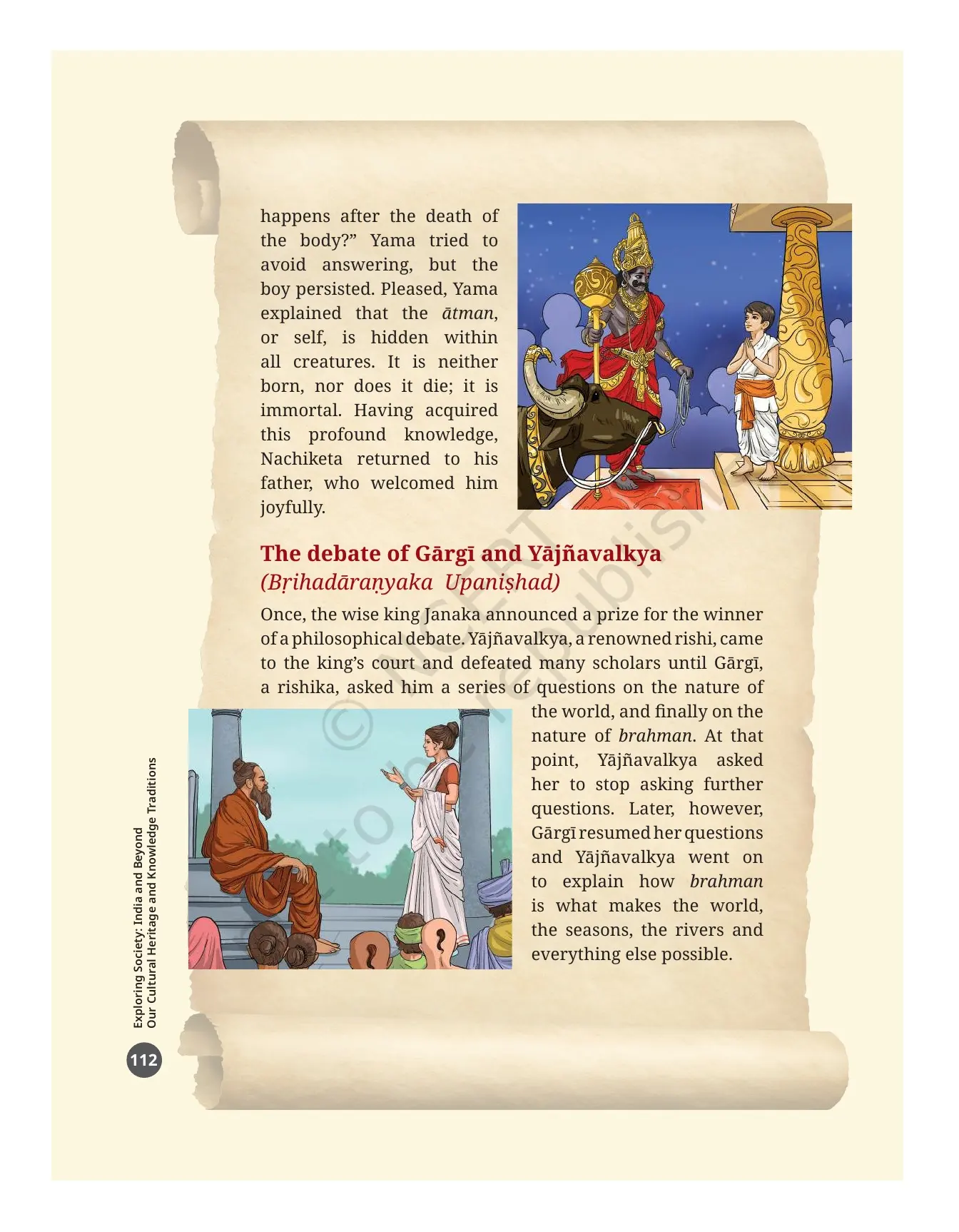
| The debate of Gārgī and Yājñavalkya | Bṛihadāraṇyaka Upaniṣhad, page 112 | King Janaka announces a prize for a philosophical debate. Gārgī, a rishika, questions the rishi Yājñavalkya on the nature of the world and of brahman. He asks her to stop, she resumes, and he explains how brahman makes the world, the seasons and the rivers possible |
| The monkey-king | A Jātaka tale, pages 116 and 117 | The Buddha in a former birth is king of a troop of monkeys. To save them from the king's soldiers he holds a tree and lets them cross the stream over his own body. He is badly hurt and dies. The watching king is moved and rethinks a ruler's duty to his subjects |
| Rohineya the burglar | A Jain story, page 117 | A skilled burglar overhears a few sentences of a sermon by Mahāvīra. Arrested and tested by a minister's clever plan, he remembers those words and defeats the plan. He then confesses, returns the stolen treasures and becomes a monk |
The book gives a one-line moral for the last story that works as a ready-made answer: it shows the importance of right action and right thinking, and the fact that everyone should have a second chance. The introduction to the Upaniṣhad stories makes a point worth quoting too: these stories show the importance of asking questions, whether the questions come from men, women or children.
Every Photograph, Activity Box and Margin Word Inside the India's Cultural Roots PDF
Unlike Chapter 6, this chapter numbers none of its images. They carry captions instead, so quote the caption when an answer needs one. Eleven margin words carry the vocabulary and eight boxes turn the reading into tasks. Tick them off as you go.
| Photograph or box | Printed page | What it shows or asks |
|---|---|---|
| Three opener photographs | 105 | A rishi from Hampi in Karnataka, the Buddha from Bhutan and Mahāvīra from Bihar |
| The Big Questions | 105 | What are the Vedas and what is their message, what new schools of thought emerged in the 1st millennium BCE and what are their core principles, and what is the contribution of folk and tribal traditions |
| Two scroll panels | 107 and 108 | ekam sat viprā bahudhā vadanti, and the Ṛig Veda call for unity beginning "Come together, speak together" |
| The timeline | 108 | 1500 BCE to 500 CE, marking the births of the Buddha and Mahāvīra, the Upaniṣhads band and the Vedic schools of thought band |
| Story illustrations | 111 and 112 | Śhvetaketu with his father, Nachiketa before Yama, and Gārgī debating Yājñavalkya |
| Two Buddha panels | 113 and 114 | The Buddha teaching from the Ajanta caves, and a stone panel some 1,800 years old showing the Buddha teaching |
| Mahāvīra painting | 115 | A traditional painting of Mahāvīra |
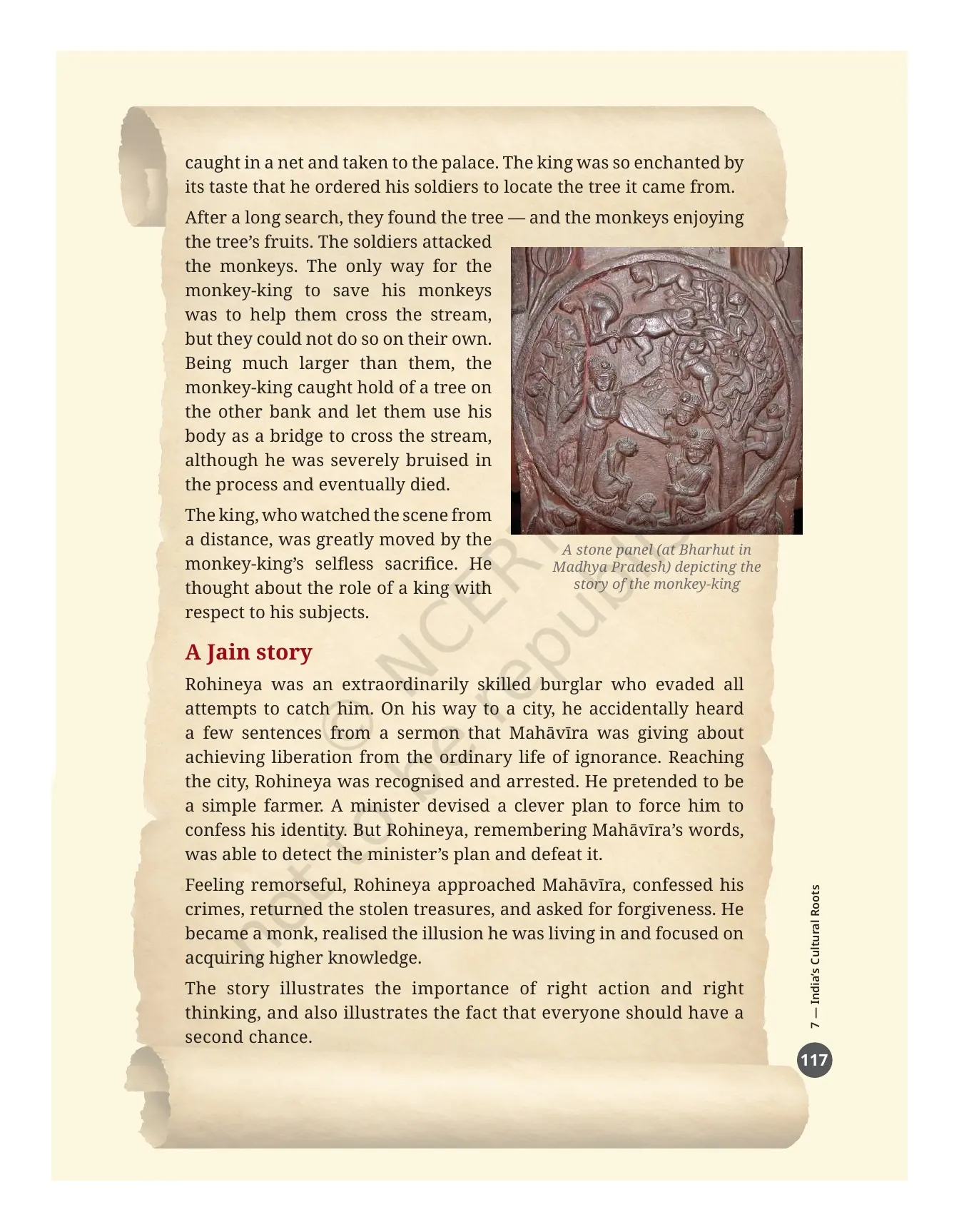
| The monkey-king panel | 117 | A stone panel at Bharhut in Madhya Pradesh depicting the story of the monkey-king |
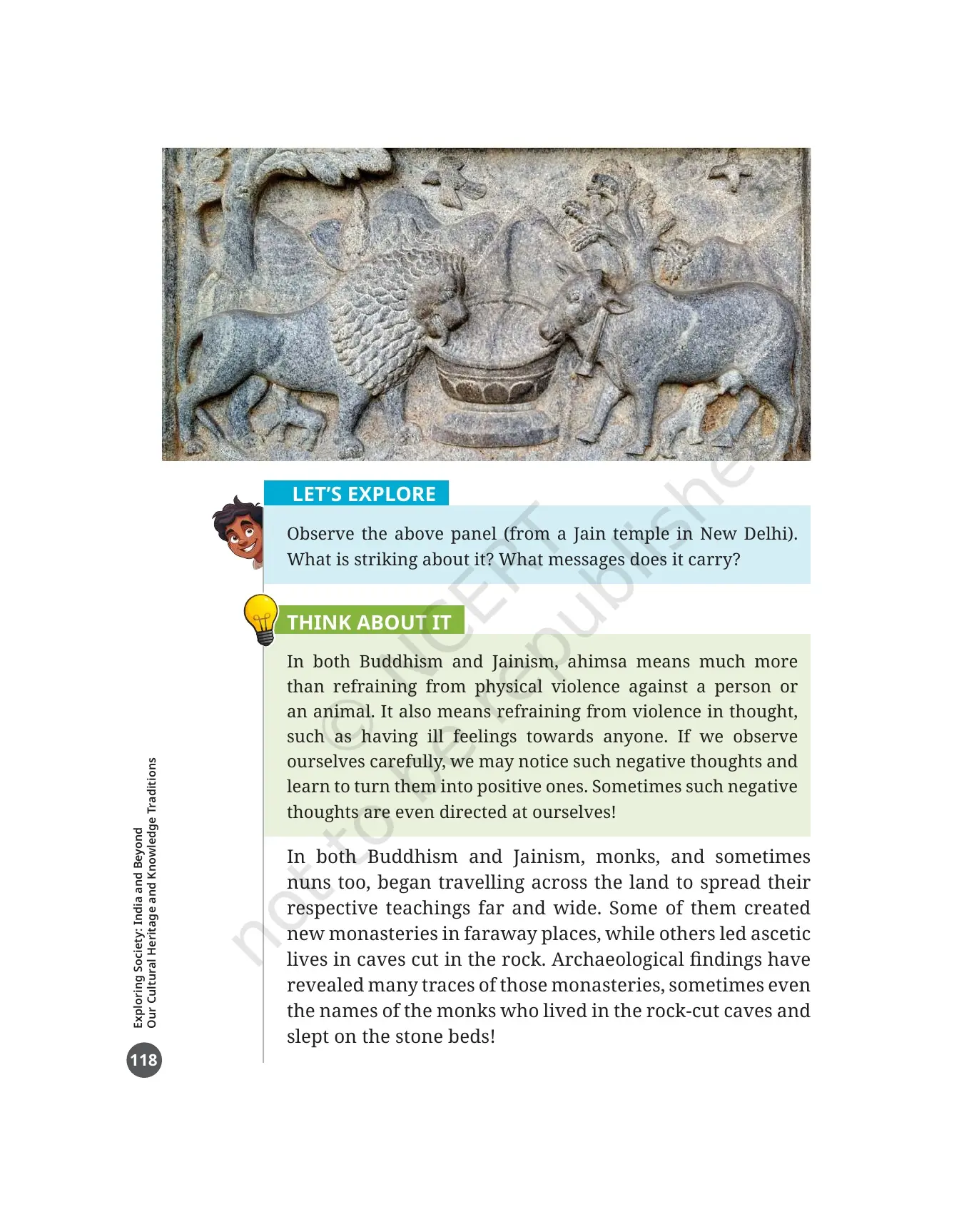
| The Jain temple panel | 118 | A carved panel from a Jain temple in New Delhi, showing animals gathered around a vessel |
| The Ellora caves | 119 | Caves cut into the rock in Maharashtra between the 6th and the 10th centuries CE, some Hindu, others Buddhist and Jain |
| A Toda tribal | 121 | Pictured beside the passage on the sacred peaks of the Nilgiris |
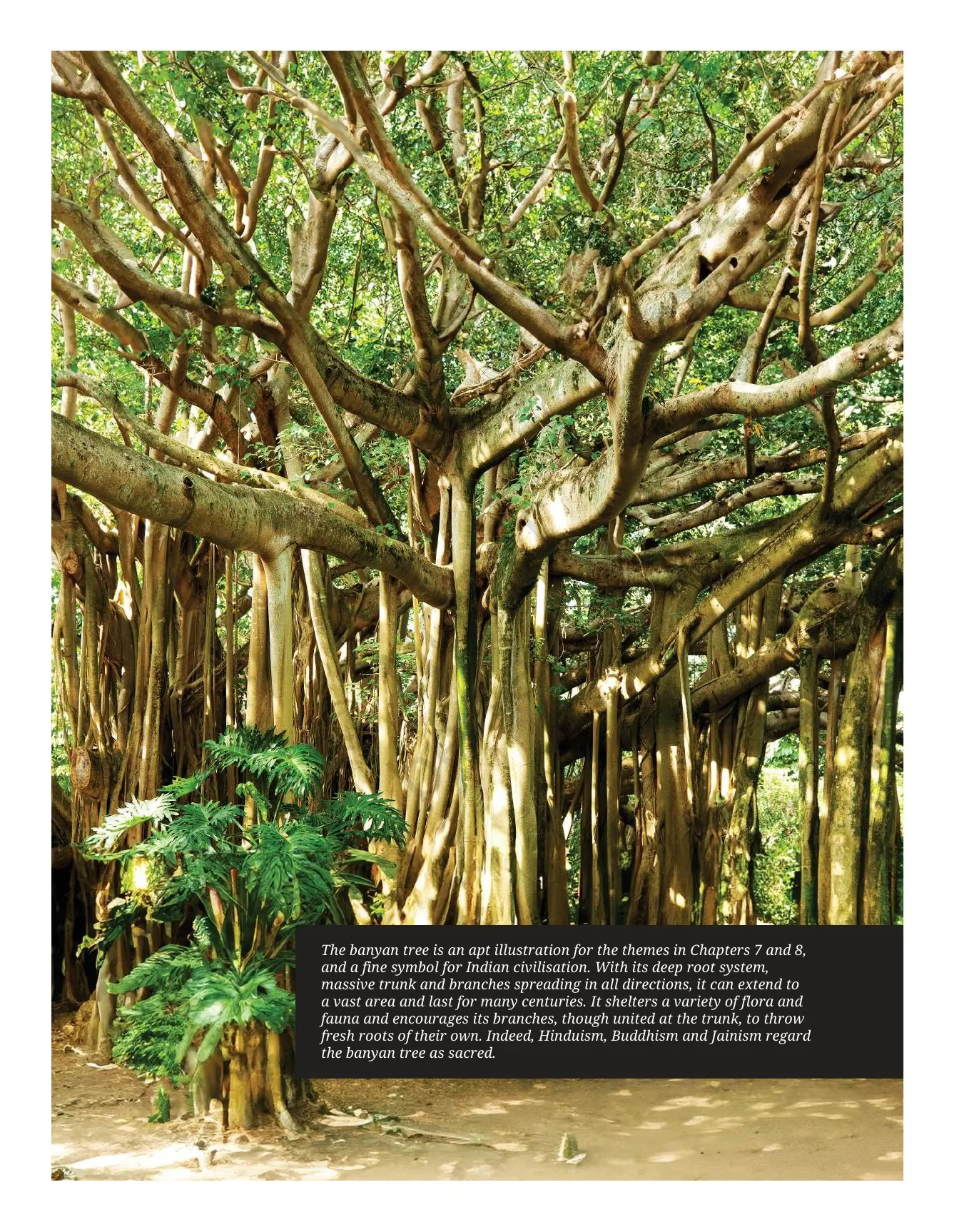
| The banyan tree | 124 | A full page on why the banyan, with its deep roots, massive trunk and spreading branches, is a fine symbol for Indian civilisation, and why Hinduism, Buddhism and Jainism regard it as sacred |
| LET'S EXPLORE boxes | 109, 115 and 118 | The term for a society that selects its leaders, discussing the Buddha panel and mapping Buddhist regions, and reading the Jain temple panel |
| THINK ABOUT IT boxes | 110, 118 and 119 | Another story that carried a message, ahimsa as freedom from violence in thought, and why the book says 'schools of thought' rather than 'religions' |
| DON'T MISS OUT boxes | 107 and 115 | The UNESCO recognition of Vedic chanting in 2008, and the meaning of jina as 'conqueror' |
| Margin words | 106, 107, 109, 110, 113 and 114 | Spiritual, Seeker, UNESCO, Cosmos, Worldview, Healer, Consciousness, Ascetic, Attachment, Monk and Nun |
| Before we move on ... | 122 | A four-point recap on the Vedas and their schools, Buddhism and Jainism, the shared concepts, and tribal belief systems |
Questions, True or False and the Class Activity at the End of the India's Cultural Roots Chapter
Printed page 123 carries 15 items in three groups, and school tests are usually built straight out of them. Most of the numbered questions are open-ended, so the marks go to students who quote a detail from the chapter instead of writing a general answer.
- If you were Nachiketa, what questions would you ask Yama? Write them in 100 to 150 words.
- Explain a few central ideas of Buddhism and comment briefly on them.
- Discuss the Buddha's quotation in class, the one that begins "Not by water is one made pure, though many people may bathe here [in sacred rivers]", so that everyone understands its meaning.
- Explain a few central ideas of Jainism and comment briefly on them.
- Consider and discuss André Béteille's thought, printed on page 122.
- Make a list of popular gods and goddesses in your region and the festivals they are associated with.
- As a class activity, list two or three tribal groups from your region or State and document some of their art and belief systems.
The seven true or false statements are the fastest marks in the chapter, because every one of them is settled by a single line in the text. The table below shows where to look.
| Statement on page 123 | The line in the chapter that settles it |
|---|---|
| The Vedic hymns were written on palm-leaf manuscripts | Page 106 says the hymns were recited orally, not written |
| The Vedas are India's oldest texts | Page 106 calls them the most ancient texts of India |
| ekam sat viprā bahudhā vadanti reflects a belief in the unity of cosmic powers | Page 107 says the rishis saw the gods and goddesses as one, not separate beings |
| Buddhism is older than the Vedas | The timeline on page 108 puts the Buddha's birth near 500 BCE, long after the Vedas |
| Jainism emerged as a branch of Buddhism | Page 115 says Jainism spread at the same time and its roots are much more ancient |
| Both Buddhism and Jainism advocated peaceful coexistence and avoiding harm to all living beings | Pages 113 and 116 both build on ahimsa, meaning non-hurting |
| Tribal belief systems are limited to belief in spirits and minor deities | Pages 121 and 122 name Donyipolo, Khandoba and Singbonga as supreme beings |
The single class activity asks you to stage a small play with Yama, god of death, surrounded by several Nachiketas asking him questions about life. Prepare it with question 1, because the questions you write there become your script.
Common Mistakes Students Make in the India's Cultural Roots Chapter
- Confusing brahman with Brahmā. Brahman is the one divine essence in everything. Brahmā is a god. The book puts the warning in brackets on printed page 109.
- Saying Jainism grew out of Buddhism. The two spread at the same time, and Jainism's roots are said to be much more ancient.
- Translating ahimsa only as non-violence. The book says it originally means non-hurting or non-injuring, and also covers violence in thought.
- Swapping the two birthplaces. Siddhārtha Gautama was born at Lumbini in present-day Nepal. Vardhamāna was born near Vaiśhālī in modern-day Bihar.
- Mixing up the two ages. The Buddha left the palace at 29. Mahāvīra left home at 30 and reached supreme wisdom after 12 years.
- Writing that the Vedas were written down. They were memorised and passed on orally for 100 to 200 generations, which is exactly why UNESCO recognised Vedic chanting in 2008.
Related Links:
- India's Cultural Roots Class 6 Handwritten Notes
- The Beginnings of Indian Civilisation Class 6 NCERT Book PDF
How to Read the Class 6 India's Cultural Roots PDF in Two Sittings
This is a 20-page chapter with a lot of new Sanskrit vocabulary, so reading it in one go rarely sticks. Split it into two sittings of about 35 minutes each, and keep a rough sheet beside you for the terms and the dates.
- Sitting 1, minutes 0 to 12: read printed pages 105 to 108 and write the four Vedas, the meaning of vid, and the 2008 UNESCO fact.
- Sitting 1, minutes 12 to 22: read Vedic society on printed pages 108 and 109, and copy jana, rājā, sabhā and samiti with one line each.
- Sitting 1, minutes 22 to 35: read printed pages 109 and 110, then write karma, rebirth, brahman and ātman in your own words.
- Sitting 2, minutes 0 to 12: read the Buddhism pages 113 to 115 and list the five steps from palace to enlightenment.
- Sitting 2, minutes 12 to 22: read the Jainism pages 115 and 116 and define ahimsa, anekāntavāda and aparigraha without looking back.
- Sitting 2, minutes 22 to 35: read the folk and tribal pages 120 to 122 and write the 705 tribes figure with the four deity and place pairs.
Come back the next day for the five story boxes on printed pages 111, 112, 116 and 117. Reading the stories after you know the terms is what makes them stick, because you can finally see which idea each story is teaching. That second pass is also what turns a chapter you have read into a chapter you can answer.
More India's Cultural Roots Class 6 Resources
The book PDF gives you the printed chapter. These pages give you the answers, the revision layer and the last-day recap for the same chapter.
| Resource | What it gives you |
|---|---|
| India's Cultural Roots Class 6 NCERT Solutions | Step-by-step answers to all 7 questions, the 7 true or false statements and the class activity, including the 100 to 150 word Nachiketa task |
| India's Cultural Roots Class 6 Revision Notes | The four Vedas, the Upaniṣhad concepts, the Buddhism and Jainism timelines and the tribal deity list in one short read |
| India's Cultural Roots Class 6 Handwritten Notes | A topper's handwritten pages with the Sanskrit terms in colour-coded boxes for a last-day recap |
| India's Cultural Roots Class 6 NCERT Book PDF | This page. The official 2026-27 chapter file, printed pages 105 to 124 of Exploring Society: India and Beyond |
NCERT Book PDF for Class 6 Social Science: All 14 Chapters
Exploring Society: India and Beyond runs to 14 chapters across five themes. Download the ones your school has taught, or take the full set in one go.
| Chapter | Resource |
|---|---|
| Chapter 1 | Locating Places on the Earth NCERT Book PDF |
| Chapter 2 | Oceans and Continents NCERT Book PDF |
| Chapter 3 | Landforms and Life NCERT Book PDF |
| Chapter 4 | Timeline and Sources of History NCERT Book PDF |
| Chapter 5 | India, That Is Bharat NCERT Book PDF |
| Chapter 6 | The Beginnings of Indian Civilisation NCERT Book PDF |
| Chapter 7 | India's Cultural Roots NCERT Book PDF (this page) |
| Chapter 8 | Unity in Diversity, or 'Many in the One' NCERT Book PDF |
| Chapter 9 | Family and Community NCERT Book PDF |
| Chapter 10 | Grassroots Democracy Part 1: Governance NCERT Book PDF |
| Chapter 11 | Grassroots Democracy Part 2: Local Government in Rural Areas NCERT Book PDF |
| Chapter 12 | Grassroots Democracy Part 3: Local Government in Urban Areas NCERT Book PDF |
| Chapter 13 | The Value of Work NCERT Book PDF |
| Chapter 14 | Economic Activities Around Us NCERT Book PDF |
India's Cultural Roots Class 6 Social Science NCERT Book PDF FAQs
Common Questions on the Class 6 Social Science Chapter 7 File
Ques. Where can I download the NCERT Class 6 Social Science Chapter 7 India's Cultural Roots PDF?
Ans. You can download it directly from this page. It is the official NCERT chapter file for the 2026-27 print of Exploring Society: India and Beyond, and it is free.
Ques. How many pages is the India's Cultural Roots chapter PDF?
Ans. The file runs to 20 pages. It covers printed pages 105 to 124 of the textbook, from the Subhāṣhita on the opening page to the full-page banyan tree photograph at the end.
Ques. What are the four Vedas named in the chapter?
Ans. The Ṛig Veda, the Yajur Veda, the Sāma Veda and the Atharva Veda. The Ṛig Veda is the most ancient of the four. The word Veda comes from the Sanskrit vid, which means knowledge, and gives us the word vidyā.
Ques. Why were the Vedas never written down?
Ans. The Vedas are thousands of hymns that were recited orally. For anything between 100 and 200 generations they were committed to memory through rigorous training and passed on with hardly any alterations. In 2008, UNESCO recognised Vedic chanting as a masterpiece of the oral and intangible heritage of humanity.
Ques. What does ekam sat viprā bahudhā vadanti mean?
Ans. The chapter translates it as "The Existent [that is, the supreme reality] is one, but sages give it many names." It appears on printed page 107 and shows that the early rishis and rishikas saw the many gods and goddesses as one, not as separate beings.
Ques. What is a jana in Vedic society?
Ans. A jana is a clan, that is, a larger group of people. The Ṛig Veda alone lists over 30 janas, including the Bharatas, the Purus, the Kurus, the Yadus and the Turvaśhas. Each clan was linked to a particular region of the northwest part of the Subcontinent.
Ques. What is brahman, and how is it different from Brahmā?
Ans. Brahman is the one divine essence in human life, nature and the universe, sometimes called just tat, meaning 'that'. This is the idea of the school known as Vedanta. The book warns on printed page 109 that brahman is not to be confused with the god Brahmā.
Ques. What is ātman according to the Upaniṣhads?
Ans. Ātman, or Self, is the divine essence that resides in every being and is ultimately one with brahman. Because of this, everything in the world is connected and interdependent. The mantras aham brahmāsmi, "I am brahman", and tat tvam asi, "You are That", express the same idea.
Ques. Where and when was the Buddha born, according to the chapter?
Ans. Siddhārtha Gautama was born at Lumbini, in present-day Nepal, about two-and-a-half millenniums ago. Scholars give widely different years, and the book notes that Chapter 4 chose 560 BCE as an approximate date.
Ques. What did the Buddha realise at Bodh Gaya?
Ans. After meditating for many days under a pipal tree at Bodh Gaya in present-day Bihar, he realised that avidyā, meaning ignorance, and attachment are the source of human suffering. He then worked out a method to remove those two causes and became known as the Buddha, the enlightened or awakened one.
Ques. What is the Sangha?
Ans. The Sangha is the community founded by the Buddha, made up of bhikṣhus or monks and, later, bhikṣhuṇīs or nuns, who dedicated themselves to practising and spreading his teachings.
Ques. What are anekāntavāda and aparigraha in Jainism?
Ans. Anekāntavāda means 'not just one' aspect or perspective, that is, the truth has many aspects and cannot be fully described by any single statement. Aparigraha means 'non-possession' and advises detachment from material possessions, limiting oneself to what is truly necessary in life.
Ques. Why is Vardhamāna called Mahāvīra, and what does the word Jain mean?
Ans. Vardhamāna left home at the age of 30, practised an ascetic discipline and achieved infinite knowledge after 12 years. He then became known as Mahāvīra, meaning 'great hero'. The word Jain or jaina comes from jina, meaning 'conqueror', but the conquest is of ignorance and attachments, not of territory or enemies.
Ques. What was the Chārvāka school?
Ans. The Chārvāka school, sometimes also called Lokāyata, believed that this material world is the only thing that exists, so there can be no life after death. It did not gain much popularity and disappeared with time. The book mentions it to show the wide diversity of belief systems people could choose from.
Ques. How many tribes did India have according to the chapter?
Ans. According to official figures, in 2011 India had 705 tribes spread over most States, with a population of about 104 million people. The book adds that this is more than the populations of Australia and the United Kingdom together.
Ques. Which tribal supreme deities are named in the chapter?
Ans. Donyipolo, worshipped by several tribes of Arunachal Pradesh, is a combined form of the Sun and the Moon. Khandoba is worshipped in parts of central India. Singbonga, worshipped by the Munda and Santhal tribals of eastern India, is a supreme deity who created the whole world.
Ques. How many questions are there at the end of the India's Cultural Roots chapter?
Ans. Printed page 123 carries 15 items in three groups: 7 numbered questions, activities and projects, 7 true or false statements, and 1 class activity in which you stage a play with Yama surrounded by several Nachiketas.
Ques. Do I need the NCERT Solutions if I already have the book PDF?
Ans. The book PDF carries the questions but not the answers. Use the India's Cultural Roots Class 6 NCERT Solutions to check all 7 end questions, the true or false set and every activity box.



Comments