




The Class 6 Social Science Chapter 11 file brings together every name, tier and example that the chapter on rural local government actually tests, from the Gram Sabha and the Sarpanch to the Zila Parishad. This is the full printed chapter from Exploring Society: India and Beyond for the 2026-27 session, with nothing shortened or reworded.
- 10-page official file: Chapter 11 runs from printed page 163 to printed page 172 of the Class 6 textbook.
- Covers the three section heads Panchayati Raj System, Gram Panchayat and Panchayat Samiti and Zila Parishad.
- Carries 2 LET'S EXPLORE boxes, 2 THINK ABOUT IT boxes, 1 numbered figure, the Exemplary Sarpanchs page and 4 end questions.


This is the unedited NCERT chapter file for the 2026-27 print run, checked page by page against the official Exploring Society: India and Beyond release before it was put on this page.
Student Feedback
What 14,260 students told us about the Local Government in Rural Areas chapter, in a Collegedunia poll taken during the 2026-27 session.
- 68% of students said they mixed up Gram Sabha and Gram Panchayat at least once in a class test.
- Most-confused pair: Panchayat Samiti and Zila Parishad, swapped by about 4 in 10 students surveyed.
- Students reported that drawing the Fig. 11.1 pyramid once fixed the village, block and district tiers in a single sitting.
Source: 2026-27 Class 6 Social Science student poll. Sample of 14,260 students from CBSE schools across 19 states.
What the Grassroots Democracy Part 2 Local Government in Rural Areas Class 6 PDF Contains, Page by Page
The file is the printed chapter in full, not a summary sheet. It opens with the Gandhi quotation on printed page 163 and closes with the Noodles page on printed page 172. Use the table below to jump straight to the part you need.
| Section in the PDF | Printed pages | What is on these pages |
|---|---|---|
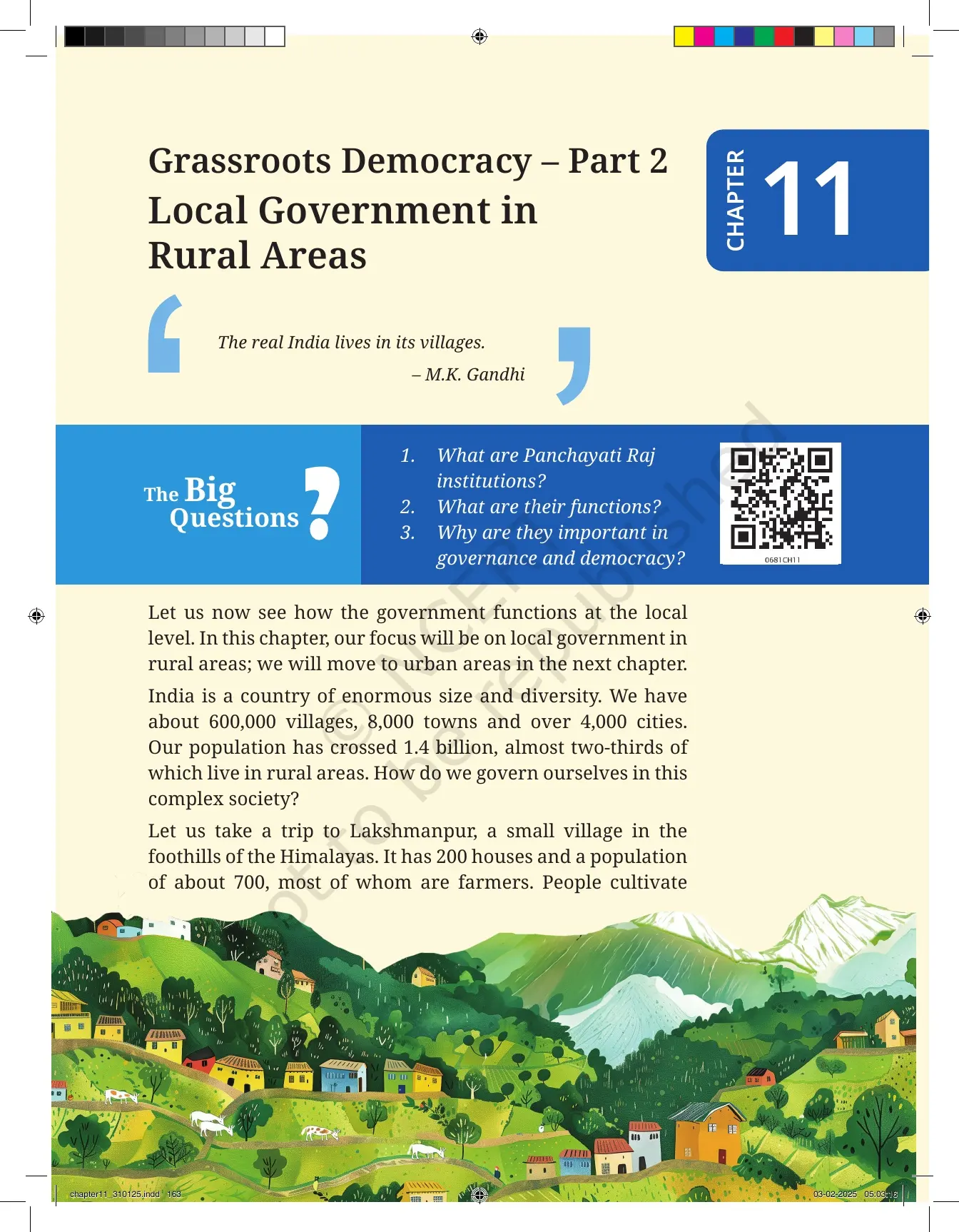
| Chapter opener | 163 | The M.K. Gandhi line on villages, the three Big Questions, India's village and town numbers, and the trip to Lakshmanpur |
| Panchayati Raj System | 164 | The needs of Lakshmanpur, the meaning of the word Panchayat, self-government, and Fig. 11.1 |
| Three tiers and Gram Panchayat | 165 | The three-tier system read bottom up, the list of responsibilities, the Gram Sabha, the Gram Panchayat and the Sarpanch |
| Exemplary Sarpanchs | 166 | A full page on three Sarpanchs: Dnyaneshwar Kamble, Vandana Bahadur Maida and Popatrao Baguji Pawar |
| Panchayat Secretary and Child-Friendly Panchayat | 167 | The Panchayat Secretary, the Patwari, the first THINK ABOUT IT box, and Bal Sabhas and Bal Panchayats in Maharashtra |
| Sikkim and the Children's Parliament | 168 | Sangkhu Radhu Khandu Gram Panchayat in west Sikkim and Bunker Roy's Children's Parliament in Rajasthan |
| Panchayat Samiti and Zila Parishad | 169 | The 2001 award, the first LET'S EXPLORE box, the block and district tiers, the Pradhan Mantri Gram Sadak Yojana and the one-third reservation for women |
| Reservation and the Arthashastra | 170 | The second THINK ABOUT IT box, the second LET'S EXPLORE box, State authority over the institutions, and the Arthashastra of Kautilya |
| Kautilya's four units, recap and questions | 171 | The Arthashastra quotation on villages, the 'Before we move on' recap and 4 numbered end items |
| Noodles | 172 | A blank Notes and Doodles page for your own rough work |
Also Check:
- Grassroots Democracy Part 2: Local Government in Rural Areas Class 6 NCERT Solutions
- Grassroots Democracy Part 2: Local Government in Rural Areas Class 6 Revision Notes
Gram Panchayat and the Three Tiers Explained on Video
Source: Magnet Brains on YouTube
The Gandhi Quotation and the Three Big Questions on Page 163
The chapter does not open with a definition. It opens with one short line from M.K. Gandhi and three Big Questions printed beside it. Every section that follows answers one of those questions, so learning them first gives you a map of the whole chapter.
- The quotation: "The real India lives in its villages." The chapter credits it to M.K. Gandhi.
- Big Question 1: What are Panchayati Raj institutions? Answered by the Panchayati Raj System section on printed page 164.
- Big Question 2: What are their functions? Answered by the Gram Panchayat and the Panchayat Samiti sections.
- Big Question 3: Why are they important in governance and democracy? Answered by the 'Before we move on' recap on printed page 171.
Chapter 10 stopped at the three levels of government and said local government would come next. This chapter picks up exactly there. It takes the bottom tier of the pyramid you already drew and opens it up, first in villages here, then in towns and cities in the chapter that follows.
Why Lakshmanpur Village Needs a Local Government of Its Own
Before naming a single institution, the chapter drops you into one village. Lakshmanpur is a small village in the foothills of the Himalayas. The numbers around it are the ones a one-mark question uses, so copy them exactly as printed.
| What the chapter counts | The figure it gives |
|---|---|
| Villages in India | About 600,000 |
| Towns in India | About 8,000 |
| Cities in India | Over 4,000 |
| Population of India | Crossed 1.4 billion |
| Share living in rural areas | Almost two-thirds of the population |
| Houses in Lakshmanpur | 200 houses |
| People in Lakshmanpur | About 700, most of them farmers |
The villagers cultivate their lands and rear cows or goats. Some have relatives serving in the armed forces, and a few younger villagers have moved to the city for jobs. The chapter then lists the everyday needs that no distant office can settle.
- Water for the fields when the crop needs it.
- Repairing the main road after heavy rains damage it.
- Maintaining the village primary school.
- Settling a dispute about land, or a case of stolen crop.
The chapter closes the example with one question that carries the whole argument: can people run to the State or the national capital for every such issue? The answer, and the reason a village needs its own council, is the Panchayati Raj system.
What the Panchayati Raj System Is and Why It Is Called Self-Government
This is the paragraph students most often blur. The chapter gives the word, the meaning and the reason in three quick steps on printed page 164. Learn the three separately, because a question can ask for any one of them.
| Term | What the chapter says it is | How to remember it |
|---|---|---|
| Panchayat | A village council. Every village in India has this system of local government | The council itself |
| Panchayati Raj | The other name for the Panchayat system, and a form of self-government | The system, not one council |
| Why it is self-government | Panchayats bring governance closer to the people, so people can take an active part in decision-making | The people rule themselves, in their own village |
The chapter then lists what Panchayats actually do. They address local issues, promote development, and make sure the benefits of government schemes reach the grassroots level. That last phrase is the link back to the word grassroots democracy you met in the previous chapter, so quote it when a question asks why the Panchayat matters to democracy.
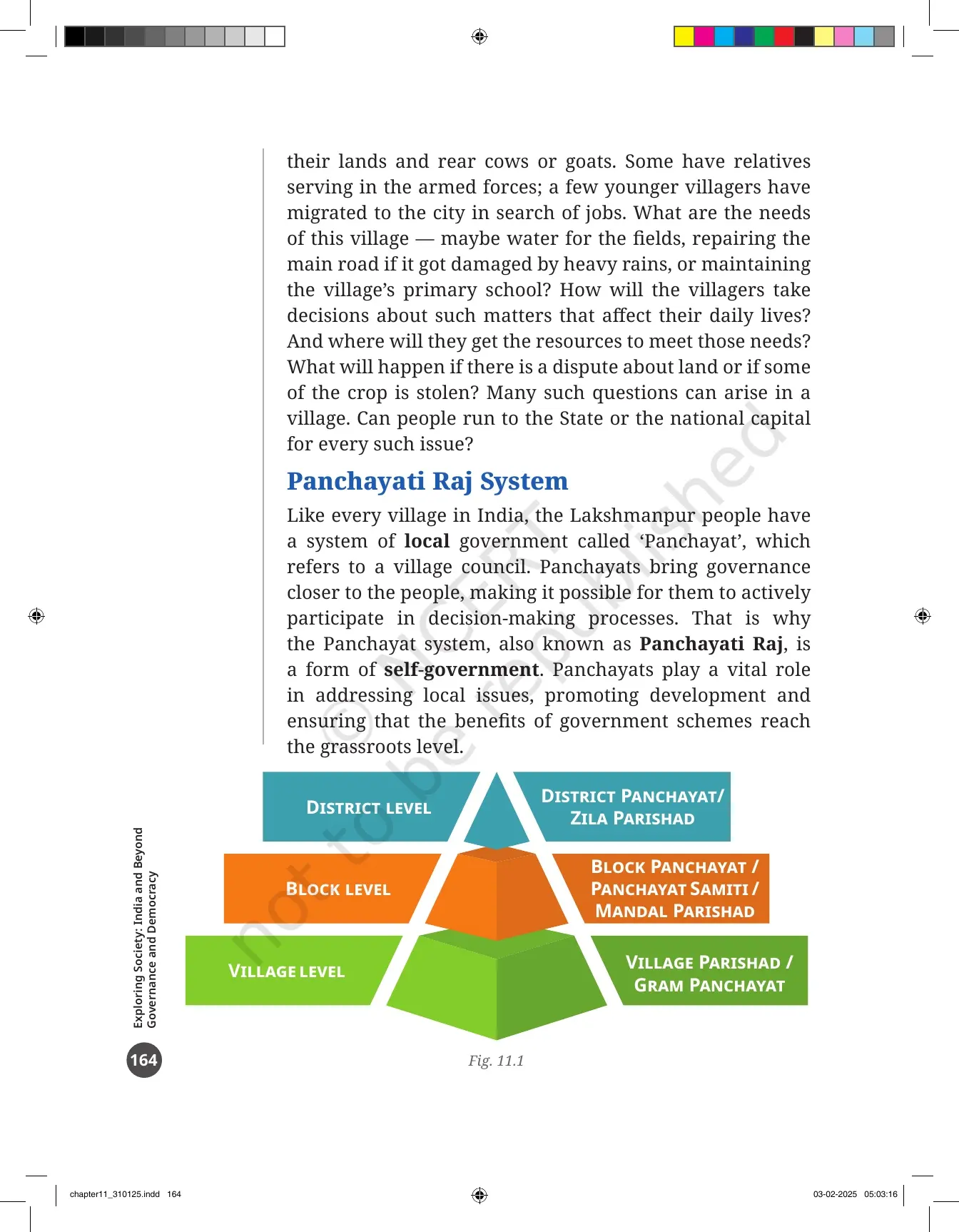
The Three Tier Structure in Fig. 11.1: Village, Block and District
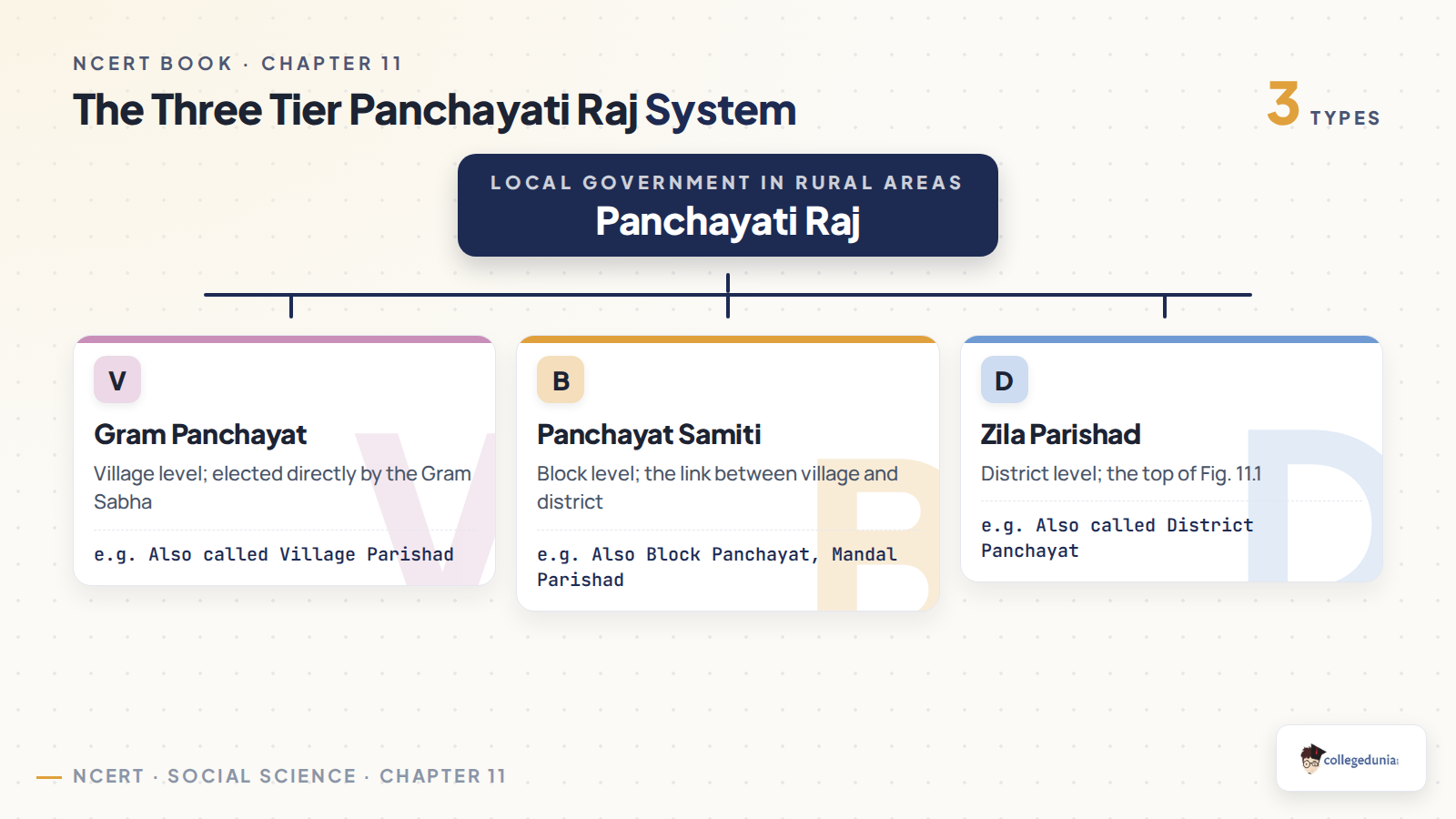
Fig. 11.1 on printed page 164 is the only numbered figure in this chapter, and almost every diagram question comes from it. It is a pyramid, and the chapter says to read it from the bottom up. Each level carries two or three names, and the book expects you to know the alternatives.
| Level | Names given in Fig. 11.1 | Where it sits |
|---|---|---|
| Village level | Village Parishad or Gram Panchayat | The base of the pyramid, closest to the people |
| Block level | Block Panchayat, Panchayat Samiti or Mandal Parishad | The middle, linking the village to the district |
| District level | District Panchayat or Zila Parishad | The top of the pyramid |
The name of the structure is the answer to question 1 at the end of the chapter. The Panchayati Raj system works at three levels, and this is called a 'three-tier system'. Together, these institutions cover almost every part of life in the district.
- Agriculture and housing.
- Maintenance of roads and management of water resources.
- Education, health care and social welfare.
- Cultural activities in the district.
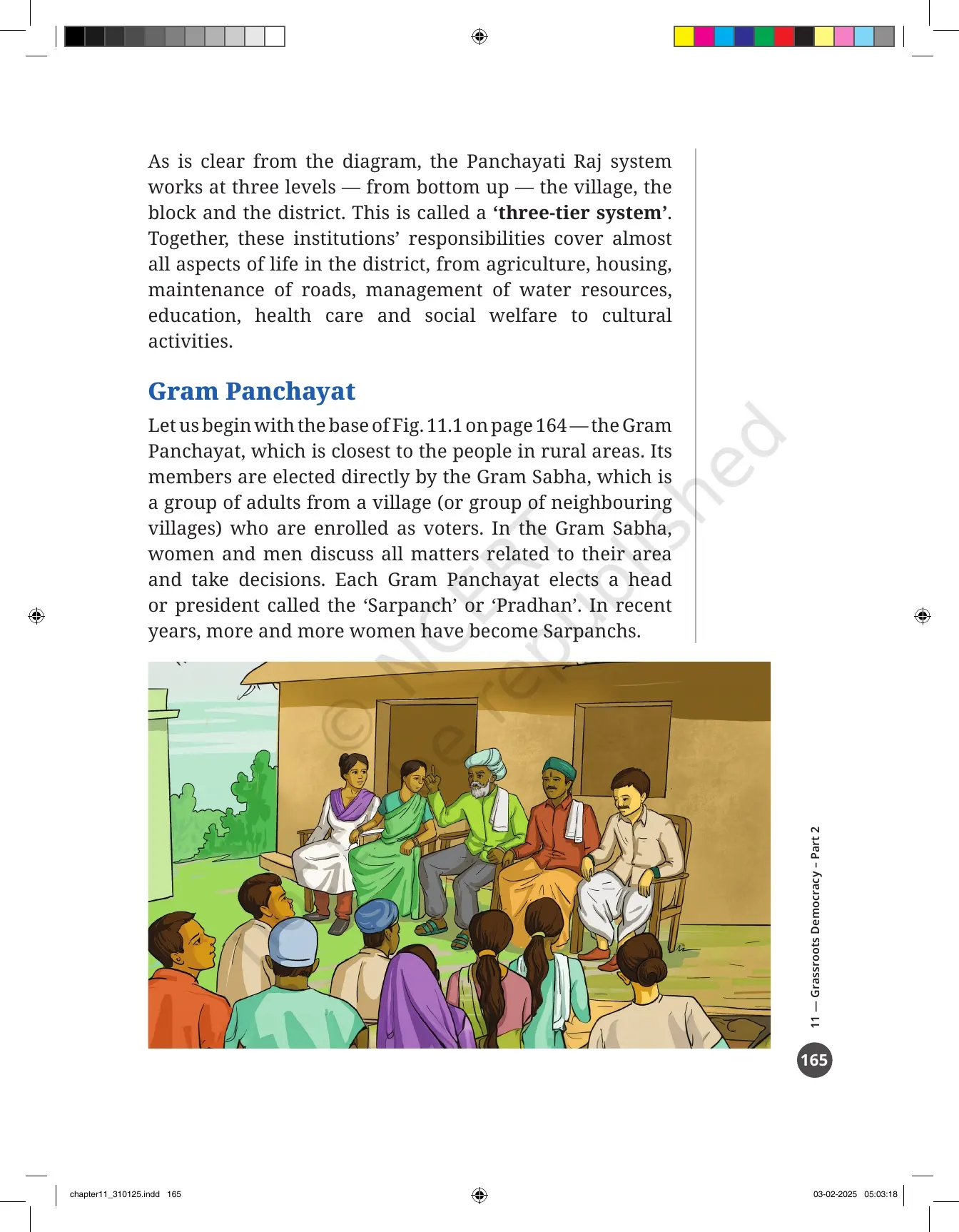
Gram Sabha and Gram Panchayat: Who Elects Whom in a Village
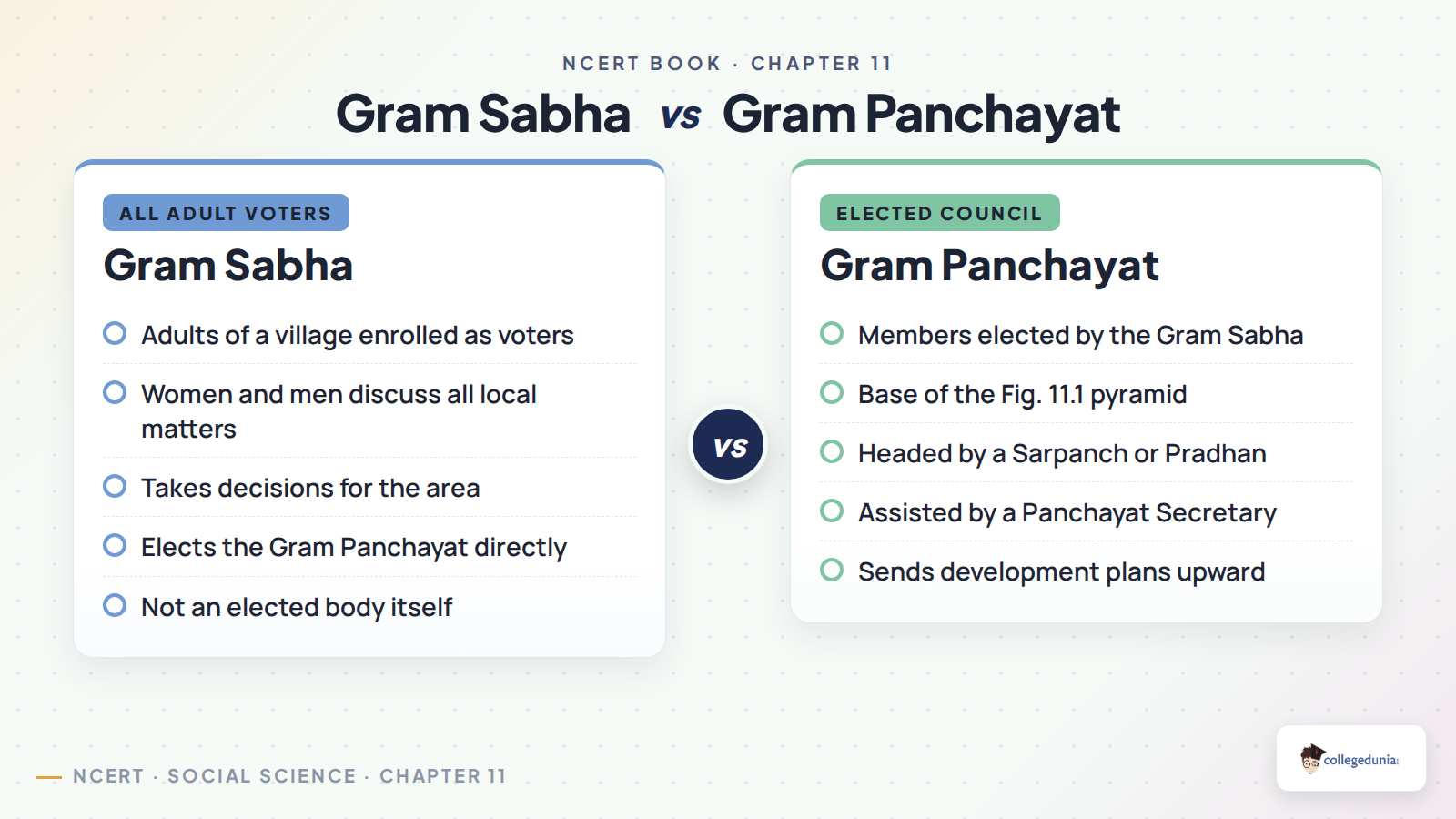
Our student poll found this the single most-swapped pair in the chapter. The two words look alike and sit one line apart in the book, but they are not the same body. One is every adult voter, the other is the elected council.
| Body | Who is in it | What it does |
|---|---|---|
| Gram Sabha | A group of adults from a village, or a group of neighbouring villages, who are enrolled as voters | Women and men discuss all matters related to their area and take decisions. It elects the Gram Panchayat members directly |
| Gram Panchayat | The elected members, plus a head called the Sarpanch or Pradhan | Runs the village, and sits at the base of Fig. 11.1 as the tier closest to the people in rural areas |
The Gram Sabha elects, the Gram Panchayat governs. That one line stops the mistake. Notice the word the chapter uses for the election: members of the Gram Panchayat are elected directly by the Gram Sabha, which makes the village tier the clearest case of direct participation in the whole book.
The Sarpanch or Pradhan and the Rise of Women Sarpanchs
Each Gram Panchayat elects a head. The chapter gives two names for the same post, and both are acceptable in an answer. It also adds one line of change that carries a mark on its own.
- The post: each Gram Panchayat elects a head or president.
- The names: the head is called the 'Sarpanch' or the 'Pradhan'.
- The change: in recent years, more and more women have become Sarpanchs.
Do not write that the Sarpanch is appointed by the government or by the State. The Sarpanch is elected by the Gram Panchayat, which is itself elected by the Gram Sabha. Tracing that chain in two lines is usually worth full marks on a short-answer question about how a village head reaches office.
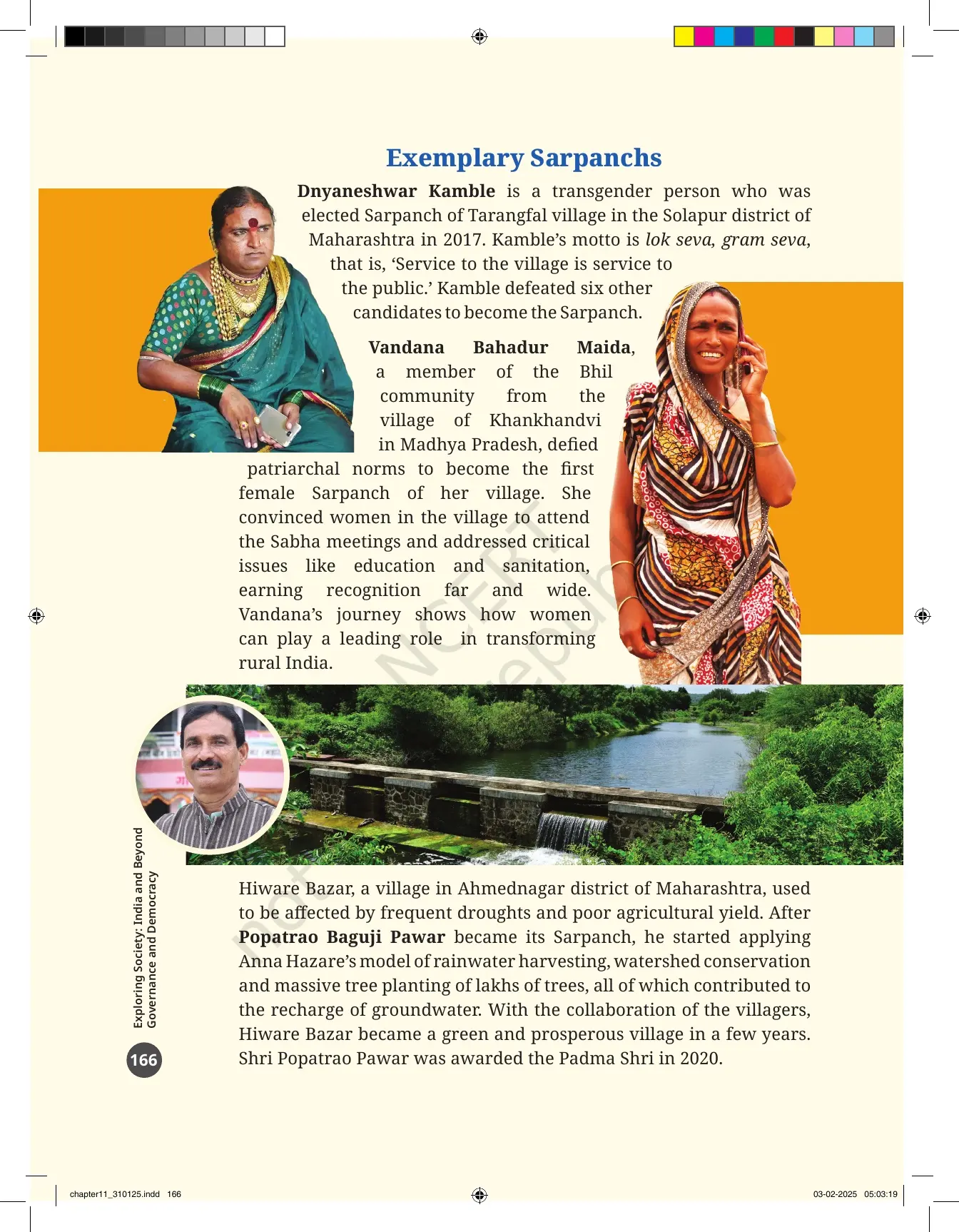
The Exemplary Sarpanchs Page: Kamble, Maida and Popatrao Pawar
Printed page 166 is given entirely to three real Sarpanchs. It is the chapter's proof that the village tier can change lives, and the names, places and years on it are the easiest one-mark facts in the whole chapter.
| Sarpanch | Village and State | What the chapter says |
|---|---|---|
| Dnyaneshwar Kamble | Tarangfal village, Solapur district, Maharashtra | A transgender person elected Sarpanch in 2017, after defeating six other candidates. The motto is lok seva, gram seva, that is, 'Service to the village is service to the public' |
| Vandana Bahadur Maida | Khankhandvi village, Madhya Pradesh | A member of the Bhil community who defied patriarchal norms to become the first female Sarpanch of her village. She convinced women to attend the Sabha meetings and took up education and sanitation |
| Popatrao Baguji Pawar | Hiware Bazar, Ahmednagar district, Maharashtra | He applied Anna Hazare's model of rainwater harvesting, watershed conservation and planting lakhs of trees, which recharged the groundwater. He was awarded the Padma Shri in 2020 |
Hiware Bazar is the example to quote when a question asks what a Panchayat can achieve. The village used to face frequent droughts and poor agricultural yield. With the villagers working alongside the Sarpanch, it became a green and prosperous village in a few years.
The Panchayat Secretary and the Patwari: Who Keeps the Village Records
A Gram Panchayat does not work alone. Printed page 167 names two officials who assist it, and students routinely give one of them the other's job. Both are short definitions worth learning word for word.
| Official | What the chapter says the job is |
|---|---|
| Panchayat Secretary | Assists the Gram Panchayat and performs administrative functions such as calling meetings and maintaining records |
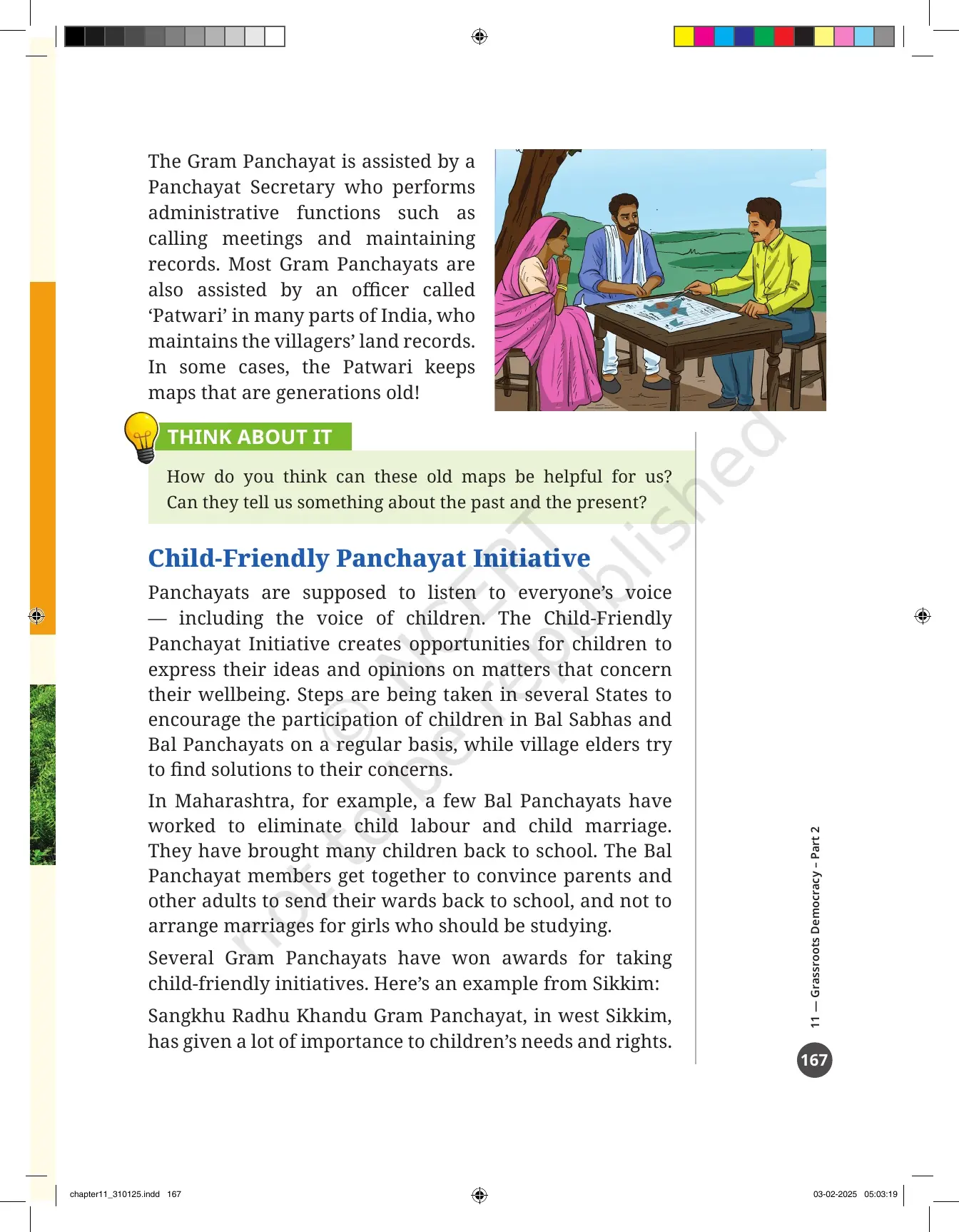
| Patwari | Assists most Gram Panchayats in many parts of India, and maintains the villagers' land records. In some cases the Patwari keeps maps that are generations old |
The first THINK ABOUT IT box sits right below the Patwari paragraph and turns those old maps into a discussion. It asks how these old maps can be helpful for us, and whether they can tell us something about the past and the present. A good two-line answer: old maps show who owned which field and how village boundaries and water bodies have shifted over the years.
The Child-Friendly Panchayat Initiative, Bal Sabhas and Bal Panchayats
The chapter makes one point loudly here: Panchayats are supposed to listen to everyone's voice, including the voice of children. The Child-Friendly Panchayat Initiative is the name of the effort, and the two bodies it creates carry names that echo the adult ones.
- What the initiative does: it creates opportunities for children to express their ideas and opinions on matters that concern their wellbeing.
- The two bodies: several States encourage the participation of children in Bal Sabhas and Bal Panchayats on a regular basis.
- Who responds: village elders try to find solutions to the concerns children raise.
- The Maharashtra example: a few Bal Panchayats have worked to eliminate child labour and child marriage, and have brought many children back to school.
The way the Maharashtra Bal Panchayats work is the detail students skip. The members get together to convince parents and other adults to send their wards back to school, and not to arrange marriages for girls who should be studying. That sentence is the whole answer to a question on how children can take part in local government.
Sangkhu Radhu Khandu and the Children's Parliament of Rajasthan
Two award-winning examples close the section on children. One is a Gram Panchayat in the north-east, the other a decades-old initiative in the desert. Keep the States attached to the names, because that is what a match-the-following question tests.
| Example | State | What it did |
|---|---|---|
| Sangkhu Radhu Khandu Gram Panchayat | West Sikkim | Built compound walls for schools to make them safer, and constructed kitchens in schools so students get hygienically cooked mid-day meals. It was declared a child-friendly Gram Panchayat |
| The 'Children's Parliament' | Rajasthan | An offshoot of Bunker Roy's 'Barefoot College' initiative. Children aged 8 to 14 take part in governance through night schools and parliament-like elections, with voter ID cards and campaigning. Elected representatives form a 'Cabinet' that oversees school management |
The Children's Parliament won the World's Children's Honorary Award in 2001. The chapter says the children used it to raise access to education, sanitation and social equality, which is the list to quote if you are asked what issues they took up.
The first LET'S EXPLORE box on printed page 169 turns all of this into a class activity. Four or five students form a Bal Panchayat while the rest of the class imagine they are the villagers. Then you work out what issues the Gram Sabha will discuss, what challenges it could face, and what solutions it will propose.
Panchayat Samiti and Zila Parishad: What the Block and District Tiers Do
The top two tiers get one tight section on printed page 169. The key idea is that the middle tier is a link, not a boss. Learn the direction of that link, because question 1 asks for the functions of each of the three tiers.
| Institution | Level | What the chapter says it does |
|---|---|---|
| Gram Panchayat | Village | Runs the village and sends its development plan upward |
| Panchayat Samiti | Block | The link between the Gram Panchayat and the Zila Parishad. It coordinates matters across Gram Panchayats, collects development plans from all of them, and presents them together at the District or State levels |
| Zila Parishad | District | The district-level institution at the top of Fig. 11.1 |
Who sits in these two bodies is a favourite short question. The members are elected by the local people, but the chapter adds that they may have other members too.
- Sarpanchs of the villages in the area.
- Local members of the State Legislative Assembly.
Why the coordination matters: putting all the village plans together makes it easier to allot funds for development projects and for government schemes. The chapter names one such scheme, the Pradhan Mantri Gram Sadak Yojana, which promotes the construction of all-weather roads in rural areas.
Reserved Seats, Disadvantaged Sections and State Control of Panchayati Raj
Two short paragraphs close the institutional part of the chapter, and both carry a number or a rule that is easy to quote. The first is about who gets a guaranteed place at the table.
- Special rules at all three levels: they exist so that disadvantaged sections of the population can make their needs and problems heard.
- Reservation for women: these institutions have a provision for reserving one-third of the seats for women.
- State authority: the structure and functions of Panchayati Raj institutions differ a little across States, because the States have authority over those institutions.
- The shared objective: to enable villagers to take an active part in the management and development of their villages and the local area.
The second THINK ABOUT IT box asks why it is important for the government to pay more attention to the needs and problems of disadvantaged sections of society. The second LET'S EXPLORE box has two tasks. Compare the governance system at the Central level with the one at the Panchayat level, and prepare a questionnaire for Panchayat members, then meet them or invite them to school and write a short report.
What the Arthashastra Says About Village Administration 2,300 Years Ago
The last special box in the chapter reaches back to an ancient text. The Arthashastra is a book on governance written by Kautilya, later also known as Chanakya, some 2,300 years ago. The chapter says it describes how a state should be structured and run, how the economy can be made prosperous, what the duties of the ruler are, and how to conduct war.
Kautilya, an expert in statecraft, sets out an administrative structure running from the village to the regional capital. The quotation printed on page 171 gives four units, and each one is fixed by a number of villages.
| Unit named by Kautilya | What the chapter translates it as | Set up for every |
|---|---|---|
| Sangrahana | A sub-district headquarters | 10 villages |
| Karvatika | District headquarters | 100 villages |
| Dronamukha | No translation is given in the chapter | 400 villages |
| Sthaniya | Provincial headquarters | 800 villages |
The chapter then asks its own question: in today's language, what names would we give these four categories? The point of the box is that a tiered structure built up from the village was already in place 2,300 years ago, which is the same idea Fig. 11.1 shows today.
Every Figure, Activity Box and Special Page Inside the Rural Local Government PDF
This chapter numbers only one figure, Fig. 11.1, so a diagram question can only come from the pyramid. Four activity boxes and three special pages carry the rest. The checklist below is the fastest way to make sure you have not skipped one.
| Figure, box or feature | Printed page | What it shows or asks |
|---|---|---|
| The opening quotation | 163 | M.K. Gandhi on the real India living in its villages |
| The Big Questions | 163 | Three questions on what Panchayati Raj institutions are, what their functions are, and why they matter to governance and democracy |
| Fig. 11.1 | 164 | The pyramid of the three tiers, with all the alternative names at each level |
| Exemplary Sarpanchs | 166 | A full page on Dnyaneshwar Kamble, Vandana Bahadur Maida and Popatrao Baguji Pawar |
| THINK ABOUT IT 1 | 167 | How old land maps kept by the Patwari can be helpful, and what they tell us about the past and the present |
| Child-Friendly Panchayat Initiative | 167 | Bal Sabhas, Bal Panchayats, and the Maharashtra work against child labour and child marriage |
| LET'S EXPLORE 1 | 169 | A class activity where a few students form a Bal Panchayat and the rest play villagers |
| THINK ABOUT IT 2 | 170 | Why the government should pay more attention to the needs of disadvantaged sections of society |
| LET'S EXPLORE 2 | 170 | Compare Central and Panchayat governance, then build a questionnaire and interview Panchayat members |
| The Arthashastra box | 170 to 171 | Kautilya's four administrative units, fixed at 10, 100, 400 and 800 villages |
| Before we move on ... | 171 | A three-point recap of the three-tier system, the two ways democracy works here, and self-governance |
| Noodles | 172 | A page for Notes and Doodles, which is what the chapter says the word stands for |
Questions, Activities and Projects at the End of the Rural Local Government Chapter
Printed page 171 carries 4 numbered items. There is no true or false set and no multiple-choice set in this chapter. Two of the four ask you to write something of your own, so start them a day early.
- Test yourself. Can you name the three tiers of the Panchayati Raj system? What are the key functions of each of the three tiers? Answer from Fig. 11.1 and printed page 169, giving the Gram Panchayat, the Panchayat Samiti and the Zila Parishad with one function each.
- Write a letter to the Sarpanch about plastic bags lying on the roadside in the village. Address it to the Sarpanch of the Gram Panchayat and ask for a clean-up drive plus dustbins.
- In your view, what type of person should be a Gram Panchayat member? Use the three Sarpanchs on printed page 166 as your evidence, and name qualities like honesty and willingness to listen to everyone.
- The village school beside a highway. Students find it hard to cross the road. List the options, say which Panchayati Raj institutions can help, and say what the students themselves can do.
Before the questions, the 'Before we move on ...' box on printed page 171 gives a three-point recap that works as a ready-made summary answer.
- The local government in rural areas is organised into a three-tier system.
- Democracy in the Panchayati Raj system works both through direct participation of people and through their elected representatives.
- The Panchayati Raj institutions give people in rural areas a measure of self-governance, so they may manage their issues and collaborate in development plans.
Common Mistakes Students Make in the Local Government in Rural Areas Chapter
- Using Gram Sabha and Gram Panchayat as the same word. The Gram Sabha is all the enrolled adult voters. The Gram Panchayat is the council they elect.
- Reading Fig. 11.1 from the top. The chapter says the system works from bottom up: village, then block, then district.
- Swapping the block and district names. Panchayat Samiti is the block level. Zila Parishad is the district level.
- Saying the Sarpanch is appointed. The Sarpanch, also called the Pradhan, is elected as the head of the Gram Panchayat.
- Giving the Patwari the Secretary's job. The Panchayat Secretary calls meetings and maintains records. The Patwari maintains land records.
- Writing that half the seats are reserved for women. The provision is for one-third of the seats.
- Forgetting who controls these institutions. The States have authority over Panchayati Raj institutions, which is why their structure differs a little from State to State.
Related Links:
- Grassroots Democracy Part 2: Local Government in Rural Areas Class 6 Handwritten Notes
- Grassroots Democracy Part 1: Governance Class 6 NCERT Book PDF
How to Read the Class 6 Rural Local Government PDF in One Sitting
This is a 10-page chapter with one numbered figure, several proper nouns and only 4 end items. One focused sitting of about 30 minutes is enough. Keep a rough sheet beside you for the pyramid and the list of names.
- Minutes 0 to 4: read printed page 163, then write the Gandhi line, the three Big Questions and the numbers for villages, towns, cities and population.
- Minutes 4 to 10: read printed page 164 and copy the Fig. 11.1 pyramid with every alternative name at each of the three levels.
- Minutes 10 to 15: read printed page 165 and write one line each on the Gram Sabha, the Gram Panchayat and the Sarpanch, marking who elects whom.
- Minutes 15 to 19: read printed page 166 and note the three Sarpanchs with their village, State and year.
- Minutes 19 to 24: read printed pages 167 and 168 and list the Panchayat Secretary, the Patwari, Bal Panchayats, Sikkim and the Children's Parliament.
- Minutes 24 to 30: read printed pages 169 to 171 and write the Panchayat Samiti link, the one-third reservation, the Gram Sadak Yojana and Kautilya's four units.
Come back the next day for the four end items on printed page 171. The letter to the Sarpanch is the one that makes the chapter stick, because you have to name a real institution and ask it to do a real job. That second pass turns a chapter you have read into a chapter you can answer.
More Grassroots Democracy Part 2: Local Government in Rural Areas Class 6 Resources
The book PDF gives you the printed chapter. These pages give you the answers, the revision layer and the last-day recap for the same chapter.
| Resource | What it gives you |
|---|---|
| Grassroots Democracy Part 2: Local Government in Rural Areas Class 6 NCERT Solutions | Step-by-step answers to all 4 end items and every activity box, including the letter to the Sarpanch and the village school beside the highway |
| Grassroots Democracy Part 2: Local Government in Rural Areas Class 6 Revision Notes | The three tiers, the Gram Sabha and Gram Panchayat difference, the officials, the reservation rule and Kautilya's four units in one short read |
| Grassroots Democracy Part 2: Local Government in Rural Areas Class 6 Handwritten Notes | A topper's handwritten pages with the Fig. 11.1 pyramid and the Gram Sabha versus Gram Panchayat split drawn out in colour-coded boxes |
| Grassroots Democracy Part 2: Local Government in Rural Areas Class 6 NCERT Book PDF | This page. The official 2026-27 chapter file, printed pages 163 to 172 of Exploring Society: India and Beyond |
NCERT Book PDF for Class 6 Social Science: All 14 Chapters
Exploring Society: India and Beyond runs to 14 chapters across five themes. Download the ones your school has taught, or take the full set in one go.
| Chapter | Resource |
|---|---|
| Chapter 1 | Locating Places on the Earth NCERT Book PDF |
| Chapter 2 | Oceans and Continents NCERT Book PDF |
| Chapter 3 | Landforms and Life NCERT Book PDF |
| Chapter 4 | Timeline and Sources of History NCERT Book PDF |
| Chapter 5 | India, That Is Bharat NCERT Book PDF |
| Chapter 6 | The Beginnings of Indian Civilisation NCERT Book PDF |
| Chapter 7 | India's Cultural Roots NCERT Book PDF |
| Chapter 8 | Unity in Diversity, or 'Many in the One' NCERT Book PDF |
| Chapter 9 | Family and Community NCERT Book PDF |
| Chapter 10 | Grassroots Democracy Part 1: Governance NCERT Book PDF |
| Chapter 11 | Grassroots Democracy Part 2: Local Government in Rural Areas NCERT Book PDF (this page) |
| Chapter 12 | Grassroots Democracy Part 3: Local Government in Urban Areas NCERT Book PDF |
| Chapter 13 | The Value of Work NCERT Book PDF |
| Chapter 14 | Economic Activities Around Us NCERT Book PDF |
Grassroots Democracy Part 2: Local Government in Rural Areas Class 6 Social Science NCERT Book PDF FAQs
Common Questions on the Class 6 Social Science Chapter 11 File
Ques. Where can I download the NCERT Class 6 Social Science Chapter 11 Grassroots Democracy Part 2 Local Government in Rural Areas PDF?
Ans. You can download it directly from this page. It is the official NCERT chapter file for the 2026-27 print of Exploring Society: India and Beyond, and it is free.
Ques. How many pages is the Local Government in Rural Areas chapter PDF?
Ans. The file runs to 10 pages. It covers printed pages 163 to 172 of the textbook, from the Gandhi quotation to the Noodles page at the end.
Ques. What is the Panchayati Raj system?
Ans. Panchayati Raj is the other name for the Panchayat system, the local government of rural India. The chapter calls it a form of self-government because it brings governance closer to the people and lets them take an active part in decision-making.
Ques. What are the three tiers of the Panchayati Raj system?
Ans. The village level, the block level and the district level. Fig. 11.1 on printed page 164 names them as the Village Parishad or Gram Panchayat, the Block Panchayat or Panchayat Samiti or Mandal Parishad, and the District Panchayat or Zila Parishad. The chapter says to read the pyramid from the bottom up.
Ques. What is the difference between the Gram Sabha and the Gram Panchayat?
Ans. The Gram Sabha is the group of adults from a village, or a group of neighbouring villages, who are enrolled as voters. The Gram Panchayat is the council its members elect directly. In the Gram Sabha, women and men discuss all matters related to their area and take decisions.
Ques. Who is the Sarpanch and how is the post filled?
Ans. The Sarpanch, also called the Pradhan, is the head or president of the Gram Panchayat. Each Gram Panchayat elects its own Sarpanch. The chapter adds that in recent years more and more women have become Sarpanchs.
Ques. What does the Panchayat Secretary do?
Ans. The Panchayat Secretary assists the Gram Panchayat with administrative functions such as calling meetings and maintaining records. This is a different job from the Patwari, who maintains the villagers' land records and sometimes keeps maps that are generations old.
Ques. Who are the three Sarpanchs on the Exemplary Sarpanchs page?
Ans. Dnyaneshwar Kamble, a transgender person elected Sarpanch of Tarangfal village in Solapur district, Maharashtra, in 2017. Vandana Bahadur Maida of the Bhil community, the first female Sarpanch of Khankhandvi village in Madhya Pradesh. Popatrao Baguji Pawar of Hiware Bazar in Ahmednagar district, Maharashtra, who was awarded the Padma Shri in 2020.
Ques. What did Popatrao Pawar do in Hiware Bazar?
Ans. Hiware Bazar used to face frequent droughts and poor agricultural yield. After Popatrao Baguji Pawar became Sarpanch, he applied Anna Hazare's model of rainwater harvesting, watershed conservation and planting lakhs of trees. Groundwater was recharged and the village became green and prosperous in a few years.
Ques. What is the Child-Friendly Panchayat Initiative?
Ans. It creates opportunities for children to express their ideas and opinions on matters that concern their wellbeing. Several States encourage children to take part in Bal Sabhas and Bal Panchayats, and village elders try to find solutions to their concerns. In Maharashtra, a few Bal Panchayats have worked to eliminate child labour and child marriage.
Ques. Why was Sangkhu Radhu Khandu Gram Panchayat given an award?
Ans. This Gram Panchayat in west Sikkim built compound walls for schools to make them safer and constructed kitchens in the schools so students get hygienically cooked mid-day meals. For these efforts it was declared a child-friendly Gram Panchayat.
Ques. What is the Children's Parliament in Rajasthan?
Ans. It is an offshoot of Bunker Roy's Barefoot College initiative. Children aged 8 to 14 take part in governance through night schools and parliament-like elections, with voter ID cards and campaigning. Elected representatives form a Cabinet that oversees school management. The initiative won the World's Children's Honorary Award in 2001.
Ques. What is the role of the Panchayat Samiti?
Ans. The Panchayat Samiti works at the block level and is the link between the Gram Panchayat and the Zila Parishad. It coordinates matters across Gram Panchayats, collects their development plans and presents them together at the District or State levels, which makes it easier to allot funds.
Ques. Who can be a member of the Panchayat Samiti and the Zila Parishad?
Ans. Members are elected by the local people. The chapter adds that these institutions may also have other members, such as the Sarpanchs of the villages in the area and local members of the State Legislative Assembly.
Ques. What is the Pradhan Mantri Gram Sadak Yojana?
Ans. It is the government scheme the chapter names as an example of what the coordinated development plans help fund. It promotes the construction of all-weather roads in rural areas.
Ques. How many seats are reserved for women in Panchayati Raj institutions?
Ans. These institutions have a provision for reserving one-third of the seats for women. Special rules at all three levels also help disadvantaged sections of the population make their needs and problems heard.
Ques. Why do Panchayati Raj institutions differ from State to State?
Ans. Because the States have authority over those institutions, so their structure and functions differ a little across States. Their objective stays the same: to enable villagers to take an active part in the management and development of their villages and the local area.
Ques. What does the Arthashastra say about villages?
Ans. The Arthashastra was written by Kautilya, later also known as Chanakya, some 2,300 years ago. It says the king shall establish a sangrahana, a sub-district headquarters, for every 10 villages; a karvatika, or district headquarters, for every 100 villages; a dronamukha for every 400 villages; and a sthaniya, a provincial headquarters, for every 800 villages.
Ques. How many questions are there at the end of the Local Government in Rural Areas chapter?
Ans. Printed page 171 carries 4 numbered items. There is no true or false set in this chapter. They ask you to name the three tiers and their functions, write a letter to the Sarpanch about plastic bags, say what type of person should be a Gram Panchayat member, and solve the problem of a village school beside a highway.
Ques. Do I need the NCERT Solutions if I already have the book PDF?
Ans. The book PDF carries the questions but not the answers. Use the Grassroots Democracy Part 2: Local Government in Rural Areas Class 6 NCERT Solutions to check all 4 end items and every activity box.



Comments